
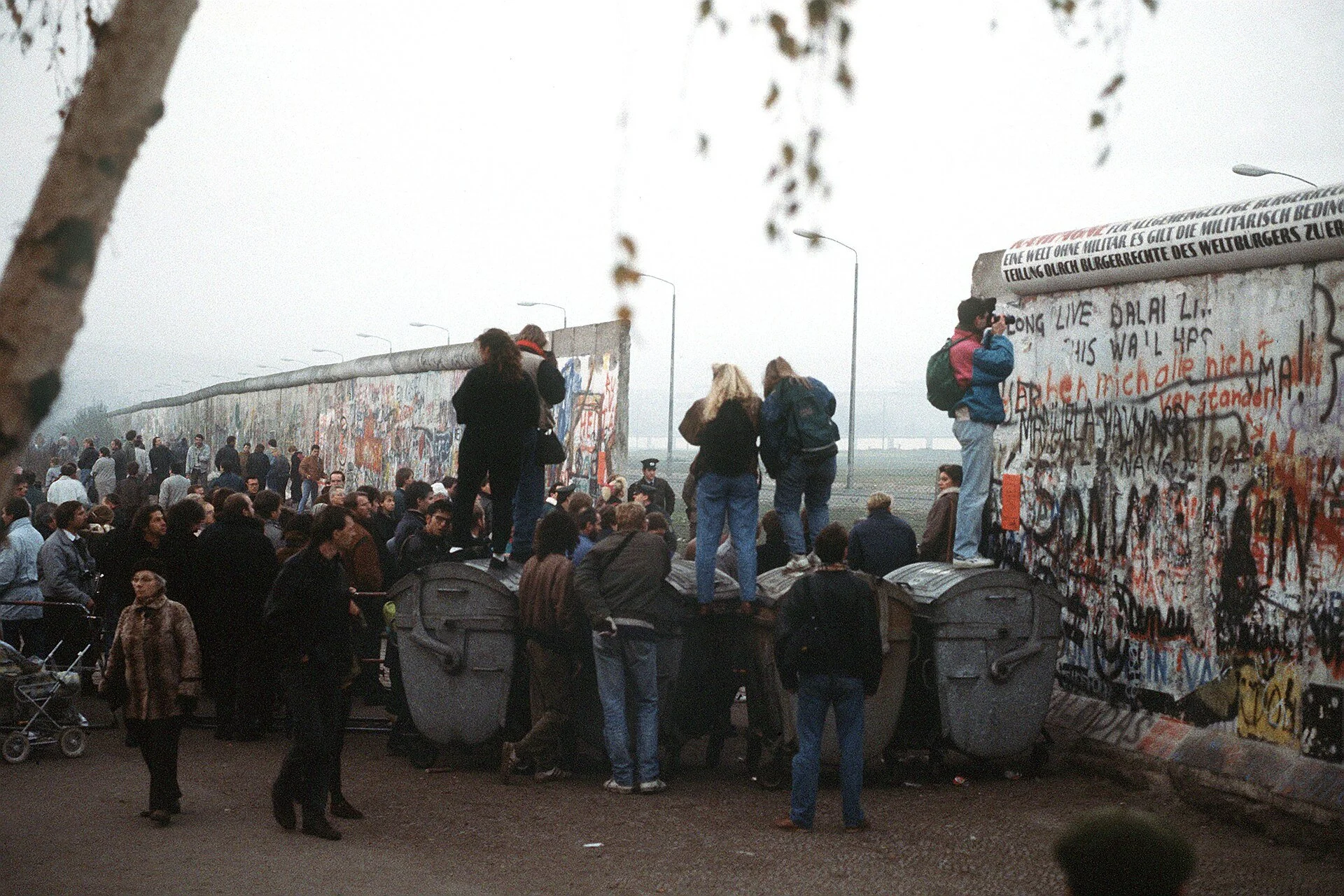
An Iron Curtain
The Second World War ended with much of the world in ruins, but from its wreckage emerged a new struggle over what the world should become. Two superpowers, the United States and the Soviet Union, championed competing visions of political power, economic freedom, and social order. One embraced capitalism and liberal democracy; the other promised equality through communism and revolution. Both claimed to represent humanity's future, and both possessed the power to shape it — or destroy it.
For nearly half a century, that confrontation divided nations, fueled revolutions, inspired resistance, justified repression, and transformed millions of lives. It produced spies and defectors, dissidents and revolutionaries, proxy wars, political prisoners, and extraordinary acts of courage and conscience. The books in this room explore the world that emerged behind and beyond the Iron Curtain — through those who defended its competing ideologies, those who challenged them, and those who lived with the consequences of a conflict that reshaped the world without becoming the war both superpowers feared most.
Hannah Arendt
R. Piper & Co. Verlag · Munich · 1958
Translated from English by Charlotte Beradt
First German Book Edition · First Printing
The Book:
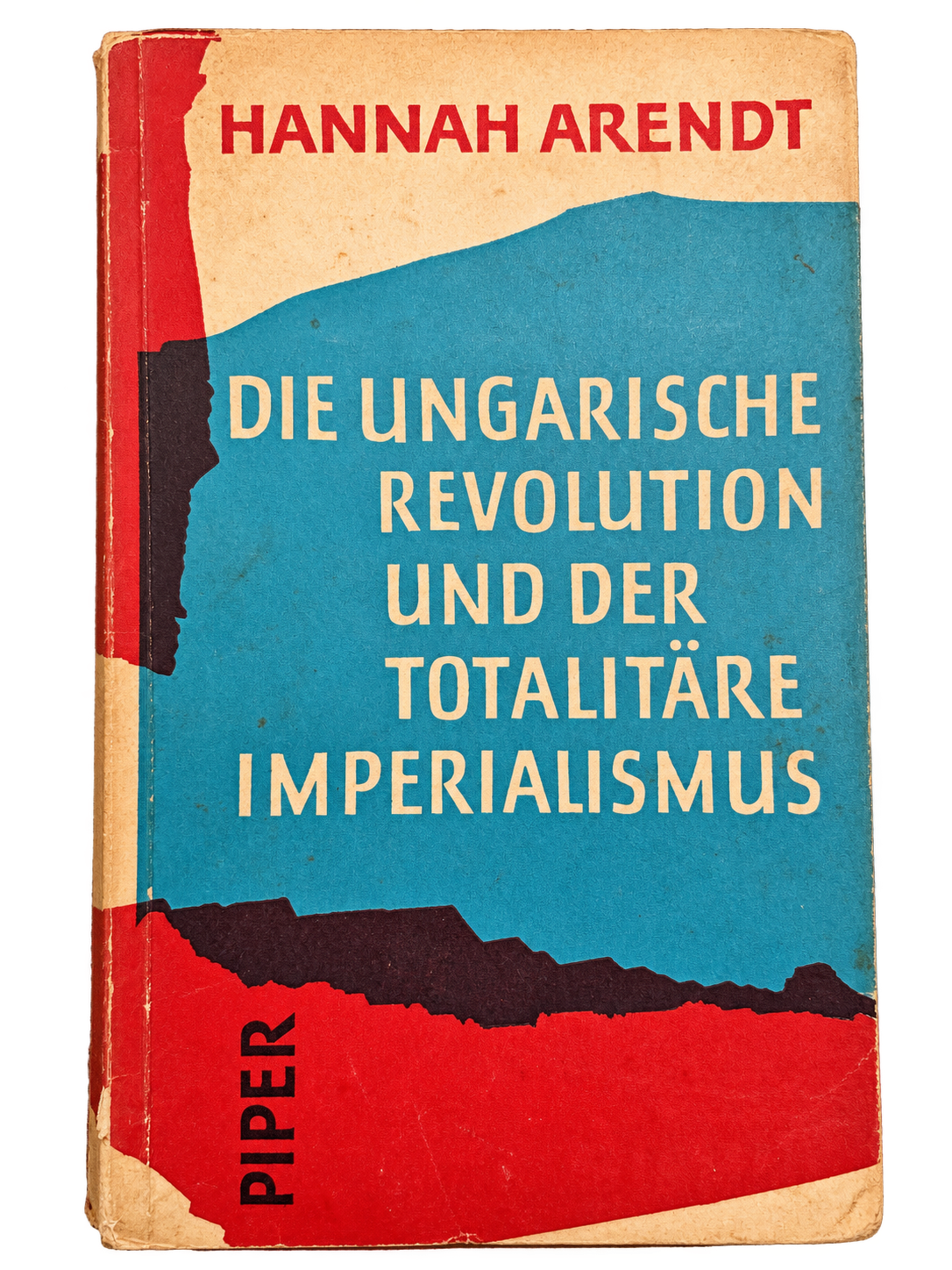
The first German book edition, first printing of Hannah Arendt's Die Ungarische Revolution und der totalitäre Imperialismus (The Hungarian Revolution and Totalitarian Imperialism), published by R. Piper & Co. in Munich in 1958. Translated from English by Charlotte Beradt, this approximately 70-page volume preserves Arendt's contemporary examination of the 1956 Hungarian uprising against Soviet domination, the emergence of revolutionary workers' councils, and the violent suppression of political freedom. Original illustrated publisher's wrappers retained.
Condition:
Very Good. Original illustrated wrappers retain strong color and complete typography, with moderate age toning, scattered spotting, and localized rubbing and wear to the edges and spine. Rear wrapper exhibits uneven toning; preliminary and terminal leaves show foxing, with occasional interior spotting. Pencil annotations and notations appear on the opening leaves. Binding remains intact, with no detached gatherings, significant structural damage, or restoration observed.
Story Of The Book
In 1956, ordinary Hungarians challenged one of the most powerful authoritarian governments on Earth. For twelve extraordinary days, they tasted freedom. Then Soviet tanks came to take it away.
The Hungarian Revolution began as a popular uprising against Soviet domination. Students, workers, and ordinary citizens took to the streets demanding political freedom and an end to repression. Revolutionary councils emerged, and for a brief moment, Hungarians began organizing their own political future.
Moscow answered with military force. Soviet troops crushed the uprising, thousands were killed, and roughly 200,000 Hungarians fled their country.
But Hannah Arendt saw something in those twelve days that military defeat could not erase.
Writing in the immediate aftermath, Arendt argued that Hungary's spontaneously organized revolutionary councils demonstrated something profoundly threatening to totalitarian power: ordinary people were capable of governing themselves without permission from a ruling party, a government, or an army.
Her analysis first appeared in English in 1958. This German edition brought that argument to readers in a divided Europe, while the Soviet Union continued to exercise control over much of the continent.
The Soviets could destroy the revolution. They could not undo what it had proved possible.
Why It's In The Collection
Die Ungarische Revolution und der totalitäre Imperialismus belongs in Consigned to Darkness because authoritarian power can suppress a revolution without defeating the ideas that inspired it.
Arendt's argument is especially important to the collection because she did not simply condemn Soviet repression. She examined what the uprising revealed about human freedom and the capacity of ordinary individuals to exercise political power for themselves.
The distinction matters. Governments often claim that authority must flow from institutions, parties, or leaders. Hungary's revolutionary councils offered Arendt a radically different possibility: political authority emerging directly from people acting together.
This particular 1958 German edition preserves that argument while the historical consequences of the uprising were still unfolding. Published only two years after Soviet forces crushed the revolution, it brought Arendt's interpretation into the European political conversation before the Cold War's outcome was known.
It is precisely the kind of publication-event object the collection seeks to preserve: not a retrospective celebration of a historical victory, but an intellectual intervention made while the struggle over its meaning remained alive.
Hungary's revolution was defeated on the battlefield. Arendt refused to let its meaning be defeated with it.
Collection Categories: Anti-Totalitarianism · Anti-Authoritarianism · Political Dissent · Political History · Political Movements · Free Expression · Publication-Event Object
———
Authentication Evidence
Original illustrated front wrapper identifies Hannah Arendt and Die ungarische Revolution und der totalitäre Imperialismus.
Title page identifies R. Piper & Co. Verlag, Munich, as publisher.
Copyright and production statement records © 1958 by R. Piper & Co. Verlag.
Original German-language text translated from English by Charlotte Beradt.
Original illustrated publisher's wrappers retain the distinctive red, blue, cream, and black design associated with the 1958 Piper publication.
Contents identify the introduction and three principal sections: "Rußland nach Stalins Tod," "Die Ungarische Revolution," and "Das Satelliten-System."
Approximately 69–70 numbered pages, consistent with independently documented copies of the original edition.
The Goethe-Institut's Hannah Arendt bibliography independently confirms the 1958 Munich Piper publication.
German institutional bibliographic records corroborate the publisher, publication date, translator, and original edition.
The underlying analysis originally appeared in English in the February 1958 Journal of Politics, preceding the German book publication.
No later-impression statement, revised publisher imprint, subsequent publication date, or facsimile characteristics appear in the examined copy.
Original publisher's imprint, wrapper design, pagination, and publication characteristics collectively support identification as the First German Book Edition · First Printing.
No exclusive first-impression diagnostic point has been established; the printing attribution rests on the available bibliographic and physical evidence.
Die Ungarische Revolution und der Totalitäre Imperialismus
Hannah Arendt
R. Piper & Co. Verlag · Munich · 1958
Translated from English by Charlotte Beradt
First German Book Edition · First Printing
In 1956, ordinary Hungarians rose against one of the most powerful authoritarian regimes on Earth. For twelve extraordinary days, they tasted freedom. Then Soviet tanks came to take it away.
The uprising was crushed. Thousands were killed, and hundreds of thousands fled. To the Soviet Union, the revolution was a threat that had to be destroyed. To Hannah Arendt, it revealed something far more dangerous to totalitarian power: ordinary people discovering that they could govern themselves.
Arendt saw in Hungary's spontaneously organized revolutionary councils the possibility of political freedom emerging without permission from parties, governments, or armies. The revolution had failed militarily, but its brief existence challenged the idea that totalitarian domination could extinguish humanity's capacity for freedom. Published in 1958, this German edition preserves Arendt's response to a revolution whose defeat became one of the Cold War's defining tragedies.
The Soviets could destroy the revolution. They could not undo what it had proved possible.
Whittaker Chambers
Random House, New York · 1952
First Edition · First Printing
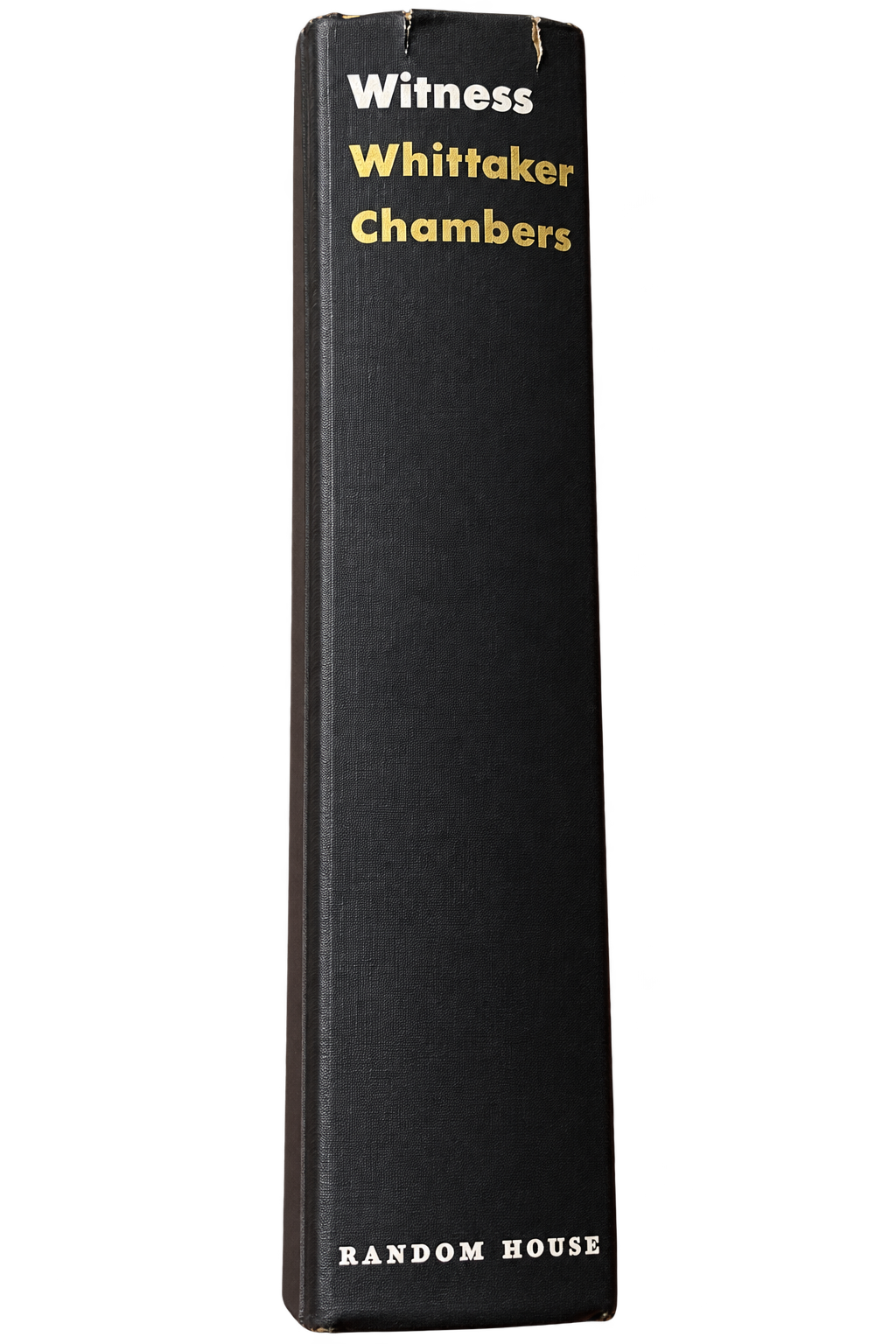
The Book: First edition, first printing of Whittaker Chambers’s Witness. The copyright page explicitly states “First Printing,” with the correct 1952 Random House publication information, H. Wolff printer statement, and Jerome Kuhl design credit. Original black publisher’s cloth binding retained. No Book Club Edition indicators observed. This copy is without dust jacket.
Condition: Near Fine. Original black publisher’s cloth remains clean and square with light shelf wear, bright spine lettering, and a sound binding. Interior remains clean and structurally sound. No dust jacket present.
Story Of The Book
Whittaker Chambers understood that ideas could demand absolute loyalty—and exact devastating personal costs.
In Witness, Chambers recounts his journey from committed Communist underground operative to one of the central witnesses in the Alger Hiss espionage case. What begins as political autobiography becomes something broader: an account of ideological conviction, betrayal, conscience, faith, and the moral consequences of breaking with a system to which one had once given oneself completely.
Published in 1952, the book transformed Chambers’s public testimony into one of the defining political memoirs of the early Cold War. More than an account of Soviet espionage, Witness became a sweeping meditation on the conflict between individual conscience and totalizing political belief. Its publication also profoundly influenced postwar conservative thought, helping establish Chambers as one of the intellectual figures who shaped the emerging modern American conservative movement.
The enduring power of the book lies partly in its refusal to present ideology as something abstract. Chambers writes about belief as something that reorganizes friendships, loyalties, identity, and moral judgment—and about dissent as something that can require the repudiation of one’s own former life.
Why It’s In The Collection
Witness belongs in the collection because it documents one of the most difficult forms of dissent: the decision to turn against a movement one once believed in completely.
Chambers was not an outside critic of Communism. He had participated in the underground world he later exposed. His testimony therefore represents political defection in its most consequential form—the moment when loyalty to an ideology collides with personal conscience.
That makes Witness especially important within the collection’s anti-totalitarian holdings. The book argues, through lived experience, that systems demanding absolute ideological loyalty eventually place themselves in conflict with individual moral judgment. Chambers’s break with Communism transformed private disillusionment into public testimony, and that testimony became part of one of the defining political controversies of the Cold War.
This first printing preserves the publication event through which that testimony became a lasting intellectual and political document—one that influenced conservative thought while also standing more broadly as a record of conscience in revolt against ideological totalitarianism.
Collection Categories: Anti-Totalitarianism · Conservative Intellectual History · Memoir & Testimony · Political History
———
Authentication Evidence
• Correct Random House title page present
• Copyright page explicitly states "First Printing"
• Correct 1952 Random House publication information present
• H. Wolff printer statement present
• Jerome Kuhl design credit present
• Original black publisher cloth binding present
• No Book Club Edition indicators observed
• First edition, first printing characteristics consistent throughout
Witness
Whittaker Chambers
Random House, New York · 1952
First Edition · First Printing
Whittaker Chambers devoted his life to an ideology he believed would save humanity. Then he came to believe that same ideology threatened to destroy it.
Once a committed Communist operating within a Soviet espionage network, Chambers abandoned the underground and became the central accuser in one of the most explosive political scandals in American history. His testimony against Alger Hiss, a respected former State Department official, helped ignite a national confrontation over espionage, loyalty, and the terrifying possibility that America's enemies had infiltrated its highest institutions.
Yet Witness is far more than the story of a spy who changed sides. Chambers believed he had escaped an ideology that demanded absolute obedience, only to discover that breaking with it could cost him his reputation, his security, and everything he loved. His memoir became a deeply personal reckoning with faith, conscience, betrayal, and the price of choosing truth over belonging.
Published in 1952, this first edition preserves one of the Cold War's most consequential acts of political testimony — a book that challenged Americans to confront not only the dangers of totalitarianism, but the extraordinary courage and terrible costs of resisting a cause to which one has surrendered one's life.
Chambers had once been willing to sacrifice everything for what he believed. Then he had to decide whether he was willing to sacrifice everything to admit he had been wrong.

Full Title:Doctrina de la Contra Intervención: Sovietización de la Economía Cubana: Ponencias, Discursos y Otros Escritos
Luis Conte Agüero
Ediciones Cruz del Sur, Montevideo · 1962
First Edition · First Printing
The Book: First edition, first printing published in Montevideo by Ediciones Cruz del Sur in 1962. 141 pages in the original red, white, and blue printed wrappers. The terminal colophon records that printing was completed on May 31, 1962, by Impresora Thau in Montevideo. No earlier edition of the title was located in the bibliographic research conducted for the collection, and no later-edition or reprinting statement appears in the volume.
Condition: Good+. Original wrappers exhibit moderate rubbing, surface soiling, edge and corner wear, small chips, short closed tears, and creasing with localized loss along the spine. The rear hinge and several interior openings show binding strain and exposed sewing, though the wrappers and text block remain substantially assembled. Interior moderately to heavily and uniformly age-toned.
Story Of The Book
Fidel Castro once had a powerful voice in Luis Conte Agüero. Then the voice turned against him.
Conte Agüero had supported and promoted Castro before the Cuban Revolution, but after breaking with the revolutionary government he went into exile and became an outspoken opponent of the new regime. Published in Montevideo in 1962, Doctrina de la Contra Intervención captures that political reversal at one of the most volatile moments of the Cold War.
The volume gathers speeches, position papers, and other writings concerning what Conte Agüero described as the “sovietization” of the Cuban economy. He argued that Soviet influence in Cuba should not be understood merely as an internal Cuban political development, but as a form of aggression with consequences for the entire Western Hemisphere. The book advances a series of doctrines—including incompatibility, legitimate defense, dangerousness, subversion as aggression, and counter-intervention—that Conte Agüero promoted during speaking tours through Latin America and the United States.
The significance of the book lies partly in who was making that argument. Conte Agüero was not an outside critic who had always opposed Castro. He had once helped promote the revolutionary narrative and was now attempting to dismantle it. Published during 1962—the year the confrontation over Cuba and the Soviet Union would culminate in the Cuban Missile Crisis—the book preserves an ideological struggle over what the Cuban Revolution was becoming while its consequences remained unresolved.
Why It’s In The Collection
The collection preserves printed objects that participated in political conflicts rather than merely explaining them after the fact. Doctrina de la contra intervención is particularly valuable in that respect because it represents political defection transformed into publication.
Conte Agüero had once advocated for Castro. From exile, he used speeches, political argument, and print to challenge the government he had previously supported and to persuade audiences throughout the Americas that revolutionary Cuba had become an instrument of Soviet expansion. Whether or not one accepts his deeply partisan interpretation, the book documents the struggle to define Cuba's political meaning while that struggle was still taking place.
The physical circumstances of publication strengthen that significance. This was not a later American history of Castroism or the Cold War, but a Spanish-language book published in Montevideo in 1962 for a broader Latin American audience, preserving the way ideological conflict over Cuba traveled beyond the island through exile networks, political speeches, and independent publication. It therefore expands the collection's treatment of dissent beyond opposition to established authoritarian governments to include the more complicated phenomenon of individuals who participated in political movements and subsequently turned against them.
Collection Categories: Anti-Totalitarianism · Political Dissent · Political History · Political Movements · Exile & Émigré Literature · Publication-Event Object
———
Authentication Evidence
• Title page identifies the author as Luis Conte Agüero, establishing the stated authorship of this copy.
• Title page gives the full title Doctrina de la contra intervención: Sovietización de la economía cubana: Ponencias, discursos y otros escritos, matching institutional and bibliographic records for the work.
• Title page identifies Ediciones Cruz del Sur as publisher and Montevideo as the place of publication, confirming the documented Uruguayan edition.
• Title page is dated 1962, confirming the publication year of this copy.
• Terminal colophon states that printing was completed on 31 May 1962 at the Talleres Gráficos de la Impresora Thau in Montevideo, independently corroborating the title-page place and date.
• Pagination reaches page 141, matching institutional descriptions recording 141 pages for the 1962 Ediciones Cruz del Sur publication.
• Original publisher’s printed wrappers are present and carry the same author, title, publisher, place, and date as the title page.
• No later-edition, revised-edition, or reprinting statement is visible in the photographed title page, preliminary matter, terminal text, or colophon.
• Library and bookseller records consistently identify this title as a Montevideo publication issued by Ediciones Cruz del Sur in 1962; no earlier edition of this title was located in the bibliographic research performed.
• The available evidence therefore supports first-edition, first-printing status, but the absence of an explicit “primera edición” statement or a publisher printing history prevents fully conclusive authentication.
• Publisher imprint, printing information, pagination, typography, and wrapper design appear internally consistent throughout.
• No evidence of facsimile production, modern reproduction, later reset typography, or replacement wrappers is visible.
Doctrina de la Contra Intervención
Full Title: Doctrina de la Contra Intervención: Sovietización de la Economía Cubana: Ponencias, Discursos y Otros Escritos
Fidel Castro once had a powerful voice in Luis Conte Agüero. Then the voice turned against him.
Conte Agüero had promoted Castro before the Revolution, but exile transformed the former ally into one of the Revolution’s most relentless Spanish-language opponents. Published in Montevideo in 1962—the year Cuba became the most dangerous square on the Cold War chessboard—this book gathered the doctrine Conte Agüero carried through Latin America and the United States: that Soviet influence in Cuba was not merely a domestic political development but a form of aggression demanding a coordinated hemispheric response.
The argument is unmistakably partisan, but that is precisely why the object matters. This first edition preserves the moment when the struggle over Cuba escaped the island and became a battle of publishing, exile, ideology, and competing claims to the future of the Americas. Conte Agüero had once helped build the revolutionary narrative. Here, he tried to dismantle it.
Luis Conte Agüero
Ediciones Cruz del Sur, Montevideo · 1962
First Edition · First Printing
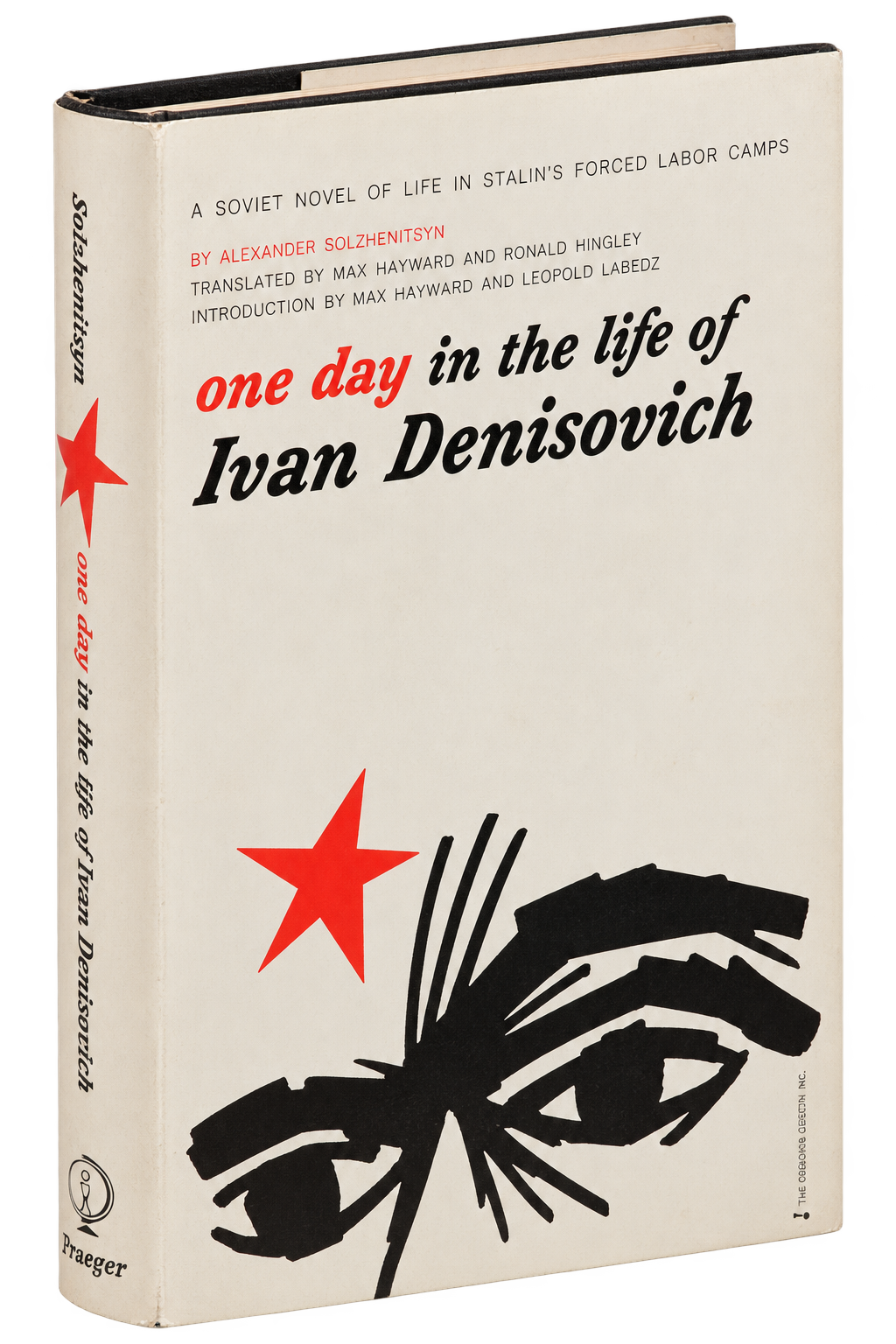
Aleksandr Solzhenitsyn
Translated by Max Hayward & Ronald Hingley
Frederick A. Praeger · New York · 1963
First English-Language Edition · First Printing
The Book:
The first English-language edition, first printing of Alexander Solzhenitsyn’s One Day in the Life of Ivan Denisovich, translated by Max Hayward and Ronald Hingley and published by Frederick A. Praeger in 1963. First published in the Soviet journal Novy Mir in November 1962, the novel drew upon Solzhenitsyn’s own imprisonment to depict a single day inside Stalin’s forced-labor camp system. Original black publisher’s cloth with gilt spine lettering and red topstain, retaining the original unclipped dust jacket priced $3.95.
Condition:
Near Fine+ book in a Near Fine dust jacket. The binding remains exceptionally square and clean, with bright black cloth, strong gilt spine lettering, vivid red topstain, and a fresh interior free of ownership markings. The original unclipped jacket shows light age toning, minor scattered surface soiling, and minimal handling and edge wear, with no significant chips or tears. No foxing, restoration, or structural defects are observed.
Story Of The Book
For years, millions of people had disappeared into Stalin’s prison camps. Then the Soviet Union itself briefly allowed one survivor to tell the world what a day inside them looked like.
Alexander Solzhenitsyn knew that world personally. Arrested in 1945 after criticizing Stalin in private correspondence, he spent eight years in prisons and labor camps before being sent into internal exile. His experiences became the foundation for Ivan Denisovich Shukhov, the prisoner whose ordinary winter day forms the entire architecture of this novel.
There is no dramatic escape. Shukhov wakes, works, searches for food, protects his possessions, navigates camp rules, endures the cold, and tries to preserve whatever fragments of dignity remain available to him.
That ordinariness was the revelation.
Solzhenitsyn did not need to describe the entire Gulag. He showed what a system of political repression looked like when surviving it had become routine.
What happened next was almost as remarkable as the novel itself. During Khrushchev’s limited campaign against Stalin’s legacy, Novy Mir editor Aleksandr Tvardovsky fought to publish the manuscript. Khrushchev ultimately approved it, and the story appeared in November 1962. Soviet readers suddenly encountered a work describing the camps not as an enemy accusation, but through literature officially permitted to circulate inside the Soviet Union.
The opening did not last. As the political climate hardened, Solzhenitsyn's work faced increasing suppression, and his relationship with the Soviet state ultimately became one of the defining literary confrontations of the Cold War.
Why It’s In The Collection
One Day in the Life of Ivan Denisovich belongs in Consigned to Darkness because one of the most powerful ways to challenge a system built on dehumanization is simply to restore the individual human being it tried to erase.
The Gulag operated on an enormous scale. Solzhenitsyn deliberately refused that scale. Instead of beginning with statistics, institutions, or ideology, he gave readers one prisoner, one camp, and one day.
That choice makes the novel an extraordinary piece of witness literature despite its fictional form. Shukhov is fictional, but the world surrounding him was reconstructed by a former prisoner from lived experience. The fiction becomes a vehicle for testimony.
This 1963 Praeger edition carries additional publication-event significance. It preserves the moment that testimony crossed into English-language publication, only months after its extraordinary appearance inside the Soviet Union and while the political consequences of Solzhenitsyn's emergence were still unfolding.
Later, The Gulag Archipelago would attempt to document the vast machinery of Soviet repression. One Day began somewhere smaller.
Before asking the world to understand millions of prisoners, Solzhenitsyn asked it to spend one day with one of them.
Collection Categories: Witness Literature · Anti-Totalitarianism · Political Imprisonment · Human Rights · Censorship · Free Expression · Political Dissent · Publication-Event Object · Cold War · Literature
———
Authentication Evidence
Title page identifies One Day in the Life of Ivan Denisovich by Alexander Solzhenitsyn and Frederick A. Praeger, New York, as publisher.
Translation is credited to Max Hayward and Ronald Hingley, with an introduction by Max Hayward and Leopold Labedz.
Copyright page records the 1963 Praeger publication, with no later-printing statement observed.
Contemporary publication records establish that the Praeger Hayward/Hingley translation and E. P. Dutton’s authorized Ralph Parker translation appeared simultaneously in the United States, making each a first English-language book edition rather than giving either sole chronological priority.
Contemporary reporting identifies the Praeger publication as the unauthorized English translation, distinguishing it bibliographically from the simultaneous authorized Dutton edition.
Original black publisher’s cloth with gilt spine lettering and red topstain is present.
Original dust jacket is present and remains unclipped at $3.95, consistent with documented first-printing Praeger copies.
No evidence of book-club manufacture, later printing, rebinding, facsimile jacket, or other bibliographic anomalies is observed.
Taken together, the 1963 Praeger imprint, Hayward/Hingley translation, absence of a later-printing statement, original binding and red topstain, and original $3.95 jacket support identification as an authentic First English-Language Edition · First Printing, representing Praeger’s unauthorized translation issued simultaneously with Dutton’s authorized English-language edition.
One Day in the Life of Ivan Denisovich
For decades, millions disappeared into Stalin's labor camps without leaving behind a public record of what life inside them actually felt like.
Then, astonishingly, the Soviet Union itself briefly allowed one survivor to speak. Rather than denouncing the Gulag through political argument, Alexander Solzhenitsyn simply followed one prisoner through a single ordinary winter day, revealing a world in which dignity survived despite systematic degradation. The novel shattered official silence surrounding the camps and became one of the defining literary indictments of twentieth-century totalitarianism. This first English-language book edition carried that testimony beyond the Soviet Union, transforming one prisoner's day into one of the modern world's most enduring witnesses against political repression.
Aleksandr Solzhenitsyn
Translated by Max Hayward & Ronald Hingley
Frederick A. Praeger · New York · 1963
First English-Language Edition · First Printing
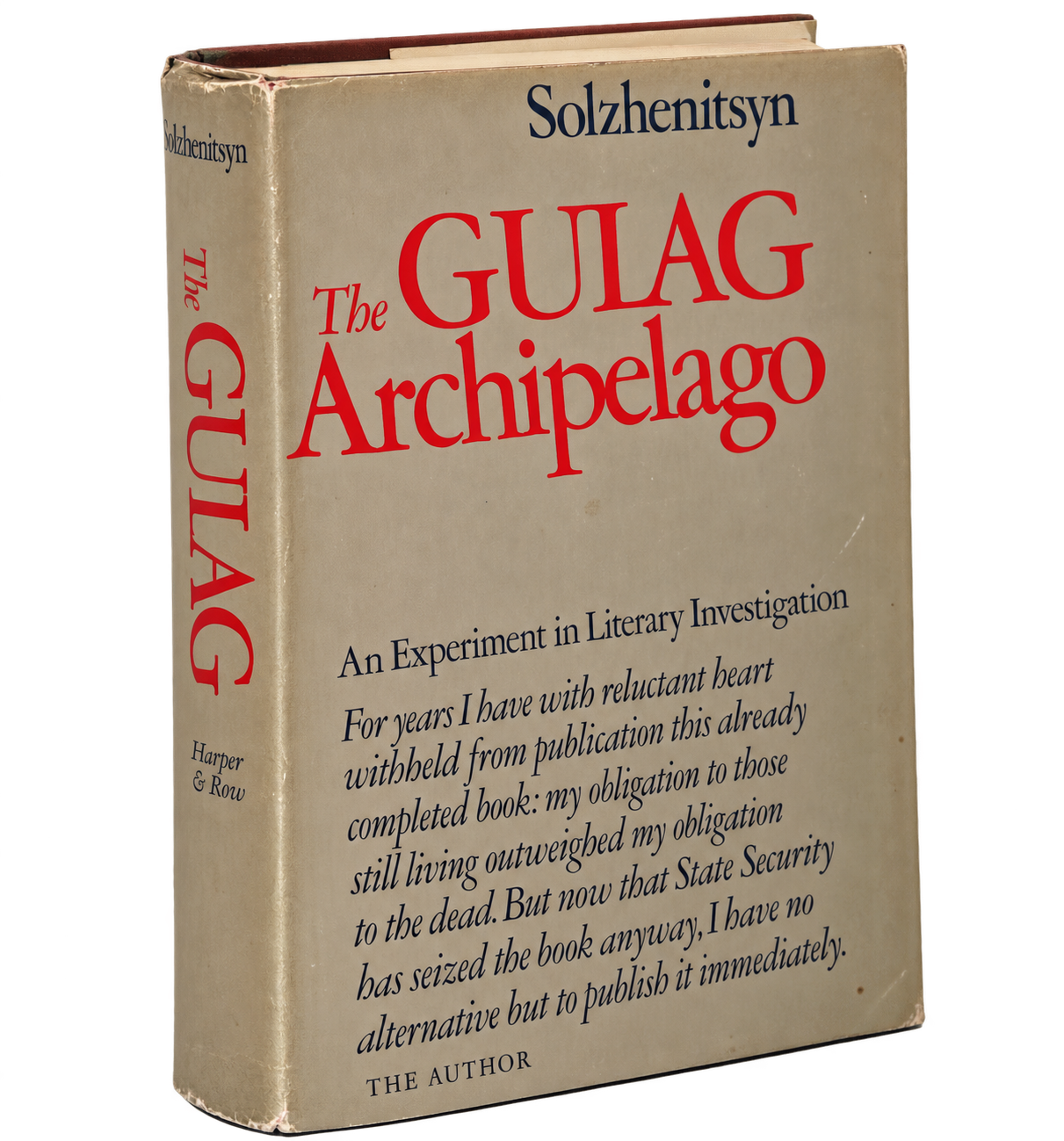
Full Title: The Gulag Archipelago, 1918–1956: An Experiment in Literary Investigation (Volumes I–II)
Aleksandr Solzhenitsyn
Translated from the Russian by Thomas P. Whitney
Harper & Row, Publishers · New York · 1974
First American Edition · First Printing
The Book:
The first American edition, first printing of Aleksandr Solzhenitsyn’s The Gulag Archipelago, 1918–1956: An Experiment in Literary Investigation, containing Volumes I–II of the larger work in a single physical hardcover volume, translated from the Russian by Thomas P. Whitney and published by Harper & Row in 1974. Combining Solzhenitsyn’s own experience of imprisonment with historical investigation and testimony gathered from former prisoners, the book reconstructs the Soviet system of arrest, interrogation, imprisonment, forced labor, and exile. xii, 660 pp. Original black publisher’s cloth with gilt spine lettering, retaining the original unclipped dust jacket priced $12.50.
Condition:
Near Fine+ book in a Near Fine dust jacket. The original black cloth remains exceptionally fresh, with bright gilt spine lettering, a square binding, crisp pages, and no ownership markings, foxing, restoration, or structural defects observed. The original unclipped jacket retains excellent color with light age toning, faint rubbing, minimal edge wear, and a few tiny closed tears, but no significant chips or paper loss.
Story Of The Book
The Soviet Union built an enormous system of political imprisonment. Solzhenitsyn set out to reconstruct the world it tried to keep hidden.
The Gulag Archipelago grew from Solzhenitsyn’s own imprisonment and years of clandestine research. But unlike One Day in the Life of Ivan Denisovich, it does not confine itself to one prisoner or one camp. Solzhenitsyn combined personal experience, historical investigation, and the testimony of former prisoners to document how repression operated across decades of Soviet rule.
The result was neither conventional history nor memoir. Solzhenitsyn called it an “experiment in literary investigation.” Arrests, interrogations, transportation, forced labor, prisons, exile, executions, and survival become parts of a vast system reconstructed through the people who experienced it.
The achievement of the book was to transform millions of individual disappearances into evidence of a system.
Solzhenitsyn kept the manuscript secret because publication inside the Soviet Union was impossible and possession endangered the people who had helped him. After Soviet security discovered a hidden copy in 1973, he authorized publication abroad. The Russian edition appeared in Paris at the end of that year; translations quickly followed. Soon afterward, Solzhenitsyn was arrested, stripped of Soviet citizenship, and expelled from the country.
Why It’s In The Collection
The Gulag Archipelago belongs in Consigned to Darkness because authoritarian power depends not only on the ability to imprison people, but on the ability to control what the rest of society knows about their imprisonment.
For decades, the Gulag existed alongside official narratives that concealed, minimized, or justified political repression. Solzhenitsyn attacked that secrecy by assembling the experiences of people the system had scattered across prisons, camps, and exile.
The book therefore represents more than testimony. It is an attempt to defeat institutional forgetting.
This 1974 first American edition preserves the moment that investigation entered American public life. Published only months after the Russian edition appeared abroad—and amid the confrontation that led to Solzhenitsyn’s expulsion from the Soviet Union—it carried evidence gathered in secrecy into unrestricted circulation.
Within the collection, it also completes an important progression in Solzhenitsyn’s work. One Day in the Life of Ivan Denisovich asks readers to experience political imprisonment through one person. Cancer Ward examines what repression leaves behind. The Gulag Archipelago reconstructs the machinery that produced both.
A state could imprison its witnesses. Solzhenitsyn built a book from their voices that the state could no longer contain.
Collection Categories: Witness Literature · Anti-Totalitarianism · Political Imprisonment · Human Rights · Censorship · Free Expression · Political Dissent · Publication-Event Object · Documentary Literature · Anti-Authoritarianism
———
Authentication Evidence
Title page identifies The Gulag Archipelago, 1918–1956: An Experiment in Literary Investigation and specifies Volumes I–II.
In this Harper & Row edition, Volumes I–II are contained together in one physical hardcover book rather than issued as two separate books.
Translation is credited to Thomas P. Whitney.
Copyright page identifies the Harper & Row first American publication and contains the publisher’s first-printing statement.
Original black publisher’s cloth with gilt spine lettering is present.
Original dust jacket is present and remains unclipped at $12.50.
No evidence of book-club manufacture, later printing, rebinding, facsimile jacket, or other bibliographic anomalies is observed.
Taken together, the first-printing statement, Harper & Row imprint, Thomas P. Whitney translation, original publisher’s binding, and original priced jacket support identification as an authentic 1974 First American Edition · First Printing of Volumes I–II, issued together in a single hardcover volume.
Full Title: The Gulag Archipelago, 1918–1956: An Experiment in Literary Investigation (Volumes I–II)
The Gulag Archipelago (Vol. I-II)
Aleksandr Solzhenitsyn
Translated from the Russian by Thomas P. Whitney
Harper & Row, Publishers · New York · 1974
First American Edition · First Printing
Governments have hidden atrocities before. Few had ever been confronted by a book assembled from hundreds of surviving witnesses determined to make concealment impossible.
Drawing upon his own imprisonment, years of investigation, and the testimony of more than two hundred former prisoners, Aleksandr Solzhenitsyn transformed the Soviet labor camp system into one of the twentieth century's greatest documentary indictments of state power. The Gulag Archipelago did not simply describe the machinery of repression—it reconstructed an entire hidden civilization built upon fear, forced labor, secrecy, and human suffering. This first American edition preserves the moment that one of history's most consequential acts of literary witness entered the English-speaking world, ensuring that the experiences the Soviet state had attempted to erase could no longer be denied.
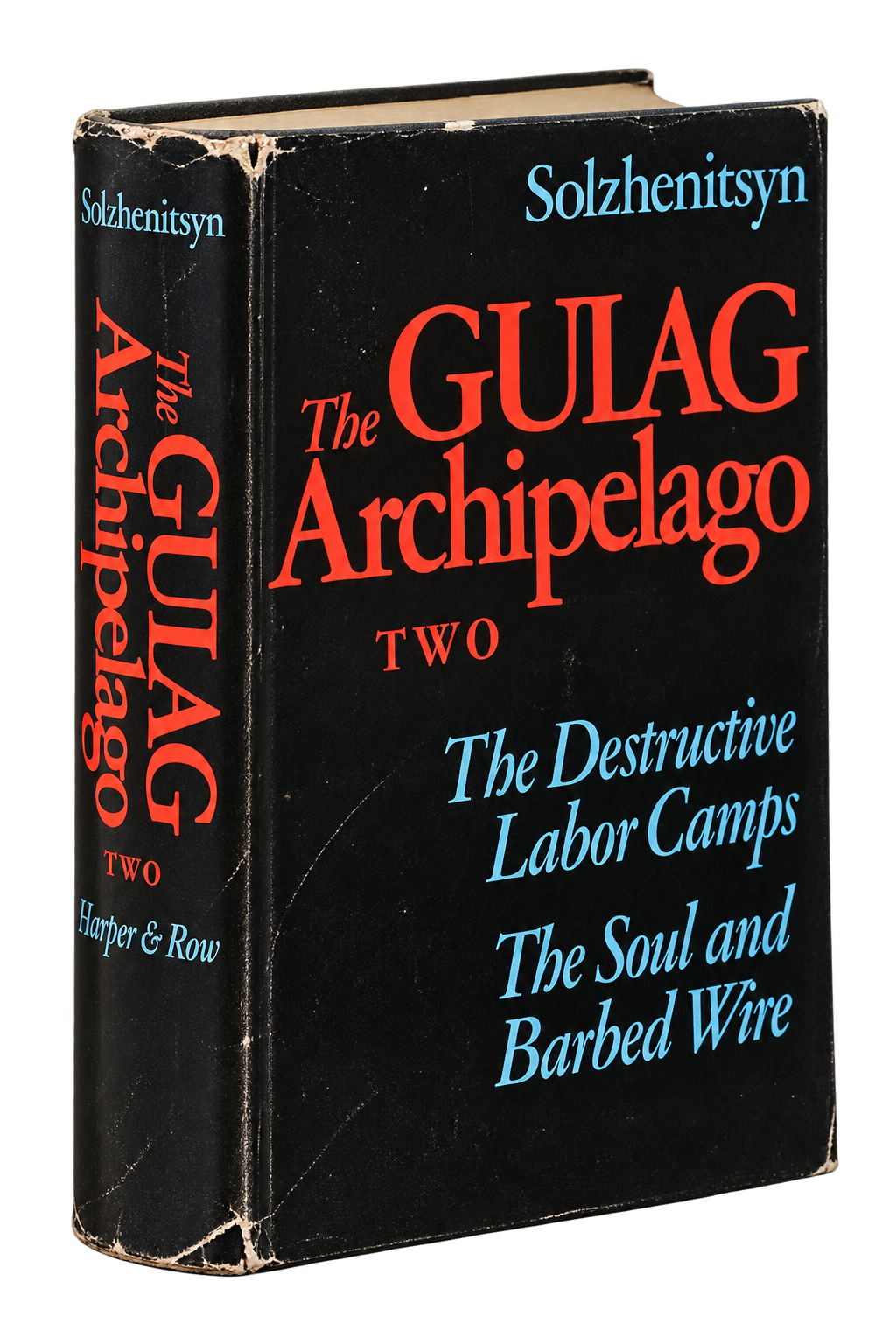
Full Title: The Gulag Archipelago, 1918–1956: An Experiment in Literary Investigation (Volumes III–IV)
Aleksandr Solzhenitsyn
Translated from the Russian by Thomas P. Whitney
Harper & Row, Publishers · New York · 1975
First American Edition · First Printing
The Book:
The first American edition, first printing of Aleksandr Solzhenitsyn’s The Gulag Archipelago, 1918–1956: An Experiment in Literary Investigation, containing Volumes III–IV of the larger work in a single physical hardcover volume. Harper & Row published Volumes I–II in one hardcover in 1974, followed by this companion volume containing Volumes III–IV in 1975. Together, the two separately published Harper & Row hardcovers form the complete first American publication of Volumes I–IV. Translated from the Russian by Thomas P. Whitney. Original black publisher’s cloth with gilt spine lettering, retaining the original unclipped dust jacket.
Condition:
Near Fine+ book in a Very Good+ dust jacket. The original black cloth remains exceptionally fresh, with bright gilt spine lettering, a square binding, crisp pages, and no ownership markings, foxing, restoration, or structural defects observed. The original jacket remains complete with moderate rubbing, scattered edge wear, minor chipping at the extremities, and light handling wear, but no significant tears or major paper loss.
Story Of The Book
The first part of The Gulag Archipelago exposed a hidden system. The concluding volume asked how that system endured.
Solzhenitsyn had already reconstructed the machinery of arrest, interrogation, imprisonment, and forced labor. Here, his investigation expands outward, examining the development of the camps across decades of Soviet rule and the lives of the people forced to inhabit them.
Again, the evidence comes from more than Solzhenitsyn himself. Personal experience is joined by the testimony of former prisoners and years of clandestine research, allowing individual stories to accumulate into a history of political repression.
The Gulag was not simply a collection of brutal prisons. Solzhenitsyn presented it as a system sustained by institutions, ideology, secrecy, and human choices.
By the time this American edition appeared in 1975, the consequences of publishing the work were already unmistakable. Solzhenitsyn had been arrested, stripped of his Soviet citizenship, and expelled from the country. The investigation the Soviet state could not permit at home was now circulating internationally.
Why It’s In The Collection
Volumes III–IV belong in Consigned to Darkness because they complete one of the twentieth century’s most consequential attempts to reconstruct a history that political power had tried to suppress.
The significance of The Gulag Archipelago lies partly in scale. Solzhenitsyn took experiences scattered across decades, prisons, labor camps, and individual memories and assembled them into a record capable of revealing the system connecting them.
Testimony became evidence; evidence became history.
Harper & Row issued the American publication in two physical books: Volumes I–II in 1974, followed by Volumes III–IV in this 1975 companion volume. Preserved together in the collection, RB-0107 and RB-0108 represent the complete first American publication of Volumes I–IV.
Within the collection’s larger Solzhenitsyn sequence, the progression is deliberate: One Day in the Life of Ivan Denisovich gives political imprisonment a human face. Cancer Ward examines what repression leaves behind. The Gulag Archipelago reconstructs the system itself.
The state had scattered its prisoners across an archipelago. Solzhenitsyn gathered their experiences back together.
Collection Categories: Witness Literature · Anti-Totalitarianism · Political Imprisonment · Human Rights · Censorship · Free Expression · Political Dissent · Publication-Event Object · Documentary Literature
———
Authentication Evidence
Title page identifies The Gulag Archipelago, 1918–1956: An Experiment in Literary Investigation, Volumes III–IV, by Aleksandr Solzhenitsyn and Harper & Row, Publishers, as publisher.
Volumes III–IV are contained together in this single physical hardcover.
Harper & Row had previously issued Volumes I–II together in a separate physical hardcover in 1974; this 1975 companion volume continues and completes the first American publication of Volumes I–IV.
Translation is credited to Thomas P. Whitney.
Copyright page identifies the publication as “First Edition” and contains the complete number line 15 16 17 18 19 10 9 8 7 6 5 4 3 2 1, directly establishing first-printing status.
Copyright page is dated 1974; the physical Harper & Row volume was published in 1975.
Original black publisher’s cloth with gilt spine lettering is present.
Original unclipped dust jacket is present and corresponds to the Harper & Row first American issue.
No evidence of book-club manufacture, later printing, rebinding, facsimile jacket, or other bibliographic anomalies is observed.
Taken together, the explicit First Edition statement, complete number line ending in 1, Harper & Row imprint, Thomas P. Whitney translation, original binding, and original dust jacket support identification as an authentic 1975 First American Edition · First Printing of Volumes III–IV, issued as the second physical volume of Harper & Row’s two-book American publication of Volumes I–IV.
Full Title: The Gulag Archipelago, 1918–1956: An Experiment in Literary Investigation (Volumes III–IV)
The Gulag Archipelago (Vol. III–IV)
Aleksandr Solzhenitsyn
Translated from the Russian by Thomas P. Whitney
Harper & Row, Publishers · New York · 1975
First American Edition · First Printing
The first volumes of The Gulag Archipelago exposed the hidden machinery of repression. The concluding volumes asked an even larger question: how could an entire political system be built upon it?
Drawing upon years of investigation, personal experience, official documents, and testimony from hundreds of former prisoners, Aleksandr Solzhenitsyn expanded his work beyond individual camps into a comprehensive history of the Soviet security state. The final volumes trace the evolution of political terror across generations while confronting the moral choices that allowed repression to endure. Published shortly after the first volumes, this first American edition completed one of the twentieth century's greatest documentary investigations, ensuring that a hidden history survived beyond the reach of censorship.
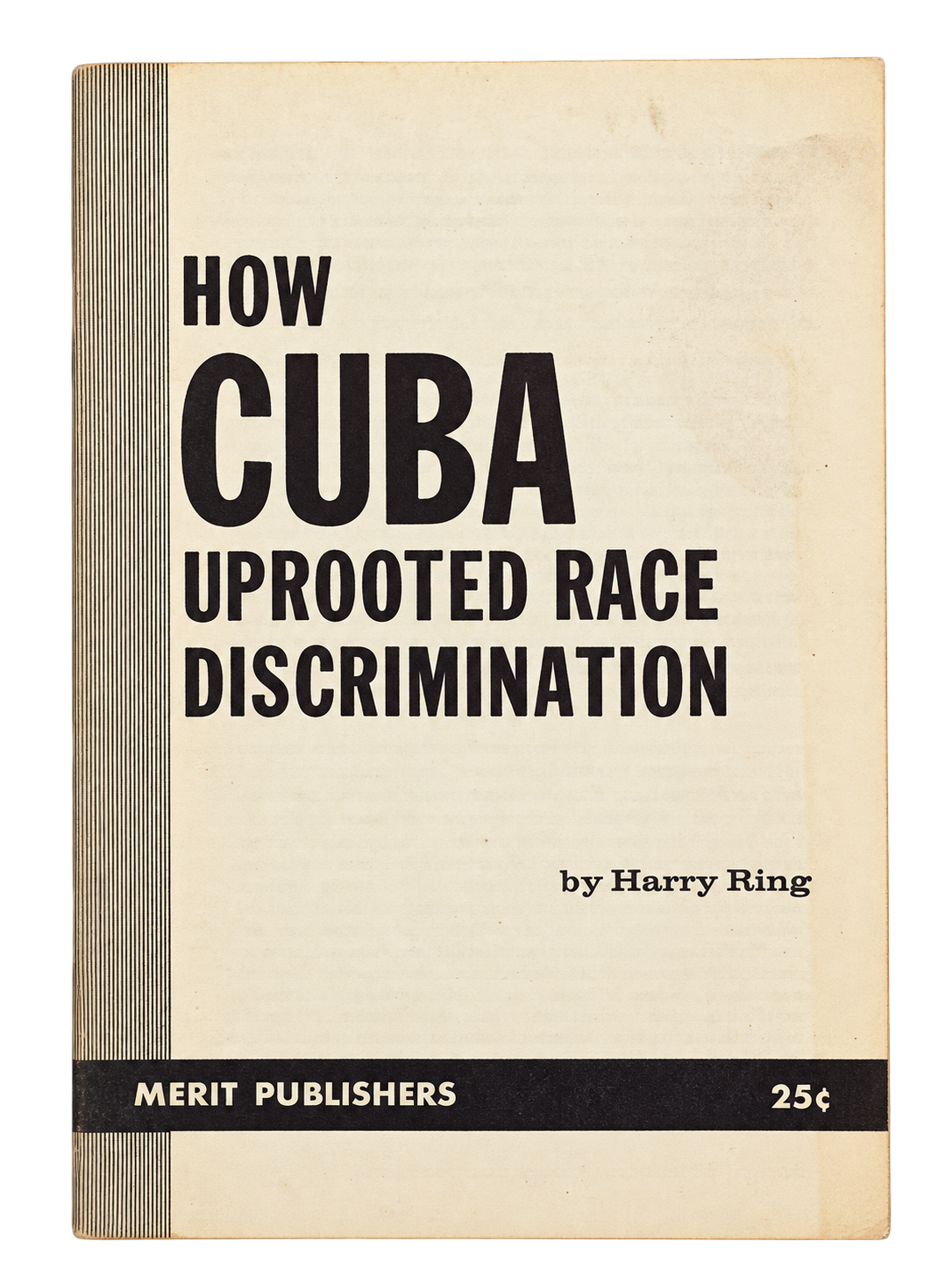
Harry Ring
Merit Publishers · New York · 1969
Second Edition · First Printing · Revised Introduction
The Book:
The June 1969 second edition of Harry Ring's How Cuba Uprooted Race Discrimination, published by Merit Publishers in New York. Originally issued by Pioneer Publishers in 1961, this revised 15-page pamphlet incorporates a new introduction informed by Ring's return visit to Cuba in 1968. Original white printed wrappers with bold black typography, striped spine decoration, and the original 25¢ cover price.
Condition:
Near Fine. Original printed wrappers remain bright and well preserved, with faint uneven discoloration, minor handling marks, and slight edge and corner wear. Interior pages are clean and bright. Binding remains sound, with no significant creasing, tears, paper loss, or restoration observed.
Story Of The Book
In 1961, an American socialist traveled to revolutionary Cuba and claimed to have witnessed something his own country had failed to accomplish: the dismantling of institutionalized racial discrimination.
While Black Americans were still fighting Jim Crow, Harry Ring argued that Cuba had begun tearing down the economic and political structures that kept Black people unequal.
He returned eight years later, convinced that the revolution had delivered on its promise. This 1969 edition brought his original argument back into circulation with a new introduction reaffirming his conclusions.
Yet the government Ring celebrated was also suppressing political dissent, raising an uncomfortable question: Can a revolution liberate people from one form of oppression while subjecting them to another?
Why It's In The Collection
How Cuba Uprooted Race Discrimination belongs in Consigned to Darkness because the history of political liberation is rarely as simple as the division between those who oppress and those who resist.
Ring's pamphlet captures a moment when American socialists looked to revolutionary Cuba as evidence that entrenched racial inequalities could be challenged through radical economic and political transformation. His argument was especially provocative in an America still struggling to dismantle segregation.
But the pamphlet also invites a more difficult conversation. The Cuban government pursued policies intended to reduce racial inequality while simultaneously concentrating political power and restricting dissent. Ring's enthusiastic assessment preserves how one contemporary observer understood those achievements and contradictions.
This particular 1969 edition is significant because Ring returned to Cuba, reconsidered the revolution's progress, and chose to reaffirm his original conclusions. It preserves not simply an early revolutionary promise, but a contemporary defense of that promise after nearly a decade of experience.
The question isn't whether Cuba challenged racial discrimination. It's whether progress toward one kind of freedom can justify the denial of another.
Collection Categories: Civil Rights · Human Rights · Political History · Political Movements · Anti-Colonialism · Labor & Economic Justice · Political Dissent
Authentication Evidence
Original front wrapper identifies How Cuba Uprooted Race Discrimination by Harry Ring.
Front wrapper identifies Merit Publishers and retains the original printed 25¢ price.
Introduction explicitly states “First edition, June 1961; second edition, June 1969.”
The June 1969 introduction discusses Ring's visits to Cuba in 1960 and 1968, distinguishing this revised edition from the original 1961 publication.
Revised introduction begins on page 2 and continues through page 5.
Original text begins on page 6 under the heading “How Cuba Uprooted Race Discrimination.”
Final numbered page is 15, consistent with independently documented copies of the 1969 edition.
Page 15 reproduces the political advertisement “Cuba — A Declaration of Conscience,” originally published in April 1961.
Rear wrapper advertises Merit Publishers' socialist and Cuban revolutionary publications, including The Diary of Che Guevara: Bolivia, Nov. 7, 1966–Oct. 7, 1967.
Rear wrapper identifies Merit Publishers at 873 Broadway, New York, N.Y. 10003.
Independent bibliographic records document the original June 1961 Pioneer Publishers edition, with an introduction by Richard Gibson.
ABAA/ILAB-affiliated Bolerium Books independently catalogs a 1969 Merit Publishers edition with an added introduction and 15 pages.
Original publisher's wrappers, revised introduction, pagination, and publisher advertisements correspond to the documented June 1969 second edition.
No later-printing statement or evidence of a subsequent impression was identified in the examined copy.
Combined bibliographic and physical evidence supports identification as the June 1969 Second Edition. First-printing status within that edition has not been independently established.
In 1961, an American socialist traveled to revolutionary Cuba and claimed to have witnessed something his own country had failed to accomplish: the dismantling of institutionalized racial discrimination.
While Black Americans were still fighting Jim Crow, Harry Ring argued that Cuba had begun tearing down the economic and political structures that kept Black people unequal. He returned eight years later, convinced that the revolution had delivered on its promise.
Yet the government Ring celebrated was also suppressing political dissent, raising an uncomfortable question: Can a revolution liberate people from one form of oppression while subjecting them to another?
This 1969 pamphlet preserves a provocative Cold War argument about racial justice, revolutionary power, and the uneasy relationship between equality and freedom.
Harry Ring
Merit Publishers · New York · 1969
Second Edition · First Printing · Revised Introduction
How Cuba Uprooted Race Discrimination
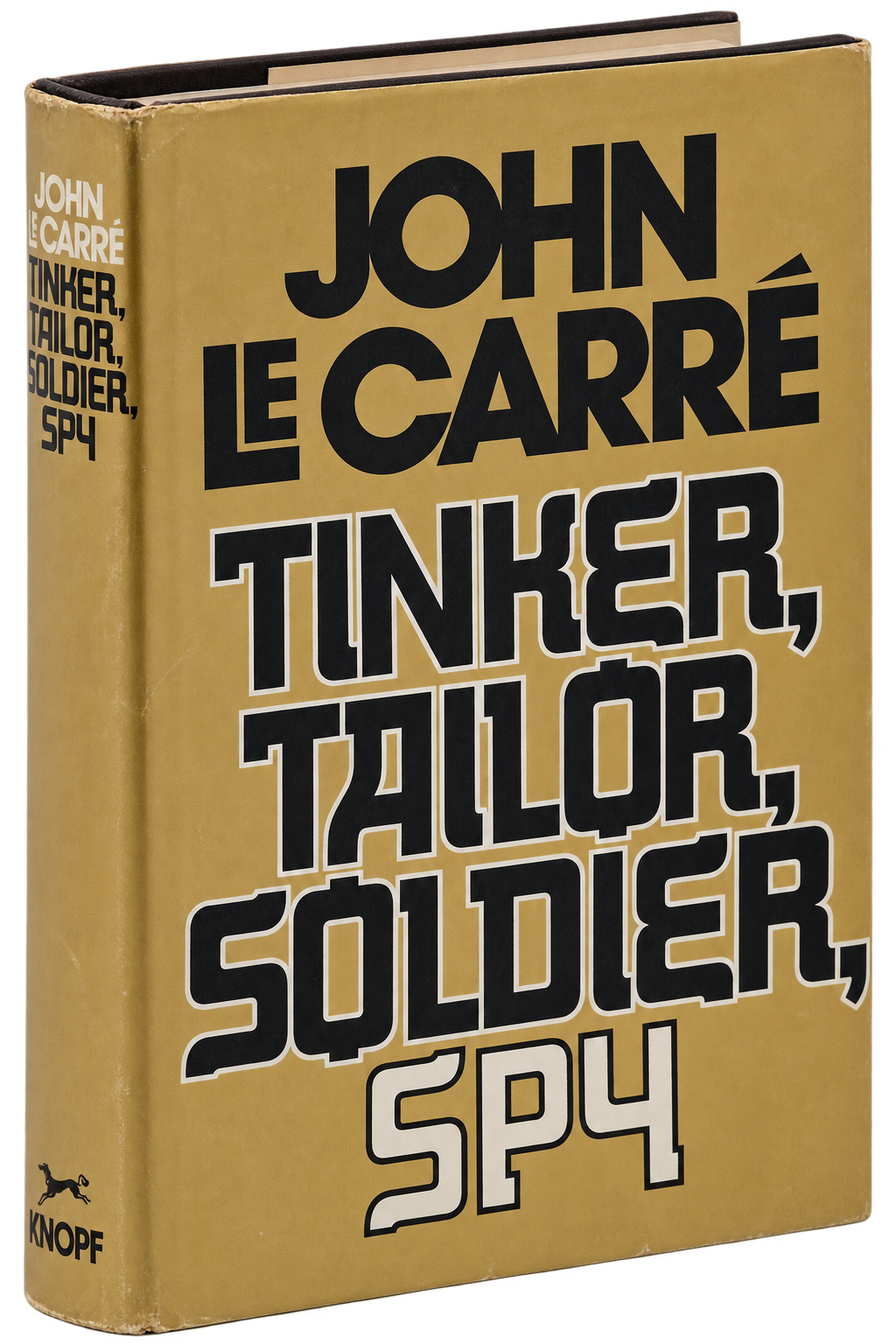
John le Carré
New York: Alfred A. Knopf, 1974
First American Edition · First Printing
The Book:
The first American edition, first printing of John le Carré’s Tinker, Tailor, Soldier, Spy, published by Alfred A. Knopf in 1974. The copyright page explicitly states “FIRST EDITION,” with no subsequent-printing statement, consistent with Knopf’s first-printing practice of the period. This copy retains its original black publisher’s cloth, gilt spine lettering, blind-stamped front-board titling, and original dust jacket. A contemporary blue “RECEIVED MAY 16 1974” stamp appears on the front free endpaper—an intriguing trace of the copy entering an institutional or business environment shortly after publication.
Condition:
Very Good+ in a Very Good dust jacket. The book remains square and structurally sound, with bright cloth, clean interior, and only light external handling wear. The principal deductions are the contemporary blue “RECEIVED MAY 16 1974” stamp and localized red transfer near the front endpaper. The original jacket remains substantially complete but exhibits moderate tanning, rubbing, scattered surface scratches, edge creasing, several short closed tears, and small chips concentrated at the spine ends and corners. The front-flap price has not been confirmed.
Story Of The Book
The greatest spy in modern fiction wasn’t hunting foreign agents. He was hunting betrayal inside his own side.
By the time John le Carré published Tinker, Tailor, Soldier, Spy in 1974, the mythology of espionage had already been badly damaged by reality. Britain had discovered that men entrusted with its deepest secrets—including members of the Cambridge spy ring—had spent years passing information to the Soviet Union. Among them was Kim Philby, a senior intelligence officer who had operated at the heart of the British establishment before defecting to Moscow in 1963.
Le Carré, himself a former British intelligence officer, transformed that atmosphere of betrayal into fiction.
The novel brings George Smiley out of retirement to investigate an almost unbearable possibility: a Soviet mole has penetrated the highest levels of the British intelligence service. The enemy is therefore not waiting beyond the Iron Curtain. He is sitting inside the institution charged with protecting the country from him.
What follows bears little resemblance to the glamorous espionage mythology of secret weapons, exotic locations, and heroic agents. Smiley works through files, memories, bureaucratic rivalries, old relationships, fragments of testimony, and carefully concealed institutional failures. Intelligence becomes less a world of adventure than a system for controlling information—and therefore controlling who is allowed to know the truth.
That makes the novel’s central betrayal larger than the identity of the mole. Le Carré asks what happens when institutions built upon secrecy become incapable of recognizing corruption within themselves. Loyalty becomes difficult to distinguish from obedience. Professional discretion becomes a mechanism for concealing failure. And the institution’s instinct for self-preservation can become almost as powerful as its desire to discover the truth.
Published as the opening volume of what became the Karla Trilogy, Tinker, Tailor, Soldier, Spy helped permanently transform espionage fiction. Le Carré replaced the fantasy of intelligence work with something darker: bureaucracy, compromised loyalties, institutional secrecy, moral ambiguity, and the possibility that those entrusted with defending a system may also be the people most capable of betraying it.
The most dangerous secret in Tinker, Tailor, Soldier, Spy is not what the enemy knows. It is what an institution refuses to see about itself.
Why It’s In The Collection
Tinker, Tailor, Soldier, Spy approaches power differently from most objects in Consigned to Darkness.
There is no banned book, political prisoner, obscenity prosecution, or public manifesto at its center. Instead, le Carré examines one of the least visible forms of governmental authority: the secret state.
Intelligence institutions necessarily operate beyond ordinary public scrutiny. They classify information, conceal operations, recruit informants, manipulate identities, and decide which truths can be known even by other parts of government. Le Carré understood that world personally, and his fiction strips away its heroic mythology to examine what secrecy does to the people and institutions entrusted with wielding it.
That makes this novel particularly relevant to the collection’s interest in institutional power. Smiley’s investigation is ultimately an attempt to recover truth from a system structurally designed to conceal information. The same machinery created to protect national secrets has also allowed betrayal to hide inside it.
The novel is not conventionally anti-government, nor does it argue that intelligence institutions should not exist. Its contribution is subtler and, for this collection, more interesting: institutions exercising extraordinary power in secret remain vulnerable to corruption, self-deception, ideological capture, and the instinct to protect themselves.
This 1974 first American edition preserves the American arrival of the novel that made that argument one of the defining stories of Cold War literature and permanently altered the popular understanding of espionage.
It belongs here because authoritarian power is not always exercised publicly. Sometimes the most consequential decisions are made precisely where the public cannot see them.
Secrecy may be necessary to intelligence. Le Carré’s warning was that secrecy can also protect the institution from the truth.
Collection Categories: Literature · Intelligence & Espionage · Political History · Anti-Authoritarianism · Cold War · Institutional Power
———
Authentication Evidence
• The title page identifies the work as Tinker, Tailor, Soldier, Spy by John le Carré, establishing the title and stated authorship of this copy.
• The title page bears the Alfred A. Knopf imprint with the 1974 publication date, establishing the first American publication.
• The copyright page explicitly states "FIRST EDITION," directly establishing first-edition status under Alfred A. Knopf's publishing practice for this period.
• The copyright page records copyright ©1974 by le Carré Productions and publication by Alfred A. Knopf, Inc., New York, consistent with the documented first American edition.
• The Borzoi colophon and publisher's imprint are present and internally consistent throughout the volume.
• Original black publisher's cloth with gilt spine lettering and blind-stamped front-board titling is present and consistent with the first American issue.
• The original dust jacket accompanies the volume and matches the known first American jacket design in typography, layout, author photograph, and flap text.
• No later-printing statement, book-club designation, facsimile characteristics, rebinding, or replacement binding components are visible in the supplied photographs.
• Edition identification: The explicit "FIRST EDITION" statement on the copyright page establishes this copy as the first American edition.
• Printing identification: Knopf identified first printings of this period through the explicit "FIRST EDITION" statement rather than later number-line conventions. No subsequent-printing statement or other indication of a later impression is present, supporting first-printing status.
The greatest spy in modern fiction wasn't hunting foreign agents. He was hunting betrayal inside his own side.
Published during the Cold War's era of growing institutional distrust, Tinker, Tailor, Soldier, Spy transformed the espionage novel by replacing glamorous secret agents with aging bureaucrats, divided loyalties, and hidden treachery at the center of British intelligence itself. George Smiley's search for a Soviet mole suggested that the greatest danger to a nation may come not from its enemies, but from trusted institutions quietly betraying themselves. This first American printing preserves the publication of the novel that permanently redefined modern espionage fiction by exposing the moral ambiguities, compromises, and quiet corruption beneath the mythology of intelligence work.
John le Carré
New York: Alfred A. Knopf, 1974
First American Edition · First Printing
Tinker, Tailor, Soldier, Spy
George Orwell disguised political history as a fable because truth often survives most effectively through allegory.
Published in the aftermath of the Second World War, Animal Farm exposed the corruption of revolutionary ideals and the transformation of liberation into dictatorship through one of the most influential political satires ever written. Its enduring power lies not in its specific historical references alone but in its demonstration that authoritarianism often emerges gradually through language, propaganda, and the manipulation of memory. This edition preserves one of the defining literary critiques of totalitarian power.
George Orwell
Harcourt, Brace and Company · New York · 1946
First US Edition · First Printing
Trip to Hanoi
Susan Sontag went to North Vietnam in May 1968 already convinced that the American war was wrong. What she found there forced her to confront how little political conviction alone had prepared her to understand the people living beneath the bombs.
Invited to Hanoi at the height of the Vietnam War, Sontag entered a country most Americans knew principally through military briefings, casualty reports, propaganda, and images of destruction. Her resulting essay is striking because she refuses to turn the Vietnamese into simple symbols of either communist menace or heroic victimhood. Instead, she documents her own discomfort, cultural assumptions, attraction to the revolution, and difficulty understanding a society radically different from her own. Scholars have subsequently identified the journey as a turning point in Sontag's development as a politically engaged writer.
The timing is crucial. This was written while American bombs were still falling and while the political meaning of Vietnam remained fiercely contested at home. Sontag was not reconstructing the war afterward. She traveled into the country her own government was bombing and returned determined to interrogate not only American policy, but the assumptions through which Americans understood the people on the other side of the war.
Susan Sontag
The Noonday Press / Farrar, Straus and Giroux · New York · 1968
First Edition · First Printing
The Jews of Silence
Full Title: The Jews of Silence: A Personal Report on Soviet Jewry
Elie Wiesel
Translated from the Hebrew with an Historical Afterword by Neal Kozodoy
Holt, Rinehart and Winston · New York · 1966
First American Edition · First Printing
Elie Wiesel survived the Holocaust. Twenty years later, he discovered millions of Jews living under another system determined to silence them.
Traveling through the Soviet Union, Wiesel encountered Jewish communities whose religious traditions, cultural identities, and freedom of expression had been systematically suppressed. Their synagogues were watched, their opportunities restricted, and their struggle largely invisible to the outside world. They had survived a century of extraordinary persecution, only to find themselves living in a country where openly embracing their Jewish identity could carry devastating consequences.
Wiesel refused to let their suffering remain invisible. In The Jews of Silence, he transformed private conversations, whispered fears, and quiet acts of defiance into a powerful indictment of Soviet repression. Yet his accusation reached beyond the Soviet government. He challenged Jews and others living in freedom who knew about the persecution but failed to speak out.
Published in 1966, this first edition helped bring the plight of Soviet Jewry to international attention, giving urgency to a human rights movement that would eventually help hundreds of thousands of Soviet Jews leave the country.
The Soviet government tried to silence its Jews. Wiesel's most uncomfortable accusation was directed at those who were free to speak — and chose not to.
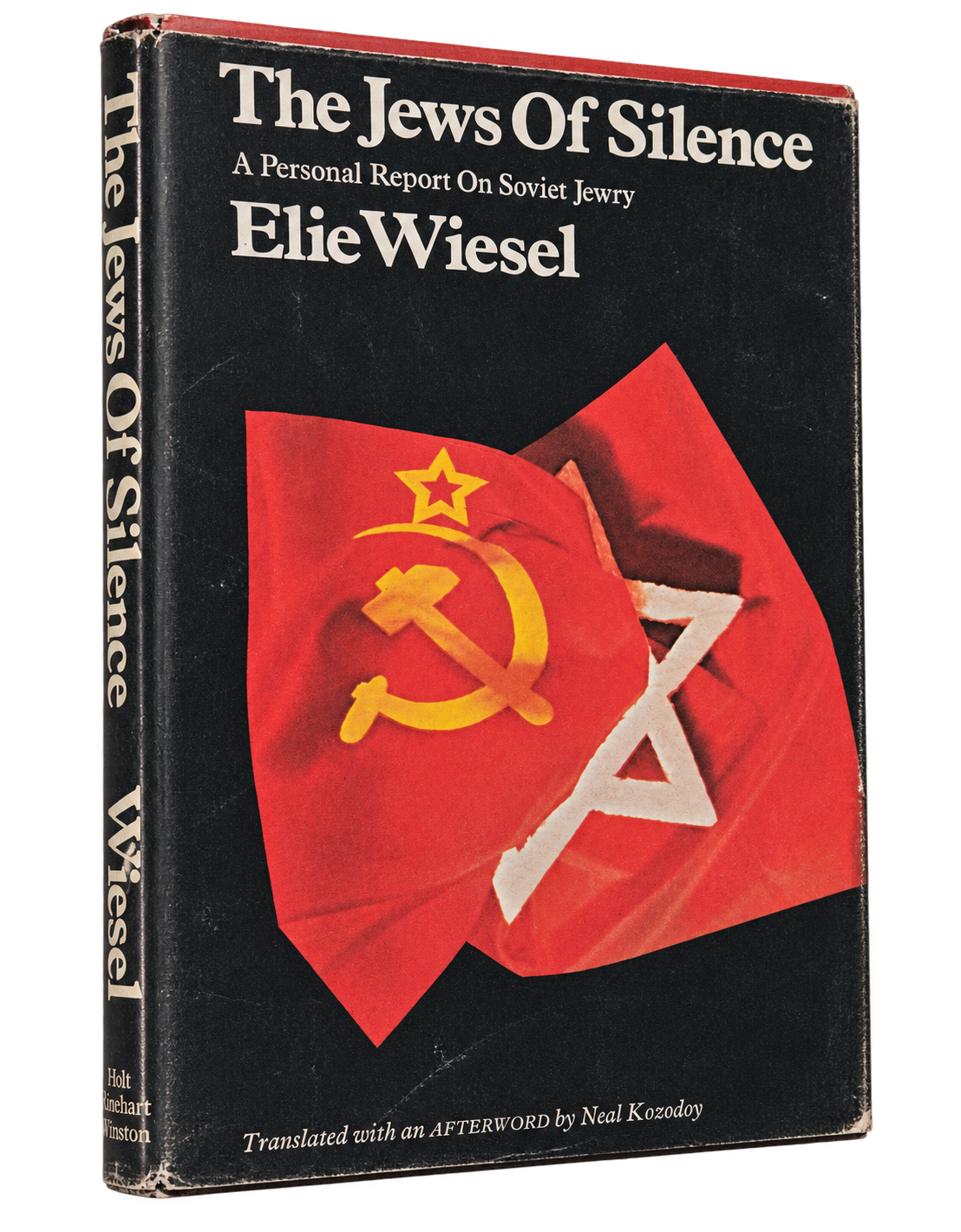
Full Title: The Jews of Silence: A Personal Report on Soviet Jewry
Elie Wiesel
Translated from the Hebrew with an Historical Afterword by Neal Kozodoy
Holt, Rinehart and Winston · New York · 1966
First American Edition · First Printing
The Book:
The First American Edition · First Printing of Elie Wiesel’s The Jews of Silence, his firsthand account of a 1965 journey through the Soviet Union to investigate Jewish life under Communist rule. Sent to the USSR by the Israeli newspaper Haaretz, Wiesel subsequently wrote his account in Hebrew as a series of articles for Yedioth Ahronoth. Translated by Neal Kozodoy, with his historical afterword on Soviet Jewry. Octavo; viii, 143 pp. This copy retains its original publisher’s binding and original unclipped $4.95 dust jacket.
Condition:
Near Fine+ book in a Near Fine original dust jacket. Original red patterned boards with black spine and gilt Star of David device remain exceptionally well preserved. Binding is square and sound with bright, clean pages, sharp corners, and no ownership markings, foxing, restoration, or structural defects observed. The original jacket remains unclipped at $4.95, showing only light rubbing, mild age toning, and trivial edge wear.
Story Of The Book
Elie Wiesel went to the Soviet Union expecting to encounter Jews reduced to silence. What he found forced him to turn the accusation somewhere else.
Sent into the USSR in 1965 to report on Jewish life behind the Iron Curtain, Wiesel traveled through Soviet cities seeking people beyond those officially presented to foreign visitors. He encountered communities subjected to discrimination, restrictions on religious and cultural life, isolation from Jews abroad, and the constant presence of state surveillance.
But he did not find a people spiritually extinguished.
Wiesel encountered Jews who continued to gather, celebrate religious holidays, seek knowledge of Jewish life abroad, and preserve an identity the Soviet system had spent decades trying to weaken. Their persistence changed the meaning of his journey. The people whose freedom had been constrained were still finding ways to remember who they were.
The accusation therefore turned outward. Wiesel concluded the book with its devastating reversal: “What torments me most is not the Jews of silence I met in Russia, but the silence of the Jews I live among today.”
The title’s deepest meaning is there. The silence Wiesel feared most was not the silence imposed by dictatorship. It was the silence chosen by people who were free.
Why It’s In The Collection
The Jews of Silence belongs in Consigned to Darkness because witness becomes an act of dissent when it carries voices across a boundary designed to contain them—and then demands something from the people on the other side.
Wiesel entered a closed society, sought out ordinary Soviet Jews, listened to them, and carried what he encountered back to an international audience. But he refused to reduce those people to passive victims. Their persistence—the survival of identity under pressure—is itself part of his testimony.
The sharper indictment falls on the outside world. Wiesel had already devoted his life to confronting the consequences of indifference to persecution. Here, he applied that moral urgency while another struggle was still unfolding.
Published in 1966, this first printing preserves that intervention before Soviet Jewry became one of the defining international human-rights causes of the Cold War.
The Soviet state tried to silence its Jews. Wiesel’s harder question was what excuse remained for everyone who could still speak.
Collection Categories: Witness Literature · Human Rights · Religious Conscience · Free Expression · Political Dissent · Anti-Authoritarianism · Anti-Totalitarianism · Cold War · Publication-Event Object
———
Authentication Evidence
Title page identifies the work as The Jews of Silence: A Personal Report on Soviet Jewry by Elie Wiesel.
Title page credits Neal Kozodoy with the translation from the Hebrew and historical afterword.
Publisher is correctly identified as Holt, Rinehart and Winston · New York, Chicago, San Francisco.
Copyright page carries the original 1966 English translation copyright.
Copyright page explicitly states “First Edition,” directly establishing first-edition status.
No subsequent-printing statement appears; Holt, Rinehart and Winston’s first-edition identification and absence of later-printing notation support first-printing status.
Institutional and specialist bibliographic records identify the 1966 Holt, Rinehart and Winston issue as the First American Edition.
Volume collates to viii, 143 pages, octavo, consistent with institutional and specialist descriptions of the first edition.
Original publisher’s red patterned boards with black spine and gilt Star of David device remain present and are consistent with the first issue.
Original dust jacket remains present.
Original dust jacket is unclipped and retains the $4.95 publisher’s price, consistent with documented first-edition jackets.
Publisher imprint, typography, binding, and jacket configuration are internally consistent with documented 1966 first-edition copies.
No evidence of book-club manufacture, ex-library ownership, remainder marking, rebinding, facsimile dust jacket, or replacement components is observed.
Observable physical and bibliographic evidence supports identification as the 1966 First American Edition · First Printing.
Yankee Bride in Moscow
Elizabeth Hampel
Liveright Publishing Corporation · New York · 1941
First Edition · First Printing · Signed Presentation Copy
Before the Cold War had a name, an American woman went to Stalin's Moscow and discovered a world where even ordinary life could be dangerous.
Elizabeth Hampel arrived in the Soviet capital as the wife of an American Embassy official. What she encountered was a society where fear was woven into everyday life, where the government controlled what people could say, what they could know, and how much they dared to trust one another. She began keeping a diary, recording the strange, unsettling, and sometimes absurd realities of living in a country where the state seemed to reach into every corner of human existence.
Her observations became Yankee Bride in Moscow, a 1941 bestseller that offered American readers an unusually intimate glimpse behind the Soviet curtain. Long before the Cold War made Stalin's dictatorship a defining American preoccupation, Hampel was describing what it felt like to live in its shadow.
This first edition carries something particularly special: Hampel personally inscribed it to “Miriam,” describing the book in her own handwriting as an account of “our experiences in Russia.” The woman who witnessed Stalin's Moscow left a personal message inside the very book she wrote to tell the world about it.
Dictatorships depend on controlling what outsiders can see. Hampel went inside, paid attention, and told everyone what she saw.
El Diario del Che en Bolivia
Full Title: El Diario del Che en Bolivia: Noviembre 7, 1966 a Octubre 7, 1967
Few revolutionary documents were intended less for publication than Che Guevara's Bolivian diary.
Written as a private operational record during his final guerrilla campaign and published only after his death, the diary transformed a confidential field journal into one of the twentieth century's most influential political documents. It preserves Guevara's final campaign not through later interpretation but through his own daily observations, recording both revolutionary conviction and ultimate failure in real time. The volume stands among the most significant firsthand documents of modern revolutionary history.
Ernesto “Che” Guevara
Havana: Instituto del Libro, 1968
First Edition · First Printing
The most dangerous spy in Graham Greene's Havana never existed.
Published in 1958 at the height of the Cold War, Our Man in Havana turned the machinery of espionage into a devastating satire of bureaucracy, intelligence agencies, and governments willing to believe comforting lies over uncomfortable truths. Greene drew upon his own experience inside British intelligence and his years reporting from politically unstable countries to expose how institutions built to uncover reality could instead manufacture it. This first Dutch edition preserves the novel's earliest introduction to Dutch readers only one year after its original publication, carrying one of Greene's sharpest warnings about the ease with which governments deceive themselves—and the extraordinary consequences that follow when fiction becomes accepted as intelligence.
A government can erase a man from a photograph. Milan Kundera understood that the harder task was keeping him erased from memory.
Written in exile after Kundera’s books had been removed from Czechoslovak libraries and he had been stripped of his citizenship, The Book of Laughter and Forgetting turned forgetting into an instrument of political power. Across seven interlocking narratives, private memories collide with official history, erotic life with ideological control, and laughter with the machinery of humiliation. This first American printing carried Kundera’s forbidden Czech-language novel into the United States at the moment his work was becoming an international argument against enforced amnesia. Totalitarian power depends upon controlling what a society remembers. Kundera’s answer was to make forgetting impossible.
Animal Farm
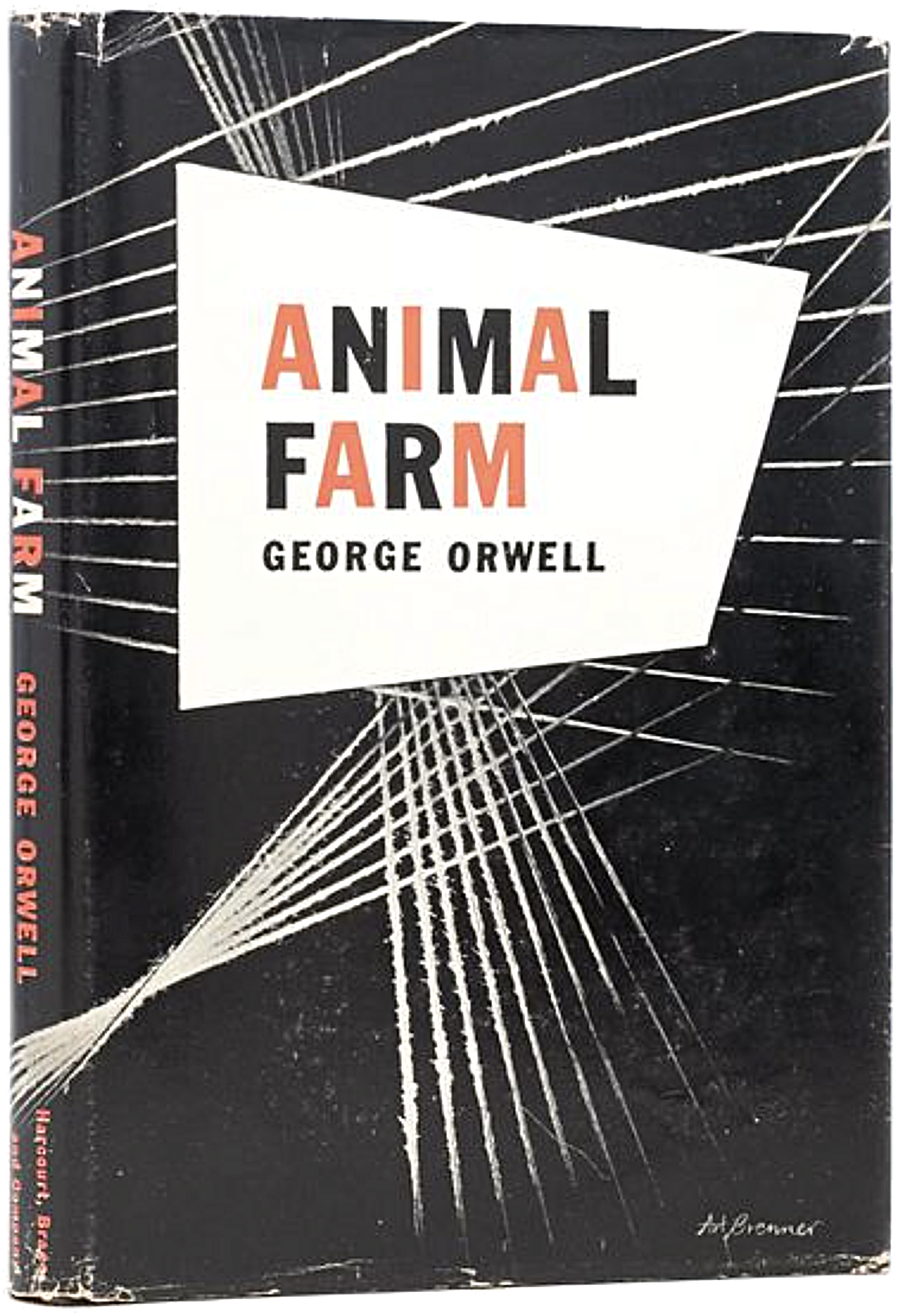
George Orwell
Harcourt, Brace and Company · New York · 1946
First US Edition · First Printing
The Book:
The first American edition, first printing of George Orwell’s Animal Farm, published by Harcourt, Brace in 1946. The copyright page explicitly states “first American edition,” and this copy retains its original black publisher’s cloth with gilt spine lettering and original dust jacket. The jacket is price-clipped, preventing authentication of the original $1.75 price.
Condition:
Near Fine in a Good+ original dust jacket. The book remains clean and sound with bright gilt spine lettering, light shelf wear, and a contemporary gift inscription on the front free endpaper. The jacket shows moderate rubbing and edge wear, several small chips, and short closed tears, with the heaviest wear at the spine ends and folds. No restoration or rebinding is observed.
Story Of The Book
George Orwell turned the history of a revolution into a farmyard fable—and produced one of the twentieth century’s most enduring warnings about political power.
The animals of Manor Farm overthrow their human owner in the hope of building an equal society. What follows is the gradual corruption of that revolution: language is manipulated, history rewritten, enemies invented, and privileges quietly restored until the distinction between liberators and oppressors disappears.
Published after the wartime alliance with the Soviet Union had made Orwell’s anti-Stalinist argument politically uncomfortable, Animal Farm showed how authoritarianism could emerge not only through force but through control over memory and language. Its warning reaches beyond the regime it originally satirized: those who control the story of the past acquire extraordinary power over what others believe is possible in the present.
Why It’s In The Collection
Animal Farm belongs at the center of Consigned to Darkness because it explains one of authoritarianism’s most powerful tools: the ability to make truth itself politically contingent.
Orwell understood that domination requires more than coercion. The pigs maintain power by changing words, rewriting history, controlling information, and persuading others to distrust their own memories. The book therefore connects directly to the collection’s broader concern with censorship, propaganda, and the relationship between expression and authority.
This 1946 first American printing preserves the moment Orwell’s warning first reached American readers, before Animal Farm became one of the defining political allegories of the modern era.
Collection Categories: Anti-Totalitarianism · Anti-Authoritarianism · Political Philosophy · Literature · Censorship · Free Expression · Publication-Event Object
———
Authentication Evidence
Title page identifies Harcourt, Brace and Company, New York, consistent with the first American edition.
Copyright page explicitly states “First American Edition,” confirming first American edition status.
No later-printing statement is present, consistent with first-printing status.
Copyright page states “Printed in the United States of America,” consistent with documented first-printing copies.
Original black publisher’s cloth binding with gilt spine lettering is present, matching documented first American first-printing copies.
Original first-issue dust jacket is retained.
Front jacket flap is price-clipped, so the original $1.75 publisher’s price cannot be authenticated directly from this copy.
Rear jacket flap lacks the statement “Printed in the USA,” independently consistent with the first-issue dust jacket; later jacket states carry that statement.
Jacket design by Art Brenner, typography, publisher imprint, and panel configuration are consistent with documented first-issue jackets.
Collation of [iv], 118 pages is consistent with documented first American copies.
No evidence of book-club manufacture, rebinding, facsimile dust jacket, or replacement components is observed.
Observable bibliographic evidence supports identification as the 1946 Harcourt, Brace first American edition, first printing, in the original first-issue dust jacket.
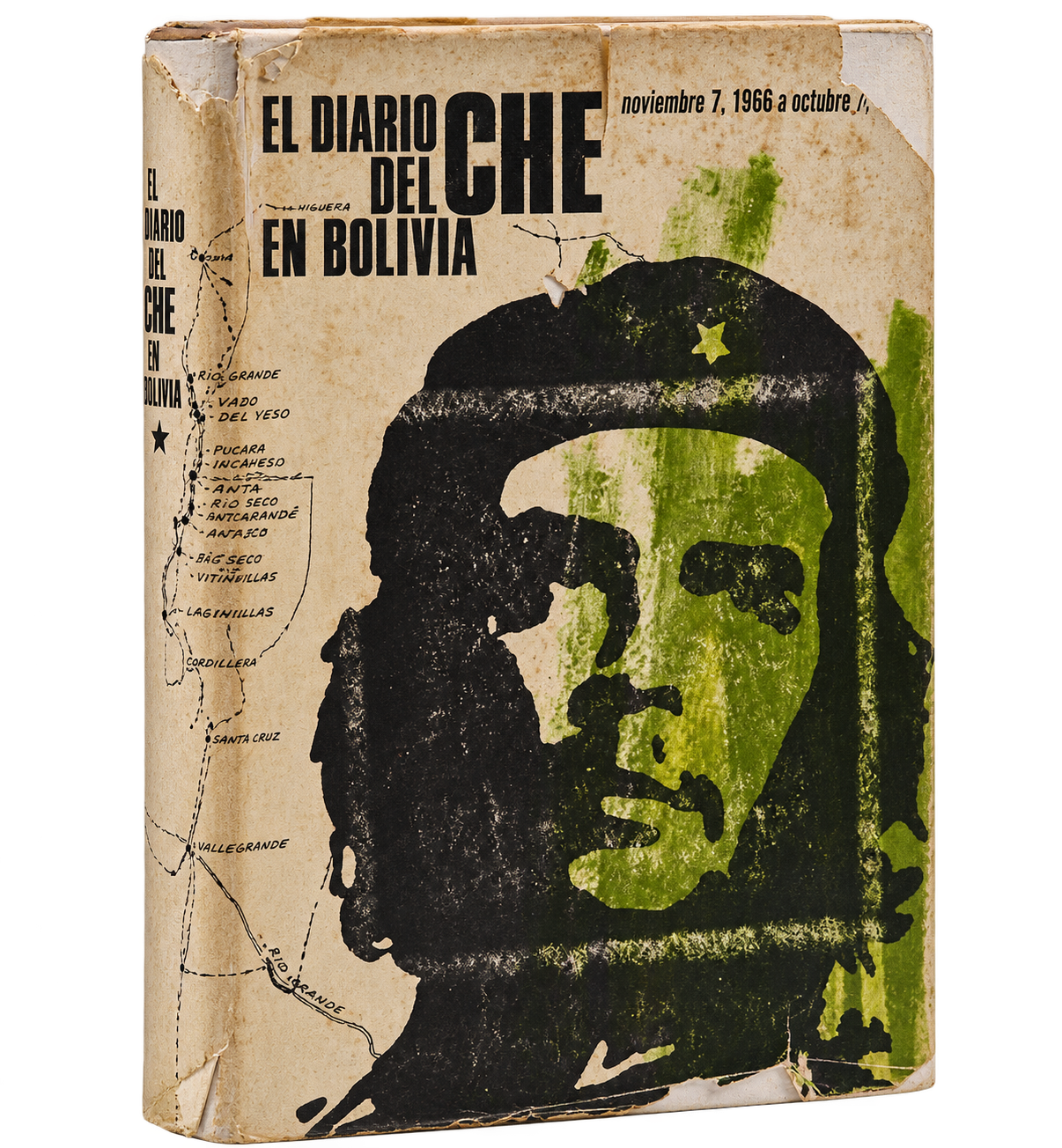
Full Title:El Diario del Che en Bolivia: Noviembre 7, 1966 a Octubre 7, 1967
Ernesto “Che” Guevara
Havana: Instituto del Libro, 1968
First Edition · First Printing
The Book:
The first Cuban edition, first printing of Che Guevara’s El Diario del Che en Bolivia, published in Havana by the Instituto del Libro in 1968, the Cuban government’s designated “Año del Guerrillero Heroico.” The volume reproduces Guevara’s private operational diary from his final guerrilla campaign in Bolivia, covering November 7, 1966 through October 7, 1967, with an introduction by Fidel Castro. This copy retains its original hard paper wrappers and original illustrated dust jacket. The first Cuban printing comprised 250,000 copies and was issued on June 26, 1968, less than nine months after Guevara’s death. This copy lacks the folding map originally issued loose at the front but is otherwise textually complete, with xxix, 346 pages and seven leaves of photographic plates.
Condition:
Very Good+ in a Very Good dust jacket. The original wrappers remain complete with moderate handling wear, edge rubbing, corner wear, and age toning consistent with use. The illustrated dust jacket shows edge wear and light toning but remains complete and presents attractively. The binding is sound and the interior complete and clean. The folding map originally issued loose at the front is absent.
Story Of The Book
Few revolutionary documents were intended less for publication than Che Guevara’s Bolivian diary.
This was not a manifesto written for supporters, a memoir polished after victory, or a history constructed with the benefit of hindsight.
It was a working document.
Beginning in November 1966, Guevara recorded the progress of the guerrilla campaign he hoped would ignite revolution in Bolivia and eventually spread armed struggle across Latin America. Day by day, the diary follows the increasingly desperate reality behind that ambition: movements, encounters, disagreements, shortages, tactical decisions, physical deterioration, isolation, and the widening distance between revolutionary expectation and what was actually happening on the ground.
Then the entries stop.
Guevara’s final entry is dated October 7, 1967. The following day he was captured by Bolivian forces. On October 9, he was executed.
His private field journal survived him.
That transformed the diary into something Guevara himself could never have planned. A confidential operational record became a political document, historical artifact, and eventually one of the most recognizable firsthand texts of twentieth-century revolutionary history.
Cuba understood its importance immediately.
In June 1968, less than a year after Guevara’s death, the Instituto del Libro published this enormous 250,000-copy Cuban edition, introduced by Fidel Castro and issued during a year the revolutionary government had officially dedicated to the “Heroic Guerrilla.”
The result is an unusually complicated publication object.
The words belong to Guevara in the field. But the book belongs equally to the political struggle over what Guevara would mean after his death.
A guerrilla’s private record of a failed revolution became the document through which another revolution began constructing his immortality.
Why It’s In The Collection
El Diario del Che en Bolivia belongs in Consigned to Darkness precisely because the collection is interested in power from both sides of the barricade.
Guevara was a revolutionary fighting established governments and advocating armed resistance against political systems he considered oppressive. He was also a central figure in the Cuban Revolution and an architect and defender of a new revolutionary state that exercised coercive power of its own.
The collection does not need to resolve that contradiction to preserve it.
This book is valuable because it brings the reader unusually close to the moment before history decided what Che Guevara would become. The diary records revolutionary conviction alongside practical failure, not through a later biographer’s reconstruction but through Guevara’s own contemporaneous observations during the campaign that ended his life.
The physical edition adds another layer. Published in Havana within months of his death, introduced by Fidel Castro, and issued during Cuba’s “Año del Guerrillero Heroico,” it documents the transformation of the dead revolutionary into a political symbol. The inventory therefore treats the object not merely as a revolutionary text, but as a primary publication-event object in the construction of Guevara’s posthumous political legacy.
That makes the book simultaneously a record of insurgency, a firsthand document of failure, and an artifact of revolutionary mythmaking.
Che Guevara went to Bolivia to export a revolution. He failed. His diary traveled farther than the revolution ever did.
Collection Categories: Revolutionary Texts · Guerrilla Warfare · Revolutionary Movements · Anti-Colonialism · Political Movements · Political Dissent · Latin American Political History · Cold War
———
Authentication Evidence
• Title page identifies Instituto del Libro, La Habana, 1968 (Año del Guerrillero Heroico), consistent with the first Cuban edition.
• Title page is dated 1968, the year of the earliest Cuban publication following Guevara's death.
• No evidence of later Cuban publisher changes, modern ISBNs, or subsequent reprint statements observed.
• The book retains its original publisher's binding and original illustrated dust jacket.
• Dust jacket artwork, map design, and publisher presentation are consistent with documented first Cuban issues.
• No evidence of book club manufacture, facsimile dust jacket, rebinding, ex-library provenance, or modern reproduction observed.
• The observed bibliographic evidence is consistent with a first Cuban edition, first printing.
Onze Man in Havana
Graham Greene
Amsterdam en Antwerpen: Uitgeverij Contact, 1959
First Dutch Edition · First Printing
Victor Marchetti & John D. Marks
Alfred A. Knopf, Inc. · New York · 1974
First Edition · First Printing
The Book:
The first edition, first printing of Victor Marchetti and John D. Marks’s The CIA and the Cult of Intelligence, published by Alfred A. Knopf in 1974. The copyright page explicitly states “First Edition,” and this copy retains its original publisher’s cloth binding and original unclipped $8.95 dust jacket.
The physical book preserves the censorship battle that preceded its publication. Passages the CIA successfully prevented the authors from publishing appear as conspicuous blank spaces in the text, while material the agency initially sought to suppress but later released appears in boldface. The result is not simply a book about government secrecy: the first edition itself records the government’s intervention in what its authors were permitted to publish.
Condition:
Very Good+ book in a Good+ original dust jacket. The original publisher’s cloth binding remains intact. The unclipped $8.95 jacket shows moderate edge wear, staining, and discoloration, with corresponding light discoloration to the endpapers. No evidence of rebinding, book-club manufacture, facsimile jacket, or replacement components is observed.
Story Of The Book
The CIA tried to censor this book before the public could read it. The authors made the censorship visible instead.
Victor Marchetti had served as a senior CIA officer before leaving the agency and becoming increasingly critical of the secrecy surrounding American intelligence operations. When he joined former State Department official John D. Marks to write The CIA and the Cult of Intelligence, the government did something unprecedented: it required the manuscript to be submitted to the CIA before publication.
The agency initially ordered 339 passages deleted. After months of legal challenges and negotiations, that number fell to 168, but those remaining passages could not legally appear when Knopf published the book in 1974. Rather than disguise what had happened, the published volume preserved the absences. Blank spaces interrupt the text where information had been suppressed; passages initially challenged and subsequently released were printed in boldface.
That decision transformed censorship into something the reader could physically see. Whatever secrets disappeared from the manuscript, the exercise of government power over the manuscript remained on the page.
The CIA succeeded in keeping 168 passages out of the book. It could not keep its censorship out of the book.
Why It’s In The Collection
The CIA and the Cult of Intelligence belongs at the center of Consigned to Darkness because the object itself embodies a conflict between government secrecy and freedom of expression.
The underlying dispute was unusually difficult. Intelligence agencies necessarily possess information that governments have legitimate reasons to protect, while democratic accountability depends upon the ability of citizens, journalists, former officials, and publishers to scrutinize institutions exercising extraordinary power in secret. Marchetti and Marks forced those principles into direct confrontation.
That is why this particular edition matters. A later edition can recount the controversy, but the 1974 first edition participated in it. Its blank spaces are artifacts of the government's successful censorship; its boldface passages record censorship attempted and withdrawn; and its original jacket openly announces the extraordinary circumstances under which the book reached the public.
Most censored books preserve the words someone tried to suppress. This one preserves some of the places where the words were taken away.
Collection Categories: Free Expression · Censorship · Government Secrecy · Intelligence History · Anti-Authoritarianism · Cold War · Publication-Event Object
———
Authentication Evidence
Copyright page explicitly states “First Edition.”
No additional printing designation appears on the copyright page, consistent with the first printing.
Later Knopf printings are explicitly designated by printing number and date, distinguishing this copy from documented later printings.
Original black publisher’s cloth binding present.
Front board bears the title blind-stamped in the cloth, consistent with documented Knopf copies.
Spine lettering in matte gold is present, consistent with documented Knopf copies.
Deckled fore-edge present, consistent with documented Knopf copies.
Original unclipped $8.95 dust jacket retained.
Jacket text describes the 168 CIA deletions, consistent with the original 1974 issue.
No evidence of rebinding, book-club manufacture, facsimile jacket, or replacement components observed.
First-edition, first-printing characteristics consistent throughout.

Milan Kundera
Translated from the Czech by Michael Henry Heim
New York: Alfred A. Knopf, 1980
First American Edition · First Printing
The Book:
The true first American edition, first printing of Milan Kundera’s The Book of Laughter and Forgetting, published by Alfred A. Knopf in 1980. The copyright page explicitly states “FIRST AMERICAN EDITION” and contains no subsequent-printing notice, consistent with Knopf’s first-printing practice for the period. The book retains its original pale blue paper-covered boards over brown cloth, with gilt decoration and lettering, and its original Fred Marcellino pictorial dust jacket. The volume collates to 228 pages. The front-flap price cannot be confirmed from the available photographs.
Condition:
Very Good in a Very Good dust jacket. The binding remains square and structurally sound with clean interior pages. The boards show moderate fading and the spine gilt noticeable rubbing. The original jacket exhibits moderate age toning, light rubbing, scattered surface scratches, several short closed tears, and small chips at the extremities, with no major loss affecting the principal design.
Story Of The Book
A government can erase a man from a photograph. Milan Kundera understood that the harder task was keeping him erased from memory.
Kundera wrote The Book of Laughter and Forgetting in exile after his writings had been suppressed in Czechoslovakia, removed from public libraries, and barred from domestic publication. By then he was living in France, and the Czechoslovak government had stripped him of his citizenship. The novel first appeared in French in 1979 before reaching American readers through this Knopf edition the following year.
Across seven connected sections, Kundera moves between exile, sexuality, loss, laughter, private memory, and political history. But running through them is a distinctly authoritarian problem: who controls what a society is allowed to remember? The novel’s famous image of a Communist official disappearing from an altered photograph transforms historical revisionism into something immediately comprehensible. Totalitarian power does not merely punish an opponent in the present. It can attempt to rewrite the past until the opponent appears never to have existed at all.
That idea makes forgetting political. Memory becomes a form of resistance because remembering people, events, betrayals, and inconvenient truths denies authority complete control over history. Kundera’s achievement was to connect that enormous political struggle to the fragility of individual memory: governments forget deliberately, while human beings forget naturally, and somewhere between the two lies the possibility that truth can disappear.
This first American edition carried that argument into the United States at precisely the moment Kundera was becoming one of the defining émigré literary voices of postwar Europe. The physical object therefore represents the American transmission of a work that could not legally circulate in the country whose political history it confronted.
Totalitarian power depends upon controlling what a society remembers. Kundera’s answer was to make forgetting impossible.
Why It’s In The Collection
The Book of Laughter and Forgetting belongs in Consigned to Darkness because it identifies a form of authoritarian power that extends beyond censorship: the power to manipulate collective memory itself.
Censorship tries to prevent people from encountering an idea. Historical revisionism goes further. It attempts to alter the record from which people understand what happened at all. A disappeared photograph, an erased dissident, a rewritten political history—these are attempts not merely to defeat opposition but to deprive future generations of the evidence that opposition ever existed.
Kundera had experienced that machinery personally. His books had been suppressed in Czechoslovakia, and he wrote the novel from exile. This 1980 first American edition is therefore especially meaningful to the collection: it carried the work of a suppressed émigré writer into another country while the political system he was criticizing still governed his homeland.
The book also occupies an important position within the collection’s Kundera holdings. The Joke documents both political persecution and the later restoration of a text compromised in its earlier American publication. The Unbearable Lightness of Being explores authoritarian power invading private life. The Book of Laughter and Forgetting supplies the third dimension: power over memory—the attempt to determine not simply what people may say or do, but what society will be permitted to remember.
That makes the first American edition a particularly strong publication-event object. It is not simply a later edition of an important anti-totalitarian novel. It is part of the international route by which writing suppressed at home escaped the jurisdiction of the state that wanted it silenced.
A regime can remove a writer from its libraries. It becomes much harder to remove him from history once his books have crossed the border.
Collection Categories: Anti-Totalitarianism · Political Dissent · Anti-Authoritarianism · Exile & Émigré Literature · Political History · Literature · Publication-Event Object · Censorship
———
Authentication Evidence
• The title page identifies the work as The Book of Laughter and Forgetting by Milan Kundera and states that it was translated from the Czech by Michael Henry Heim.
• The title page bears the Alfred A. Knopf imprint, New York, and the date 1980, establishing the American publisher, place, and year of publication.
• The copyright page explicitly states FIRST AMERICAN EDITION, directly establishing the edition represented by this copy.
• The copyright page records the original Czech title as Kniha smíchu a zapomnění, copyright ©1978 by Milan Kundera, French publication by Éditions Gallimard, and English translation copyright ©1979 by Éditions Gallimard.
• The copyright page gives ISBN 0-394-50896-3, matching institutional and dealer records for the 1980 Knopf first American edition.
• The photographed volume contains the documented publisher’s binding of pale blue paper-covered boards over brown cloth, with gilt decoration and lettering. Independent specialist descriptions identify the same construction for the first American edition.
• The original Fred Marcellino pictorial jacket is present and corresponds in design, typography, author photograph, and flap text to documented first American copies.
• The photographed copyright page contains no later-printing statement, reprint designation, book-club notice, or subsequent-edition language.
• The book’s 228-page collation agrees with institutional and specialist records for the edition.
• No evidence of rebinding, facsimile production, replacement title or copyright leaves, or a modern reproduction is visible.
• The explicit FIRST AMERICAN EDITION statement establishes the edition. Under Knopf’s publishing practice for this period, that statement in the absence of any subsequent-printing notice supports first-printing status.
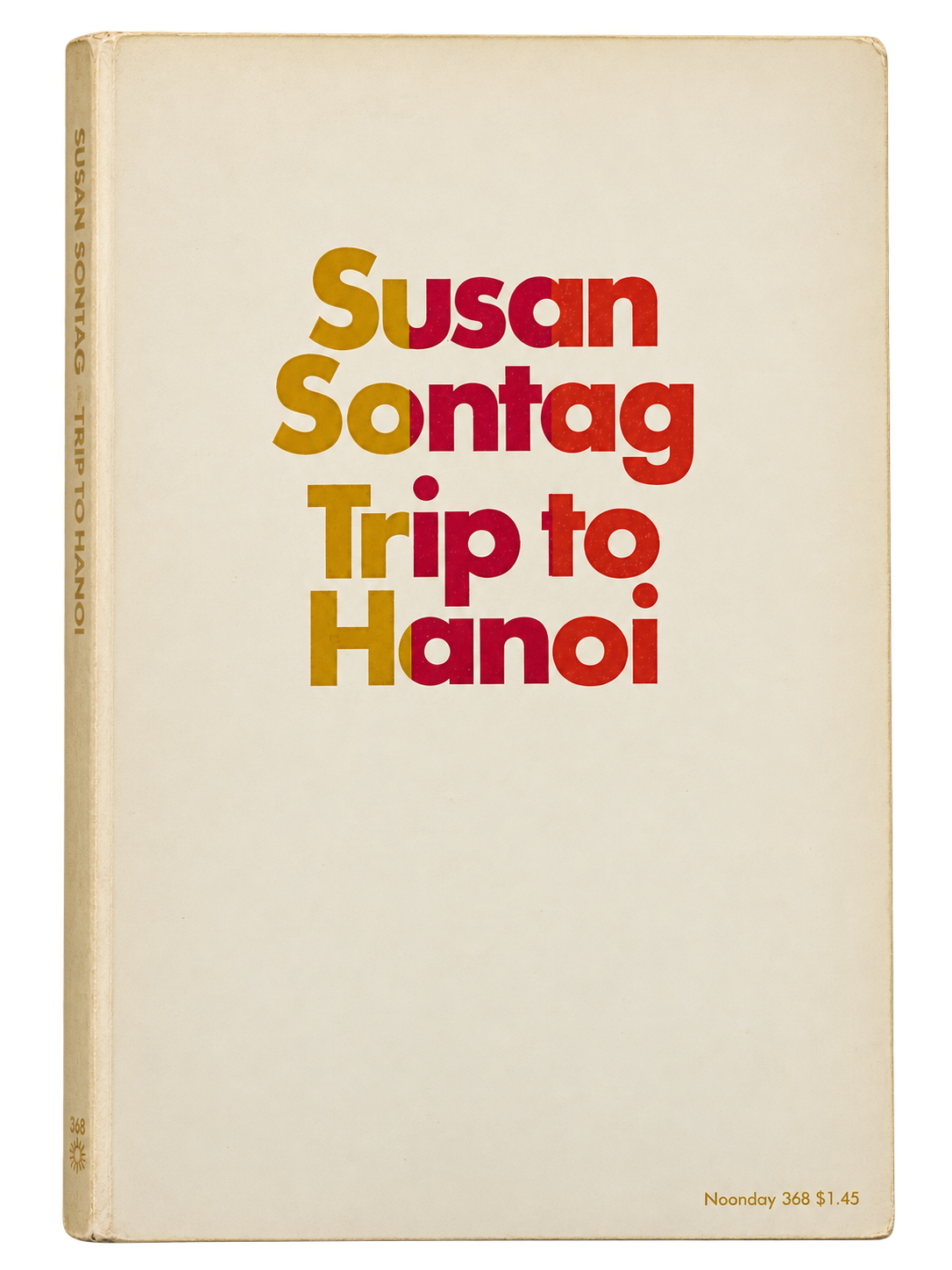
Susan Sontag
The Noonday Press / Farrar, Straus and Giroux · New York · 1968
First Edition · First Printing
The Book:
The First Edition · First Printing of Susan Sontag’s Trip to Hanoi, her account of a May 1968 visit to North Vietnam while the United States was actively at war with the country. Rather than straightforward reportage, Sontag turned the journey into an intellectual diary, examining both North Vietnamese society and the assumptions she carried with her as an American antiwar intellectual. The essay first appeared in Esquire in December 1968 before publication as this standalone Noonday Press volume. 91 pp. Original cream printed wrappers, Noonday designation N368, and original $1.45 price retained. Cover designed by Lawrence Ratzkin.
Condition:
Near Fine+. An exceptionally fresh copy in the original printed wrappers, with crisp edges, sharp corners, a straight spine, and tight binding. Interior remains remarkably clean and bright. Mild uniform age toning and negligible handling wear are the principal defects. No ownership inscriptions, institutional markings, restoration, or other significant faults observed.
Story Of The Book
Susan Sontag went to North Vietnam already convinced that America’s war was wrong. What she found there forced her to confront how little political conviction alone had prepared her to understand the people living beneath the bombs.
Invited to Hanoi in May 1968, Sontag entered a country most Americans knew through military briefings, casualty reports, propaganda, and images of destruction. She could easily have returned with a simple antiwar tract. Instead, Trip to Hanoi records something messier.
Sontag was sympathetic to North Vietnam, but she also wrote candidly about her discomfort, cultural prejudices, misunderstandings, and difficulty making sense of a society radically different from her own. She resisted turning the Vietnamese into either communist villains or flawless revolutionary heroes.
That uncertainty is what gives the book its power.
Sontag traveled to the country her own government was bombing—and discovered that opposing a war was easier than understanding the people living inside it.
Why It’s In The Collection
Trip to Hanoi belongs in Consigned to Darkness because dissent is strongest when it is willing to question itself.
Sontag opposed American intervention in Vietnam, but this book is not valuable simply because she took the antiwar side. Its importance lies in her willingness to travel into a country her own government was bombing and then scrutinize both American power and her own ideological assumptions.
The timing matters enormously. This was not retrospective moral clarity. The bombs were still falling, the war was still being fought, and Americans were still arguing over what Vietnam meant. This first printing preserves that uncertainty as it happened.
Sontag went looking for evidence against the war. She came back with an argument against certainty.
Collection Categories: Publication-Event Object · Political Dissent · War & Conflict · Political History · Anti-Authoritarianism · Witness Literature · Free Expression · Literature
———
Authentication Evidence
Title page identifies the work as Trip to Hanoi by Susan Sontag.
Title page identifies Farrar, Straus and Giroux · New York as publisher.
Copyright page states “Copyright © 1968 by Susan Sontag.”
Copyright page explicitly states “First printing, 1968,” directly confirming first-printing status.
Copyright page records Library of Congress Catalog Card Number 69-15403.
Copyright page states that the volume was published simultaneously in Canada by Doubleday Canada Ltd., Toronto.
Copyright page states “Printed in the United States of America.”
Copyright page credits Kay Rexrode with the book design.
Original Noonday Press wrappers remain present.
Wrappers retain Noonday series designation N368.
Original $1.45 publisher’s price remains present.
Front wrapper retains the original mustard-yellow and magenta typographic design.
Rear wrapper credits Lawrence Ratzkin with the cover design.
Rear wrapper identifies The Noonday Press, 19 Union Square West, New York, New York 10003.
Physical collation comprises 91 numbered pages, consistent with bibliographic records for the original Noonday edition.
Contemporary and specialist bibliographic sources identify the Noonday/Farrar, Straus and Giroux publication as the original edition.
Independent specialist cataloging records the New York Noonday Press issue as 1968, First Printing, corroborating the publication statement in this copy.
Some later bibliographic databases assign the Noonday edition a 1969 publication date, but the book itself explicitly states “First printing, 1968,” and independent records corroborate a 1968 first edition.
The essay first appeared in Esquire in December 1968.
No later-printing statement, facsimile designation, replacement wrappers, or rebinding is observed.
Observable physical and bibliographic evidence supports identification as the 1968 First Edition · First Printing.
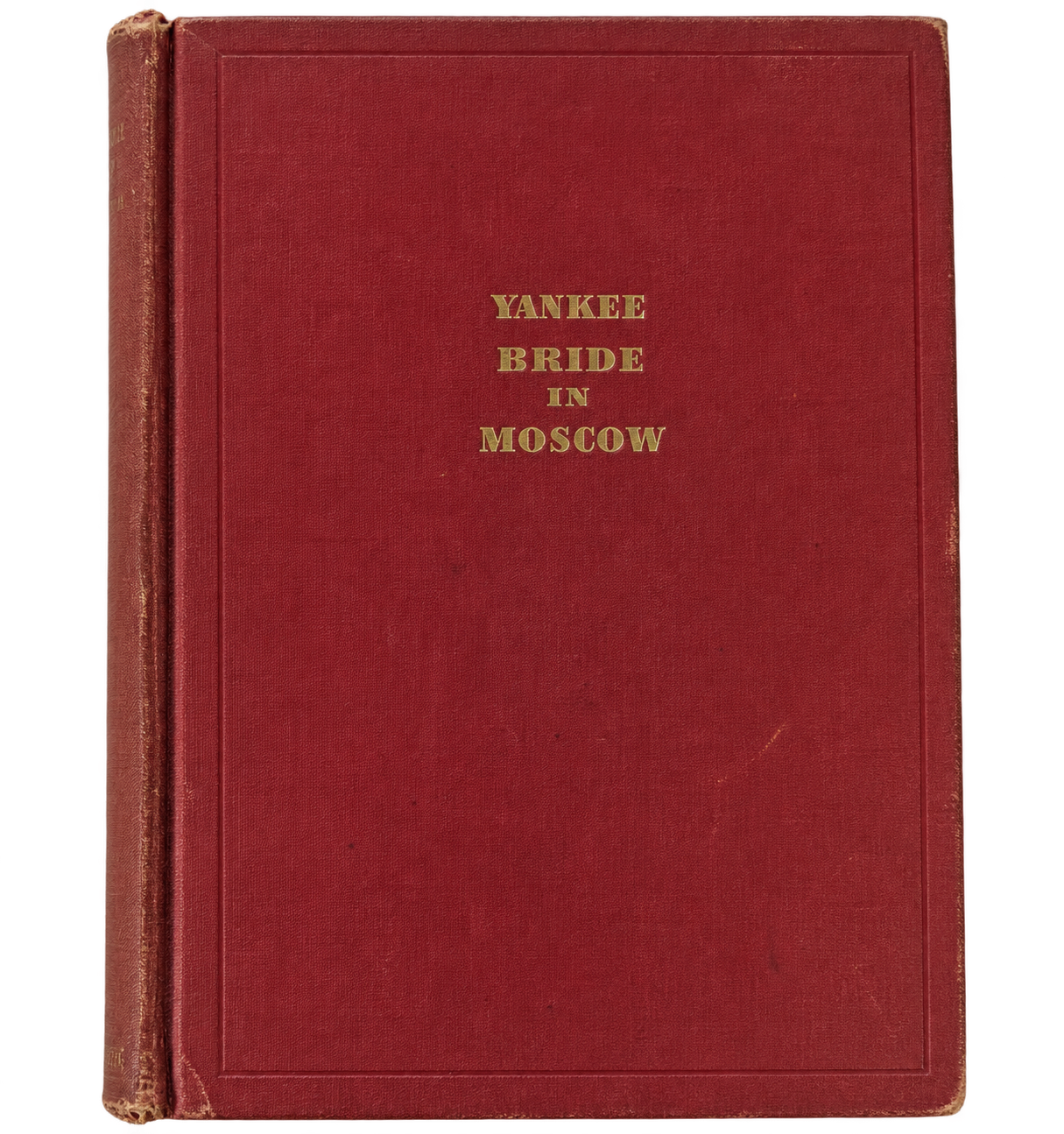
Elizabeth Hampel
Liveright Publishing Corporation · New York · 1941
First Edition · First Printing · Signed Presentation Copy
The Book:
The First Edition · First Printing of Elizabeth Hampel’s Yankee Bride in Moscow, her firsthand account of life in Stalin-era Moscow while her husband served on the staff of the American Embassy. Developed from the diary Hampel kept during her time in the Soviet capital, the book became a contemporary bestseller and offered American readers an unusually immediate civilian view of everyday life under Stalin. This copy is especially distinguished as a signed presentation copy, inscribed by Hampel to “Miriam” and signed “Elizabeth ‘Liz’ Hampel.” In the inscription, Hampel explicitly describes the book as an account of “our experiences in Russia,” directly linking this physical copy to the lived events behind the text. 319 pp. Original red publisher’s cloth with gilt lettering retained.
Condition:
Very Good. Original red publisher’s cloth remains sound, with moderate rubbing and handling wear, localized fraying and small cloth losses at the spine ends, light corner wear, and fading and dulling to the spine. Scattered spotting and previous-owner markings appear on the endpapers, but the interior remains otherwise clean and structurally sound. The signed presentation inscription remains clear and legible on the front free endpaper. No evidence of rebinding or restoration observed. No dust jacket present.
Story Of The Book
Before the Cold War had a name, Elizabeth Hampel went to Stalin’s Moscow and wrote down what she saw.
Living in the Soviet capital while her husband served on the staff of the American Embassy, Hampel kept a diary of daily life around her—social customs, shortages, bureaucracy, political atmosphere, and the ordinary experience of living inside one of the world’s most tightly controlled states.
Published in 1941, Yankee Bride in Moscow carried those observations to a substantial American readership. Its significance lies in its perspective: this is not a political treatise or a retrospective history of Stalinism. It is the record of an American civilian encountering the Soviet system at ground level.
That makes this particular copy unusually intimate. Hampel did not merely sign it. In her presentation inscription to “Miriam,” she explicitly describes the book as an account of “our experiences in Russia.”
The inscription collapses the distance between witness and object. The woman who lived the experience, wrote the book, and published the account then personally identified this copy as a record of that experience.
The politics are large. The perspective—and this copy’s connection to it—is deeply personal.
Why It’s In The Collection
Yankee Bride in Moscow belongs in Consigned to Darkness because authoritarian systems are often most revealing when seen not through ideology, but through ordinary life.
Hampel was not writing as a Soviet dissident, philosopher, or later historian. She was an American woman living inside Stalin’s Moscow and recording what that experience looked and felt like from day to day.
That makes the book an important counterweight to the collection’s more explicitly political anti-totalitarian works. It shows how power appears in daily life: through bureaucracy, scarcity, social behavior, surveillance, restriction, and the small accommodations people make inside controlled societies.
But this copy carries an additional layer of significance. It does not merely preserve Hampel’s testimony; it preserves Hampel herself identifying the book as the record of what she and her husband experienced in Russia.
That makes the inscription more than autograph value. It reinforces the book’s function as witness.
History explains the system. Hampel shows what it felt like to live inside it—and this copy carries her own hand saying so.
Collection Categories: Witness Literature · Memoir & Testimony · Anti-Authoritarianism · Anti-Totalitarianism · Political History · Cold War · Women’s History & Feminism · Signed
———
Authentication Evidence
Title page identifies the work as Yankee Bride in Moscow by Elizabeth Hampel.
Title page names Liveright Publishing Corporation · New York as publisher.
Copyright page states “Copyright, 1941, by Liveright Publishing Corporation.”
Copyright page contains no subsequent-printing statement, impression notice, or later publication date.
Documented Liveright publishing practice for this period generally omitted a first-edition statement while identifying subsequent printings; the absence of a later-printing designation therefore supports First Printing identification.
Original publisher’s red cloth binding remains present.
Binding retains gilt title to the front board and gilt title, author name, and Liveright device to the spine.
Numbered text terminates normally on page 319.
No physical evidence of missing terminal text leaves or removed gatherings is observed.
Front free endpaper bears a personal presentation inscription addressed to “Miriam.”
Inscription is signed “Elizabeth ‘Liz’ Hampel.”
Hampel’s inscription explicitly refers to “our experiences in Russia,” directly connecting the presentation copy to the experiences documented in the book.
The inscription is therefore content-relevant presentation provenance, not merely a detached autograph.
Previous ownership includes a printed address label for Mrs. George M. Raeber, Jr., King of Prussia, Pennsylvania, together with later pencil notations.
No documented chain presently connects Miriam to Mrs. Raeber.
No evidence of book-club manufacture, later rebinding, facsimile components, or later publisher issue is observed.
Observable physical and bibliographic evidence supports identification as the 1941 First Edition · First Printing · Signed Presentation Copy.

Graham Greene
Amsterdam en Antwerpen: Uitgeverij Contact, 1959
First Dutch Edition · First Printing
The Book:
The first Dutch edition, first printing of Graham Greene’s Our Man in Havana, published in Dutch as Onze Man in Havana only one year after the original English edition. Translated by H. W. J. Schaap, the volume retains its original mustard-yellow publisher’s cloth with blue spine lettering and front-board decoration, as well as its original pictorial dust jacket with the printed price of f 6.90. The publication page records the original English title and the 1959 Contact translation copyright, confirming this as the novel’s first Dutch appearance.
Condition:
Near Fine in a Very Good dust jacket. The book itself is exceptionally well preserved, with a square, tight binding, bright cloth, and a remarkably clean interior apart from a previous-owner signature on the front free endpaper. The original jacket retains strong front-panel artwork but shows substantial spine fading, moderate edge wear, several small chips and short tears, a triangular loss at the upper edge of the rear panel, and an old tape repair along the lower rear edge. It is protected in an archival polyester jacket.
Story Of The Book
The most dangerous spy in Graham Greene’s Havana never existed.
Jim Wormold sells vacuum cleaners in pre-revolutionary Cuba. He is not an intelligence officer. He has no secret network and no important information to provide.
Then British intelligence recruits him.
Needing the money but lacking actual sources, Wormold begins inventing them. He fabricates agents, manufactures reports, and sends London increasingly elaborate intelligence—including drawings inspired by vacuum-cleaner parts that are interpreted as evidence of sinister military installations.
The absurdity is funny because the institution takes it seriously.
That is Greene’s real target.
Our Man in Havana is not primarily a satire of one incompetent spy. It is a satire of organizations supposedly devoted to discovering truth that become more interested in information that confirms what they already expect to find. Wormold’s inventions succeed because the bureaucracy receiving them wants them to be true.
And once an institution has invested its credibility in a fiction, correcting the fiction becomes more threatening than believing it.
Greene knew something about that world. His own experience in British intelligence gave the novel’s comedy a sharper edge: behind the jokes is a warning about secrecy, bureaucracy, incentives, and the enormous political consequences that can follow when governments mistake plausible stories for verified facts. The inventory identifies precisely this critique of intelligence culture, fabricated information, and institutional self-deception as the book’s central relevance to the collection.
The timing of this edition adds another remarkable layer. Onze Man in Havana appeared in 1959, just a year after Greene’s original novel—and at the very moment the Cuban Revolution was transforming the actual Havana in which his fictional intelligence farce had been set.
Wormold invents intelligence because he has nothing real to report. The frightening part is how eagerly power turns his inventions into reality.
Why It’s In The Collection
Onze Man in Havana belongs in Consigned to Darkness because governments do not need to deliberately lie in order to become dangerous.
Sometimes they only need systems that reward certainty more than doubt.
Greene’s intelligence officers are not conventional tyrants. Their failure is institutional. Information rises through a bureaucracy, acquires authority because official people repeat it, and eventually becomes difficult to challenge precisely because the institution has already acted as though it were true.
That makes the novel an unusually useful examination of the relationship between truth and government power.
Many books in the collection ask what happens when authorities conceal the truth. Greene asks something different: what happens when an institution becomes so confident in its own processes that it can no longer reliably distinguish truth from the fiction those processes have produced?
This Dutch first edition is a supporting rather than definitive bibliographical copy—the English first edition remains the collection’s long-term upgrade target. But it is a genuine first edition in its own national publication history, retaining its original priced jacket and preserving the novel’s introduction to Dutch readers only one year after its first appearance.
And because it appeared in 1959, this particular edition carries Greene’s fictional Havana into an especially striking historical moment: a Cold War satire about governments misunderstanding Cuba reaching new readers just as Cuba itself was becoming one of the central geopolitical problems governments would struggle to understand.
Greene’s joke is that the intelligence is fake. His warning is that once an institution believes it, the consequences become real.
Collection Categories: Publication-Event Object · Literature · Political History · Anti-Authoritarianism · War & Conflict · Cold War · Institutional Power · Espionage & Intelligence
———
Authentication Evidence
• Correct Dutch title page reading Onze Man in Havana by Graham Greene.
• Title page identifies Uitgeverij Contact, Amsterdam en Antwerpen, consistent with the original Dutch publication.
• Verso states the original English title, Our Man in Havana (1958), identifying this as the authorized Dutch translation.
• Copyright page records Translation Copyright 1959 by Contact, Amsterdam, establishing the first Dutch publication year.
• Translation credited to H. W. J. Schaap, consistent with the original Dutch edition.
• Original publisher's cloth binding with the correct blue stamped spine lettering and front-board decoration remains present.
• Original publisher's pictorial dust jacket survives.
• Dust jacket retains the printed publisher's price Geb. / 6.90, indicating an original priced jacket rather than a later replacement.
• Jacket typography, artwork, and publisher imprint are consistent throughout.
• No book-club indicators, later edition statements, or evidence of modern rebinding or restoration are observed.
• All observable bibliographic characteristics are consistent with the first Dutch edition, first printing.
The CIA and the Cult of Intelligence
Victor Marchetti & John D. Marks
Alfred A. Knopf, Inc. · New York · 1974
First Edition · First Printing
The CIA was willing to go to extraordinary lengths to keep its secrets. Victor Marchetti was willing to go to extraordinary lengths to expose them.
A former senior CIA officer, Marchetti knew what happened behind the walls of America's most powerful intelligence agency. He also knew how much of it the American public was never supposed to see. When he decided to reveal that hidden world, the CIA fought back — taking him to court, demanding the removal of classified material, and attempting to control what Americans could read about their own government.
The result was The CIA and the Cult of Intelligence, a book unlike almost any other. Published in 1974 with passages literally blacked out by government order, it became an extraordinary artifact of censorship: a book whose missing words revealed just how far the government was willing to go to protect its secrets.
This first edition preserves one of the most remarkable confrontations between government secrecy and freedom of expression in American history. Its censored pages confront readers with a disturbing question: How can citizens hold their government accountable for things they're not allowed to know?
The CIA wanted to decide what Americans could read. This book made that power visible.
The Book of Laughter and Forgetting
Milan Kundera
Translated from the Czech by Michael Henry Heim
New York: Alfred A. Knopf, 1980
First American Edition · First Printing