
 Image 1 of 1
Tinker, Tailor, Soldier, Spy — John le Carré
John le Carré
New York: Alfred A. Knopf, 1974
First American Edition · First Printing
The Book:
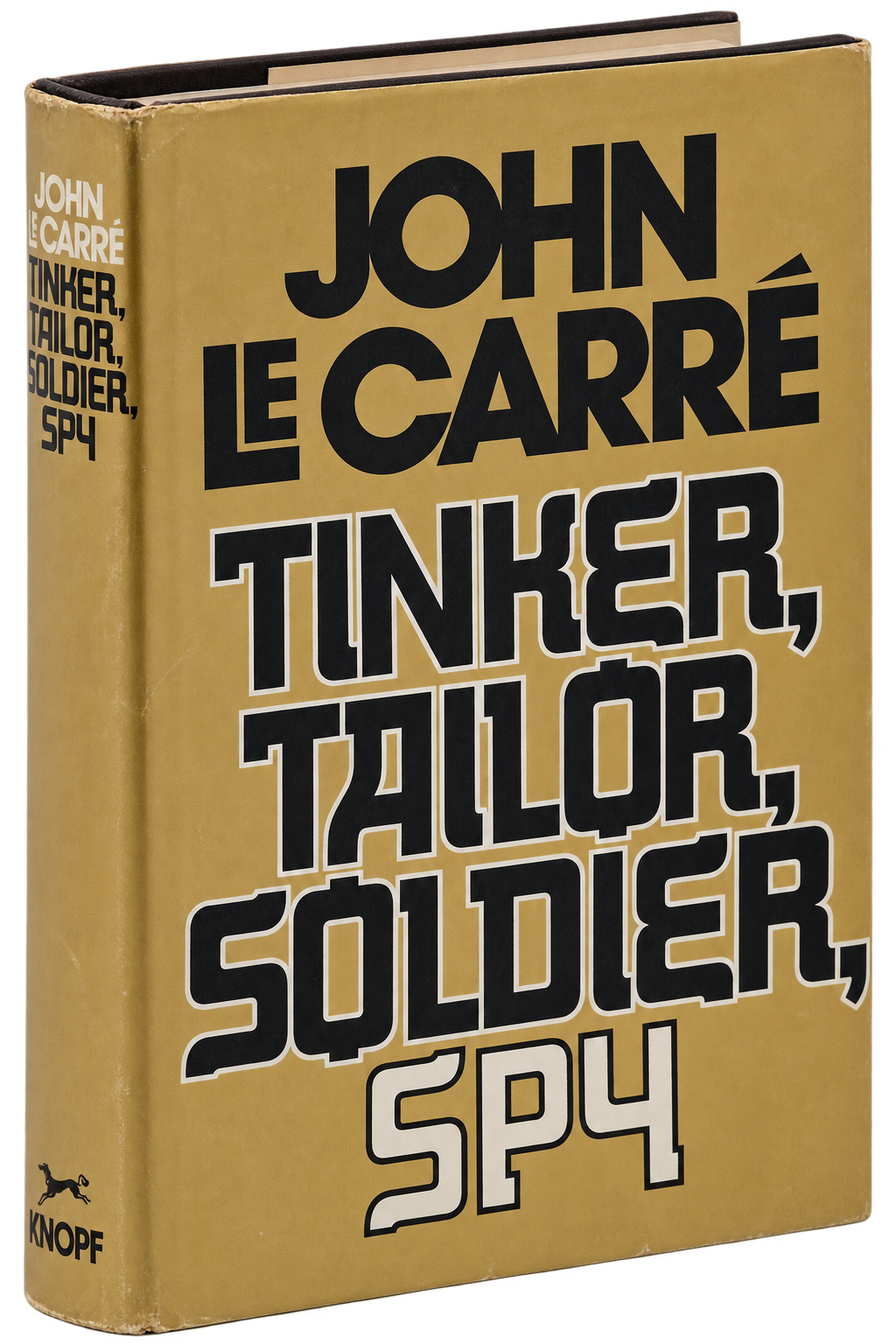
The first American edition, first printing of John le Carré’s Tinker, Tailor, Soldier, Spy, published by Alfred A. Knopf in 1974. The copyright page explicitly states “FIRST EDITION,” with no subsequent-printing statement, consistent with Knopf’s first-printing practice of the period. This copy retains its original black publisher’s cloth, gilt spine lettering, blind-stamped front-board titling, and original dust jacket. A contemporary blue “RECEIVED MAY 16 1974” stamp appears on the front free endpaper—an intriguing trace of the copy entering an institutional or business environment shortly after publication.
Condition:
Very Good+ in a Very Good dust jacket. The book remains square and structurally sound, with bright cloth, clean interior, and only light external handling wear. The principal deductions are the contemporary blue “RECEIVED MAY 16 1974” stamp and localized red transfer near the front endpaper. The original jacket remains substantially complete but exhibits moderate tanning, rubbing, scattered surface scratches, edge creasing, several short closed tears, and small chips concentrated at the spine ends and corners. The front-flap price has not been confirmed.
Story Of The Book
The greatest spy in modern fiction wasn’t hunting foreign agents. He was hunting betrayal inside his own side.
By the time John le Carré published Tinker, Tailor, Soldier, Spy in 1974, the mythology of espionage had already been badly damaged by reality. Britain had discovered that men entrusted with its deepest secrets—including members of the Cambridge spy ring—had spent years passing information to the Soviet Union. Among them was Kim Philby, a senior intelligence officer who had operated at the heart of the British establishment before defecting to Moscow in 1963.
Le Carré, himself a former British intelligence officer, transformed that atmosphere of betrayal into fiction.
The novel brings George Smiley out of retirement to investigate an almost unbearable possibility: a Soviet mole has penetrated the highest levels of the British intelligence service. The enemy is therefore not waiting beyond the Iron Curtain. He is sitting inside the institution charged with protecting the country from him.
What follows bears little resemblance to the glamorous espionage mythology of secret weapons, exotic locations, and heroic agents. Smiley works through files, memories, bureaucratic rivalries, old relationships, fragments of testimony, and carefully concealed institutional failures. Intelligence becomes less a world of adventure than a system for controlling information—and therefore controlling who is allowed to know the truth.
That makes the novel’s central betrayal larger than the identity of the mole. Le Carré asks what happens when institutions built upon secrecy become incapable of recognizing corruption within themselves. Loyalty becomes difficult to distinguish from obedience. Professional discretion becomes a mechanism for concealing failure. And the institution’s instinct for self-preservation can become almost as powerful as its desire to discover the truth.
Published as the opening volume of what became the Karla Trilogy, Tinker, Tailor, Soldier, Spy helped permanently transform espionage fiction. Le Carré replaced the fantasy of intelligence work with something darker: bureaucracy, compromised loyalties, institutional secrecy, moral ambiguity, and the possibility that those entrusted with defending a system may also be the people most capable of betraying it.
The most dangerous secret in Tinker, Tailor, Soldier, Spy is not what the enemy knows. It is what an institution refuses to see about itself.
Why It’s In The Collection
Tinker, Tailor, Soldier, Spy approaches power differently from most objects in Consigned to Darkness.
There is no banned book, political prisoner, obscenity prosecution, or public manifesto at its center. Instead, le Carré examines one of the least visible forms of governmental authority: the secret state.
Intelligence institutions necessarily operate beyond ordinary public scrutiny. They classify information, conceal operations, recruit informants, manipulate identities, and decide which truths can be known even by other parts of government. Le Carré understood that world personally, and his fiction strips away its heroic mythology to examine what secrecy does to the people and institutions entrusted with wielding it.
That makes this novel particularly relevant to the collection’s interest in institutional power. Smiley’s investigation is ultimately an attempt to recover truth from a system structurally designed to conceal information. The same machinery created to protect national secrets has also allowed betrayal to hide inside it.
The novel is not conventionally anti-government, nor does it argue that intelligence institutions should not exist. Its contribution is subtler and, for this collection, more interesting: institutions exercising extraordinary power in secret remain vulnerable to corruption, self-deception, ideological capture, and the instinct to protect themselves.
This 1974 first American edition preserves the American arrival of the novel that made that argument one of the defining stories of Cold War literature and permanently altered the popular understanding of espionage.
It belongs here because authoritarian power is not always exercised publicly. Sometimes the most consequential decisions are made precisely where the public cannot see them.
Secrecy may be necessary to intelligence. Le Carré’s warning was that secrecy can also protect the institution from the truth.
Collection Categories: Literature · Intelligence & Espionage · Political History · Anti-Authoritarianism · Cold War · Institutional Power
———
Authentication Evidence
• The title page identifies the work as Tinker, Tailor, Soldier, Spy by John le Carré, establishing the title and stated authorship of this copy.
• The title page bears the Alfred A. Knopf imprint with the 1974 publication date, establishing the first American publication.
• The copyright page explicitly states "FIRST EDITION," directly establishing first-edition status under Alfred A. Knopf's publishing practice for this period.
• The copyright page records copyright ©1974 by le Carré Productions and publication by Alfred A. Knopf, Inc., New York, consistent with the documented first American edition.
• The Borzoi colophon and publisher's imprint are present and internally consistent throughout the volume.
• Original black publisher's cloth with gilt spine lettering and blind-stamped front-board titling is present and consistent with the first American issue.
• The original dust jacket accompanies the volume and matches the known first American jacket design in typography, layout, author photograph, and flap text.
• No later-printing statement, book-club designation, facsimile characteristics, rebinding, or replacement binding components are visible in the supplied photographs.
• Edition identification: The explicit "FIRST EDITION" statement on the copyright page establishes this copy as the first American edition.
• Printing identification: Knopf identified first printings of this period through the explicit "FIRST EDITION" statement rather than later number-line conventions. No subsequent-printing statement or other indication of a later impression is present, supporting first-printing status.