
 Image 1 of 1
The Book of Laughter and Forgetting — Milan Kundera
Milan Kundera
Translated from the Czech by Michael Henry Heim
New York: Alfred A. Knopf, 1980
First American Edition · First Printing
The Book:
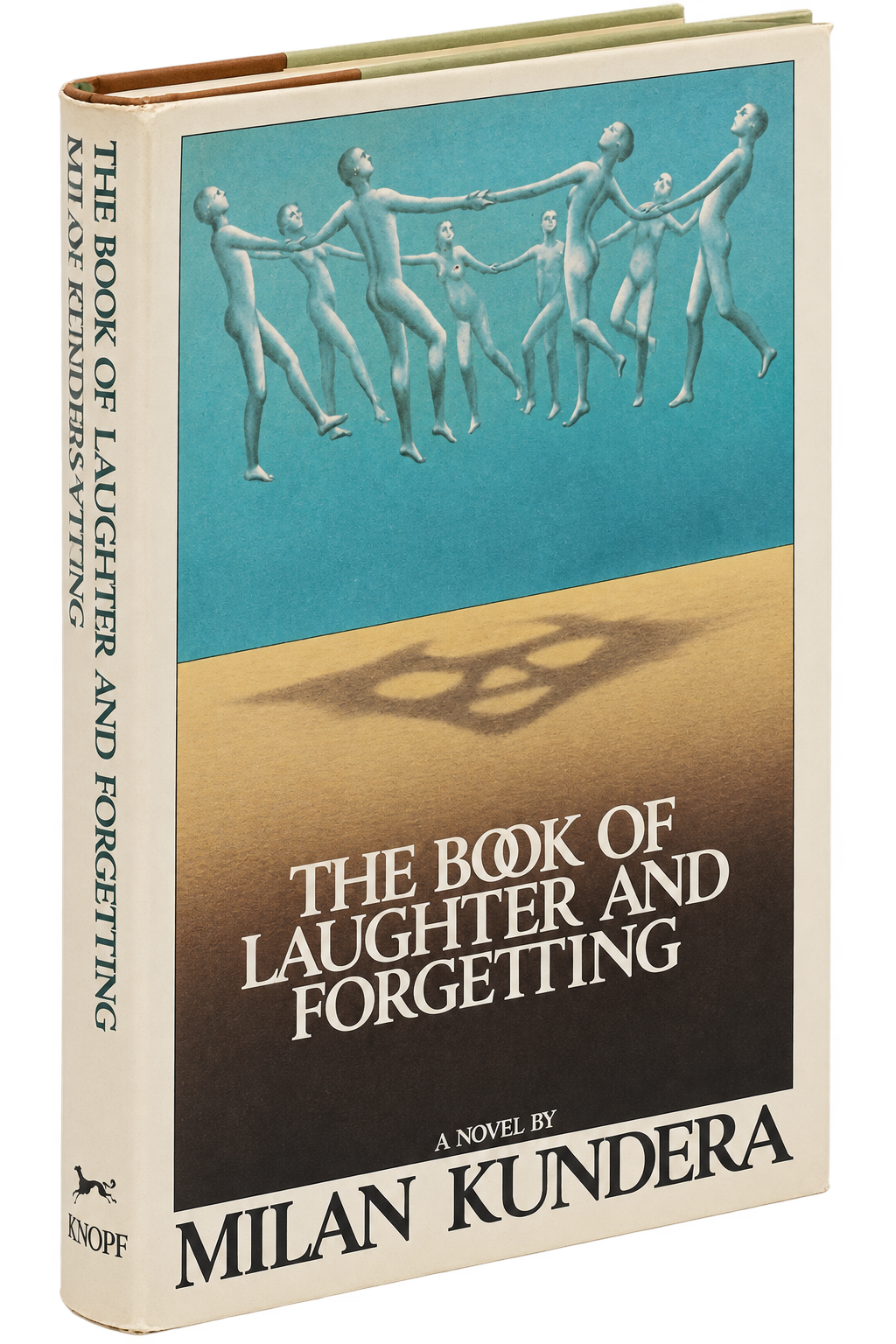
The true first American edition, first printing of Milan Kundera’s The Book of Laughter and Forgetting, published by Alfred A. Knopf in 1980. The copyright page explicitly states “FIRST AMERICAN EDITION” and contains no subsequent-printing notice, consistent with Knopf’s first-printing practice for the period. The book retains its original pale blue paper-covered boards over brown cloth, with gilt decoration and lettering, and its original Fred Marcellino pictorial dust jacket. The volume collates to 228 pages. The front-flap price cannot be confirmed from the available photographs.
Condition:
Very Good in a Very Good dust jacket. The binding remains square and structurally sound with clean interior pages. The boards show moderate fading and the spine gilt noticeable rubbing. The original jacket exhibits moderate age toning, light rubbing, scattered surface scratches, several short closed tears, and small chips at the extremities, with no major loss affecting the principal design.
Story Of The Book
A government can erase a man from a photograph. Milan Kundera understood that the harder task was keeping him erased from memory.
Kundera wrote The Book of Laughter and Forgetting in exile after his writings had been suppressed in Czechoslovakia, removed from public libraries, and barred from domestic publication. By then he was living in France, and the Czechoslovak government had stripped him of his citizenship. The novel first appeared in French in 1979 before reaching American readers through this Knopf edition the following year.
Across seven connected sections, Kundera moves between exile, sexuality, loss, laughter, private memory, and political history. But running through them is a distinctly authoritarian problem: who controls what a society is allowed to remember? The novel’s famous image of a Communist official disappearing from an altered photograph transforms historical revisionism into something immediately comprehensible. Totalitarian power does not merely punish an opponent in the present. It can attempt to rewrite the past until the opponent appears never to have existed at all.
That idea makes forgetting political. Memory becomes a form of resistance because remembering people, events, betrayals, and inconvenient truths denies authority complete control over history. Kundera’s achievement was to connect that enormous political struggle to the fragility of individual memory: governments forget deliberately, while human beings forget naturally, and somewhere between the two lies the possibility that truth can disappear.
This first American edition carried that argument into the United States at precisely the moment Kundera was becoming one of the defining émigré literary voices of postwar Europe. The physical object therefore represents the American transmission of a work that could not legally circulate in the country whose political history it confronted.
Totalitarian power depends upon controlling what a society remembers. Kundera’s answer was to make forgetting impossible.
Why It’s In The Collection
The Book of Laughter and Forgetting belongs in Consigned to Darkness because it identifies a form of authoritarian power that extends beyond censorship: the power to manipulate collective memory itself.
Censorship tries to prevent people from encountering an idea. Historical revisionism goes further. It attempts to alter the record from which people understand what happened at all. A disappeared photograph, an erased dissident, a rewritten political history—these are attempts not merely to defeat opposition but to deprive future generations of the evidence that opposition ever existed.
Kundera had experienced that machinery personally. His books had been suppressed in Czechoslovakia, and he wrote the novel from exile. This 1980 first American edition is therefore especially meaningful to the collection: it carried the work of a suppressed émigré writer into another country while the political system he was criticizing still governed his homeland.
The book also occupies an important position within the collection’s Kundera holdings. The Joke documents both political persecution and the later restoration of a text compromised in its earlier American publication. The Unbearable Lightness of Being explores authoritarian power invading private life. The Book of Laughter and Forgetting supplies the third dimension: power over memory—the attempt to determine not simply what people may say or do, but what society will be permitted to remember.
That makes the first American edition a particularly strong publication-event object. It is not simply a later edition of an important anti-totalitarian novel. It is part of the international route by which writing suppressed at home escaped the jurisdiction of the state that wanted it silenced.
A regime can remove a writer from its libraries. It becomes much harder to remove him from history once his books have crossed the border.
Collection Categories: Anti-Totalitarianism · Political Dissent · Anti-Authoritarianism · Exile & Émigré Literature · Political History · Literature · Publication-Event Object · Censorship
———
Authentication Evidence
• The title page identifies the work as The Book of Laughter and Forgetting by Milan Kundera and states that it was translated from the Czech by Michael Henry Heim.
• The title page bears the Alfred A. Knopf imprint, New York, and the date 1980, establishing the American publisher, place, and year of publication.
• The copyright page explicitly states FIRST AMERICAN EDITION, directly establishing the edition represented by this copy.
• The copyright page records the original Czech title as Kniha smíchu a zapomnění, copyright ©1978 by Milan Kundera, French publication by Éditions Gallimard, and English translation copyright ©1979 by Éditions Gallimard.
• The copyright page gives ISBN 0-394-50896-3, matching institutional and dealer records for the 1980 Knopf first American edition.
• The photographed volume contains the documented publisher’s binding of pale blue paper-covered boards over brown cloth, with gilt decoration and lettering. Independent specialist descriptions identify the same construction for the first American edition.
• The original Fred Marcellino pictorial jacket is present and corresponds in design, typography, author photograph, and flap text to documented first American copies.
• The photographed copyright page contains no later-printing statement, reprint designation, book-club notice, or subsequent-edition language.
• The book’s 228-page collation agrees with institutional and specialist records for the edition.
• No evidence of rebinding, facsimile production, replacement title or copyright leaves, or a modern reproduction is visible.
• The explicit FIRST AMERICAN EDITION statement establishes the edition. Under Knopf’s publishing practice for this period, that statement in the absence of any subsequent-printing notice supports first-printing status.