
 Image 1 of 1
The Jews of Silence — Elie Wiesel
Full Title: The Jews of Silence: A Personal Report on Soviet Jewry
Elie Wiesel
Translated from the Hebrew with an Historical Afterword by Neal Kozodoy
Holt, Rinehart and Winston · New York · 1966
First American Edition · First Printing
The Book:
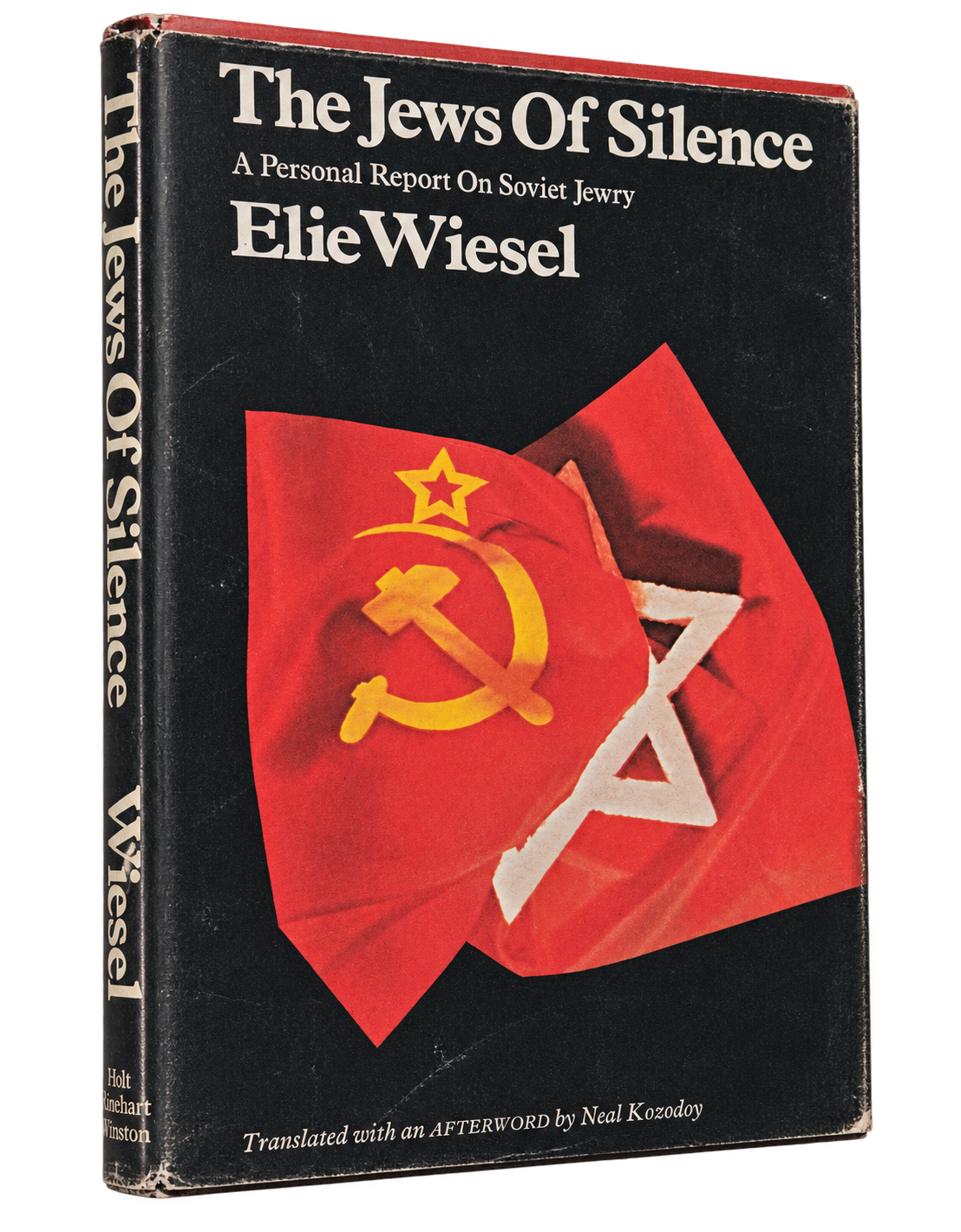
The First American Edition · First Printing of Elie Wiesel’s The Jews of Silence, his firsthand account of a 1965 journey through the Soviet Union to investigate Jewish life under Communist rule. Sent to the USSR by the Israeli newspaper Haaretz, Wiesel subsequently wrote his account in Hebrew as a series of articles for Yedioth Ahronoth. Translated by Neal Kozodoy, with his historical afterword on Soviet Jewry. Octavo; viii, 143 pp. This copy retains its original publisher’s binding and original unclipped $4.95 dust jacket.
Condition:
Near Fine+ book in a Near Fine original dust jacket. Original red patterned boards with black spine and gilt Star of David device remain exceptionally well preserved. Binding is square and sound with bright, clean pages, sharp corners, and no ownership markings, foxing, restoration, or structural defects observed. The original jacket remains unclipped at $4.95, showing only light rubbing, mild age toning, and trivial edge wear.
Story Of The Book
Elie Wiesel went to the Soviet Union expecting to encounter Jews reduced to silence. What he found forced him to turn the accusation somewhere else.
Sent into the USSR in 1965 to report on Jewish life behind the Iron Curtain, Wiesel traveled through Soviet cities seeking people beyond those officially presented to foreign visitors. He encountered communities subjected to discrimination, restrictions on religious and cultural life, isolation from Jews abroad, and the constant presence of state surveillance.
But he did not find a people spiritually extinguished.
Wiesel encountered Jews who continued to gather, celebrate religious holidays, seek knowledge of Jewish life abroad, and preserve an identity the Soviet system had spent decades trying to weaken. Their persistence changed the meaning of his journey. The people whose freedom had been constrained were still finding ways to remember who they were.
The accusation therefore turned outward. Wiesel concluded the book with its devastating reversal: “What torments me most is not the Jews of silence I met in Russia, but the silence of the Jews I live among today.”
The title’s deepest meaning is there. The silence Wiesel feared most was not the silence imposed by dictatorship. It was the silence chosen by people who were free.
Why It’s In The Collection
The Jews of Silence belongs in Consigned to Darkness because witness becomes an act of dissent when it carries voices across a boundary designed to contain them—and then demands something from the people on the other side.
Wiesel entered a closed society, sought out ordinary Soviet Jews, listened to them, and carried what he encountered back to an international audience. But he refused to reduce those people to passive victims. Their persistence—the survival of identity under pressure—is itself part of his testimony.
The sharper indictment falls on the outside world. Wiesel had already devoted his life to confronting the consequences of indifference to persecution. Here, he applied that moral urgency while another struggle was still unfolding.
Published in 1966, this first printing preserves that intervention before Soviet Jewry became one of the defining international human-rights causes of the Cold War.
The Soviet state tried to silence its Jews. Wiesel’s harder question was what excuse remained for everyone who could still speak.
Collection Categories: Witness Literature · Human Rights · Religious Conscience · Free Expression · Political Dissent · Anti-Authoritarianism · Anti-Totalitarianism · Cold War · Publication-Event Object
———
Authentication Evidence
Title page identifies the work as The Jews of Silence: A Personal Report on Soviet Jewry by Elie Wiesel.
Title page credits Neal Kozodoy with the translation from the Hebrew and historical afterword.
Publisher is correctly identified as Holt, Rinehart and Winston · New York, Chicago, San Francisco.
Copyright page carries the original 1966 English translation copyright.
Copyright page explicitly states “First Edition,” directly establishing first-edition status.
No subsequent-printing statement appears; Holt, Rinehart and Winston’s first-edition identification and absence of later-printing notation support first-printing status.
Institutional and specialist bibliographic records identify the 1966 Holt, Rinehart and Winston issue as the First American Edition.
Volume collates to viii, 143 pages, octavo, consistent with institutional and specialist descriptions of the first edition.
Original publisher’s red patterned boards with black spine and gilt Star of David device remain present and are consistent with the first issue.
Original dust jacket remains present.
Original dust jacket is unclipped and retains the $4.95 publisher’s price, consistent with documented first-edition jackets.
Publisher imprint, typography, binding, and jacket configuration are internally consistent with documented 1966 first-edition copies.
No evidence of book-club manufacture, ex-library ownership, remainder marking, rebinding, facsimile dust jacket, or replacement components is observed.
Observable physical and bibliographic evidence supports identification as the 1966 First American Edition · First Printing.