
 Image 1 of 1
The Gulag Archipelago (Vol. III–IV) — Aleksandr Solzhenitsyn
Full Title: The Gulag Archipelago, 1918–1956: An Experiment in Literary Investigation (Volumes III–IV)
Aleksandr Solzhenitsyn
Translated from the Russian by Thomas P. Whitney
Harper & Row, Publishers · New York · 1975
First American Edition · First Printing
The Book:
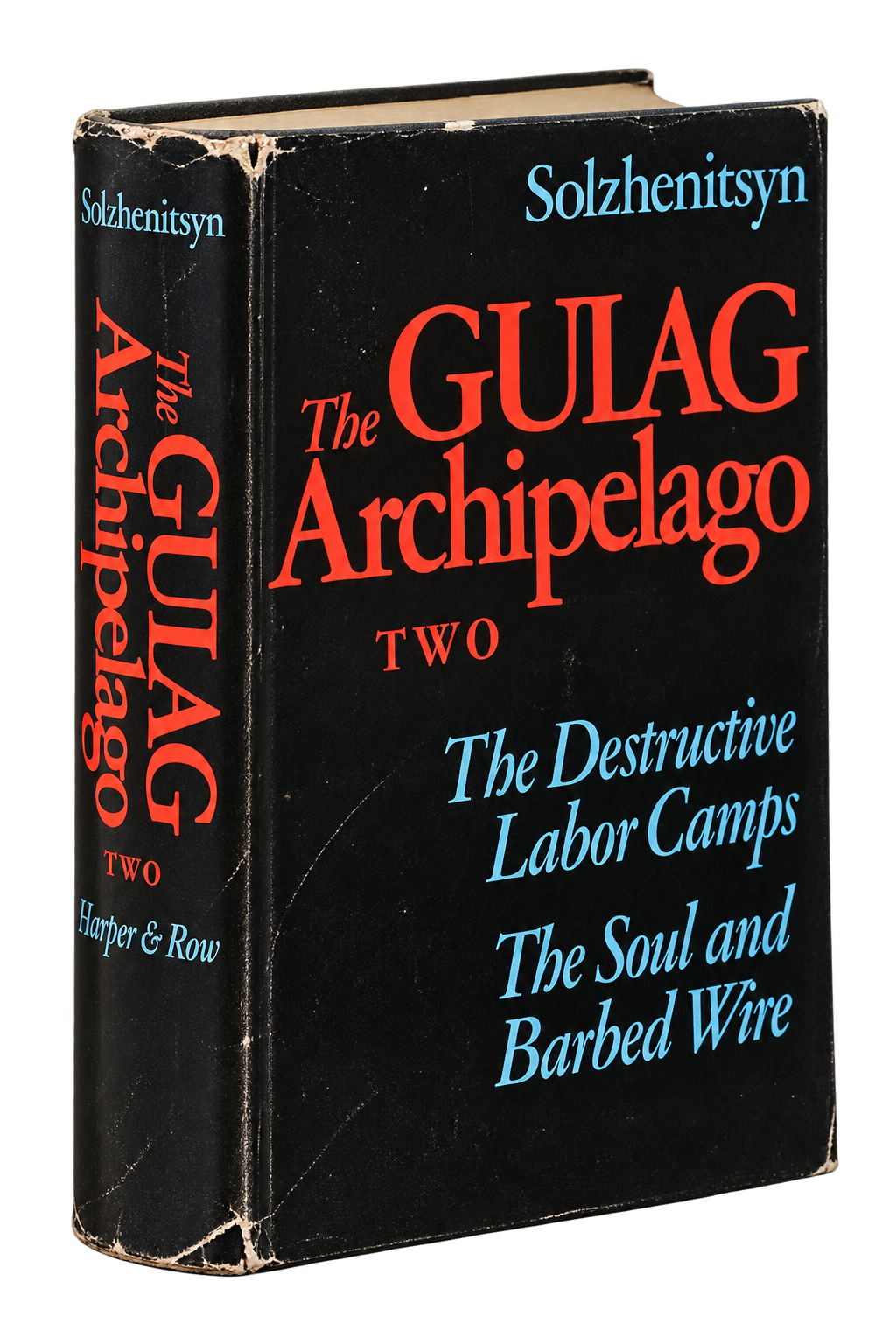
The first American edition, first printing of Aleksandr Solzhenitsyn’s The Gulag Archipelago, 1918–1956: An Experiment in Literary Investigation, containing Volumes III–IV of the larger work in a single physical hardcover volume. Harper & Row published Volumes I–II in one hardcover in 1974, followed by this companion volume containing Volumes III–IV in 1975. Together, the two separately published Harper & Row hardcovers form the complete first American publication of Volumes I–IV. Translated from the Russian by Thomas P. Whitney. Original black publisher’s cloth with gilt spine lettering, retaining the original unclipped dust jacket.
Condition:
Near Fine+ book in a Very Good+ dust jacket. The original black cloth remains exceptionally fresh, with bright gilt spine lettering, a square binding, crisp pages, and no ownership markings, foxing, restoration, or structural defects observed. The original jacket remains complete with moderate rubbing, scattered edge wear, minor chipping at the extremities, and light handling wear, but no significant tears or major paper loss.
Story Of The Book
The first part of The Gulag Archipelago exposed a hidden system. The concluding volume asked how that system endured.
Solzhenitsyn had already reconstructed the machinery of arrest, interrogation, imprisonment, and forced labor. Here, his investigation expands outward, examining the development of the camps across decades of Soviet rule and the lives of the people forced to inhabit them.
Again, the evidence comes from more than Solzhenitsyn himself. Personal experience is joined by the testimony of former prisoners and years of clandestine research, allowing individual stories to accumulate into a history of political repression.
The Gulag was not simply a collection of brutal prisons. Solzhenitsyn presented it as a system sustained by institutions, ideology, secrecy, and human choices.
By the time this American edition appeared in 1975, the consequences of publishing the work were already unmistakable. Solzhenitsyn had been arrested, stripped of his Soviet citizenship, and expelled from the country. The investigation the Soviet state could not permit at home was now circulating internationally.
Why It’s In The Collection
Volumes III–IV belong in Consigned to Darkness because they complete one of the twentieth century’s most consequential attempts to reconstruct a history that political power had tried to suppress.
The significance of The Gulag Archipelago lies partly in scale. Solzhenitsyn took experiences scattered across decades, prisons, labor camps, and individual memories and assembled them into a record capable of revealing the system connecting them.
Testimony became evidence; evidence became history.
Harper & Row issued the American publication in two physical books: Volumes I–II in 1974, followed by Volumes III–IV in this 1975 companion volume. Preserved together in the collection, RB-0107 and RB-0108 represent the complete first American publication of Volumes I–IV.
Within the collection’s larger Solzhenitsyn sequence, the progression is deliberate: One Day in the Life of Ivan Denisovich gives political imprisonment a human face. Cancer Ward examines what repression leaves behind. The Gulag Archipelago reconstructs the system itself.
The state had scattered its prisoners across an archipelago. Solzhenitsyn gathered their experiences back together.
Collection Categories: Witness Literature · Anti-Totalitarianism · Political Imprisonment · Human Rights · Censorship · Free Expression · Political Dissent · Publication-Event Object · Documentary Literature
———
Authentication Evidence
Title page identifies The Gulag Archipelago, 1918–1956: An Experiment in Literary Investigation, Volumes III–IV, by Aleksandr Solzhenitsyn and Harper & Row, Publishers, as publisher.
Volumes III–IV are contained together in this single physical hardcover.
Harper & Row had previously issued Volumes I–II together in a separate physical hardcover in 1974; this 1975 companion volume continues and completes the first American publication of Volumes I–IV.
Translation is credited to Thomas P. Whitney.
Copyright page identifies the publication as “First Edition” and contains the complete number line 15 16 17 18 19 10 9 8 7 6 5 4 3 2 1, directly establishing first-printing status.
Copyright page is dated 1974; the physical Harper & Row volume was published in 1975.
Original black publisher’s cloth with gilt spine lettering is present.
Original unclipped dust jacket is present and corresponds to the Harper & Row first American issue.
No evidence of book-club manufacture, later printing, rebinding, facsimile jacket, or other bibliographic anomalies is observed.
Taken together, the explicit First Edition statement, complete number line ending in 1, Harper & Row imprint, Thomas P. Whitney translation, original binding, and original dust jacket support identification as an authentic 1975 First American Edition · First Printing of Volumes III–IV, issued as the second physical volume of Harper & Row’s two-book American publication of Volumes I–IV.