
 Image 1 of 1
Yankee Bride in Moscow — Elizabeth Hampel
Elizabeth Hampel
Liveright Publishing Corporation · New York · 1941
First Edition · First Printing · Signed Presentation Copy
The Book:
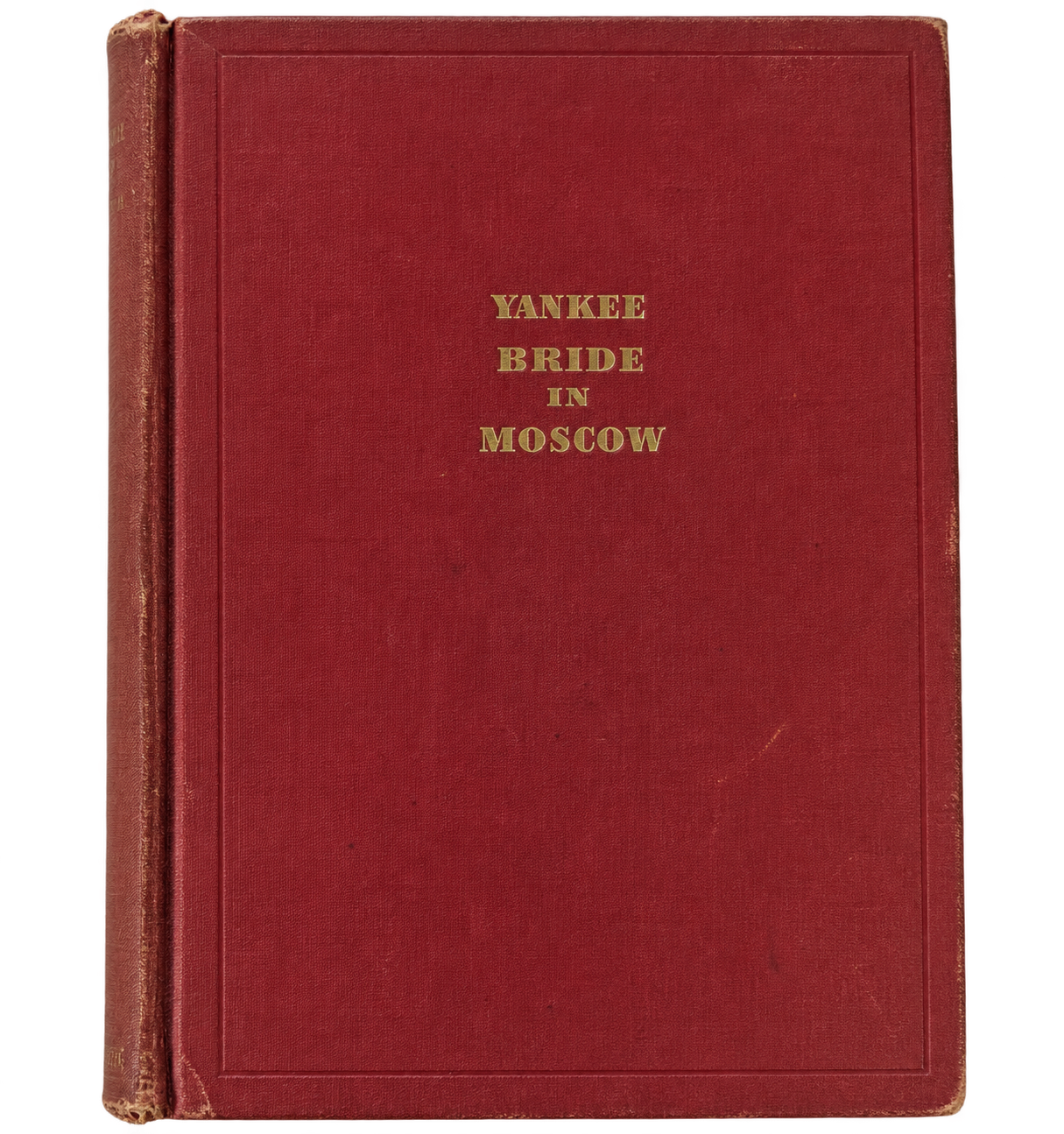
The First Edition · First Printing of Elizabeth Hampel’s Yankee Bride in Moscow, her firsthand account of life in Stalin-era Moscow while her husband served on the staff of the American Embassy. Developed from the diary Hampel kept during her time in the Soviet capital, the book became a contemporary bestseller and offered American readers an unusually immediate civilian view of everyday life under Stalin. This copy is especially distinguished as a signed presentation copy, inscribed by Hampel to “Miriam” and signed “Elizabeth ‘Liz’ Hampel.” In the inscription, Hampel explicitly describes the book as an account of “our experiences in Russia,” directly linking this physical copy to the lived events behind the text. 319 pp. Original red publisher’s cloth with gilt lettering retained.
Condition:
Very Good. Original red publisher’s cloth remains sound, with moderate rubbing and handling wear, localized fraying and small cloth losses at the spine ends, light corner wear, and fading and dulling to the spine. Scattered spotting and previous-owner markings appear on the endpapers, but the interior remains otherwise clean and structurally sound. The signed presentation inscription remains clear and legible on the front free endpaper. No evidence of rebinding or restoration observed. No dust jacket present.
Story Of The Book
Before the Cold War had a name, Elizabeth Hampel went to Stalin’s Moscow and wrote down what she saw.
Living in the Soviet capital while her husband served on the staff of the American Embassy, Hampel kept a diary of daily life around her—social customs, shortages, bureaucracy, political atmosphere, and the ordinary experience of living inside one of the world’s most tightly controlled states.
Published in 1941, Yankee Bride in Moscow carried those observations to a substantial American readership. Its significance lies in its perspective: this is not a political treatise or a retrospective history of Stalinism. It is the record of an American civilian encountering the Soviet system at ground level.
That makes this particular copy unusually intimate. Hampel did not merely sign it. In her presentation inscription to “Miriam,” she explicitly describes the book as an account of “our experiences in Russia.”
The inscription collapses the distance between witness and object. The woman who lived the experience, wrote the book, and published the account then personally identified this copy as a record of that experience.
The politics are large. The perspective—and this copy’s connection to it—is deeply personal.
Why It’s In The Collection
Yankee Bride in Moscow belongs in Consigned to Darkness because authoritarian systems are often most revealing when seen not through ideology, but through ordinary life.
Hampel was not writing as a Soviet dissident, philosopher, or later historian. She was an American woman living inside Stalin’s Moscow and recording what that experience looked and felt like from day to day.
That makes the book an important counterweight to the collection’s more explicitly political anti-totalitarian works. It shows how power appears in daily life: through bureaucracy, scarcity, social behavior, surveillance, restriction, and the small accommodations people make inside controlled societies.
But this copy carries an additional layer of significance. It does not merely preserve Hampel’s testimony; it preserves Hampel herself identifying the book as the record of what she and her husband experienced in Russia.
That makes the inscription more than autograph value. It reinforces the book’s function as witness.
History explains the system. Hampel shows what it felt like to live inside it—and this copy carries her own hand saying so.
Collection Categories: Witness Literature · Memoir & Testimony · Anti-Authoritarianism · Anti-Totalitarianism · Political History · Cold War · Women’s History & Feminism · Signed
———
Authentication Evidence
Title page identifies the work as Yankee Bride in Moscow by Elizabeth Hampel.
Title page names Liveright Publishing Corporation · New York as publisher.
Copyright page states “Copyright, 1941, by Liveright Publishing Corporation.”
Copyright page contains no subsequent-printing statement, impression notice, or later publication date.
Documented Liveright publishing practice for this period generally omitted a first-edition statement while identifying subsequent printings; the absence of a later-printing designation therefore supports First Printing identification.
Original publisher’s red cloth binding remains present.
Binding retains gilt title to the front board and gilt title, author name, and Liveright device to the spine.
Numbered text terminates normally on page 319.
No physical evidence of missing terminal text leaves or removed gatherings is observed.
Front free endpaper bears a personal presentation inscription addressed to “Miriam.”
Inscription is signed “Elizabeth ‘Liz’ Hampel.”
Hampel’s inscription explicitly refers to “our experiences in Russia,” directly connecting the presentation copy to the experiences documented in the book.
The inscription is therefore content-relevant presentation provenance, not merely a detached autograph.
Previous ownership includes a printed address label for Mrs. George M. Raeber, Jr., King of Prussia, Pennsylvania, together with later pencil notations.
No documented chain presently connects Miriam to Mrs. Raeber.
No evidence of book-club manufacture, later rebinding, facsimile components, or later publisher issue is observed.
Observable physical and bibliographic evidence supports identification as the 1941 First Edition · First Printing · Signed Presentation Copy.