
 Image 1 of 1
Trip to Hanoi — Susan Sontag
Susan Sontag
The Noonday Press / Farrar, Straus and Giroux · New York · 1968
First Edition · First Printing
The Book:
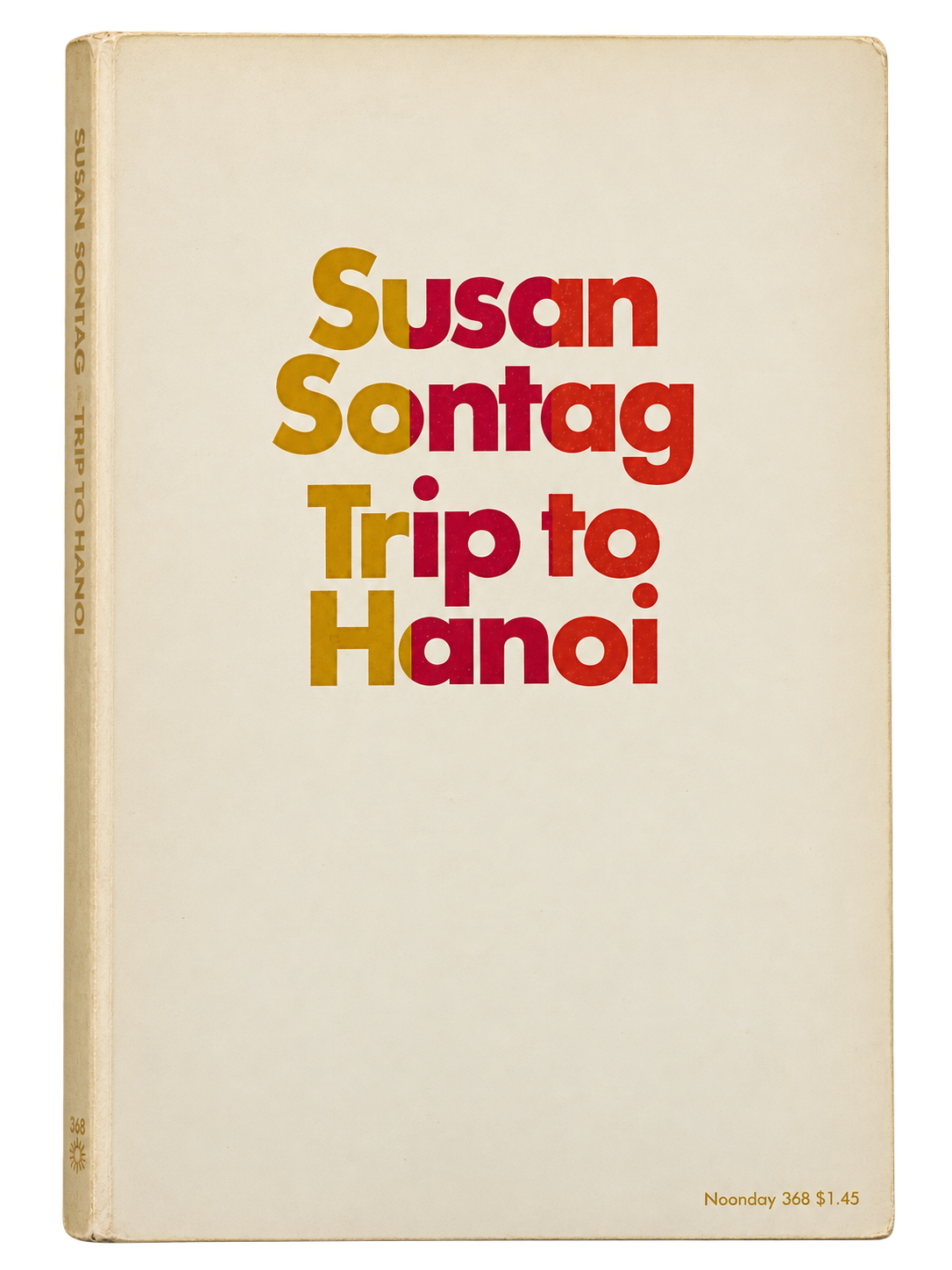
The First Edition · First Printing of Susan Sontag’s Trip to Hanoi, her account of a May 1968 visit to North Vietnam while the United States was actively at war with the country. Rather than straightforward reportage, Sontag turned the journey into an intellectual diary, examining both North Vietnamese society and the assumptions she carried with her as an American antiwar intellectual. The essay first appeared in Esquire in December 1968 before publication as this standalone Noonday Press volume. 91 pp. Original cream printed wrappers, Noonday designation N368, and original $1.45 price retained. Cover designed by Lawrence Ratzkin.
Condition:
Near Fine+. An exceptionally fresh copy in the original printed wrappers, with crisp edges, sharp corners, a straight spine, and tight binding. Interior remains remarkably clean and bright. Mild uniform age toning and negligible handling wear are the principal defects. No ownership inscriptions, institutional markings, restoration, or other significant faults observed.
Story Of The Book
Susan Sontag went to North Vietnam already convinced that America’s war was wrong. What she found there forced her to confront how little political conviction alone had prepared her to understand the people living beneath the bombs.
Invited to Hanoi in May 1968, Sontag entered a country most Americans knew through military briefings, casualty reports, propaganda, and images of destruction. She could easily have returned with a simple antiwar tract. Instead, Trip to Hanoi records something messier.
Sontag was sympathetic to North Vietnam, but she also wrote candidly about her discomfort, cultural prejudices, misunderstandings, and difficulty making sense of a society radically different from her own. She resisted turning the Vietnamese into either communist villains or flawless revolutionary heroes.
That uncertainty is what gives the book its power.
Sontag traveled to the country her own government was bombing—and discovered that opposing a war was easier than understanding the people living inside it.
Why It’s In The Collection
Trip to Hanoi belongs in Consigned to Darkness because dissent is strongest when it is willing to question itself.
Sontag opposed American intervention in Vietnam, but this book is not valuable simply because she took the antiwar side. Its importance lies in her willingness to travel into a country her own government was bombing and then scrutinize both American power and her own ideological assumptions.
The timing matters enormously. This was not retrospective moral clarity. The bombs were still falling, the war was still being fought, and Americans were still arguing over what Vietnam meant. This first printing preserves that uncertainty as it happened.
Sontag went looking for evidence against the war. She came back with an argument against certainty.
Collection Categories: Publication-Event Object · Political Dissent · War & Conflict · Political History · Anti-Authoritarianism · Witness Literature · Free Expression · Literature
———
Authentication Evidence
Title page identifies the work as Trip to Hanoi by Susan Sontag.
Title page identifies Farrar, Straus and Giroux · New York as publisher.
Copyright page states “Copyright © 1968 by Susan Sontag.”
Copyright page explicitly states “First printing, 1968,” directly confirming first-printing status.
Copyright page records Library of Congress Catalog Card Number 69-15403.
Copyright page states that the volume was published simultaneously in Canada by Doubleday Canada Ltd., Toronto.
Copyright page states “Printed in the United States of America.”
Copyright page credits Kay Rexrode with the book design.
Original Noonday Press wrappers remain present.
Wrappers retain Noonday series designation N368.
Original $1.45 publisher’s price remains present.
Front wrapper retains the original mustard-yellow and magenta typographic design.
Rear wrapper credits Lawrence Ratzkin with the cover design.
Rear wrapper identifies The Noonday Press, 19 Union Square West, New York, New York 10003.
Physical collation comprises 91 numbered pages, consistent with bibliographic records for the original Noonday edition.
Contemporary and specialist bibliographic sources identify the Noonday/Farrar, Straus and Giroux publication as the original edition.
Independent specialist cataloging records the New York Noonday Press issue as 1968, First Printing, corroborating the publication statement in this copy.
Some later bibliographic databases assign the Noonday edition a 1969 publication date, but the book itself explicitly states “First printing, 1968,” and independent records corroborate a 1968 first edition.
The essay first appeared in Esquire in December 1968.
No later-printing statement, facsimile designation, replacement wrappers, or rebinding is observed.
Observable physical and bibliographic evidence supports identification as the 1968 First Edition · First Printing.