


Old Books, Current Events.
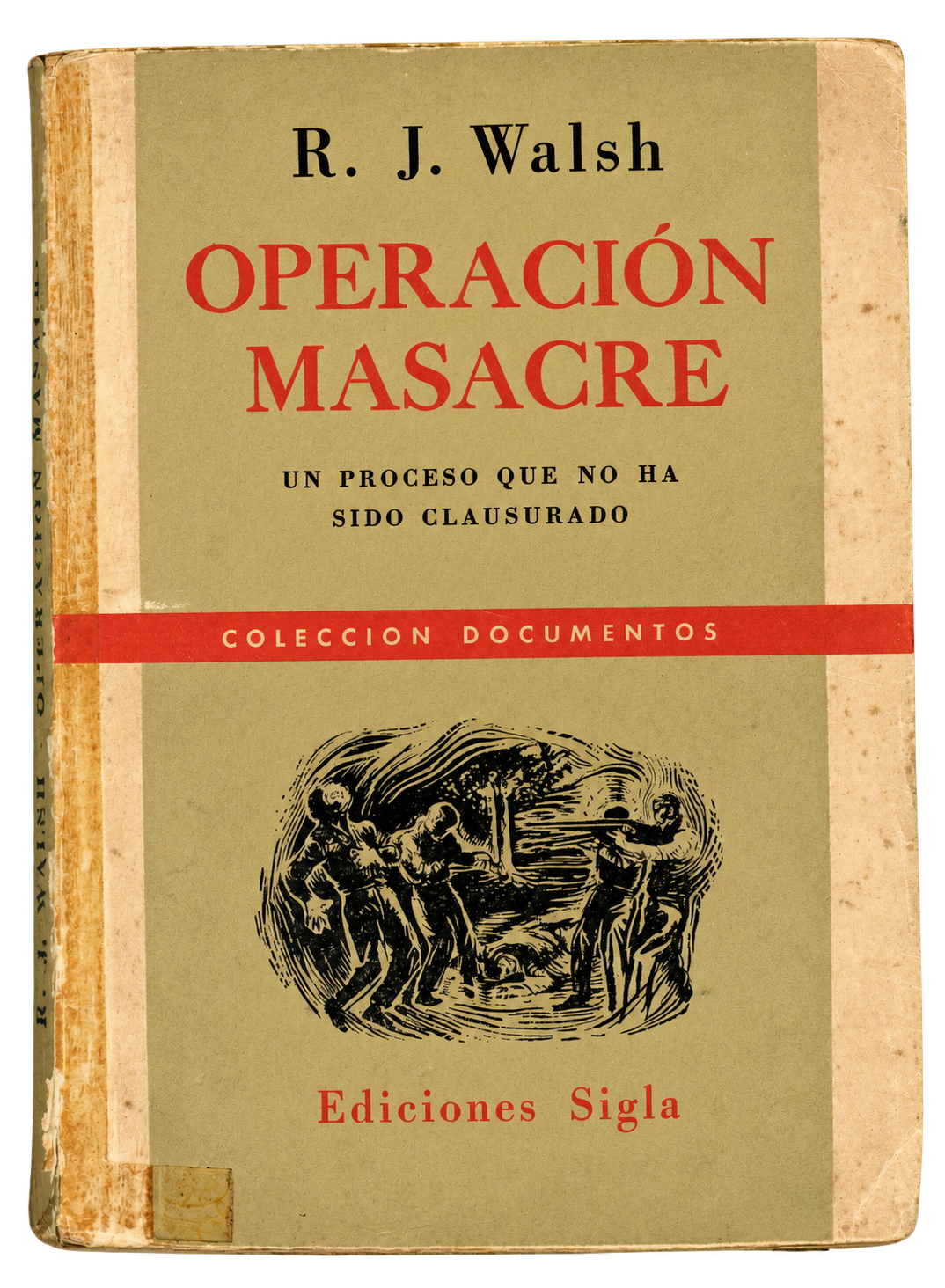
Full Title:Operación Masacre: Un proceso que no ha sido clausurado
Rodolfo J. Walsh
Ediciones Sigla, Buenos Aires · 1957
First Edition · First Printing
The Book: True first edition, first printing of Rodolfo J. Walsh’s Operación Masacre: Un proceso que no ha sido clausurado. The title page carries the correct Ediciones Sigla imprint, and the original publisher’s printed wrappers are present and consistent with the documented 1957 first edition. Wrapper design, typography, and publisher presentation correspond to the original Sigla issue, with no evidence of later publisher imprints, replacement wrappers, facsimile production, or rebinding. Prior bibliographic authentication conducted for this copy, together with its observable physical characteristics, supports identification as the true first edition, first printing.
Condition: Very Good+. The original printed wrappers remain complete and securely attached, with light to moderate age toning, modest rubbing along the spine and extremities, minor handling wear, and softened corners. The binding remains sound with a complete text block and clean interior. No ownership inscriptions, bookplates, institutional markings, library stamps, or evidence of restoration observed.
Story Of The Book
One man survived his execution. That single fact changed journalism forever.
When Rodolfo Walsh learned that a man had survived an illegal firing squad following Argentina’s failed June 1956 uprising, he refused to dismiss the story as rumor. His investigation led him to other survivors and witnesses and ultimately to evidence of clandestine executions carried out by the Argentine state.
Walsh reconstructed what happened through survivor interviews, eyewitness testimony, and documentary investigation, transforming accounts that could have disappeared into a permanent record. Published in Buenos Aires in 1957, Operación Masacre exposed the killings while many of those responsible remained in positions of authority.
The book became one of the foundational works of investigative narrative journalism, preceding the international emergence of the nonfiction novel by several years. But its importance extends beyond literary innovation. Walsh demonstrated that journalism could do more than report what institutions said had happened: it could independently reconstruct events and produce evidence capable of contradicting the state itself.
Walsh did not simply write about an official lie. He created a record that could survive it.
Why It’s In The Collection
Operación Masacre belongs near the center of the collection because it demonstrates how publication can challenge a government’s ability to control the truth about its own violence.
Walsh confronted an extraordinary imbalance of power. The state possessed police authority, political institutions, and the ability to construct an official account of what had occurred. The survivors possessed their testimony. Walsh transformed that testimony into documented evidence and publication gave that evidence an audience the government could no longer completely control.
That makes this first printing especially important. It does not preserve a later historical reconstruction produced after the facts had become broadly accepted. It preserves the original publication through which Walsh’s investigation entered public discourse while the controversy remained unresolved and many of those implicated remained in power.
The book therefore embodies one of the collection’s central ideas: printed objects can alter the balance between truth and power. Operación Masacre transformed survivor testimony into documentary evidence against the state and demonstrated that when authority attempts to erase an event, publication can make that erasure considerably more difficult.
Collection Categories: Publication-Event Object · Investigative Journalism · Witness Literature · Political Dissent · Anti-Authoritarianism · Human Rights · Political History
———
Authentication Evidence
• Correct title page identifying Operación Masacre by Rodolfo J. Walsh.
• Title page bears the correct Ediciones Sigla imprint, establishing the original publisher.
• Original publisher's printed wrappers are present and consistent with the documented first edition.
• Wrapper design, typography, and publisher presentation are consistent with the known 1957 Sigla issue.
• No evidence of later publisher imprints, replacement wrappers, or facsimile production is observed.
• Through prior bibliographic authentication conducted for this copy, this issue has been established as the true 1957 first edition, first printing. The supplied photographs are consistent with that conclusion.
• The observable bibliographic characteristics and previously established first-print authentication together support identification as the true first edition, first printing.
Operación Masacre
Rodolfo J. Walsh, Ediciones Sigla, 1957. First edition, first printing.
The Current Event
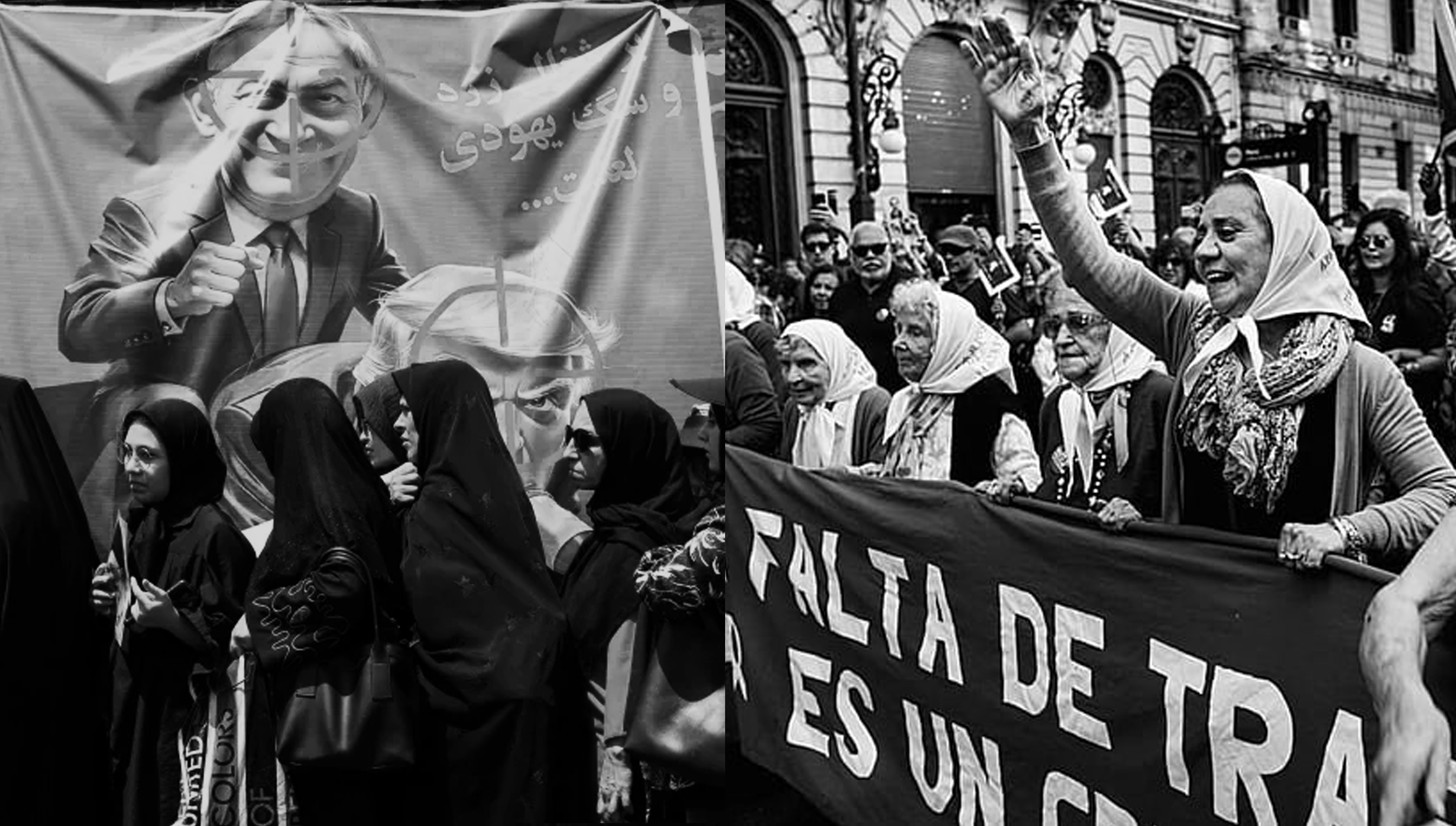
Iran says it is defending itself from enemies abroad. At home, authorities are arresting activists, tightening controls on public life, and executing people accused of collaborating with Israel. As war conditions linger, the government has expanded a security crackdown that critics say increasingly treats dissent itself as a threat to the state. Source: Al Jazeera: Iran tightens security grip at home as war conditions with US linger — (Aug 2026)
The Book
In 1956, Argentina's military government responded to an attempted uprising with secret executions. The government’s bullshit official story might have survived—except some of the men who were supposed to be dead survived. Rodolfo Walsh found them. In 1957, while the government responsible remained in power, he published Operación Masacre. This is its first printing.
The Connection
Governments have always claimed extraordinary powers when they believe the state is in danger. The dangerous question is what happens when the state gets to decide who the danger is. Seventy years ago, Walsh went looking for the people who disappeared inside that distinction—and discovered men who had survived their own executions.

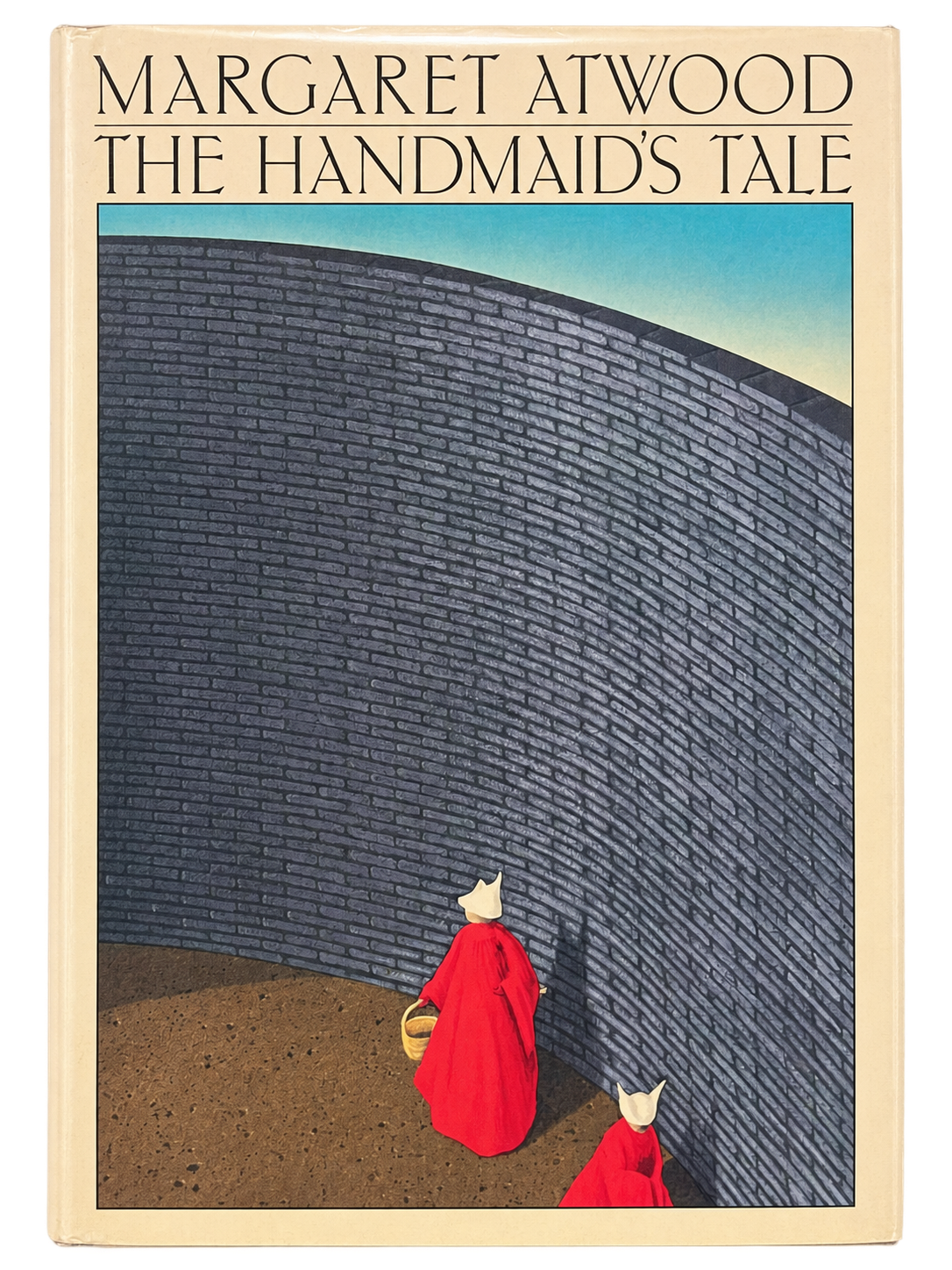
The Warning & The Return to Gilead
Margaret Atwood
Boston · London · 1986–2019
First American Edition · First UK Edition
First Printings
Curated Two-Volume Publication-Event Set
The Set:
A curated pairing of two first-printing Margaret Atwood novels separated by thirty-three years: the 1986 Houghton Mifflin First American Edition · First Printing of The Handmaid’s Tale and the 2019 Chatto & Windus First UK Edition · First Printing of The Testaments. The first introduced American readers to Gilead, a theocratic dictatorship built through the systematic destruction of women’s autonomy. The second returned to that world more than three decades later, shifting the question from how authoritarianism takes hold to how it survives, fractures, and can be resisted from within. Together, the two books preserve Atwood’s original warning and her return to it after a generation of cultural life.
Included Titles:
The Handmaid’s Tale — Margaret Atwood
Houghton Mifflin Company · Boston · 1986
First American Edition · First Printing
Original quarter-cloth binding · Original unclipped $16.95 dust jacketThe Testaments — Margaret Atwood
Chatto & Windus · London · 2019
First UK Edition · First Printing
Original publisher’s boards · Original dust jacket
Condition:
Very Good+ to Fine overall. The Handmaid’s Tale grades Very Good+ in a Very Good- original dust jacket, retaining its original unclipped $16.95 price. The Testaments grades Fine in a Fine original dust jacket. Both volumes retain their original publisher-issued bindings and jackets.
Story Of The Set
In 1986, Margaret Atwood imagined how a society could make the loss of women’s freedom feel inevitable. Thirty-three years later, she returned to ask whether such a society could ever be permanent.
The Handmaid’s Tale introduced Gilead through Offred, a woman stripped of her name, family, property, independence, and control over her own body. Atwood’s warning was not built around dictatorship appearing fully formed. Gilead emerges through fear, political crisis, religious certainty, institutional cooperation, and the gradual normalization of what would once have seemed impossible.
The novel became one of modern literature’s defining anti-authoritarian works, but Atwood left its regime suspended between apparent permanence and eventual historical collapse.
In 2019, The Testaments returned to Gilead from multiple perspectives inside and outside its structure. The focus had shifted. The question was no longer only how freedom is taken, but how people compromise with power, survive within it, undermine it, and help bring it down.
By then, The Handmaid’s Tale had spent more than three decades moving through literature and public culture. Atwood was not simply revisiting a fictional world. She was returning to a warning that readers had spent a generation interpreting against their own politics, fears, and institutions.
The first book imagines the making of Gilead. The second imagines the beginning of its undoing.
Why It’s In The Collection
The Handmaid’s Set belongs in Consigned to Darkness because warnings have histories of their own.
The 1986 First American Edition preserves the moment American readers first encountered Atwood’s vision of a society converting ideology, fear, and religious authority into political control over ordinary life—especially the lives and bodies of women.
The Testaments gives the collection something more unusual than a conventional sequel. Atwood returned to the same authoritarian system thirty-three years later and approached power from the other direction: its compromises, internal contradictions, hidden dissenters, and vulnerability to the people forced to live inside it.
Preserved together in first-printing editions, the two books document not only Gilead’s imagined history, but the life of an anti-authoritarian warning across a generation.
One book asks how freedom can disappear. The other asks what it takes to make freedom possible again.
Collection Categories: Women’s History & Feminism · Anti-Authoritarianism · Anti-Totalitarianism · Political Dissent · Religious Conscience · Human Rights · Literature · Publication-Event Object
———
Authentication Evidence
The Handmaid’s Tale title page identifies Houghton Mifflin Company, Boston, consistent with the 1986 First American Edition.
Copyright page carries the complete first-printing number line “V 10 9 8 7 6 5 4 3 2 1,” confirming first-printing status.
Original publisher’s quarter-cloth over paper-covered boards remain present.
Original dust jacket remains present.
Original dust jacket is unclipped and retains the $16.95 price.
Observed bibliographic and physical evidence supports identification of The Handmaid’s Tale as the 1986 First American Edition · First Printing.
The Testaments title page identifies Chatto & Windus, London, establishing the UK publication.
Copyright page identifies the original 2019 publication and carries the complete first-printing number line ending in 1, confirming first-printing status.
Original publisher’s hardcover binding remains present.
Original dust jacket remains present.
Observed bibliographic evidence supports identification of The Testaments as the 2019 First UK Edition · First Printing.
No evidence of book-club manufacture, remainder marks, facsimile components, replacement jackets, or rebinding is observed.
Original publisher-issued formats are retained throughout both volumes.
The two books are curatorially assembled; no claim is made that these copies were originally issued or marketed together as a publisher-issued set.
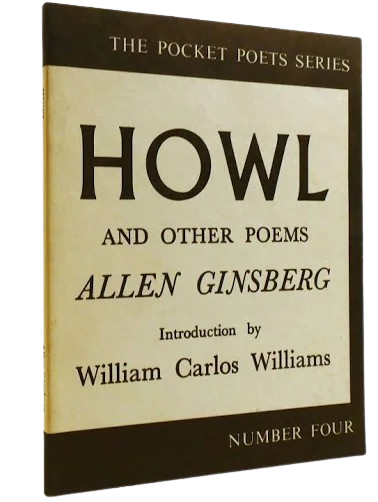
Allen Ginsberg
San Francisco: City Lights Books, 1956
First Edition · Third Printing
The Book:
The first edition, third printing of Allen Ginsberg’s Howl and Other Poems, issued as Number Four in Lawrence Ferlinghetti’s Pocket Poets Series. The rear wrapper explicitly states “Third Printing” and retains the original 75-cent price. This printing is especially significant because it was the first printing of Howl manufactured in the United States. The first two printings had been produced in England by Villiers; after U.S. Customs seized copies of the second printing on import, City Lights shifted production domestically, placing the next printing beyond that particular point of government control. This third printing also differs visibly from the first two in lacking the separate white paper wraparound label, with the title information incorporated directly into the cover design.
Condition:
Near Fine+. An exceptionally bright example in the original publisher’s wrappers, with only minimal handling wear. The staple binding remains tight, the interior is clean, and the original 75-cent price and “Third Printing” designation remain clearly present on the rear wrapper. No rebinding, restoration, facsimile wrappers, or ex-library markings are evident.
Story Of The Book
Allen Ginsberg wrote the poem. Lawrence Ferlinghetti decided the government would not decide whether readers could have it.
When City Lights published Howl and Other Poems, Ginsberg’s language was sexually explicit, politically disillusioned, psychologically raw, and deliberately hostile to the boundaries respectable American culture placed around literature.
The authorities responded by trying to stop the book.
The first two printings were manufactured in England. When copies of the second printing entered the United States, Customs seized them as obscene. Ferlinghetti and City Lights then faced the prospect that the government could use the border itself as a censorship tool.
So City Lights changed the book.
Not the poem.
The manufacture.
The third printing was produced in the United States.
That is what makes this copy such a strong publication-event object. It was not merely printed while Howl was controversial. Its physical production changed because the government had interfered with the book’s circulation.
Ferlinghetti’s response was practical and defiant: if Customs could stop imported copies, the next copies would not be imported.
The obscenity prosecution continued, and Judge Clayton Horn would not rule until October 1957. This third printing therefore belongs to the unresolved middle of the fight — after government suppression had begun, but before the courts had declared Howl protected literature.
When the government used the border to stop Howl, City Lights moved the printing inside the border.
Why It’s In The Collection
Howl and Other Poems is one of the clearest examples in Consigned to Darkness of a book whose physical form records the struggle over whether it could exist.
A later printing can preserve Ginsberg’s poem.
This printing preserves the publisher’s response to censorship.
That distinction is why the collection deliberately sought the third printing. It was the first domestic printing produced after Customs had seized the English-printed second printing, making the object itself part of City Lights’ effort to keep Howl in circulation despite government interference.
Its bibliographical features reinforce that history. The rear wrapper identifies it as the third printing, while the absence of the separate white wraparound label used on the first two printings provides an additional visible point of identification. The inventory already treats the copy as a publication-event object rather than merely an early impression, and that is the right way to understand it.
This is not simply a copy of a famous poem from the censorship era.
It is a copy produced because censorship had already begun to shape how the book had to be made.
The government tried to stop Howl at the border. City Lights answered by printing it at home.
Collection Categories: Free Expression · Censorship · Obscenity Law & Court History · Beat Generation · Literature · Poetry · Anti-Authoritarianism · Publication-Event Object
———
Authentication Evidence
• Title page reads Howl and Other Poems by Allen Ginsberg, published by The Pocket Poets Series, Number Four, City Lights Books, San Francisco, consistent with the original first edition.
• This copy belongs to the original 1956 City Lights first edition, which remained in continuous production through successive printings without constituting a new edition.
• Rear wrapper is explicitly printed "Third Printing," identifying this as the authentic third printing of the first edition.
• Library of Congress Catalog Card Number 56-8587 appears on the publication page, consistent with authentic early printings.
• Original publisher's wrappers, typography, layout, and Pocket Poets Series design match documented third-printing copies.
• Original 75-cent price remains on the rear wrapper.
• No evidence of rebinding, facsimile wrappers, ex-library provenance, or restoration observed.
• The observed bibliographic evidence is consistent with an authentic first edition, third printing.
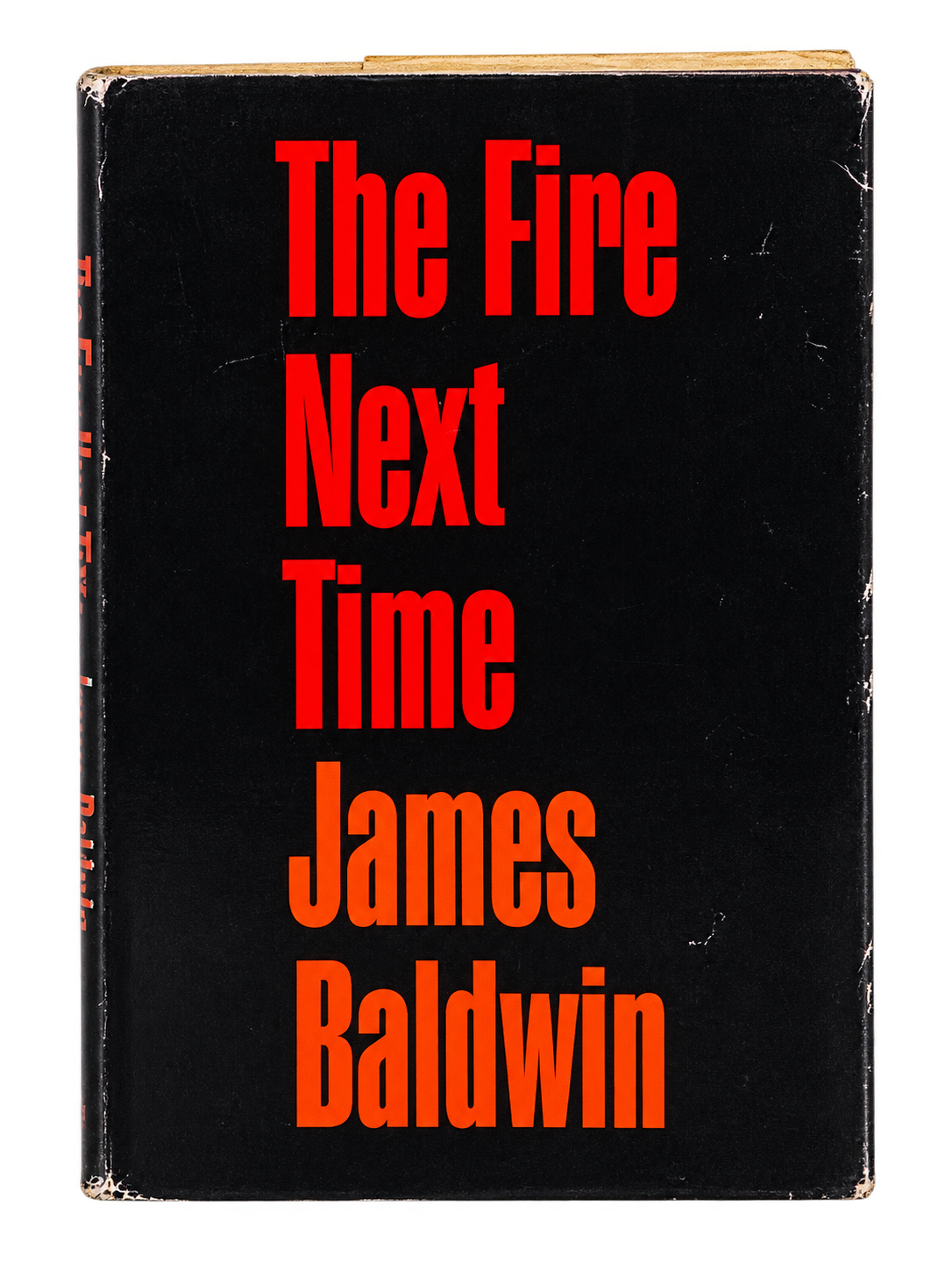
James Baldwin
The Dial Press, New York · 1963
True First Edition · First Printing
The Book: True first edition, first printing. Original beige publisher’s cloth with red spine lettering and Baldwin’s facsimile signature stamped in red on the front board. Original first-state dust jacket retained. The book preserves its original red top stain.
Condition: Very Good+ book in Good+ dust jacket. The jacket exhibits moderate rubbing and edge wear with several small chips and short closed tears, particularly at the spine ends and corners. The book has scattered foxing to the cloth, a previous owner’s inscription on the front free endpaper, and a previous owner’s name written on the top edge of the text block. Binding remains tight with no restoration observed.
Story Of The Book
James Baldwin rejected the comforting belief that racial injustice belonged only to America’s past.
Published in 1963 at the height of the Civil Rights Movement, The Fire Next Time brought together two essays—My Dungeon Shook and Down at the Cross—in which Baldwin confronted race, religion, identity, and the consequences of a country unwilling to reckon honestly with its history. Rather than offering a conventional political program, Baldwin addressed the moral and psychological structures that allowed racial inequality to endure, challenging both Black despair and white complacency.
The book appeared during a transformative year in the struggle for American civil rights, as conflicts over segregation and racial equality forced questions of citizenship and democracy into the center of national life. Baldwin insisted that the country's future depended not simply upon changing laws, but upon Americans confronting truths about themselves and one another that they had long resisted. The result became one of the defining literary interventions of the Civil Rights era and one of the twentieth century’s most enduring meditations on race and American democracy.
Why It’s In The Collection
The collection preserves printed objects that challenged entrenched systems of power and altered public understanding of individual liberty and human dignity. The Fire Next Time does this through the force of argument, personal experience, and moral persuasion.
Baldwin refuses to reduce racial injustice to abstract politics. His examination moves between history and intimate experience, locating the consequences of racial hierarchy in individual identity, family, religion, fear, anger, and love. In doing so, he demonstrates how literature can challenge systems of authority by exposing the human realities those systems depend upon society overlooking.
This first printing therefore occupies a central place in the collection’s documentation of civil rights, free expression, racial equality, and human dignity. It preserves Baldwin’s argument as it entered American public life during the Civil Rights Movement itself: a demand not merely for legal reform, but for a more fundamental reckoning with the meaning of equality and democratic responsibility.
Collection Categories: Free Expression · Civil Rights · Anti-Authoritarianism · Literature
———
Authentication Evidence
• Title page reads The Dial Press, New York, 1963, consistent with the first edition.
• Copyright page contains only the 1963/1962 copyright with no later printings stated, consistent with a first printing.
• Original beige cloth binding with red spine lettering and publisher's facsimile signature on the front board, consistent with the first issue binding.
• Original black Paul Bacon dust jacket present with Baldwin portrait on the rear panel, consistent with the first-state jacket.
• Red top stain present, consistent with first-printing copies.
• No evidence of book-club manufacture, later rebinding, or facsimile dust jacket observed.
• First edition, first printing characteristics consistent throughout.
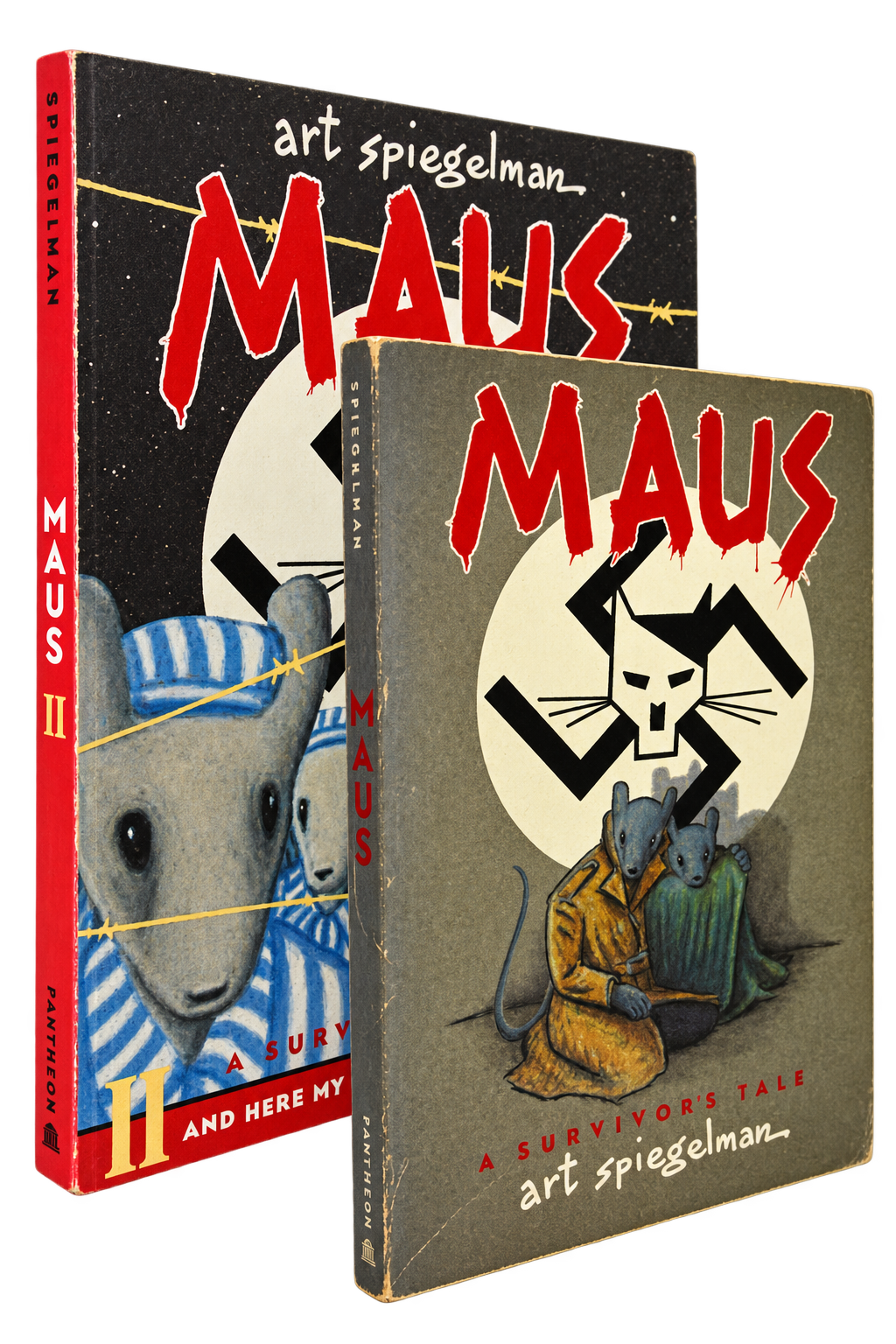
Maus: A Survivor’s Tale & Maus II: A Survivor’s Tale: And Here My Troubles Began
Art Spiegelman
Pantheon Books · New York · 1986–1991
First Editions · First Printings
Curated Two-Volume Publication-Event Set
The Set:
A curated pairing of the true first edition, first printing of Maus: A Survivor’s Tale (1986) and the first edition, first printing of Maus II: A Survivor’s Tale: And Here My Troubles Began (1991). The first volume retains its original French wrappers and $8.95 rear-cover price; Maus II retains its original dust jacket. Together, the two volumes preserve Art Spiegelman’s Holocaust narrative in the original book-form editions through which the complete work first entered the world.
Included Titles:
Maus: A Survivor’s Tale — Art Spiegelman
Pantheon Books · New York · 1986
First Edition · First Printing
Original French wrappers · $8.95 rear-cover priceMaus II: A Survivor’s Tale: And Here My Troubles Began — Art Spiegelman
Pantheon Books · New York · 1991
First Edition · First Printing
Original hardcover binding · Original dust jacket
Condition:
Very Good to Near Fine overall. Maus: A Survivor’s Tale grades Very Good, retaining its original French wrappers. Maus II grades Near Fine in a Near Fine original dust jacket. Both volumes retain their original publisher-issued formats with no evidence of rebinding or replacement components observed.
Story Of The Set
Art Spiegelman used the visual language of comics to tell a story many believed the medium was incapable of carrying.
Maus reconstructs the Holocaust through Spiegelman’s conversations with his father, Vladek, a Polish Jew who survived Auschwitz. But the work is not simply Vladek’s testimony. Spiegelman also records the difficult process of receiving that testimony: the gaps in memory, inherited trauma, family conflict, and the burden placed on a son trying to transform another person’s survival into history.
The story first developed serially in RAW, but Pantheon’s 1986 Maus: A Survivor’s Tale transformed it into a book that reached a far larger audience. Five years later, Maus II completed the narrative.
Its impact extended far beyond comics. In 1992, the completed Maus received a special Pulitzer Prize, an extraordinary recognition for a work that had challenged assumptions about what comics could accomplish as literature, history, memoir, and witness.
The form once associated with disposable entertainment had become a vessel for one of history’s most difficult acts of remembrance.
Why It’s In The Collection
The Maus Set belongs in Consigned to Darkness because witness does not end with the person who experienced an atrocity. It also depends on whether someone preserves the testimony—and whether another generation is willing to receive it.
Spiegelman transformed his father’s memories into something deliberately difficult to categorize: biography, autobiography, oral history, graphic literature, and Holocaust testimony exist simultaneously on the page. The result preserves not only what happened to Vladek, but what happened when his son tried to understand it.
That makes these particular editions important. Later boxed sets and collected editions preserve the text, but this pairing preserves the original book-form publication events: the 1986 volume through which Maus first reached readers as a book and the 1991 volume that completed the work.
Together, they document both an act of historical witness and a transformation in the possibilities of printed storytelling.
Vladek Spiegelman survived the history. Art Spiegelman, his son, made sure his testimony survived him.
Collection Categories: Graphic Literature · Holocaust & Genocide · Witness Literature · Memoir & Testimony · Publication-Event Object · Literature · Anti-Authoritarianism · Multi-Volume Set
———
Authentication Evidence
Maus: A Survivor’s Tale copyright page ends “Manufactured in U.S.A. // First Edition,” the diagnostic formulation identifying the first edition and distinguishing it from later printings that retain the original copyright date.
Maus: A Survivor’s Tale retains its original French-flap wrappers.
The original $8.95 U.S. price remains present on the rear wrapper.
The wrapper is the early publication design and lacks the later “Volume I: My Father Bleeds History” designation.
Taken together, the copyright-page formulation, original wrapper configuration, and pricing support identification of Maus: A Survivor’s Tale as the 1986 First Edition · First Printing.
Maus II: A Survivor’s Tale: And Here My Troubles Began copyright page explicitly states “First Edition.”
Maus II retains the complete first-printing number line ending in 1, directly establishing first-printing status.
Maus II is the stand-alone hardcover first edition, rather than the contemporaneous paperback issue or a volume supplied as part of a later pairing or boxed set.
Original publisher’s hardcover binding remains present on Maus II.
Original unclipped dust jacket remains present on Maus II.
First-printing jackets are documented with the original $18.00 U.S.A. / $23.50 Canada price; the jacket price on this copy should be stated as a physical authentication point only where directly confirmed.
Maus II collates to 135 pages, consistent with documented copies of the 1991 first edition.
Pantheon imprints, typography, bindings, and publication details are consistent with the respective original editions.
No evidence of book-club manufacture, facsimile components, remainder marks, rebinding, or replacement wrappers is observed.
Observable and independently corroborated bibliographic evidence supports identification of both volumes as First Edition · First Printing copies.
The two volumes are curatorially paired; no claim is made that these copies were originally issued or marketed together as a publisher-issued set.
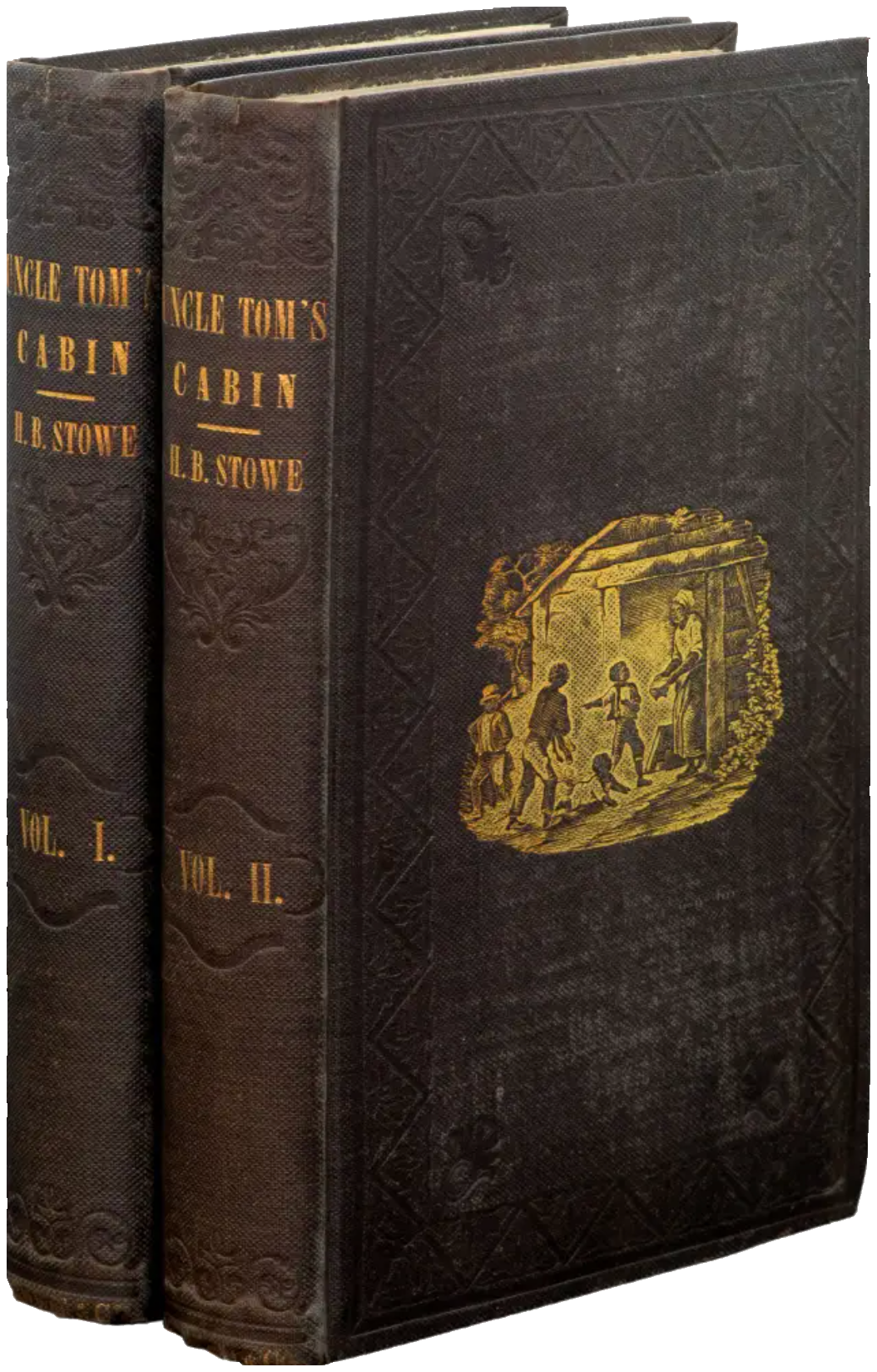
Full Title:Uncle Tom’s Cabin; or, Life Among the Lowly
Harriet Beecher Stowe
John P. Jewett & Company, Boston · 1852
First Edition · Early Printing (“Tenth Thousandths”) · Two Volumes
The Book: First edition, early printing (“Tenth Thousand”) of Harriet Beecher Stowe’s Uncle Tom’s Cabin; or, Life Among the Lowly, complete in two matching volumes. Both volumes carry the correct 1852 John P. Jewett publisher imprint and explicitly state “Tenth Thousandths,” identifying them as part of the extraordinary sequence of early printings produced to meet immediate demand for the novel. Original publisher’s brown cloth bindings with gilt pictorial stamping retained. Publisher, date, edition statements, and printing designations are consistent throughout both volumes, with no evidence of later rebinding or restoration observed.
Condition: Good. Both volumes remain complete and structurally sound in their original publisher’s bindings. The brown cloth exhibits heavy spine wear and areas of cloth loss, moderate corner wear, and other handling consistent with age and use. Interiors show foxing and scattered staining. No ownership writing observed. Despite substantial wear, the matched set survives intact in its original 1852 bindings.
Story Of The Book
Few novels have ever done more to change what a nation was willing to see.
When Harriet Beecher Stowe published Uncle Tom’s Cabin in 1852, slavery was already at the center of American political conflict. Her intervention was to make that enormous institution intimate. Through the lives of enslaved men, women, children, and families, Stowe asked readers to encounter human beings where political arguments had too often allowed them to see property, economics, law, or abstraction.
The response was extraordinary. Demand became so intense that John P. Jewett rapidly issued successive printings designated by the number of thousands produced. This matched “Tenth Thousand” set belongs to that first surge of publication in 1852, when the novel was moving through American culture with extraordinary speed and becoming part of the national struggle over slavery itself.
The reaction also demonstrated how threatening literature could become to established power. Uncle Tom’s Cabin was fiercely condemned across the slaveholding South and treated as dangerous abolitionist literature. In 1857, Maryland minister Samuel Green was sentenced to ten years in prison after authorities discovered Uncle Tom’s Cabin among abolitionist materials in his possession—an extraordinary example of the danger that could accompany possessing and circulating antislavery print.
Stowe did not abolish slavery with a novel. But she demonstrated that literature could alter the moral terrain on which political arguments were fought.
Why It’s In The Collection
Uncle Tom’s Cabin belongs near the historical center of the collection because it demonstrates the extraordinary power of literature to restore humanity where systems of power depend upon denying it.
Slavery required more than laws permitting ownership of human beings. It required an intellectual and moral architecture capable of reducing people to categories—slave, property, labor, capital. Stowe attacked that architecture through narrative. Her characters experience separation, fear, violence, faith, love, parenthood, loss, and hope. Whatever the novel’s limitations and the complicated history of its racial representations, its central political force came from insisting that readers confront the humanity obscured by the institution it opposed.
This particular set matters because it is not a later commemorative edition of a famous nineteenth-century novel. The two volumes were printed in 1852, during the original publishing phenomenon itself. Their “Tenth Thousand” designation places them among the copies produced as unprecedented demand was carrying Stowe’s argument into homes and public debate across the country.
That makes the object more than an early copy of a famous book. It is a surviving participant in one of the most consequential publication events in American history—a physical artifact from the moment a work of fiction became part of the struggle over whether one human being could rightfully own another.
Collection Categories: Civil Rights · Human Rights · Anti-Authoritarianism · Literature · Publication-Event Object
———
Authentication Evidence
• Correct John P. Jewett publisher imprint, confirming first edition
• Copyright pages dated 1852, consistent with first edition
• Both volumes state “Tenth Thousand,” confirming authentic early printing
• Matching two-volume set
• Publisher, date, and edition statements consistent throughout both volumes
• First edition, early printing characteristics consistent throughout

Extraordinary Stories Flying Under the Market's Radar

Susan Brownmiller
Simon and Schuster, New York · 1975
First Edition · First Printing
The Book: True first edition, first printing of Susan Brownmiller’s Against Our Will: Men, Women and Rape. The copyright page carries the complete first-printing number line “1 2 3 4 5 6 7 8 9 10.” Original brown publisher’s cloth in the original unclipped $10.95 first-state dust jacket. No evidence of book-club manufacture, remainder marking, rebinding, ex-library provenance, or facsimile components.
Condition: Near Fine book in Near Fine dust jacket. The jacket exhibits light age toning with minimal handling wear. The book remains exceptionally clean with a tight binding, bright spine lettering, and no ownership markings, foxing, structural defects, or restoration observed.
Story Of The Book
Susan Brownmiller challenged one of society’s oldest assumptions by arguing that rape should be understood not simply as an individual act of sexual violence, but as an instrument of power.
Published in 1975 at the height of second-wave feminism, Against Our Will brought together legal history, sociology, journalism, and feminist analysis to examine how sexual violence had been understood—and frequently misunderstood—across history and institutions. Brownmiller argued that rape could not adequately be explained as an isolated crime of individual passion. Its significance had to be considered within larger relationships between gender, violence, fear, and social power.
That argument transformed a subject frequently hidden, minimized, or treated as a private misfortune into a matter of public and political concern. The book became one of the foundational works of modern feminist thought, influencing subsequent scholarship, activism, legal debate, and public discussion surrounding sexual violence.
Its importance also lies in the controversy it generated. Brownmiller offered an ambitious theory about the relationship between rape and male power that became enormously influential while also provoking substantial debate within and beyond feminism. Whatever conclusions readers draw from its arguments, Against Our Will helped permanently change the terms on which sexual violence could be discussed in public.
This first printing preserves the publication at the moment those arguments entered the wider culture, before decades of scholarship, criticism, legal reform, and activism responded to them.
Why It’s In The Collection
Against Our Will belongs in the collection because it demonstrates how publication can transform something society has normalized or marginalized into a subject that institutions are forced to confront.
Brownmiller challenged prevailing assumptions about sexual violence by reframing the question around power. In doing so, she helped move rape from the margins of public discussion into debates about law, consent, gender, human rights, and institutional responsibility. The importance of the object is therefore not dependent upon treating every argument in the book as the final word on its subject. Its significance lies in the scale of the conversation its publication helped change.
That makes the first printing especially appropriate for a collection concerned with books that altered relationships between truth, authority, and individual liberty. It preserves the original publication of a work that challenged established social understandings and contributed to a fundamental reconsideration of an issue long obscured by silence, stigma, and inherited assumptions.
Collection Categories: Free Expression · Women’s Rights · Feminism · Human Rights · Criminal Justice · Social Justice
———
Authentication Evidence
• Title page reads Simon and Schuster, New York, consistent with the true first edition.
• Copyright page bears the original 1975 copyright with no indication of a later edition or revised issue, consistent with the first edition.
• Copyright page contains the complete 1 2 3 4 5 6 7 8 9 10 number line, establishing first-printing status.
• Original publisher's brown cloth binding is consistent with the first issue.
• Original unclipped $10.95 first-state dust jacket present.
• No evidence of book club manufacture, remainder marks, rebinding, ex-library provenance, or facsimile dust jacket observed.
• The observed bibliographic evidence is consistent with a true first edition, first printing.
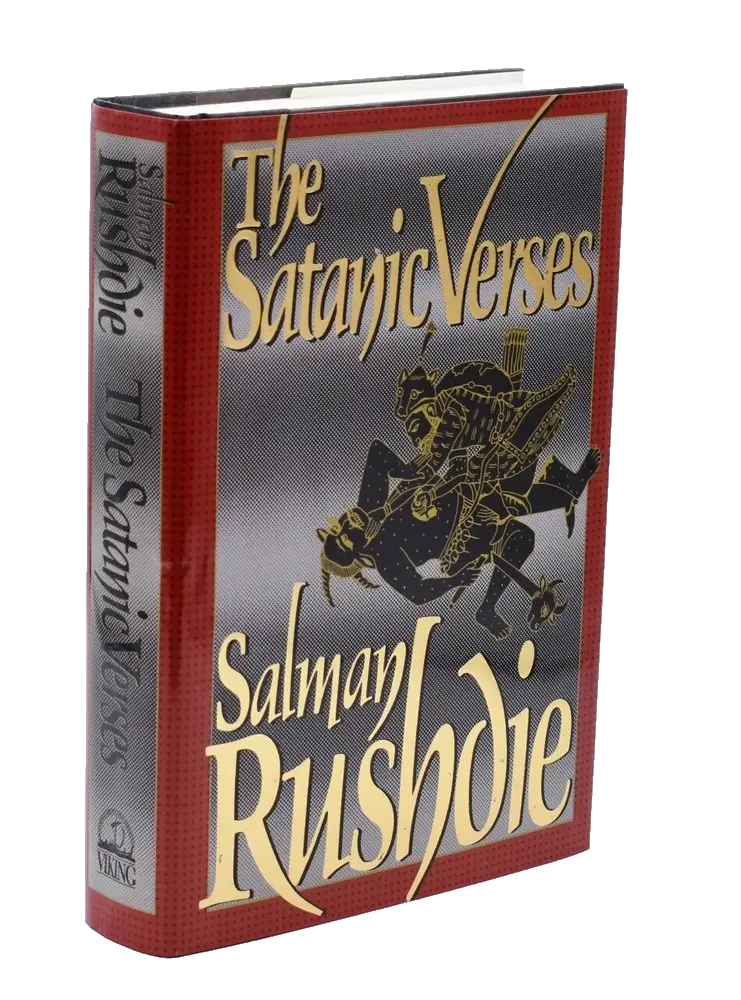
Salman Rushdie
Viking Penguin Inc., New York · 1989
First American Edition · Tenth Printing
The Book: First American edition, tenth printing of Salman Rushdie’s The Satanic Verses. The title page bears the Viking publisher imprint, while the copyright page states “Published in 1989 by Viking Penguin Inc.” and contains a printer’s key ending in 10, establishing tenth-printing status. Original publisher’s quarter black cloth over black paper-covered boards with gilt spine lettering in the original unclipped dust jacket retaining the $19.95 price. No evidence of book-club manufacture, ex-library provenance, rebinding, facsimile dust jacket, or other bibliographic alteration observed.
Condition: Near Fine+ book in Near Fine dust jacket. The book retains bright boards, strong gilt spine lettering, a square binding, and an exceptionally clean interior, with only light offsetting to the front pastedown and facing free endpaper. The original jacket remains exceptionally bright with minimal handling wear, slight softening at the spine ends, and no significant chips, tears, or paper loss.
Story Of The Book
Few novels have demonstrated more dramatically that the consequences of publishing a book can become larger than the book itself.
When Salman Rushdie published The Satanic Verses, its fictional treatment of religious themes ignited an international crisis. Protests spread across countries, governments banned the novel, and in 1989 Iran’s Ayatollah Ruhollah Khomeini issued a fatwa calling for Rushdie’s death. What had begun as a work of literary fiction became a global confrontation over blasphemy, religious authority, censorship, and whether offense could justify the suppression of art.
The danger did not remain theoretical. The controversy exposed people throughout the publishing chain—authors, publishers, translators, booksellers, and others associated with bringing the novel to readers—to threats and violence. Rushdie himself was forced to live for years under extraordinary security precautions. The physical circulation of the book consequently acquired a significance independent of its literary content: printing it, distributing it, selling it, and defending its availability became acts in an international struggle over freedom of expression.
This tenth American printing belongs to that history. It was not produced decades later, after The Satanic Verses had become a safely historical controversy. It was printed in the original Viking edition during the period when the conflict surrounding the novel was actively unfolding.
A book had become dangerous because people insisted that other people must not be allowed to read it.
Why It’s In The Collection
The Satanic Verses belongs at the center of the collection because few modern books have tested the principle of free expression at such extraordinary human cost.
The controversy moved censorship beyond the familiar question of whether a government could legally prohibit a book. It raised a more fundamental problem: what happens to freedom of expression when writers and the people who enable their work to circulate can be threatened with violence for publishing ideas others consider intolerable?
That is also why this particular tenth printing remains historically meaningful despite not being the bibliographically preferred first printing. It is a contemporary artifact of the publication event itself. The continued production of copies during the international crisis meant that Viking was not merely preserving a literary work after the controversy had passed; the publisher was continuing to place the contested work into circulation while efforts to suppress it remained active.
Within the collection, the object therefore preserves something larger than Rushdie’s novel. It preserves a moment when the ordinary machinery of publishing—printing a book, shipping it, stocking it, selling it, reading it—became an extraordinary affirmation that threats and violence should not determine which ideas are allowed to exist in print.
Collection Categories: Free Expression · Censorship · Publication-Event Object · Religious Conscience · Human Rights · Political History · Literature
———
Authentication Evidence
• Title page identifies the work as The Satanic Verses by Salman Rushdie and bears the Viking publisher imprint.
• Copyright page states “Published in 1989 by Viking Penguin Inc.”, establishing publication within the original American Viking edition.
• Copyright page records copyright © Salman Rushdie 1988, consistent with the work’s original publication chronology.
• The copyright page contains a printer’s key ending in 10, identifying this copy as the tenth printing.
• No revised-edition, new-edition, book-club, or later-edition designation appears on the title or copyright pages.
• Original unclipped dust jacket retains the printed $19.95 publisher’s price.
• Jacket typography, artwork, publisher information, and author photograph are consistent with the Viking American hardcover issue.
• Original publisher’s quarter black cloth over black paper-covered boards with gilt spine lettering is present.
• No evidence of book-club manufacture, ex-library provenance, rebinding, facsimile dust jacket, or other bibliographic alteration is visible in the supplied photographs.
• The combined title-page imprint, copyright information, printer’s key, original priced jacket, and publisher’s binding support identification as an authentic First American Edition, Tenth Printing.

Tshenuwani Simon Farisani
Fortress Press, Philadelphia · 1987
First Edition · First Printing
The Book: True first edition, first printing of Tshenuwani Simon Farisani’s Diary from a South African Prison, edited by John A. Evenson. The copyright page bears the original 1987 Fortress Press copyright and the printer’s code 3004E87, with no statement of a later printing, subsequent impression, revised edition, or reissue. Original publisher’s pictorial paper wrappers as issued. No evidence of later issue points, book-club manufacture, or subsequent reprint observed.
Condition: Very Good+. The original pictorial wrappers exhibit moderate edge wear, light rubbing, minor creasing, and small areas of chipping. The binding remains tight and the interior clean, with no ownership markings observed.
Story Of The Book
Apartheid tried to isolate its prisoners from the world. Tshenuwani Simon Farisani turned imprisonment into testimony.
A Lutheran pastor and anti-apartheid activist, Farisani was repeatedly imprisoned, interrogated, and tortured by South African authorities. Diary from a South African Prison records that experience from inside the system itself, preserving not a later historian’s reconstruction but the voice of someone who personally endured the machinery of political repression.
Published in 1987, while apartheid still remained in force, the book brought Farisani’s account of detention and abuse into international circulation. His testimony reveals political imprisonment not simply as confinement, but as an attempt to break the individual psychologically, morally, and spiritually—to make continued opposition appear impossible.
Farisani’s religious identity gives the book another dimension. His resistance was inseparable from conscience: the state could control his physical circumstances, but it could not easily dictate the moral obligations by which he understood them.
The book therefore preserves the collision between two forms of authority—one enforced by prisons and coercion, the other grounded in conscience.
Why It’s In The Collection
Diary from a South African Prison belongs in the collection because it documents authoritarian power from the perspective of the person subjected to it.
Farisani does not describe political imprisonment as an abstraction. He records what interrogation, torture, detention, and state intimidation actually do to a human being. That makes the book an especially direct form of witness literature: the institutions of apartheid appear not merely as laws or historical structures, but as forces acting upon an individual body and conscience.
Its publication date matters as well. This was not testimony assembled after apartheid had fallen. The first edition appeared while the system Farisani condemned still possessed the power to imprison its opponents. Publication therefore carried his experience beyond the institutions attempting to contain him and placed that testimony before readers elsewhere in the world.
Within the collection, the book demonstrates one of the essential functions of witness: power may control a prisoner’s circumstances, but publication can prevent it from controlling the final account of what happened there.
Collection Categories: Political Imprisonment · Witness Literature · Memoir & Testimony · Human Rights · Anti-Authoritarianism · Religious Conscience
———
Authentication Evidence
• Title page identifies Fortress Press, Philadelphia, consistent with the original publisher of the work.
• Copyright page bears the original 1987 Fortress Press copyright with no indication of a later edition, revised edition, or reissue.
• The book was originally published by Fortress Press in 1987, consistent with the first edition.
• Copyright page contains the original printer's code 3004E87, consistent with the initial printing.
• Copyright page contains no statement of a later printing, subsequent impression, or reprint.
• The original pictorial paper wrappers match those found on documented first-printing examples.
• No evidence of later issue points, book club manufacture, or subsequent reprint observed.
• The observed bibliographic evidence is consistent with a true first edition, first printing.
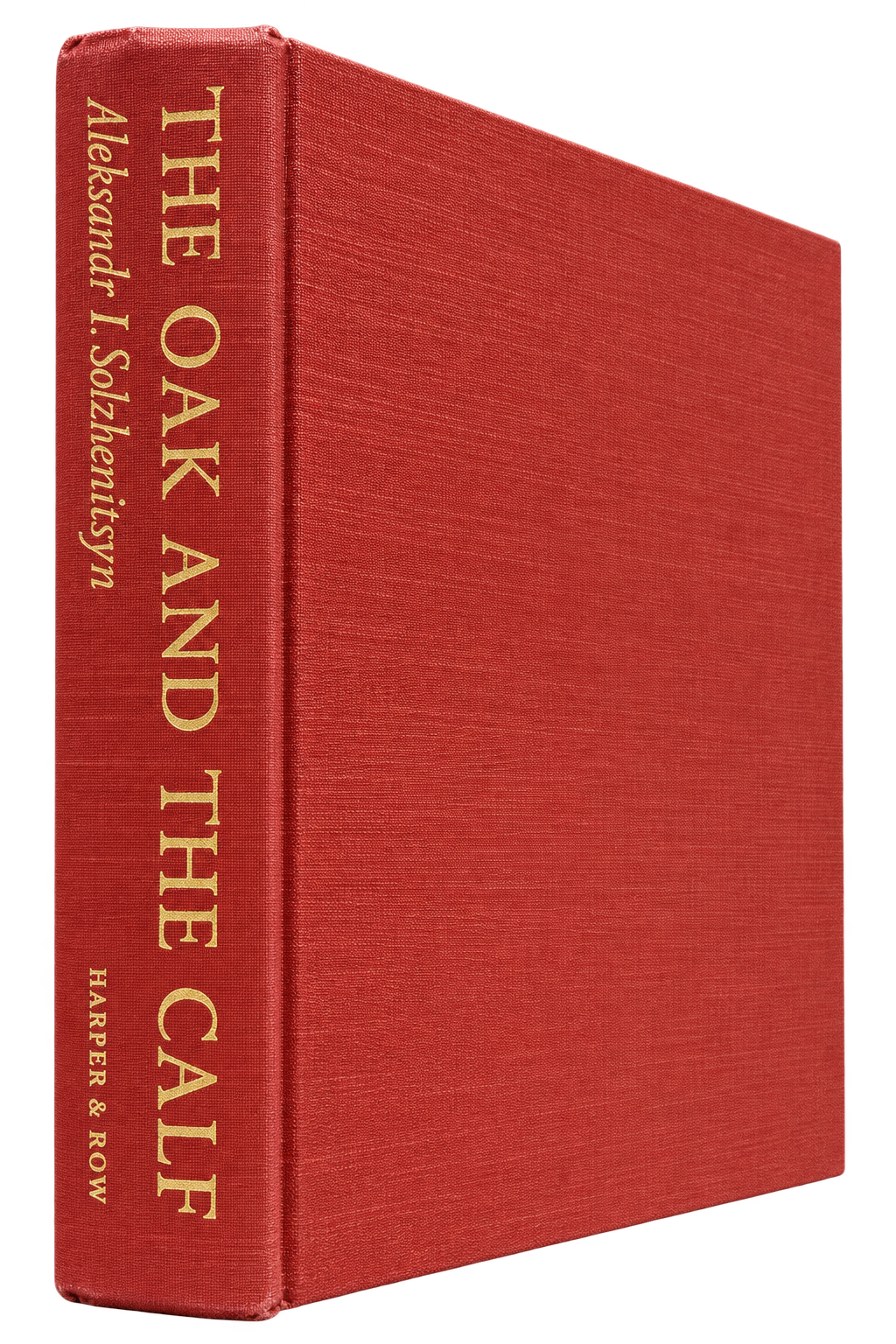
Full Title:The Oak and the Calf: Sketches of Literary Life in the Soviet Union
Aleksandr Solzhenitsyn
Harper & Row, Publishers, New York · 1980
First American Edition · First Printing
The Book: First American edition, first printing of Aleksandr Solzhenitsyn’s The Oak and the Calf: Sketches of Literary Life in the Soviet Union, translated from the Russian by Harry Willetts. The copyright page explicitly states “FIRST HARPER & ROW EDITION” and carries the complete first-printing number line 10 9 8 7 6 5 4 3 2 1. Original salmon-colored publisher’s cloth with silver spine lettering. No evidence of book-club manufacture, rebinding, later printing, facsimile binding, or other bibliographic inconsistencies observed. This copy is without dust jacket.
Condition: Near Fine. The original publisher’s cloth remains clean with bright silver spine lettering, a square and tight binding, and a clean interior free of ownership markings, foxing, restoration, or structural defects. Light rubbing and minor shelf handling to the cloth. No dust jacket present.
Story Of The Book
Authoritarian governments can imprison writers. Solzhenitsyn discovered something more subtle: they can try to control whether writing exists at all.
The Oak and the Calf is Solzhenitsyn’s autobiographical account of his struggle to write, preserve, circulate, and publish literature within the Soviet Union. Rather than returning primarily to the prisons and labor camps that made him one of the twentieth century’s most important witnesses, he turns his attention to the institutions surrounding literature itself—the publishers, editors, censors, political authorities, and surveillance apparatus that determined which words could reach the public.
The book traces the years in which Solzhenitsyn wrote and fought to publish the works that would eventually expose Soviet repression to the world. His conflict with the state demonstrates that censorship does not require simply banning a finished book. A government capable of controlling publishers, literary institutions, professional careers, and access to readers can attempt to prevent inconvenient literature from becoming public knowledge in the first place.
Solzhenitsyn nevertheless continued writing. Manuscripts were hidden, circulated outside official channels, and ultimately carried beyond the Soviet Union. By the time The Oak and the Calf appeared in this American edition, its author had himself been expelled from his country.
The memoir therefore records an extraordinary struggle over a deceptively simple question: who gets to decide whether a writer can reach a reader?
Why It’s In The Collection
The Oak and the Calf belongs in the collection because it provides something unusually valuable: a dissident writer’s firsthand account of how censorship actually works from the inside.
Other Solzhenitsyn works in the collection document what Soviet repression did to human beings. One Day in the Life of Ivan Denisovich reduces the Gulag to the experience of a single prisoner. The Gulag Archipelago reconstructs the enormous system behind that experience. The Oak and the Calf documents another part of the same authoritarian structure: the machinery attempting to control what could be written and remembered about it.
That distinction makes the book especially important to the collection’s treatment of free expression. Solzhenitsyn shows censorship not as a single prohibition but as a system—publication denied, manuscripts endangered, writers surveilled, institutions pressured, and access to audiences controlled. His eventual success demonstrates why authoritarian governments fear independent literature: once testimony escapes the institutions designed to contain it, the state loses its monopoly over the historical record.
This first American edition preserves Solzhenitsyn’s own history of that struggle after his expulsion from the Soviet Union, transforming the mechanisms that once operated against him in secrecy into a permanent public record.
Collection Categories: Witness Literature · Free Expression · Censorship · Anti-Totalitarianism · Memoir & Testimony
———
Authentication Evidence
• Title page identifies Harper & Row, Publishers, New York.
• Copyright page dated 1979 with FIRST HARPER & ROW EDITION explicitly stated.
• Complete first-printing number line present: 10 9 8 7 6 5 4 3 2 1, confirming a first printing.
• Title page correctly identifies The Oak and the Calf: Sketches of Literary Life in the Soviet Union.
• Translator correctly identified as Harry Willetts.
• Original publisher's cloth binding with silver spine lettering present and consistent with the first American issue.
• No evidence of book club manufacture, rebound covers, later printing, facsimile binding, or other bibliographic inconsistencies observed.

Breyten Breytenbach
Farrar, Straus and Giroux, New York · 1985
First American Edition · First Printing
The Book: First American edition, first printing of Breyten Breytenbach’s The True Confessions of an Albino Terrorist. The copyright page explicitly states “First American printing, 1985.” Original black cloth spine over black paper-covered boards in the original unclipped first-state dust jacket. No evidence of book-club manufacture, remainder marking, rebinding, ex-library provenance, or facsimile components.
Condition: Near Fine book in Near Fine dust jacket. The original jacket exhibits only light age toning and minimal handling wear. The book remains exceptionally clean with a tight binding, bright gilt spine lettering, and no ownership markings, foxing, structural defects, or restoration observed.
Story Of The Book
Breyten Breytenbach entered prison as a poet and emerged determined to expose the machinery of apartheid from within.
A South African writer and opponent of apartheid, Breytenbach was imprisoned by the apartheid government. The True Confessions of an Albino Terrorist transforms that experience into a literary examination of political imprisonment, interrogation, isolation, identity, and state repression.
Rather than describing apartheid solely through its laws or public institutions, Breytenbach writes from inside its machinery of coercion. His account explores what happens when authoritarian power acquires physical control over an individual and attempts to extend that control inward—over memory, identity, language, and the prisoner's understanding of himself.
The result combines firsthand testimony with literary reflection. Breytenbach does not portray resistance as uncomplicated heroism. He records its loneliness, uncertainty, fear, and moral complexity, revealing political imprisonment as an attempt not merely to confine the body but to destabilize the individual contained within it.
Published in the United States in 1985, during apartheid's final decade, this first American edition brought Breytenbach's testimony to American readers while the system he condemned remained in power.
Why It’s In The Collection
The True Confessions of an Albino Terrorist represents one of the collection’s most important forms of historical evidence: testimony produced by someone who personally experienced the exercise of authoritarian power.
Breytenbach does not reconstruct political imprisonment through government documents or later historical research. He describes what imprisonment, interrogation, and repression actually did to the individual subjected to them. That makes the book an important example of witness literature—an account capable of restoring human experience to systems of oppression that can otherwise be understood only through laws, institutions, and statistics.
The first American edition also preserves the international transmission of that testimony. Published while apartheid remained in force, it carried the account of an imprisoned South African dissident into the United States at a moment when international opposition to the regime was intensifying.
Within the collection, the book therefore documents both political imprisonment and the act of bearing witness afterward. Authoritarian power temporarily controlled Breytenbach’s physical freedom. Publication gave him the opportunity to describe that power publicly, permanently, and beyond the borders of the government that had imprisoned him.
Collection Categories: Witness Literature · Memoir & Testimony · Political Imprisonment · Political Dissent · Anti-Authoritarianism · Human Rights · Free Expression
———
Authentication Evidence
• Title page reads Farrar Straus Giroux, New York, consistent with the first American edition.
• Copyright page states Copyright © 1983 and First American printing, 1985, establishing this as the first American edition rather than the true first edition.
• Copyright page explicitly states "First American printing, 1985," establishing first-printing status.
• Original publisher's binding matches the first American issue.
• Original unclipped first-state dust jacket present.
• No evidence of book club manufacture, remainder marks, rebinding, ex-library provenance, or facsimile dust jacket observed.
• The observed bibliographic evidence is consistent with a first American edition, first printing.
Dangerous Book of the Month
Some books are worth exploring precisely because their ideas are terrible. Here we examine books that were harmful, hateful, or legitimately dangerous — books that helped bad ideas travel.
These books weren't admitted into the collection to be admired. They're here because they are or once were powerful, and power is the defining subject of anti-authoritarianism.
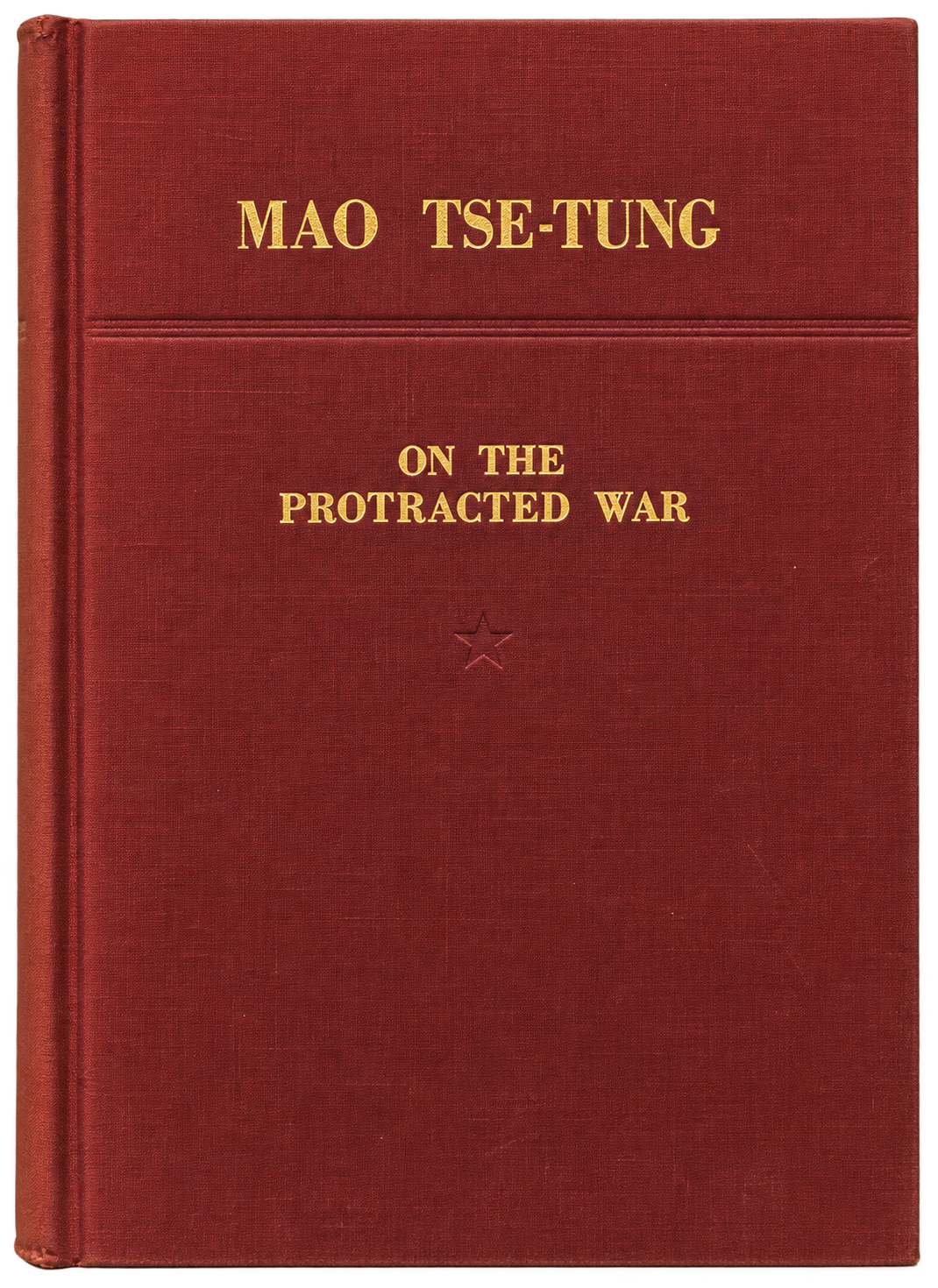
Mao Tse-tung (Mao Zedong)
Foreign Languages Press, Peking · 1954
First English Edition · First Printing
The Book: First English-language edition, first printing of Mao Tse-tung’s On the Protracted War. The title page explicitly states “First Edition · June 1954” and identifies Foreign Languages Press, Peking, as publisher. The publisher’s note explains that the English translation was based upon the second edition of the Chinese text, while the present English-language volume itself is explicitly identified as the first edition and contains no indication of a later impression or reprint. Original publisher’s maroon cloth with silver lettering. Printed in the People’s Republic of China by the state publisher responsible for disseminating Mao’s writings internationally. No evidence of rebinding, facsimile production, ex-library provenance, restoration, or later publisher issue observed.
Condition: Near Fine. The original maroon publisher’s cloth remains exceptionally well preserved with bright silver lettering, a square and sound binding, and a clean interior. Only light shelf wear is present. No documented ownership history, institutional markings, rebinding, or restoration observed.
Story Of The Book
Before Mao Zedong became one of history’s most powerful dictators, he had to persuade people to follow him.
Originally delivered in 1938 during the Second Sino-Japanese War, On the Protracted War presented Mao’s argument for how a materially weaker China could ultimately defeat Japan through a prolonged conflict. Rather than accepting either inevitable defeat or the possibility of rapid victory, Mao described war as a process whose balance of power could change through endurance, organization, popular mobilization, and strategic patience.
The historical irony is what makes the book especially important to this collection. Mao appears here not principally as the ruler of an authoritarian state, but as a revolutionary intellectual explaining how a weaker movement can resist superior power. The rhetoric is disciplined, strategic, and often persuasive. It offers sacrifice, national liberation, and eventual victory rather than openly announcing the coercive political system that would later emerge under Mao’s leadership.
That distinction matters. Authoritarian movements do not necessarily begin by advertising repression. They can begin with arguments about liberation, justice, national survival, equality, and resistance to an existing order.
On the Protracted War preserves Mao while he is making that argument.
Why It’s In The Collection
On the Protracted War occupies an unusual place in the collection because the dissident eventually became the dictator.
Most objects in the collection document individuals challenging systems of power. Mao complicates that narrative. His revolutionary movement genuinely confronted existing political and military authority, yet the government he ultimately led concentrated enormous power of its own and presided over catastrophic campaigns of political repression and social engineering.
That makes the book valuable precisely because its ideas cannot be dismissed as obviously monstrous. The collection preserves harmful and authoritarian ideas not to admire them, but because understanding power requires understanding how people become persuaded to build, surrender to, or participate in it. On the Protracted War captures Mao as strategist and revolutionary advocate, before the consequences of Maoism had become historical knowledge.
This 1954 first English edition adds another layer. Issued by Foreign Languages Press after Mao had taken power, it represents the Chinese state deliberately translating and exporting the revolutionary arguments that helped bring that state into existence. The physical object therefore connects revolutionary dissent to institutional power: ideas once used to challenge authority were now being disseminated internationally by the government those ideas helped create.
Within the collection, Mao therefore serves as a warning against treating anti-authoritarianism as a permanent identity rather than a principle. Someone can resist one system of domination and subsequently construct another. The meaningful question is not simply whether a person challenges power, but what happens when that person finally possesses it.
Collection Categories: Political Dissent · Political Movements · Political History · War & Conflict · Anti-Authoritarianism · Counter-Thesis Object · Publication-Event Object
———
Authentication Evidence
• Title page identifies On the Protracted War by Mao Tse-tung, published by Foreign Languages Press, Peking.
• First Edition Evidence: Title page states "First Edition · June 1954," consistent with the first English-language edition issued by Foreign Languages Press.
• First Printing Evidence: Publisher's note specifies that this English translation is based upon the second edition of the Chinese text while the title page explicitly identifies the present volume as the First Edition (June 1954) with no indication of any later impression or reprint.
• The volume was printed in the People's Republic of China by the original state publisher responsible for disseminating Mao's works internationally.
• Original publisher's maroon cloth binding with silver lettering matches known first English issue examples.
• No evidence of rebinding, facsimile production, ex-library provenance, restoration, or later publisher issue observed.
• The observed bibliographic evidence is fully consistent with an authentic First English Edition, First Printing.
The frightening thing about this book isn't that Mao sounds like a monster. It's that he doesn't.
Written while Mao was still a revolutionary leader fighting for power, On the Protracted War presents revolution as disciplined, rational, strategic, and ultimately hopeful. The ideas helped guide a movement that would eventually seize control of China and establish one of the twentieth century's most powerful authoritarian states.
This first English-language edition preserves those arguments not as the commands of a dictator, but as the persuasion of a revolutionary who had not yet won power.
Bad ideas don't always announce themselves as bad ideas. Sometimes they arrive as convincing answers to real problems. That's often exactly what makes them both popular and powerful.
Chairman Mao would later rule China for 27 years, overseeing political purges, mass repression, the Cultural Revolution, and the Great Leap Forward — a campaign that produced a catastrophic famine in which tens of millions died.
John Cudahy
Privately Printed · New York · 1940
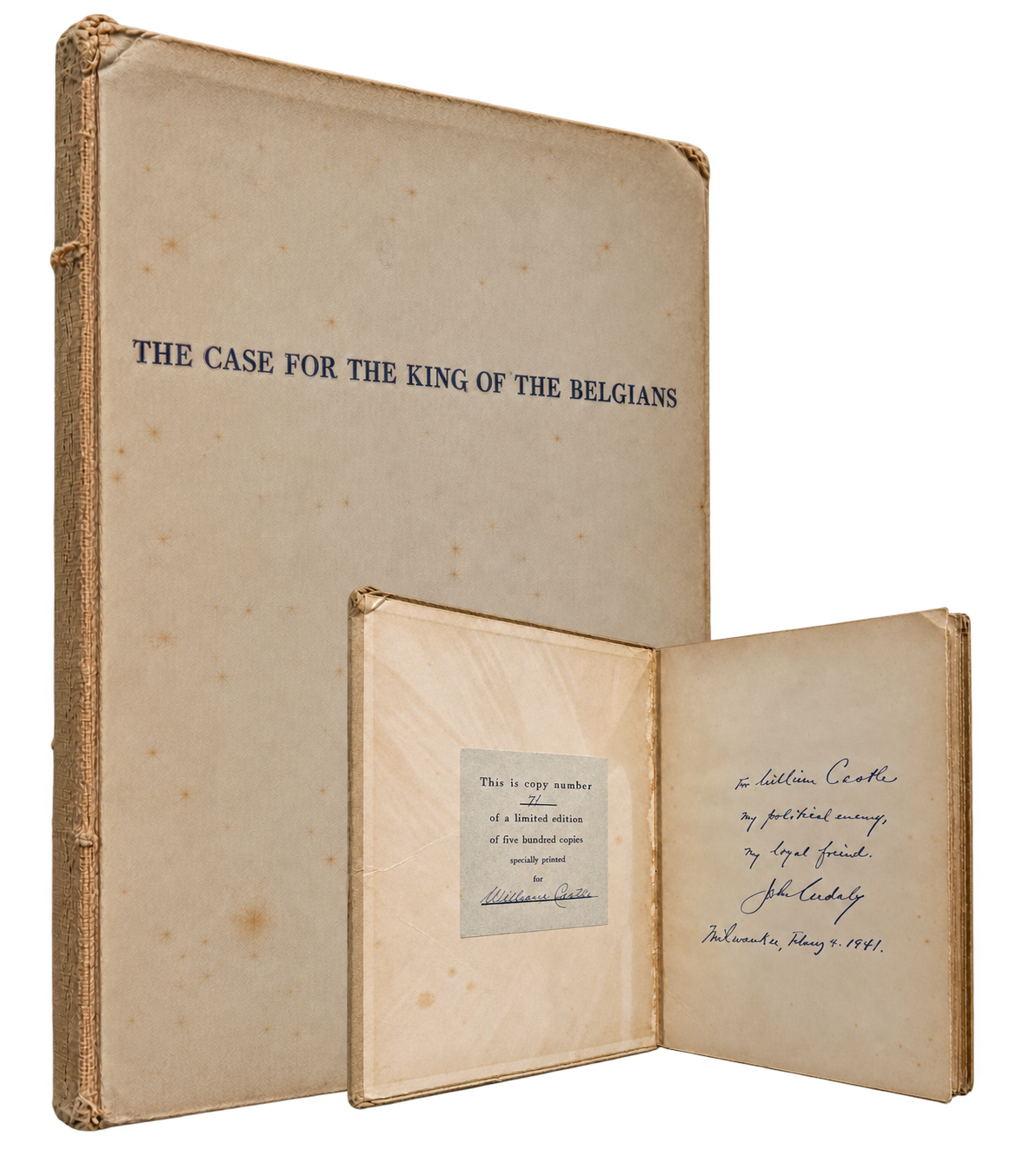
First Edition · First Printing · Limited Edition · No. 71 of 500 · Signed Presentation Copy
The Book:
The First Edition · First Printing of John Cudahy’s The Case for the King of the Belgians, privately published in 1940 as an immediate defense of King Leopold III after Belgium’s surrender to Germany. Cudahy had served as U.S. Ambassador to Belgium during the German invasion, and used his firsthand diplomatic experience to challenge the prevailing Allied accusation that Leopold’s surrender amounted to betrayal. This copy is No. 71 of a limited edition of 500 copies specially printed for William Richards Castle Jr., former U.S. Ambassador to Japan and Under Secretary of State, and is personally inscribed by Cudahy to Castle in 1941.
Condition:
Good+. Original paper-covered hard boards remain present, with title printed in blue to the front board. Externally worn, with overall soiling and spotting, edge and corner wear, and substantial loss to the paper covering of the spine exposing portions of the underlying binding structure. Interior is substantially cleaner and remains sound and intact. No modern rebinding or restoration observed.
Story Of The Book
Belgium had fallen to Hitler. Its king had surrendered his army. Much of the Allied world called him a traitor. John Cudahy disagreed—and published his case while the controversy was still unfolding.
As U.S. Ambassador to Belgium during the German invasion, Cudahy had watched the crisis at close range. In The Case for the King of the Belgians, he argued that Leopold III’s decision to surrender was not simple betrayal, but a wartime act that had to be judged against the military collapse happening around him.
That made the book a contemporary intervention, not a retrospective history. Later events would complicate Cudahy’s defense of Leopold, but in 1940 much of that history had not happened yet. Cudahy was disputing the emerging wartime narrative while its ultimate meaning remained unsettled.
This copy carries that dispute directly into the world of American diplomacy. Its limitation states that it was specially printed for William Richards Castle Jr., and Cudahy later inscribed it to him:
“For William Castle / my particular enemy / my loyal friend.”
Castle and Cudahy were politically engaged friends who disagreed while moving through the same diplomatic and anti-interventionist circles. Surviving correspondence places them together in 1941 discussing Germany, American intervention, and the possibility of negotiated peace.
The book argued against a wartime consensus. This copy preserves that argument inside the private network where such questions were being debated.
Why It’s In The Collection
The Case for the King of the Belgians belongs in Consigned to Darkness because wartime narratives acquire power quickly—and dissent becomes more consequential when the facts are still unsettled.
Cudahy was not defending an abstract historical figure decades later. He was a recently serving ambassador challenging the dominant interpretation of an event he had personally witnessed. Later history would complicate his defense considerably, but Cudahy did not have the benefit of later history.
The association copy makes the object substantially stronger. This was not merely one of 500 privately printed books; it was one of 500 copies printed for a specific senior American diplomat and then personally inscribed to that same diplomat by the author. That places the physical book inside the political conversation it represents.
Its significance is not that Cudahy was necessarily right. It is that the object preserves a senior diplomat resisting the simplification of wartime events into an accepted moral narrative—and doing so before history had finished deciding what they meant.
The public argument concerned a king. This copy preserves the private argument among diplomats about war, loyalty, and truth.
Collection Categories: Publication-Event Object · Witness Literature · Memoir & Testimony · Political Dissent · Political History · War & Conflict · Conservative Intellectual History · Diplomacy & Statecraft · Anti-Interventionism
———
Authentication Evidence
Title page identifies the work as The Case for the King of the Belgians by The Honorable John Cudahy, The American Ambassador to Belgium and Minister to Luxembourg.
Title page is printed New York · 1940.
Independent bibliographic records identify the privately published 1940 New York issue as the original edition of the work.
Integral limitation leaf explicitly states: “This is copy number 71 of a limited edition of Five Hundred copies specially printed for William Castle.”
Present copy is therefore directly identified as No. 71 of 500.
The limitation statement itself directly associates the special printing with William Castle.
Front blank bears a presentation inscription addressed “For William Castle.”
Inscription is signed “John Cudahy” and dated “Richmond, Va. 1941.”
Inscription reads “my particular enemy / my loyal friend,” consistent with a personal relationship involving political disagreement and friendship.
William Castle is identified as William Richards Castle Jr. (1878–1963), former U.S. Ambassador to Japan and Under Secretary of State.
Surviving archival correspondence independently documents direct contact between Castle and Cudahy in 1941.
Castle’s February 14, 1941 correspondence records meeting with John Cudahy and Charles Lindbergh concerning Cudahy’s proposed reporting from Germany and the possibility of negotiated peace.
That correspondence independently corroborates the historical plausibility of the presentation inscription and association.
Original paper-covered hard boards and integral leaves are consistent with the privately printed limited issue.
No evidence of facsimile reproduction, later reprint, modern rebinding, or restoration is observed.
First Edition identification is supported by the original 1940 privately printed issue.
First Printing identification is supported by the integral limitation statement identifying this copy as part of the original limited printing of 500.
Limitation, authorship of the presentation inscription, and association with William Richards Castle Jr. are mutually consistent across the physical and documentary evidence.
Observable evidence supports identification as the 1940 First Edition · First Printing · No. 71 of 500 · Signed Presentation Copy to William Richards Castle Jr.
The Case For The King of the Belgians
John Cudahy, Privately Printed, 1940. Signed, Numbered, and Inscribed.
Limited edition, first printing.
One of the things I love most about collecting historical books is that sometimes the people who pen these pages have no idea how history will remember their present.
In February 1941, the future was especially uncertain for John Cudahy when he signed and inscribed this book to his friend and political adversary William Richards Castle Jr., former Under Secretary of State and U.S. Ambassador to Japan.
Neither man knew that ten months later the United States would be thrust into the war, transforming the course of the conflict and the future of the world they knew.
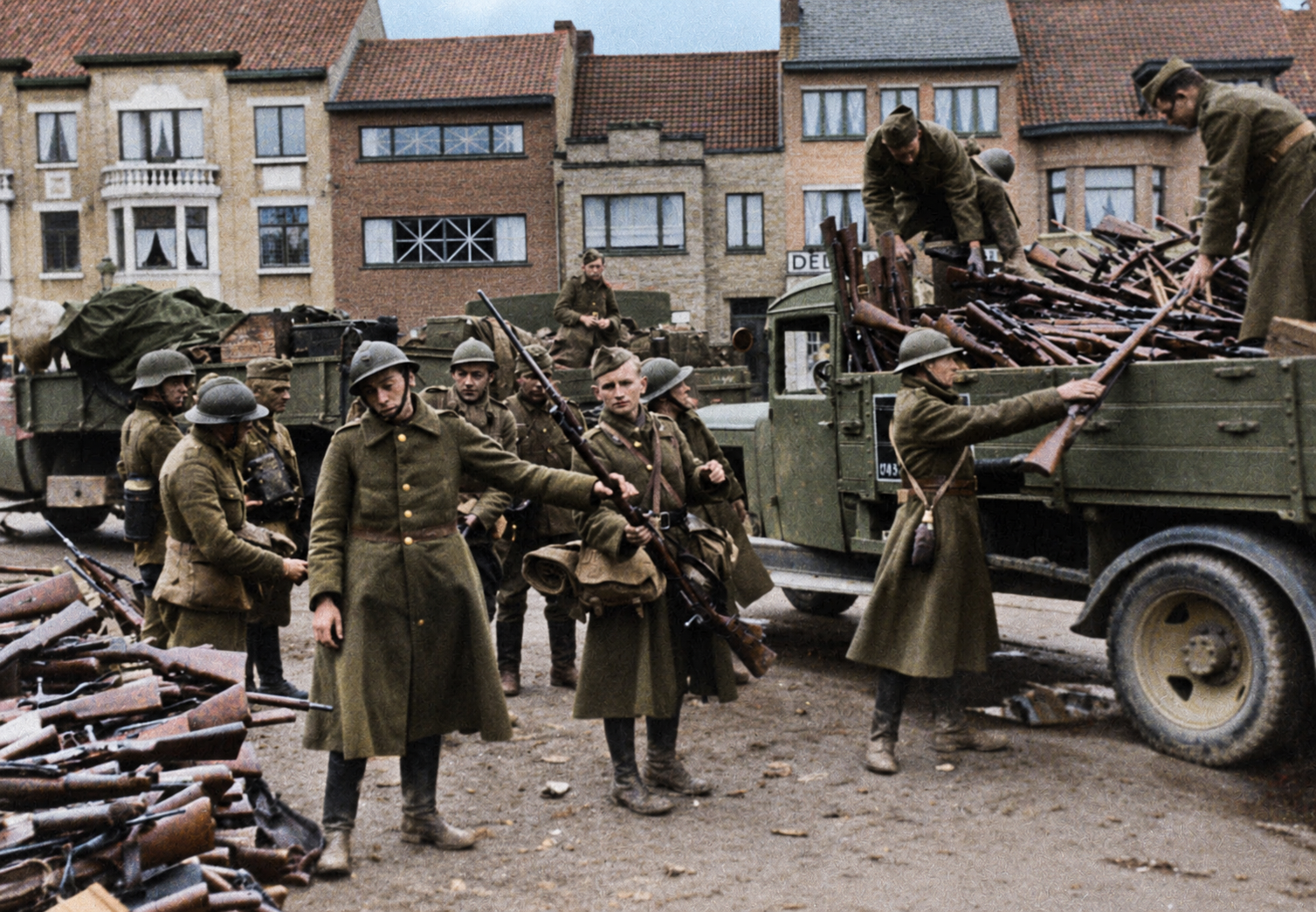
In 1940, Belgium had fallen to Hitler and King Leopold III had surrendered his army. Across the Allied world, a story was already taking shape: the King had betrayed his country. Cudahy, the sitting U.S. Ambassador to Belgium during the Nazi invasion, thought that judgment was dangerously simple. So, while the controversy was still unfolding, he privately printed 500 copies of his defense of the King.
History would later complicate Cudahy's argument considerably. But Cudahy didn't have the benefit of history. All he had to go on were the events unfolding before him in real time. That's what makes this book so fascinating: it preserves an insider's eyewitness account arguing against an emerging consensus before anyone knew how the story would end. The Holocaust, Pearl Harbor, the hidden horrors of Imperial Japan's Unit 731, and the ultimate shape of the postwar world were significant unknowns in Cudahy's world.
And this particular copy brings us even closer to that uncertain moment. It was specially printed for Castle, then personally inscribed to him by Cudahy: “For William Castle / my political enemy / my loyal friend.”
These weren't random historical figures whose names later ended up in the same book. They knew one another. They disagreed with one another. They themselves were actively debating Germany, American intervention, war, and the possibility of peace while history was being forged around them daily.
That's why I love this book! It gives readers a uniquely personal glimpse into a world whose future was still radically uncertain — as we turn its pages today, in a world neither man could have imagined. This is definitely a “story of the book” I personally think you should know about.