
 Image 1 of 1
How Cuba Uprooted Race Discrimination — Harry Ring
Harry Ring
Merit Publishers · New York · 1969
Second Edition · First Printing · Revised Introduction
The Book:
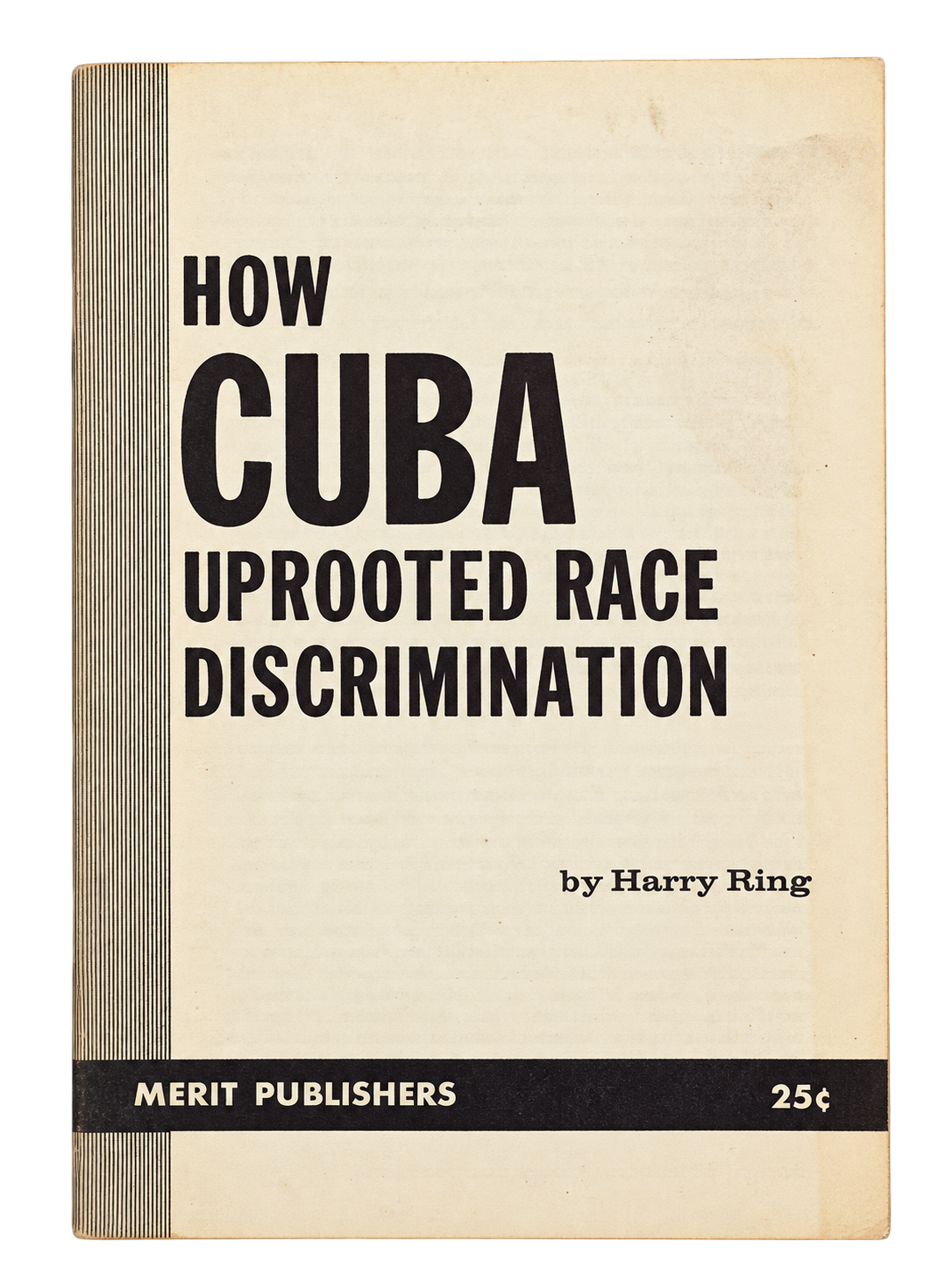
The June 1969 second edition of Harry Ring's How Cuba Uprooted Race Discrimination, published by Merit Publishers in New York. Originally issued by Pioneer Publishers in 1961, this revised 15-page pamphlet incorporates a new introduction informed by Ring's return visit to Cuba in 1968. Original white printed wrappers with bold black typography, striped spine decoration, and the original 25¢ cover price.
Condition:
Near Fine. Original printed wrappers remain bright and well preserved, with faint uneven discoloration, minor handling marks, and slight edge and corner wear. Interior pages are clean and bright. Binding remains sound, with no significant creasing, tears, paper loss, or restoration observed.
Story Of The Book
In 1961, an American socialist traveled to revolutionary Cuba and claimed to have witnessed something his own country had failed to accomplish: the dismantling of institutionalized racial discrimination.
While Black Americans were still fighting Jim Crow, Harry Ring argued that Cuba had begun tearing down the economic and political structures that kept Black people unequal.
He returned eight years later, convinced that the revolution had delivered on its promise. This 1969 edition brought his original argument back into circulation with a new introduction reaffirming his conclusions.
Yet the government Ring celebrated was also suppressing political dissent, raising an uncomfortable question: Can a revolution liberate people from one form of oppression while subjecting them to another?
Why It's In The Collection
How Cuba Uprooted Race Discrimination belongs in Consigned to Darkness because the history of political liberation is rarely as simple as the division between those who oppress and those who resist.
Ring's pamphlet captures a moment when American socialists looked to revolutionary Cuba as evidence that entrenched racial inequalities could be challenged through radical economic and political transformation. His argument was especially provocative in an America still struggling to dismantle segregation.
But the pamphlet also invites a more difficult conversation. The Cuban government pursued policies intended to reduce racial inequality while simultaneously concentrating political power and restricting dissent. Ring's enthusiastic assessment preserves how one contemporary observer understood those achievements and contradictions.
This particular 1969 edition is significant because Ring returned to Cuba, reconsidered the revolution's progress, and chose to reaffirm his original conclusions. It preserves not simply an early revolutionary promise, but a contemporary defense of that promise after nearly a decade of experience.
The question isn't whether Cuba challenged racial discrimination. It's whether progress toward one kind of freedom can justify the denial of another.
Collection Categories: Civil Rights · Human Rights · Political History · Political Movements · Anti-Colonialism · Labor & Economic Justice · Political Dissent
Authentication Evidence
Original front wrapper identifies How Cuba Uprooted Race Discrimination by Harry Ring.
Front wrapper identifies Merit Publishers and retains the original printed 25¢ price.
Introduction explicitly states “First edition, June 1961; second edition, June 1969.”
The June 1969 introduction discusses Ring's visits to Cuba in 1960 and 1968, distinguishing this revised edition from the original 1961 publication.
Revised introduction begins on page 2 and continues through page 5.
Original text begins on page 6 under the heading “How Cuba Uprooted Race Discrimination.”
Final numbered page is 15, consistent with independently documented copies of the 1969 edition.
Page 15 reproduces the political advertisement “Cuba — A Declaration of Conscience,” originally published in April 1961.
Rear wrapper advertises Merit Publishers' socialist and Cuban revolutionary publications, including The Diary of Che Guevara: Bolivia, Nov. 7, 1966–Oct. 7, 1967.
Rear wrapper identifies Merit Publishers at 873 Broadway, New York, N.Y. 10003.
Independent bibliographic records document the original June 1961 Pioneer Publishers edition, with an introduction by Richard Gibson.
ABAA/ILAB-affiliated Bolerium Books independently catalogs a 1969 Merit Publishers edition with an added introduction and 15 pages.
Original publisher's wrappers, revised introduction, pagination, and publisher advertisements correspond to the documented June 1969 second edition.
No later-printing statement or evidence of a subsequent impression was identified in the examined copy.
Combined bibliographic and physical evidence supports identification as the June 1969 Second Edition. First-printing status within that edition has not been independently established.