
 Image 1 of 1
El Diario del Che en Bolivia — Ernesto “Che” Guevara
Full Title:El Diario del Che en Bolivia: Noviembre 7, 1966 a Octubre 7, 1967
Ernesto “Che” Guevara
Havana: Instituto del Libro, 1968
First Edition · First Printing
The Book:
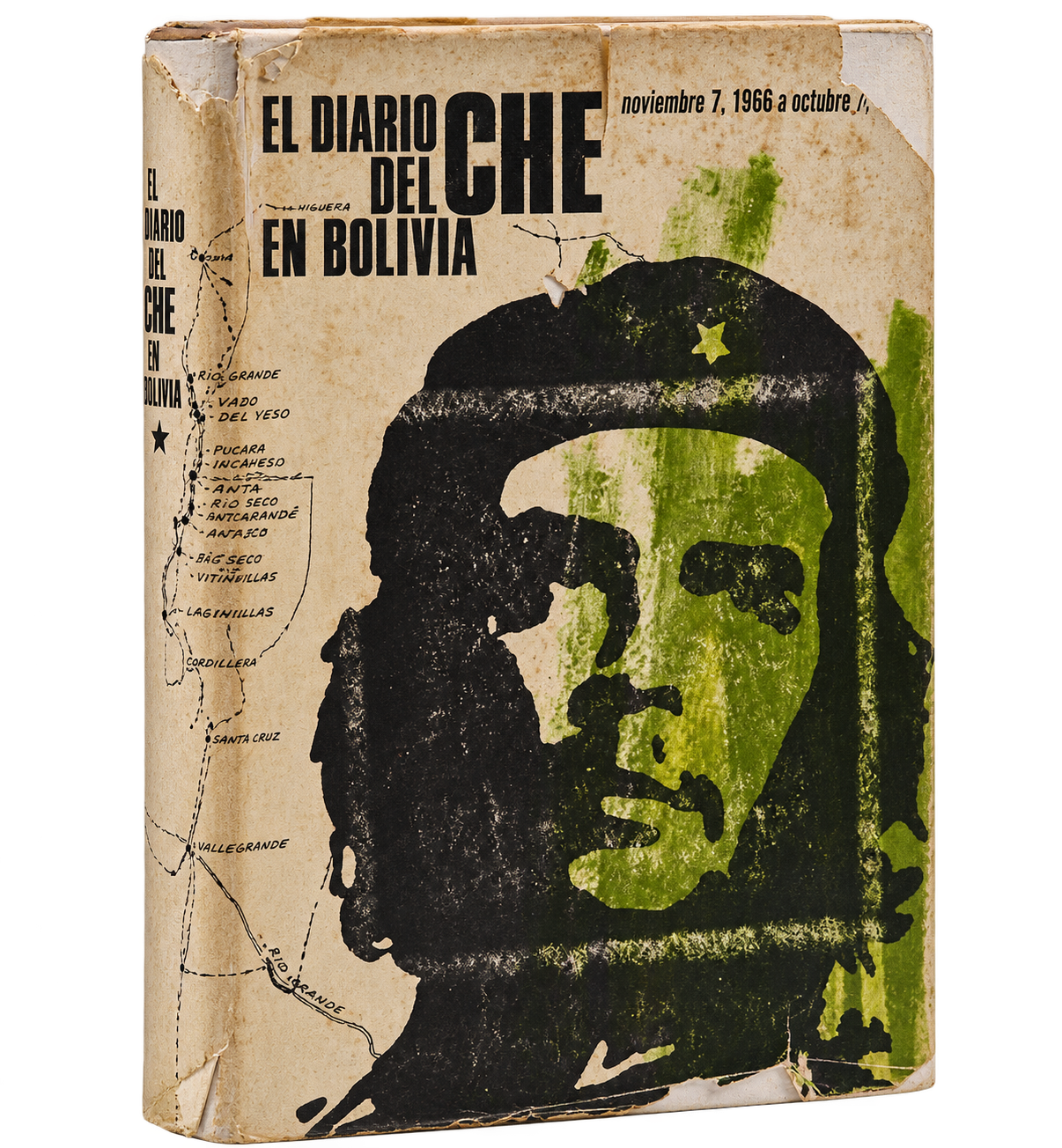
The first Cuban edition, first printing of Che Guevara’s El Diario del Che en Bolivia, published in Havana by the Instituto del Libro in 1968, the Cuban government’s designated “Año del Guerrillero Heroico.” The volume reproduces Guevara’s private operational diary from his final guerrilla campaign in Bolivia, covering November 7, 1966 through October 7, 1967, with an introduction by Fidel Castro. This copy retains its original hard paper wrappers and original illustrated dust jacket. The first Cuban printing comprised 250,000 copies and was issued on June 26, 1968, less than nine months after Guevara’s death. This copy lacks the folding map originally issued loose at the front but is otherwise textually complete, with xxix, 346 pages and seven leaves of photographic plates.
Condition:
Very Good+ in a Very Good dust jacket. The original wrappers remain complete with moderate handling wear, edge rubbing, corner wear, and age toning consistent with use. The illustrated dust jacket shows edge wear and light toning but remains complete and presents attractively. The binding is sound and the interior complete and clean. The folding map originally issued loose at the front is absent.
Story Of The Book
Few revolutionary documents were intended less for publication than Che Guevara’s Bolivian diary.
This was not a manifesto written for supporters, a memoir polished after victory, or a history constructed with the benefit of hindsight.
It was a working document.
Beginning in November 1966, Guevara recorded the progress of the guerrilla campaign he hoped would ignite revolution in Bolivia and eventually spread armed struggle across Latin America. Day by day, the diary follows the increasingly desperate reality behind that ambition: movements, encounters, disagreements, shortages, tactical decisions, physical deterioration, isolation, and the widening distance between revolutionary expectation and what was actually happening on the ground.
Then the entries stop.
Guevara’s final entry is dated October 7, 1967. The following day he was captured by Bolivian forces. On October 9, he was executed.
His private field journal survived him.
That transformed the diary into something Guevara himself could never have planned. A confidential operational record became a political document, historical artifact, and eventually one of the most recognizable firsthand texts of twentieth-century revolutionary history.
Cuba understood its importance immediately.
In June 1968, less than a year after Guevara’s death, the Instituto del Libro published this enormous 250,000-copy Cuban edition, introduced by Fidel Castro and issued during a year the revolutionary government had officially dedicated to the “Heroic Guerrilla.”
The result is an unusually complicated publication object.
The words belong to Guevara in the field. But the book belongs equally to the political struggle over what Guevara would mean after his death.
A guerrilla’s private record of a failed revolution became the document through which another revolution began constructing his immortality.
Why It’s In The Collection
El Diario del Che en Bolivia belongs in Consigned to Darkness precisely because the collection is interested in power from both sides of the barricade.
Guevara was a revolutionary fighting established governments and advocating armed resistance against political systems he considered oppressive. He was also a central figure in the Cuban Revolution and an architect and defender of a new revolutionary state that exercised coercive power of its own.
The collection does not need to resolve that contradiction to preserve it.
This book is valuable because it brings the reader unusually close to the moment before history decided what Che Guevara would become. The diary records revolutionary conviction alongside practical failure, not through a later biographer’s reconstruction but through Guevara’s own contemporaneous observations during the campaign that ended his life.
The physical edition adds another layer. Published in Havana within months of his death, introduced by Fidel Castro, and issued during Cuba’s “Año del Guerrillero Heroico,” it documents the transformation of the dead revolutionary into a political symbol. The inventory therefore treats the object not merely as a revolutionary text, but as a primary publication-event object in the construction of Guevara’s posthumous political legacy.
That makes the book simultaneously a record of insurgency, a firsthand document of failure, and an artifact of revolutionary mythmaking.
Che Guevara went to Bolivia to export a revolution. He failed. His diary traveled farther than the revolution ever did.
Collection Categories: Revolutionary Texts · Guerrilla Warfare · Revolutionary Movements · Anti-Colonialism · Political Movements · Political Dissent · Latin American Political History · Cold War
———
Authentication Evidence
• Title page identifies Instituto del Libro, La Habana, 1968 (Año del Guerrillero Heroico), consistent with the first Cuban edition.
• Title page is dated 1968, the year of the earliest Cuban publication following Guevara's death.
• No evidence of later Cuban publisher changes, modern ISBNs, or subsequent reprint statements observed.
• The book retains its original publisher's binding and original illustrated dust jacket.
• Dust jacket artwork, map design, and publisher presentation are consistent with documented first Cuban issues.
• No evidence of book club manufacture, facsimile dust jacket, rebinding, ex-library provenance, or modern reproduction observed.
• The observed bibliographic evidence is consistent with a first Cuban edition, first printing.