
 Image 1 of 1
One Day in the Life of Ivan Denisovich — Alexander Solzhenitsyn
Aleksandr Solzhenitsyn
Translated by Max Hayward & Ronald Hingley
Frederick A. Praeger · New York · 1963
First English-Language Edition · First Printing
The Book:
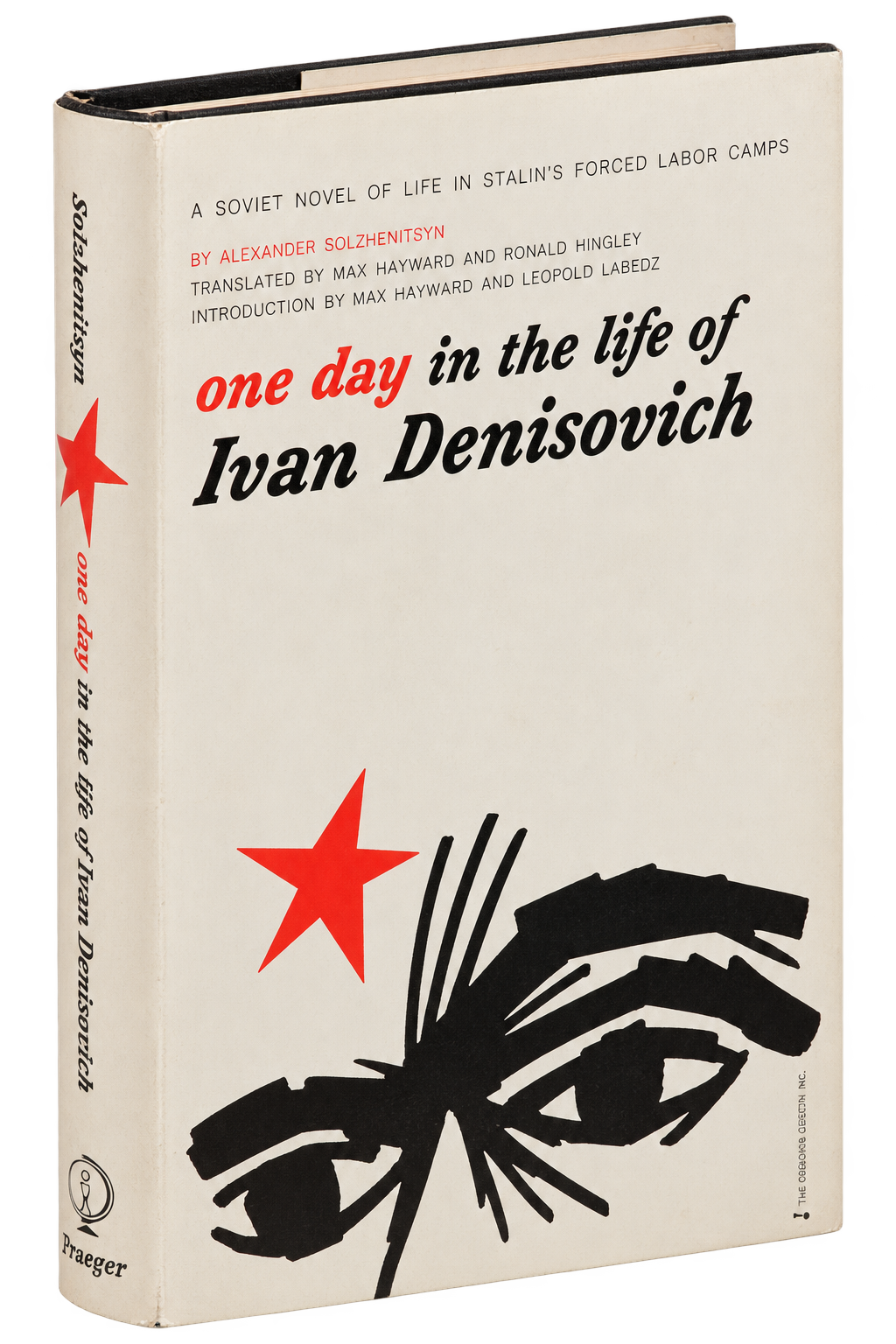
The first English-language edition, first printing of Alexander Solzhenitsyn’s One Day in the Life of Ivan Denisovich, translated by Max Hayward and Ronald Hingley and published by Frederick A. Praeger in 1963. First published in the Soviet journal Novy Mir in November 1962, the novel drew upon Solzhenitsyn’s own imprisonment to depict a single day inside Stalin’s forced-labor camp system. Original black publisher’s cloth with gilt spine lettering and red topstain, retaining the original unclipped dust jacket priced $3.95.
Condition:
Near Fine+ book in a Near Fine dust jacket. The binding remains exceptionally square and clean, with bright black cloth, strong gilt spine lettering, vivid red topstain, and a fresh interior free of ownership markings. The original unclipped jacket shows light age toning, minor scattered surface soiling, and minimal handling and edge wear, with no significant chips or tears. No foxing, restoration, or structural defects are observed.
Story Of The Book
For years, millions of people had disappeared into Stalin’s prison camps. Then the Soviet Union itself briefly allowed one survivor to tell the world what a day inside them looked like.
Alexander Solzhenitsyn knew that world personally. Arrested in 1945 after criticizing Stalin in private correspondence, he spent eight years in prisons and labor camps before being sent into internal exile. His experiences became the foundation for Ivan Denisovich Shukhov, the prisoner whose ordinary winter day forms the entire architecture of this novel.
There is no dramatic escape. Shukhov wakes, works, searches for food, protects his possessions, navigates camp rules, endures the cold, and tries to preserve whatever fragments of dignity remain available to him.
That ordinariness was the revelation.
Solzhenitsyn did not need to describe the entire Gulag. He showed what a system of political repression looked like when surviving it had become routine.
What happened next was almost as remarkable as the novel itself. During Khrushchev’s limited campaign against Stalin’s legacy, Novy Mir editor Aleksandr Tvardovsky fought to publish the manuscript. Khrushchev ultimately approved it, and the story appeared in November 1962. Soviet readers suddenly encountered a work describing the camps not as an enemy accusation, but through literature officially permitted to circulate inside the Soviet Union.
The opening did not last. As the political climate hardened, Solzhenitsyn's work faced increasing suppression, and his relationship with the Soviet state ultimately became one of the defining literary confrontations of the Cold War.
Why It’s In The Collection
One Day in the Life of Ivan Denisovich belongs in Consigned to Darkness because one of the most powerful ways to challenge a system built on dehumanization is simply to restore the individual human being it tried to erase.
The Gulag operated on an enormous scale. Solzhenitsyn deliberately refused that scale. Instead of beginning with statistics, institutions, or ideology, he gave readers one prisoner, one camp, and one day.
That choice makes the novel an extraordinary piece of witness literature despite its fictional form. Shukhov is fictional, but the world surrounding him was reconstructed by a former prisoner from lived experience. The fiction becomes a vehicle for testimony.
This 1963 Praeger edition carries additional publication-event significance. It preserves the moment that testimony crossed into English-language publication, only months after its extraordinary appearance inside the Soviet Union and while the political consequences of Solzhenitsyn's emergence were still unfolding.
Later, The Gulag Archipelago would attempt to document the vast machinery of Soviet repression. One Day began somewhere smaller.
Before asking the world to understand millions of prisoners, Solzhenitsyn asked it to spend one day with one of them.
Collection Categories: Witness Literature · Anti-Totalitarianism · Political Imprisonment · Human Rights · Censorship · Free Expression · Political Dissent · Publication-Event Object · Cold War · Literature
———
Authentication Evidence
Title page identifies One Day in the Life of Ivan Denisovich by Alexander Solzhenitsyn and Frederick A. Praeger, New York, as publisher.
Translation is credited to Max Hayward and Ronald Hingley, with an introduction by Max Hayward and Leopold Labedz.
Copyright page records the 1963 Praeger publication, with no later-printing statement observed.
Contemporary publication records establish that the Praeger Hayward/Hingley translation and E. P. Dutton’s authorized Ralph Parker translation appeared simultaneously in the United States, making each a first English-language book edition rather than giving either sole chronological priority.
Contemporary reporting identifies the Praeger publication as the unauthorized English translation, distinguishing it bibliographically from the simultaneous authorized Dutton edition.
Original black publisher’s cloth with gilt spine lettering and red topstain is present.
Original dust jacket is present and remains unclipped at $3.95, consistent with documented first-printing Praeger copies.
No evidence of book-club manufacture, later printing, rebinding, facsimile jacket, or other bibliographic anomalies is observed.
Taken together, the 1963 Praeger imprint, Hayward/Hingley translation, absence of a later-printing statement, original binding and red topstain, and original $3.95 jacket support identification as an authentic First English-Language Edition · First Printing, representing Praeger’s unauthorized translation issued simultaneously with Dutton’s authorized English-language edition.