
 Image 1 of 1
The Gulag Archipelago (Vol. I-II) — Aleksandr Solzhenitsyn
Full Title: The Gulag Archipelago, 1918–1956: An Experiment in Literary Investigation (Volumes I–II)
Aleksandr Solzhenitsyn
Translated from the Russian by Thomas P. Whitney
Harper & Row, Publishers · New York · 1974
First American Edition · First Printing
The Book:
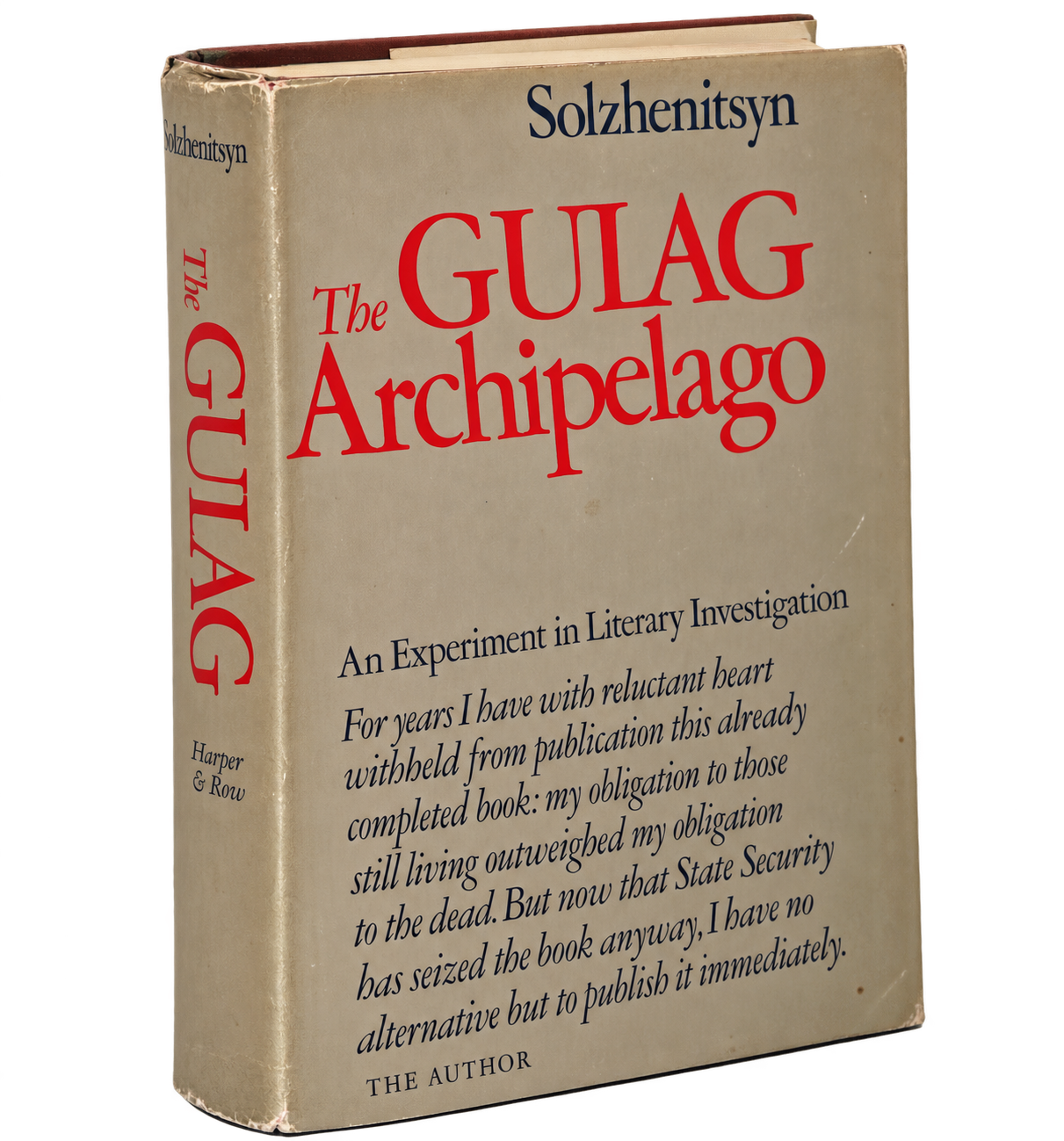
The first American edition, first printing of Aleksandr Solzhenitsyn’s The Gulag Archipelago, 1918–1956: An Experiment in Literary Investigation, containing Volumes I–II of the larger work in a single physical hardcover volume, translated from the Russian by Thomas P. Whitney and published by Harper & Row in 1974. Combining Solzhenitsyn’s own experience of imprisonment with historical investigation and testimony gathered from former prisoners, the book reconstructs the Soviet system of arrest, interrogation, imprisonment, forced labor, and exile. xii, 660 pp. Original black publisher’s cloth with gilt spine lettering, retaining the original unclipped dust jacket priced $12.50.
Condition:
Near Fine+ book in a Near Fine dust jacket. The original black cloth remains exceptionally fresh, with bright gilt spine lettering, a square binding, crisp pages, and no ownership markings, foxing, restoration, or structural defects observed. The original unclipped jacket retains excellent color with light age toning, faint rubbing, minimal edge wear, and a few tiny closed tears, but no significant chips or paper loss.
Story Of The Book
The Soviet Union built an enormous system of political imprisonment. Solzhenitsyn set out to reconstruct the world it tried to keep hidden.
The Gulag Archipelago grew from Solzhenitsyn’s own imprisonment and years of clandestine research. But unlike One Day in the Life of Ivan Denisovich, it does not confine itself to one prisoner or one camp. Solzhenitsyn combined personal experience, historical investigation, and the testimony of former prisoners to document how repression operated across decades of Soviet rule.
The result was neither conventional history nor memoir. Solzhenitsyn called it an “experiment in literary investigation.” Arrests, interrogations, transportation, forced labor, prisons, exile, executions, and survival become parts of a vast system reconstructed through the people who experienced it.
The achievement of the book was to transform millions of individual disappearances into evidence of a system.
Solzhenitsyn kept the manuscript secret because publication inside the Soviet Union was impossible and possession endangered the people who had helped him. After Soviet security discovered a hidden copy in 1973, he authorized publication abroad. The Russian edition appeared in Paris at the end of that year; translations quickly followed. Soon afterward, Solzhenitsyn was arrested, stripped of Soviet citizenship, and expelled from the country.
Why It’s In The Collection
The Gulag Archipelago belongs in Consigned to Darkness because authoritarian power depends not only on the ability to imprison people, but on the ability to control what the rest of society knows about their imprisonment.
For decades, the Gulag existed alongside official narratives that concealed, minimized, or justified political repression. Solzhenitsyn attacked that secrecy by assembling the experiences of people the system had scattered across prisons, camps, and exile.
The book therefore represents more than testimony. It is an attempt to defeat institutional forgetting.
This 1974 first American edition preserves the moment that investigation entered American public life. Published only months after the Russian edition appeared abroad—and amid the confrontation that led to Solzhenitsyn’s expulsion from the Soviet Union—it carried evidence gathered in secrecy into unrestricted circulation.
Within the collection, it also completes an important progression in Solzhenitsyn’s work. One Day in the Life of Ivan Denisovich asks readers to experience political imprisonment through one person. Cancer Ward examines what repression leaves behind. The Gulag Archipelago reconstructs the machinery that produced both.
A state could imprison its witnesses. Solzhenitsyn built a book from their voices that the state could no longer contain.
Collection Categories: Witness Literature · Anti-Totalitarianism · Political Imprisonment · Human Rights · Censorship · Free Expression · Political Dissent · Publication-Event Object · Documentary Literature · Anti-Authoritarianism
———
Authentication Evidence
Title page identifies The Gulag Archipelago, 1918–1956: An Experiment in Literary Investigation and specifies Volumes I–II.
In this Harper & Row edition, Volumes I–II are contained together in one physical hardcover book rather than issued as two separate books.
Translation is credited to Thomas P. Whitney.
Copyright page identifies the Harper & Row first American publication and contains the publisher’s first-printing statement.
Original black publisher’s cloth with gilt spine lettering is present.
Original dust jacket is present and remains unclipped at $12.50.
No evidence of book-club manufacture, later printing, rebinding, facsimile jacket, or other bibliographic anomalies is observed.
Taken together, the first-printing statement, Harper & Row imprint, Thomas P. Whitney translation, original publisher’s binding, and original priced jacket support identification as an authentic 1974 First American Edition · First Printing of Volumes I–II, issued together in a single hardcover volume.