
 Image 1 of 1
The CIA and the Cult of Intelligence — Victor Marchetti & John D. Marks
Victor Marchetti & John D. Marks
Alfred A. Knopf, Inc. · New York · 1974
First Edition · First Printing
The Book:
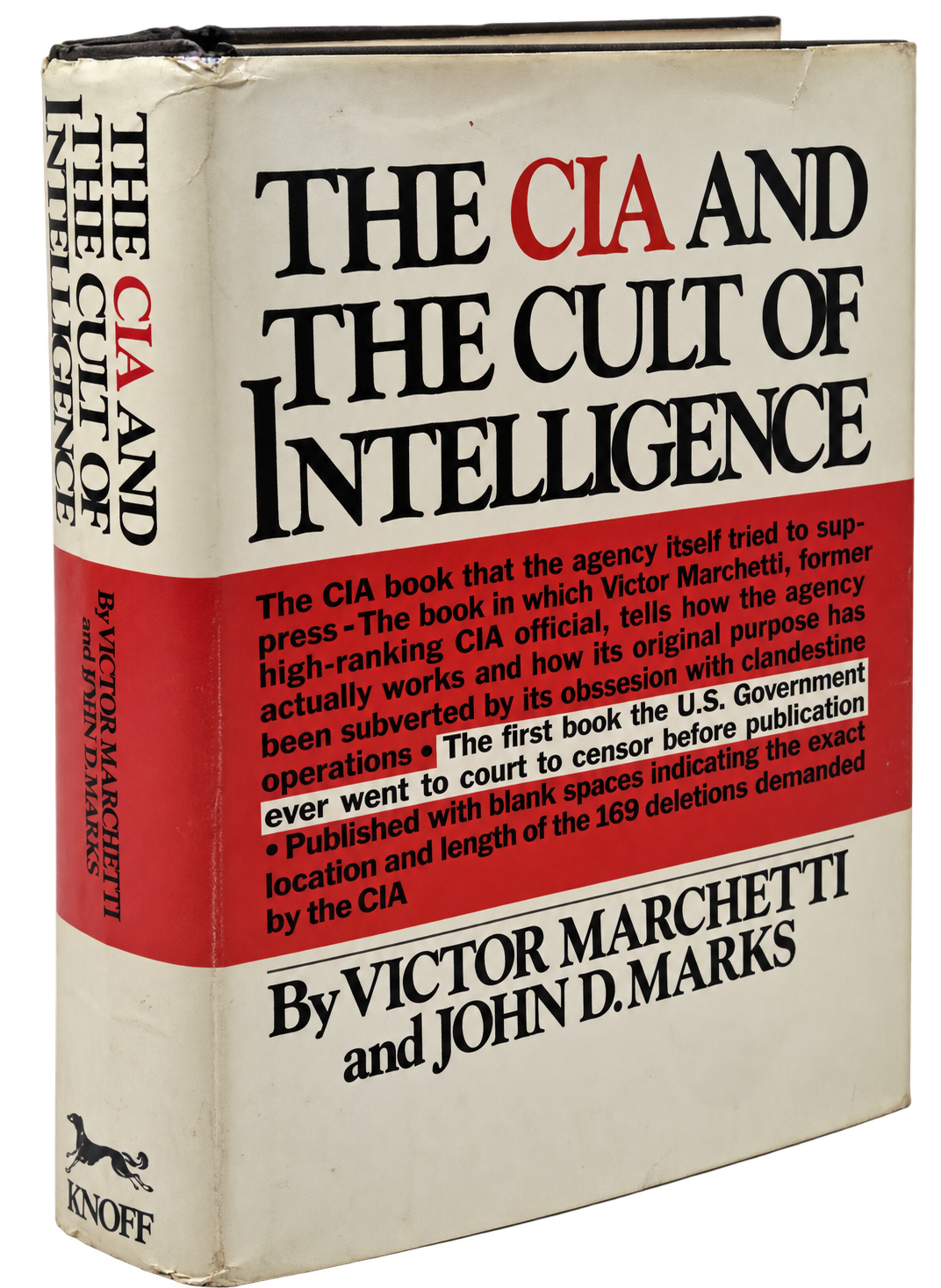
The first edition, first printing of Victor Marchetti and John D. Marks’s The CIA and the Cult of Intelligence, published by Alfred A. Knopf in 1974. The copyright page explicitly states “First Edition,” and this copy retains its original publisher’s cloth binding and original unclipped $8.95 dust jacket.
The physical book preserves the censorship battle that preceded its publication. Passages the CIA successfully prevented the authors from publishing appear as conspicuous blank spaces in the text, while material the agency initially sought to suppress but later released appears in boldface. The result is not simply a book about government secrecy: the first edition itself records the government’s intervention in what its authors were permitted to publish.
Condition:
Very Good+ book in a Good+ original dust jacket. The original publisher’s cloth binding remains intact. The unclipped $8.95 jacket shows moderate edge wear, staining, and discoloration, with corresponding light discoloration to the endpapers. No evidence of rebinding, book-club manufacture, facsimile jacket, or replacement components is observed.
Story Of The Book
The CIA tried to censor this book before the public could read it. The authors made the censorship visible instead.
Victor Marchetti had served as a senior CIA officer before leaving the agency and becoming increasingly critical of the secrecy surrounding American intelligence operations. When he joined former State Department official John D. Marks to write The CIA and the Cult of Intelligence, the government did something unprecedented: it required the manuscript to be submitted to the CIA before publication.
The agency initially ordered 339 passages deleted. After months of legal challenges and negotiations, that number fell to 168, but those remaining passages could not legally appear when Knopf published the book in 1974. Rather than disguise what had happened, the published volume preserved the absences. Blank spaces interrupt the text where information had been suppressed; passages initially challenged and subsequently released were printed in boldface.
That decision transformed censorship into something the reader could physically see. Whatever secrets disappeared from the manuscript, the exercise of government power over the manuscript remained on the page.
The CIA succeeded in keeping 168 passages out of the book. It could not keep its censorship out of the book.
Why It’s In The Collection
The CIA and the Cult of Intelligence belongs at the center of Consigned to Darkness because the object itself embodies a conflict between government secrecy and freedom of expression.
The underlying dispute was unusually difficult. Intelligence agencies necessarily possess information that governments have legitimate reasons to protect, while democratic accountability depends upon the ability of citizens, journalists, former officials, and publishers to scrutinize institutions exercising extraordinary power in secret. Marchetti and Marks forced those principles into direct confrontation.
That is why this particular edition matters. A later edition can recount the controversy, but the 1974 first edition participated in it. Its blank spaces are artifacts of the government's successful censorship; its boldface passages record censorship attempted and withdrawn; and its original jacket openly announces the extraordinary circumstances under which the book reached the public.
Most censored books preserve the words someone tried to suppress. This one preserves some of the places where the words were taken away.
Collection Categories: Free Expression · Censorship · Government Secrecy · Intelligence History · Anti-Authoritarianism · Cold War · Publication-Event Object
———
Authentication Evidence
Copyright page explicitly states “First Edition.”
No additional printing designation appears on the copyright page, consistent with the first printing.
Later Knopf printings are explicitly designated by printing number and date, distinguishing this copy from documented later printings.
Original black publisher’s cloth binding present.
Front board bears the title blind-stamped in the cloth, consistent with documented Knopf copies.
Spine lettering in matte gold is present, consistent with documented Knopf copies.
Deckled fore-edge present, consistent with documented Knopf copies.
Original unclipped $8.95 dust jacket retained.
Jacket text describes the 168 CIA deletions, consistent with the original 1974 issue.
No evidence of rebinding, book-club manufacture, facsimile jacket, or replacement components observed.
First-edition, first-printing characteristics consistent throughout.