
 Image 1 of 1
The Satanic Verses — Salman Rushdie
Salman Rushdie
Viking Penguin Inc., New York · 1989
First American Edition · Tenth Printing
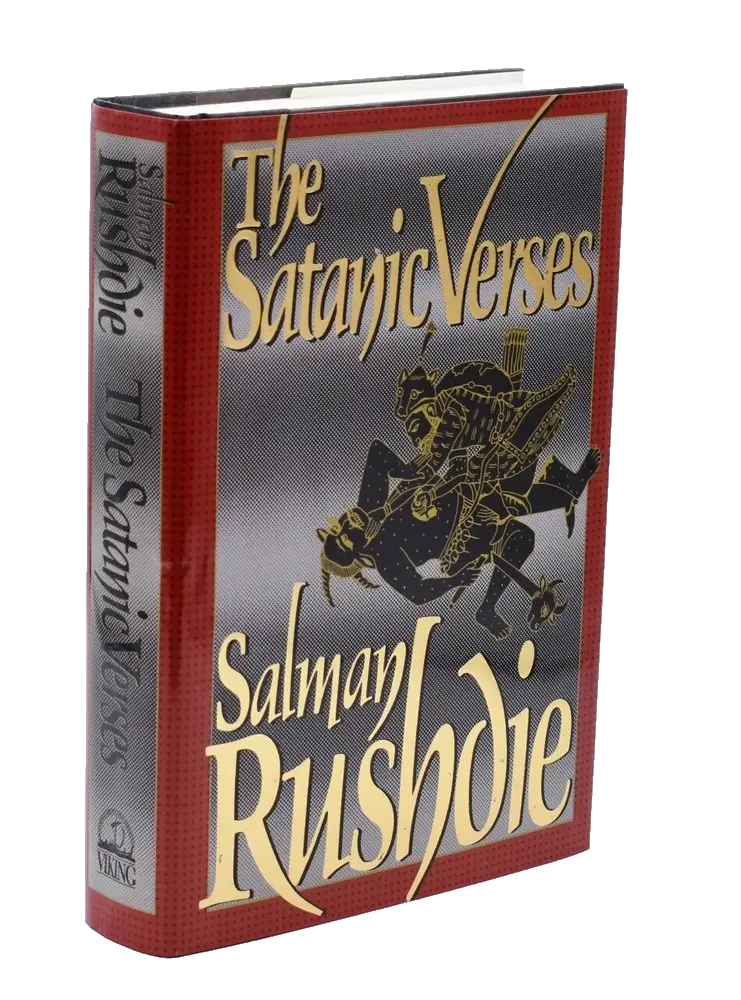
The Book: First American edition, tenth printing of Salman Rushdie’s The Satanic Verses. The title page bears the Viking publisher imprint, while the copyright page states “Published in 1989 by Viking Penguin Inc.” and contains a printer’s key ending in 10, establishing tenth-printing status. Original publisher’s quarter black cloth over black paper-covered boards with gilt spine lettering in the original unclipped dust jacket retaining the $19.95 price. No evidence of book-club manufacture, ex-library provenance, rebinding, facsimile dust jacket, or other bibliographic alteration observed.
Condition: Near Fine+ book in Near Fine dust jacket. The book retains bright boards, strong gilt spine lettering, a square binding, and an exceptionally clean interior, with only light offsetting to the front pastedown and facing free endpaper. The original jacket remains exceptionally bright with minimal handling wear, slight softening at the spine ends, and no significant chips, tears, or paper loss.
Story Of The Book
Few novels have demonstrated more dramatically that the consequences of publishing a book can become larger than the book itself.
When Salman Rushdie published The Satanic Verses, its fictional treatment of religious themes ignited an international crisis. Protests spread across countries, governments banned the novel, and in 1989 Iran’s Ayatollah Ruhollah Khomeini issued a fatwa calling for Rushdie’s death. What had begun as a work of literary fiction became a global confrontation over blasphemy, religious authority, censorship, and whether offense could justify the suppression of art.
The danger did not remain theoretical. The controversy exposed people throughout the publishing chain—authors, publishers, translators, booksellers, and others associated with bringing the novel to readers—to threats and violence. Rushdie himself was forced to live for years under extraordinary security precautions. The physical circulation of the book consequently acquired a significance independent of its literary content: printing it, distributing it, selling it, and defending its availability became acts in an international struggle over freedom of expression.
This tenth American printing belongs to that history. It was not produced decades later, after The Satanic Verses had become a safely historical controversy. It was printed in the original Viking edition during the period when the conflict surrounding the novel was actively unfolding.
A book had become dangerous because people insisted that other people must not be allowed to read it.
Why It’s In The Collection
The Satanic Verses belongs at the center of the collection because few modern books have tested the principle of free expression at such extraordinary human cost.
The controversy moved censorship beyond the familiar question of whether a government could legally prohibit a book. It raised a more fundamental problem: what happens to freedom of expression when writers and the people who enable their work to circulate can be threatened with violence for publishing ideas others consider intolerable?
That is also why this particular tenth printing remains historically meaningful despite not being the bibliographically preferred first printing. It is a contemporary artifact of the publication event itself. The continued production of copies during the international crisis meant that Viking was not merely preserving a literary work after the controversy had passed; the publisher was continuing to place the contested work into circulation while efforts to suppress it remained active.
Within the collection, the object therefore preserves something larger than Rushdie’s novel. It preserves a moment when the ordinary machinery of publishing—printing a book, shipping it, stocking it, selling it, reading it—became an extraordinary affirmation that threats and violence should not determine which ideas are allowed to exist in print.
Collection Categories: Free Expression · Censorship · Publication-Event Object · Religious Conscience · Human Rights · Political History · Literature
———
Authentication Evidence
• Title page identifies the work as The Satanic Verses by Salman Rushdie and bears the Viking publisher imprint.
• Copyright page states “Published in 1989 by Viking Penguin Inc.”, establishing publication within the original American Viking edition.
• Copyright page records copyright © Salman Rushdie 1988, consistent with the work’s original publication chronology.
• The copyright page contains a printer’s key ending in 10, identifying this copy as the tenth printing.
• No revised-edition, new-edition, book-club, or later-edition designation appears on the title or copyright pages.
• Original unclipped dust jacket retains the printed $19.95 publisher’s price.
• Jacket typography, artwork, publisher information, and author photograph are consistent with the Viking American hardcover issue.
• Original publisher’s quarter black cloth over black paper-covered boards with gilt spine lettering is present.
• No evidence of book-club manufacture, ex-library provenance, rebinding, facsimile dust jacket, or other bibliographic alteration is visible in the supplied photographs.
• The combined title-page imprint, copyright information, printer’s key, original priced jacket, and publisher’s binding support identification as an authentic First American Edition, Tenth Printing.