
 Image 1 of 1
Howl and Other Poems — Allen Ginsberg
Allen Ginsberg
San Francisco: City Lights Books, 1956
First Edition · Third Printing
The Book:
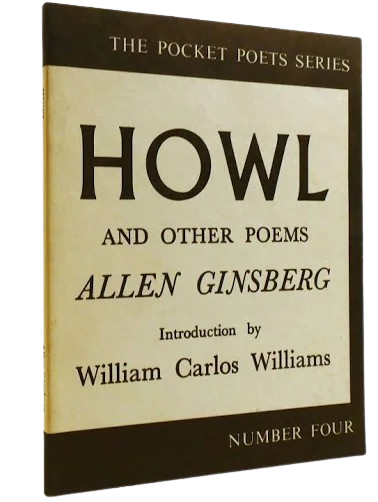
The first edition, third printing of Allen Ginsberg’s Howl and Other Poems, issued as Number Four in Lawrence Ferlinghetti’s Pocket Poets Series. The rear wrapper explicitly states “Third Printing” and retains the original 75-cent price. This printing is especially significant because it was the first printing of Howl manufactured in the United States. The first two printings had been produced in England by Villiers; after U.S. Customs seized copies of the second printing on import, City Lights shifted production domestically, placing the next printing beyond that particular point of government control. This third printing also differs visibly from the first two in lacking the separate white paper wraparound label, with the title information incorporated directly into the cover design.
Condition:
Near Fine+. An exceptionally bright example in the original publisher’s wrappers, with only minimal handling wear. The staple binding remains tight, the interior is clean, and the original 75-cent price and “Third Printing” designation remain clearly present on the rear wrapper. No rebinding, restoration, facsimile wrappers, or ex-library markings are evident.
Story Of The Book
Allen Ginsberg wrote the poem. Lawrence Ferlinghetti decided the government would not decide whether readers could have it.
When City Lights published Howl and Other Poems, Ginsberg’s language was sexually explicit, politically disillusioned, psychologically raw, and deliberately hostile to the boundaries respectable American culture placed around literature.
The authorities responded by trying to stop the book.
The first two printings were manufactured in England. When copies of the second printing entered the United States, Customs seized them as obscene. Ferlinghetti and City Lights then faced the prospect that the government could use the border itself as a censorship tool.
So City Lights changed the book.
Not the poem.
The manufacture.
The third printing was produced in the United States.
That is what makes this copy such a strong publication-event object. It was not merely printed while Howl was controversial. Its physical production changed because the government had interfered with the book’s circulation.
Ferlinghetti’s response was practical and defiant: if Customs could stop imported copies, the next copies would not be imported.
The obscenity prosecution continued, and Judge Clayton Horn would not rule until October 1957. This third printing therefore belongs to the unresolved middle of the fight — after government suppression had begun, but before the courts had declared Howl protected literature.
When the government used the border to stop Howl, City Lights moved the printing inside the border.
Why It’s In The Collection
Howl and Other Poems is one of the clearest examples in Consigned to Darkness of a book whose physical form records the struggle over whether it could exist.
A later printing can preserve Ginsberg’s poem.
This printing preserves the publisher’s response to censorship.
That distinction is why the collection deliberately sought the third printing. It was the first domestic printing produced after Customs had seized the English-printed second printing, making the object itself part of City Lights’ effort to keep Howl in circulation despite government interference.
Its bibliographical features reinforce that history. The rear wrapper identifies it as the third printing, while the absence of the separate white wraparound label used on the first two printings provides an additional visible point of identification. The inventory already treats the copy as a publication-event object rather than merely an early impression, and that is the right way to understand it.
This is not simply a copy of a famous poem from the censorship era.
It is a copy produced because censorship had already begun to shape how the book had to be made.
The government tried to stop Howl at the border. City Lights answered by printing it at home.
Collection Categories: Free Expression · Censorship · Obscenity Law & Court History · Beat Generation · Literature · Poetry · Anti-Authoritarianism · Publication-Event Object
———
Authentication Evidence
• Title page reads Howl and Other Poems by Allen Ginsberg, published by The Pocket Poets Series, Number Four, City Lights Books, San Francisco, consistent with the original first edition.
• This copy belongs to the original 1956 City Lights first edition, which remained in continuous production through successive printings without constituting a new edition.
• Rear wrapper is explicitly printed "Third Printing," identifying this as the authentic third printing of the first edition.
• Library of Congress Catalog Card Number 56-8587 appears on the publication page, consistent with authentic early printings.
• Original publisher's wrappers, typography, layout, and Pocket Poets Series design match documented third-printing copies.
• Original 75-cent price remains on the rear wrapper.
• No evidence of rebinding, facsimile wrappers, ex-library provenance, or restoration observed.
• The observed bibliographic evidence is consistent with an authentic first edition, third printing.