
 Image 1 of 1
On the Protracted War — Mao Tse-tung (Mao Zedong)
Mao Tse-tung (Mao Zedong)
Foreign Languages Press, Peking · 1954
First English Edition · First Printing
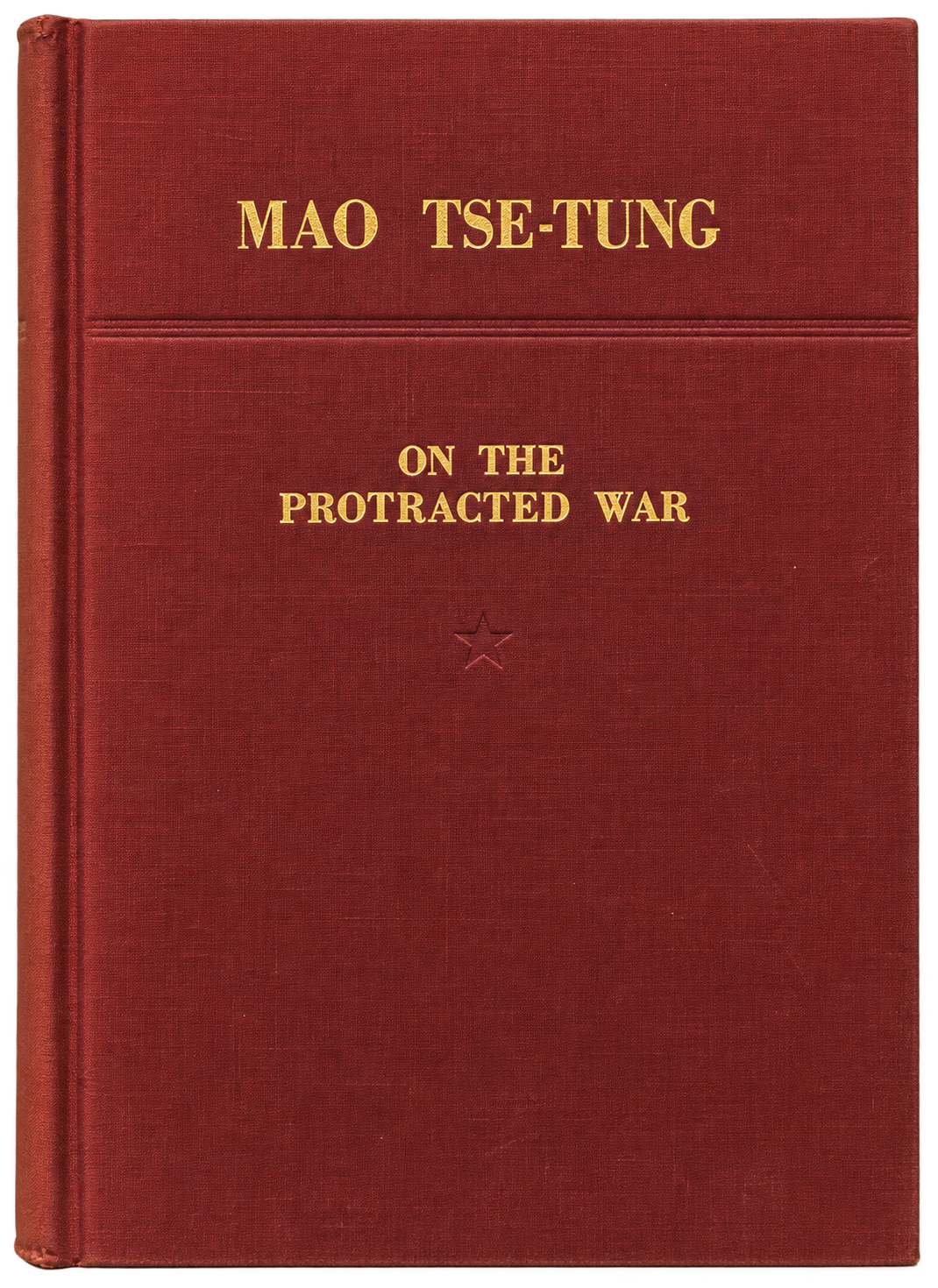
The Book: First English-language edition, first printing of Mao Tse-tung’s On the Protracted War. The title page explicitly states “First Edition · June 1954” and identifies Foreign Languages Press, Peking, as publisher. The publisher’s note explains that the English translation was based upon the second edition of the Chinese text, while the present English-language volume itself is explicitly identified as the first edition and contains no indication of a later impression or reprint. Original publisher’s maroon cloth with silver lettering. Printed in the People’s Republic of China by the state publisher responsible for disseminating Mao’s writings internationally. No evidence of rebinding, facsimile production, ex-library provenance, restoration, or later publisher issue observed.
Condition: Near Fine. The original maroon publisher’s cloth remains exceptionally well preserved with bright silver lettering, a square and sound binding, and a clean interior. Only light shelf wear is present. No documented ownership history, institutional markings, rebinding, or restoration observed.
Story Of The Book
Before Mao Zedong became one of history’s most powerful dictators, he had to persuade people to follow him.
Originally delivered in 1938 during the Second Sino-Japanese War, On the Protracted War presented Mao’s argument for how a materially weaker China could ultimately defeat Japan through a prolonged conflict. Rather than accepting either inevitable defeat or the possibility of rapid victory, Mao described war as a process whose balance of power could change through endurance, organization, popular mobilization, and strategic patience.
The historical irony is what makes the book especially important to this collection. Mao appears here not principally as the ruler of an authoritarian state, but as a revolutionary intellectual explaining how a weaker movement can resist superior power. The rhetoric is disciplined, strategic, and often persuasive. It offers sacrifice, national liberation, and eventual victory rather than openly announcing the coercive political system that would later emerge under Mao’s leadership.
That distinction matters. Authoritarian movements do not necessarily begin by advertising repression. They can begin with arguments about liberation, justice, national survival, equality, and resistance to an existing order.
On the Protracted War preserves Mao while he is making that argument.
Why It’s In The Collection
On the Protracted War occupies an unusual place in the collection because the dissident eventually became the dictator.
Most objects in the collection document individuals challenging systems of power. Mao complicates that narrative. His revolutionary movement genuinely confronted existing political and military authority, yet the government he ultimately led concentrated enormous power of its own and presided over catastrophic campaigns of political repression and social engineering.
That makes the book valuable precisely because its ideas cannot be dismissed as obviously monstrous. The collection preserves harmful and authoritarian ideas not to admire them, but because understanding power requires understanding how people become persuaded to build, surrender to, or participate in it. On the Protracted War captures Mao as strategist and revolutionary advocate, before the consequences of Maoism had become historical knowledge.
This 1954 first English edition adds another layer. Issued by Foreign Languages Press after Mao had taken power, it represents the Chinese state deliberately translating and exporting the revolutionary arguments that helped bring that state into existence. The physical object therefore connects revolutionary dissent to institutional power: ideas once used to challenge authority were now being disseminated internationally by the government those ideas helped create.
Within the collection, Mao therefore serves as a warning against treating anti-authoritarianism as a permanent identity rather than a principle. Someone can resist one system of domination and subsequently construct another. The meaningful question is not simply whether a person challenges power, but what happens when that person finally possesses it.
Collection Categories: Political Dissent · Political Movements · Political History · War & Conflict · Anti-Authoritarianism · Counter-Thesis Object · Publication-Event Object
———
Authentication Evidence
• Title page identifies On the Protracted War by Mao Tse-tung, published by Foreign Languages Press, Peking.
• First Edition Evidence: Title page states "First Edition · June 1954," consistent with the first English-language edition issued by Foreign Languages Press.
• First Printing Evidence: Publisher's note specifies that this English translation is based upon the second edition of the Chinese text while the title page explicitly identifies the present volume as the First Edition (June 1954) with no indication of any later impression or reprint.
• The volume was printed in the People's Republic of China by the original state publisher responsible for disseminating Mao's works internationally.
• Original publisher's maroon cloth binding with silver lettering matches known first English issue examples.
• No evidence of rebinding, facsimile production, ex-library provenance, restoration, or later publisher issue observed.
• The observed bibliographic evidence is fully consistent with an authentic First English Edition, First Printing.