
 Image 1 of 1
The Fire Next time — James Baldwin
James Baldwin
The Dial Press, New York · 1963
True First Edition · First Printing
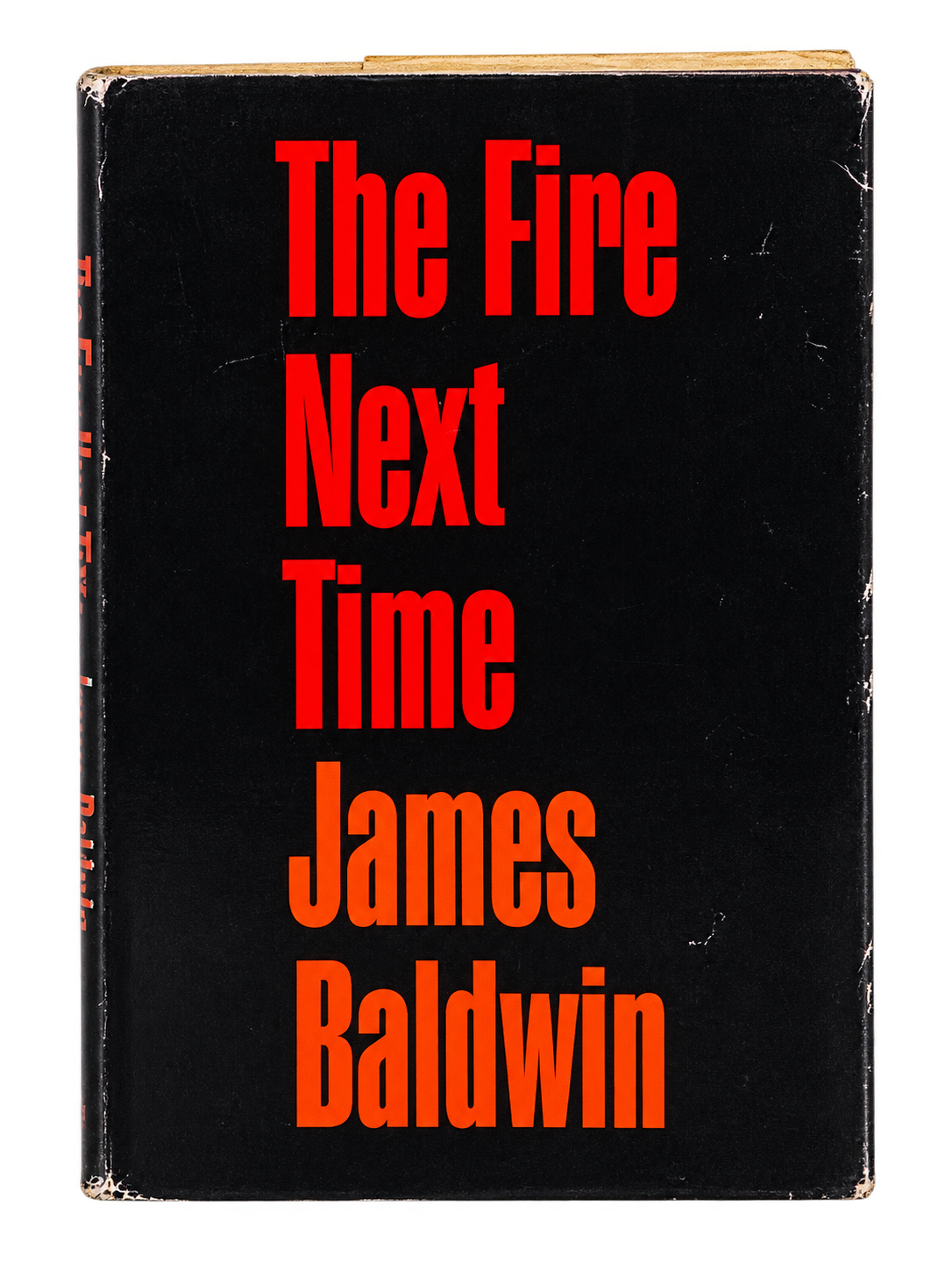
The Book: True first edition, first printing. Original beige publisher’s cloth with red spine lettering and Baldwin’s facsimile signature stamped in red on the front board. Original first-state dust jacket retained. The book preserves its original red top stain.
Condition: Very Good+ book in Good+ dust jacket. The jacket exhibits moderate rubbing and edge wear with several small chips and short closed tears, particularly at the spine ends and corners. The book has scattered foxing to the cloth, a previous owner’s inscription on the front free endpaper, and a previous owner’s name written on the top edge of the text block. Binding remains tight with no restoration observed.
Story Of The Book
James Baldwin rejected the comforting belief that racial injustice belonged only to America’s past.
Published in 1963 at the height of the Civil Rights Movement, The Fire Next Time brought together two essays—My Dungeon Shook and Down at the Cross—in which Baldwin confronted race, religion, identity, and the consequences of a country unwilling to reckon honestly with its history. Rather than offering a conventional political program, Baldwin addressed the moral and psychological structures that allowed racial inequality to endure, challenging both Black despair and white complacency.
The book appeared during a transformative year in the struggle for American civil rights, as conflicts over segregation and racial equality forced questions of citizenship and democracy into the center of national life. Baldwin insisted that the country's future depended not simply upon changing laws, but upon Americans confronting truths about themselves and one another that they had long resisted. The result became one of the defining literary interventions of the Civil Rights era and one of the twentieth century’s most enduring meditations on race and American democracy.
Why It’s In The Collection
The collection preserves printed objects that challenged entrenched systems of power and altered public understanding of individual liberty and human dignity. The Fire Next Time does this through the force of argument, personal experience, and moral persuasion.
Baldwin refuses to reduce racial injustice to abstract politics. His examination moves between history and intimate experience, locating the consequences of racial hierarchy in individual identity, family, religion, fear, anger, and love. In doing so, he demonstrates how literature can challenge systems of authority by exposing the human realities those systems depend upon society overlooking.
This first printing therefore occupies a central place in the collection’s documentation of civil rights, free expression, racial equality, and human dignity. It preserves Baldwin’s argument as it entered American public life during the Civil Rights Movement itself: a demand not merely for legal reform, but for a more fundamental reckoning with the meaning of equality and democratic responsibility.
Collection Categories: Free Expression · Civil Rights · Anti-Authoritarianism · Literature
———
Authentication Evidence
• Title page reads The Dial Press, New York, 1963, consistent with the first edition.
• Copyright page contains only the 1963/1962 copyright with no later printings stated, consistent with a first printing.
• Original beige cloth binding with red spine lettering and publisher's facsimile signature on the front board, consistent with the first issue binding.
• Original black Paul Bacon dust jacket present with Baldwin portrait on the rear panel, consistent with the first-state jacket.
• Red top stain present, consistent with first-printing copies.
• No evidence of book-club manufacture, later rebinding, or facsimile dust jacket observed.
• First edition, first printing characteristics consistent throughout.