
 Image 1 of 1
The Oak and the Calf — Aleksandr Solzhenitsyn
Full Title:The Oak and the Calf: Sketches of Literary Life in the Soviet Union
Aleksandr Solzhenitsyn
Harper & Row, Publishers, New York · 1980
First American Edition · First Printing
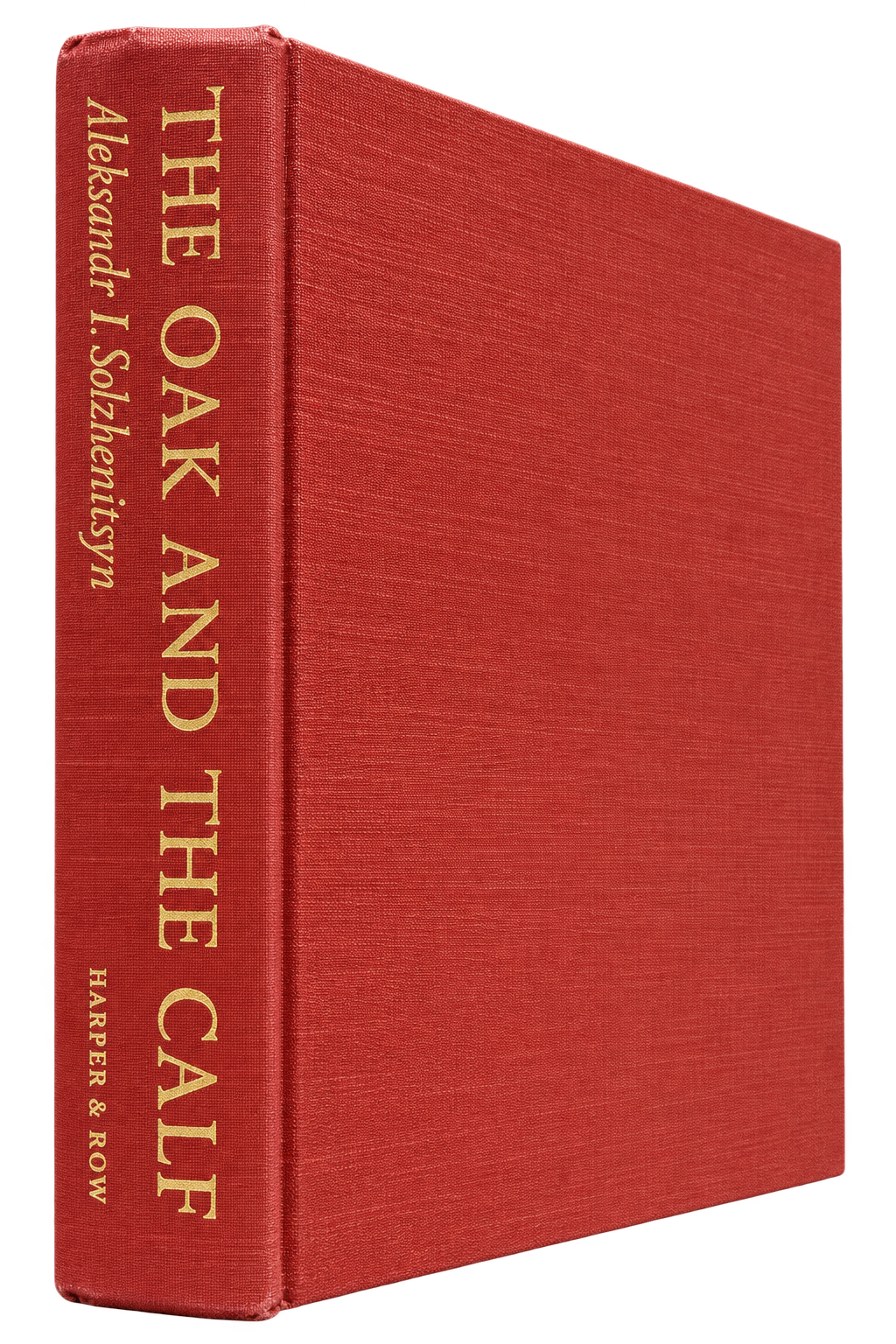
The Book: First American edition, first printing of Aleksandr Solzhenitsyn’s The Oak and the Calf: Sketches of Literary Life in the Soviet Union, translated from the Russian by Harry Willetts. The copyright page explicitly states “FIRST HARPER & ROW EDITION” and carries the complete first-printing number line 10 9 8 7 6 5 4 3 2 1. Original salmon-colored publisher’s cloth with silver spine lettering. No evidence of book-club manufacture, rebinding, later printing, facsimile binding, or other bibliographic inconsistencies observed. This copy is without dust jacket.
Condition: Near Fine. The original publisher’s cloth remains clean with bright silver spine lettering, a square and tight binding, and a clean interior free of ownership markings, foxing, restoration, or structural defects. Light rubbing and minor shelf handling to the cloth. No dust jacket present.
Story Of The Book
Authoritarian governments can imprison writers. Solzhenitsyn discovered something more subtle: they can try to control whether writing exists at all.
The Oak and the Calf is Solzhenitsyn’s autobiographical account of his struggle to write, preserve, circulate, and publish literature within the Soviet Union. Rather than returning primarily to the prisons and labor camps that made him one of the twentieth century’s most important witnesses, he turns his attention to the institutions surrounding literature itself—the publishers, editors, censors, political authorities, and surveillance apparatus that determined which words could reach the public.
The book traces the years in which Solzhenitsyn wrote and fought to publish the works that would eventually expose Soviet repression to the world. His conflict with the state demonstrates that censorship does not require simply banning a finished book. A government capable of controlling publishers, literary institutions, professional careers, and access to readers can attempt to prevent inconvenient literature from becoming public knowledge in the first place.
Solzhenitsyn nevertheless continued writing. Manuscripts were hidden, circulated outside official channels, and ultimately carried beyond the Soviet Union. By the time The Oak and the Calf appeared in this American edition, its author had himself been expelled from his country.
The memoir therefore records an extraordinary struggle over a deceptively simple question: who gets to decide whether a writer can reach a reader?
Why It’s In The Collection
The Oak and the Calf belongs in the collection because it provides something unusually valuable: a dissident writer’s firsthand account of how censorship actually works from the inside.
Other Solzhenitsyn works in the collection document what Soviet repression did to human beings. One Day in the Life of Ivan Denisovich reduces the Gulag to the experience of a single prisoner. The Gulag Archipelago reconstructs the enormous system behind that experience. The Oak and the Calf documents another part of the same authoritarian structure: the machinery attempting to control what could be written and remembered about it.
That distinction makes the book especially important to the collection’s treatment of free expression. Solzhenitsyn shows censorship not as a single prohibition but as a system—publication denied, manuscripts endangered, writers surveilled, institutions pressured, and access to audiences controlled. His eventual success demonstrates why authoritarian governments fear independent literature: once testimony escapes the institutions designed to contain it, the state loses its monopoly over the historical record.
This first American edition preserves Solzhenitsyn’s own history of that struggle after his expulsion from the Soviet Union, transforming the mechanisms that once operated against him in secrecy into a permanent public record.
Collection Categories: Witness Literature · Free Expression · Censorship · Anti-Totalitarianism · Memoir & Testimony
———
Authentication Evidence
• Title page identifies Harper & Row, Publishers, New York.
• Copyright page dated 1979 with FIRST HARPER & ROW EDITION explicitly stated.
• Complete first-printing number line present: 10 9 8 7 6 5 4 3 2 1, confirming a first printing.
• Title page correctly identifies The Oak and the Calf: Sketches of Literary Life in the Soviet Union.
• Translator correctly identified as Harry Willetts.
• Original publisher's cloth binding with silver spine lettering present and consistent with the first American issue.
• No evidence of book club manufacture, rebound covers, later printing, facsimile binding, or other bibliographic inconsistencies observed.