
 Image 1 of 3
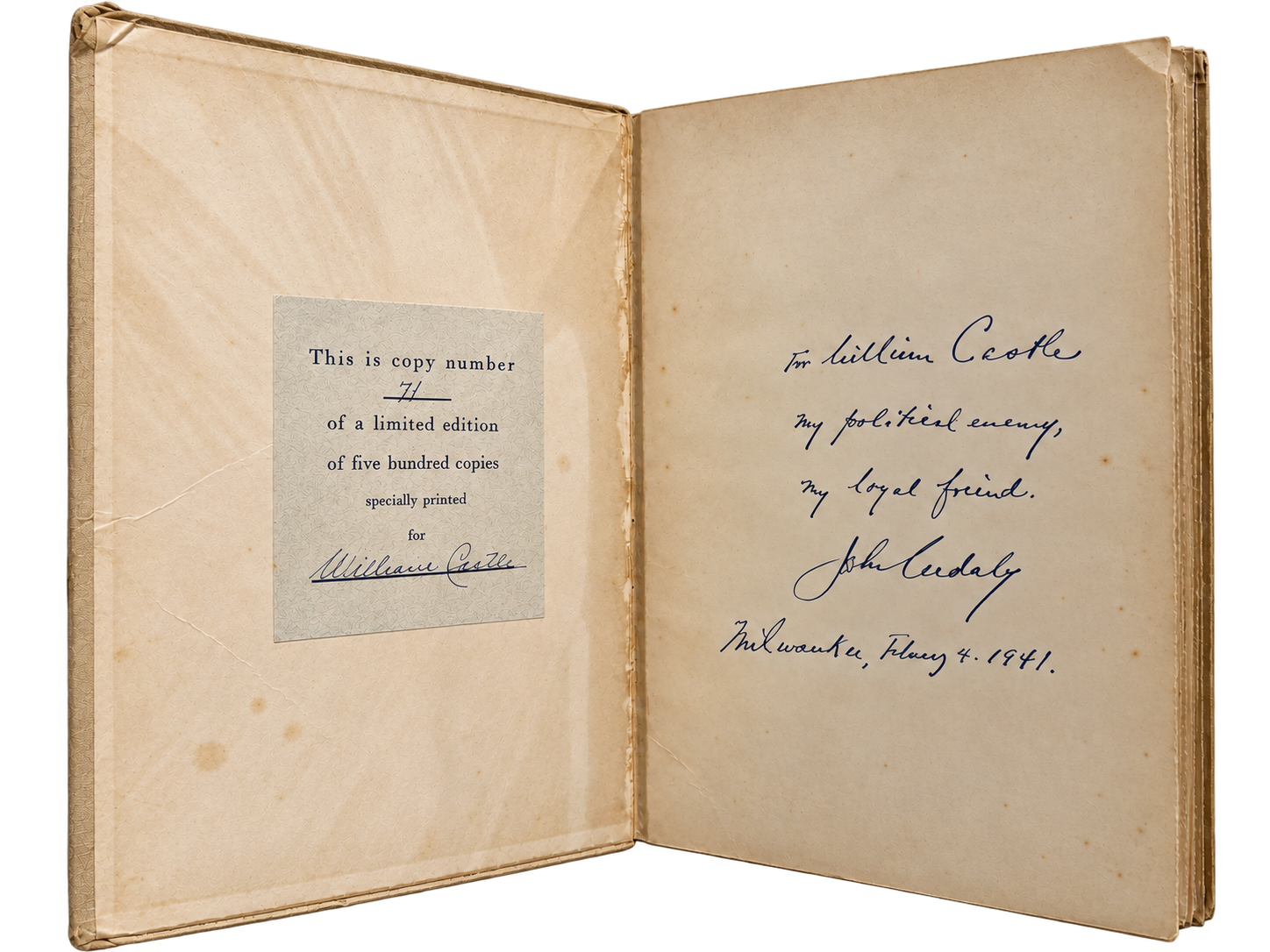 Image 2 of 3
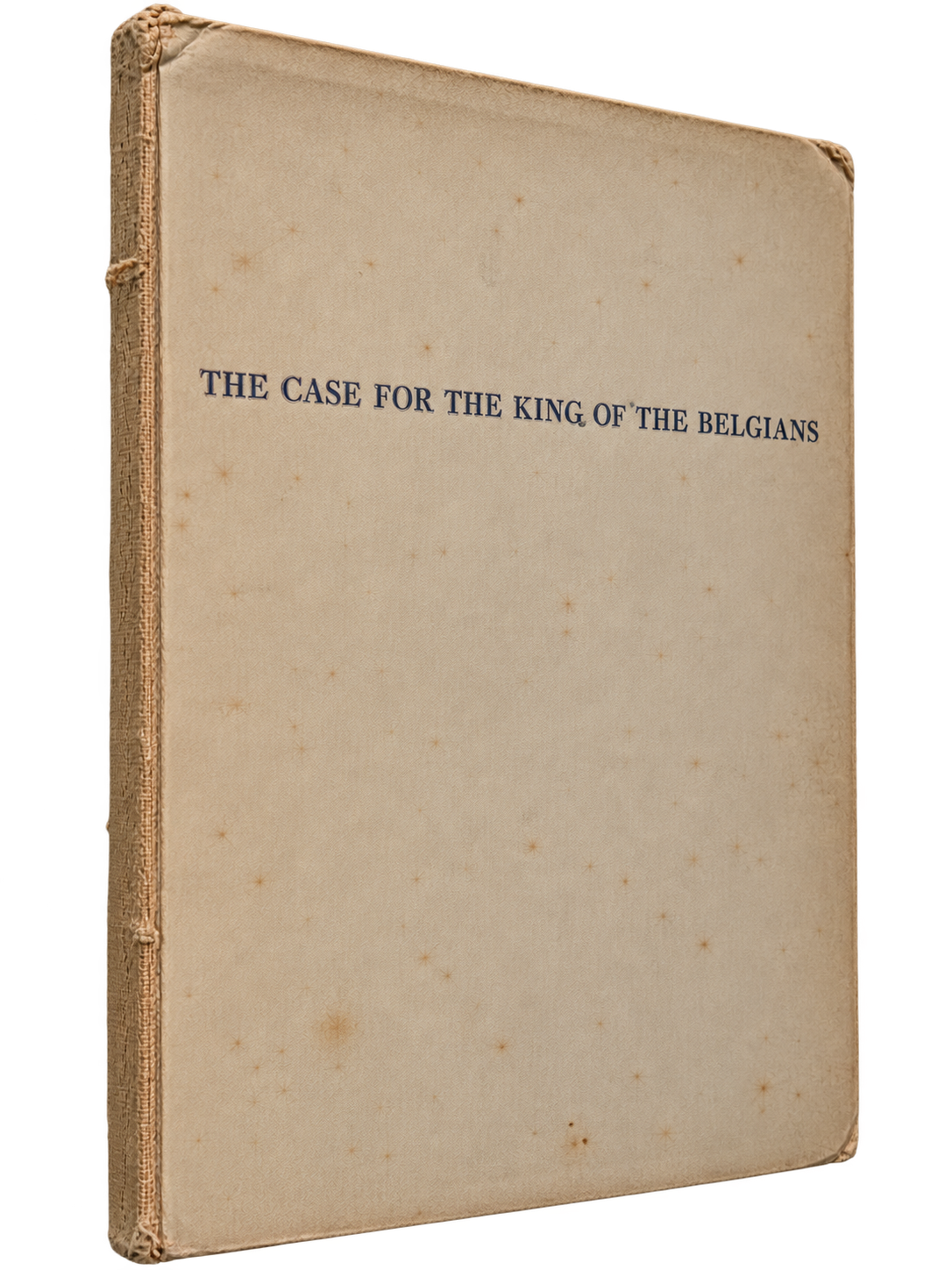 Image 3 of 3
The Case for the King of the Belgians — John Cudahy
John Cudahy
Privately Printed · New York · 1940
First Edition · First Printing · Limited Edition · No. 71 of 500 · Signed Presentation Copy
The Book:
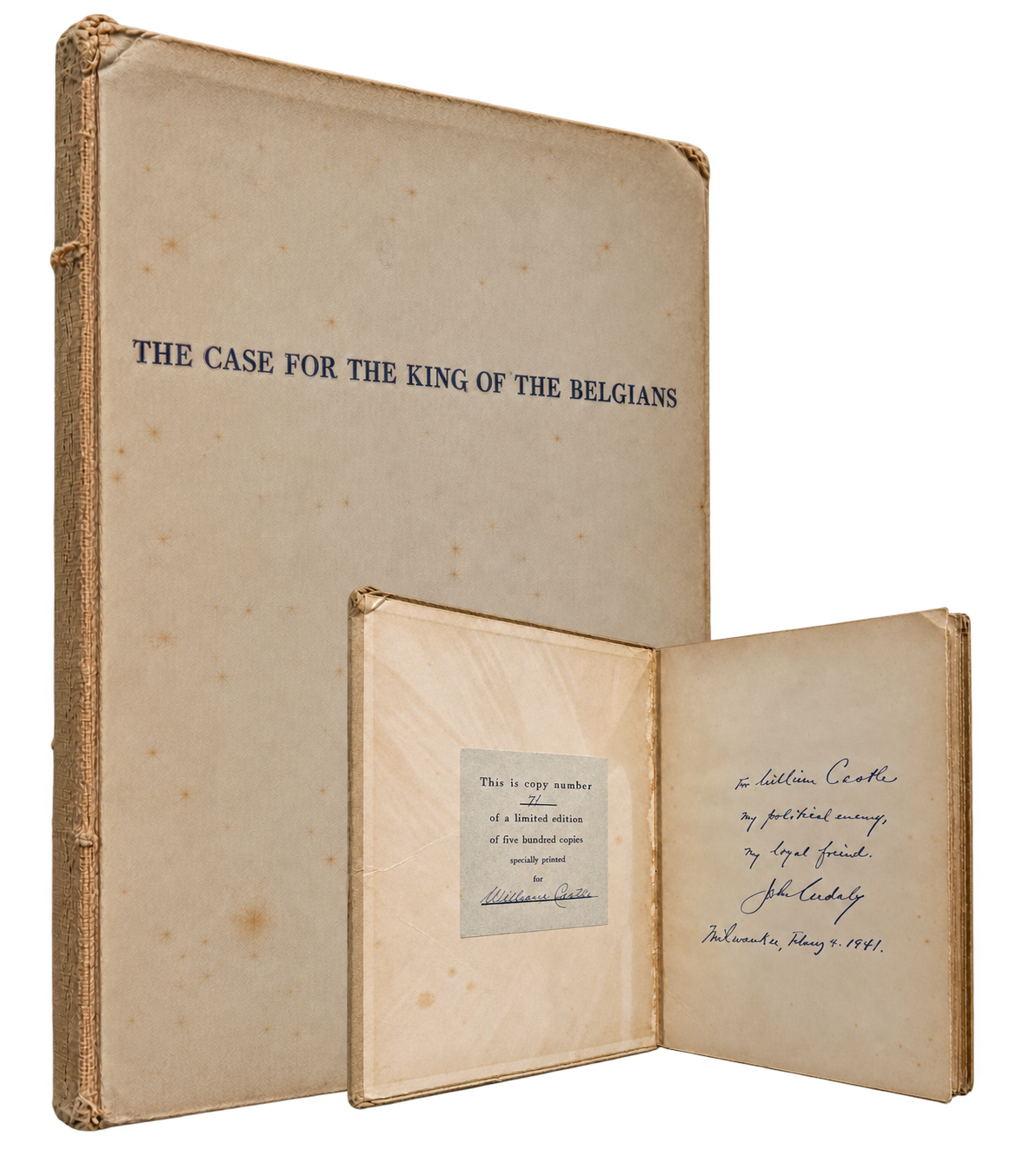
The First Edition · First Printing of John Cudahy’s The Case for the King of the Belgians, privately published in 1940 as an immediate defense of King Leopold III after Belgium’s surrender to Germany. Cudahy had served as U.S. Ambassador to Belgium during the German invasion, and used his firsthand diplomatic experience to challenge the prevailing Allied accusation that Leopold’s surrender amounted to betrayal. This copy is No. 71 of a limited edition of 500 copies specially printed for William Richards Castle Jr., former U.S. Ambassador to Japan and Under Secretary of State, and is personally inscribed by Cudahy to Castle in 1941.
Condition:
Good+. Original paper-covered hard boards remain present, with title printed in blue to the front board. Externally worn, with overall soiling and spotting, edge and corner wear, and substantial loss to the paper covering of the spine exposing portions of the underlying binding structure. Interior is substantially cleaner and remains sound and intact. No modern rebinding or restoration observed.
Story Of The Book
Belgium had fallen to Hitler. Its king had surrendered his army. Much of the Allied world called him a traitor. John Cudahy disagreed—and published his case while the controversy was still unfolding.
As U.S. Ambassador to Belgium during the German invasion, Cudahy had watched the crisis at close range. In The Case for the King of the Belgians, he argued that Leopold III’s decision to surrender was not simple betrayal, but a wartime act that had to be judged against the military collapse happening around him.
That made the book a contemporary intervention, not a retrospective history. Later events would complicate Cudahy’s defense of Leopold, but in 1940 much of that history had not happened yet. Cudahy was disputing the emerging wartime narrative while its ultimate meaning remained unsettled.
This copy carries that dispute directly into the world of American diplomacy. Its limitation states that it was specially printed for William Richards Castle Jr., and Cudahy later inscribed it to him:
“For William Castle / my particular enemy / my loyal friend.”
Castle and Cudahy were politically engaged friends who disagreed while moving through the same diplomatic and anti-interventionist circles. Surviving correspondence places them together in 1941 discussing Germany, American intervention, and the possibility of negotiated peace.
The book argued against a wartime consensus. This copy preserves that argument inside the private network where such questions were being debated.
Why It’s In The Collection
The Case for the King of the Belgians belongs in Consigned to Darkness because wartime narratives acquire power quickly—and dissent becomes more consequential when the facts are still unsettled.
Cudahy was not defending an abstract historical figure decades later. He was a recently serving ambassador challenging the dominant interpretation of an event he had personally witnessed. Later history would complicate his defense considerably, but Cudahy did not have the benefit of later history.
The association copy makes the object substantially stronger. This was not merely one of 500 privately printed books; it was one of 500 copies printed for a specific senior American diplomat and then personally inscribed to that same diplomat by the author. That places the physical book inside the political conversation it represents.
Its significance is not that Cudahy was necessarily right. It is that the object preserves a senior diplomat resisting the simplification of wartime events into an accepted moral narrative—and doing so before history had finished deciding what they meant.
The public argument concerned a king. This copy preserves the private argument among diplomats about war, loyalty, and truth.
Collection Categories: Publication-Event Object · Witness Literature · Memoir & Testimony · Political Dissent · Political History · War & Conflict · Conservative Intellectual History · Diplomacy & Statecraft · Anti-Interventionism
———
Authentication Evidence
Title page identifies the work as The Case for the King of the Belgians by The Honorable John Cudahy, The American Ambassador to Belgium and Minister to Luxembourg.
Title page is printed New York · 1940.
Independent bibliographic records identify the privately published 1940 New York issue as the original edition of the work.
Integral limitation leaf explicitly states: “This is copy number 71 of a limited edition of Five Hundred copies specially printed for William Castle.”
Present copy is therefore directly identified as No. 71 of 500.
The limitation statement itself directly associates the special printing with William Castle.
Front blank bears a presentation inscription addressed “For William Castle.”
Inscription is signed “John Cudahy” and dated “Richmond, Va. 1941.”
Inscription reads “my particular enemy / my loyal friend,” consistent with a personal relationship involving political disagreement and friendship.
William Castle is identified as William Richards Castle Jr. (1878–1963), former U.S. Ambassador to Japan and Under Secretary of State.
Surviving archival correspondence independently documents direct contact between Castle and Cudahy in 1941.
Castle’s February 14, 1941 correspondence records meeting with John Cudahy and Charles Lindbergh concerning Cudahy’s proposed reporting from Germany and the possibility of negotiated peace.
That correspondence independently corroborates the historical plausibility of the presentation inscription and association.
Original paper-covered hard boards and integral leaves are consistent with the privately printed limited issue.
No evidence of facsimile reproduction, later reprint, modern rebinding, or restoration is observed.
First Edition identification is supported by the original 1940 privately printed issue.
First Printing identification is supported by the integral limitation statement identifying this copy as part of the original limited printing of 500.
Limitation, authorship of the presentation inscription, and association with William Richards Castle Jr. are mutually consistent across the physical and documentary evidence.
Observable evidence supports identification as the 1940 First Edition · First Printing · No. 71 of 500 · Signed Presentation Copy to William Richards Castle Jr.