
 Image 1 of 1
Uncle Tom’s Cabin — Harriet Beecher Stowe
Full Title:Uncle Tom’s Cabin; or, Life Among the Lowly
Harriet Beecher Stowe
John P. Jewett & Company, Boston · 1852
First Edition · Early Printing (“Tenth Thousandths”) · Two Volumes
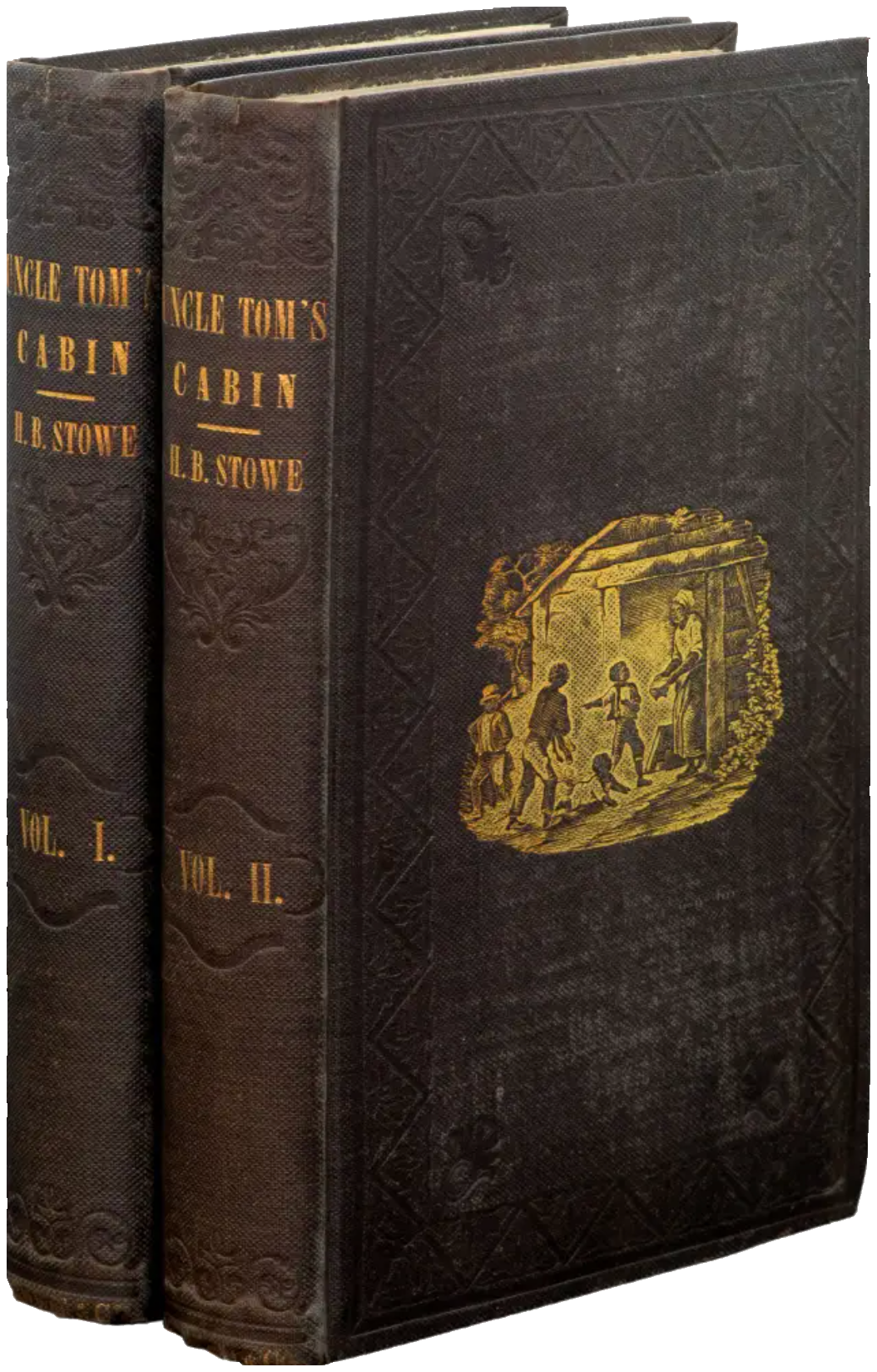
The Book: First edition, early printing (“Tenth Thousand”) of Harriet Beecher Stowe’s Uncle Tom’s Cabin; or, Life Among the Lowly, complete in two matching volumes. Both volumes carry the correct 1852 John P. Jewett publisher imprint and explicitly state “Tenth Thousandths,” identifying them as part of the extraordinary sequence of early printings produced to meet immediate demand for the novel. Original publisher’s brown cloth bindings with gilt pictorial stamping retained. Publisher, date, edition statements, and printing designations are consistent throughout both volumes, with no evidence of later rebinding or restoration observed.
Condition: Good. Both volumes remain complete and structurally sound in their original publisher’s bindings. The brown cloth exhibits heavy spine wear and areas of cloth loss, moderate corner wear, and other handling consistent with age and use. Interiors show foxing and scattered staining. No ownership writing observed. Despite substantial wear, the matched set survives intact in its original 1852 bindings.
Story Of The Book
Few novels have ever done more to change what a nation was willing to see.
When Harriet Beecher Stowe published Uncle Tom’s Cabin in 1852, slavery was already at the center of American political conflict. Her intervention was to make that enormous institution intimate. Through the lives of enslaved men, women, children, and families, Stowe asked readers to encounter human beings where political arguments had too often allowed them to see property, economics, law, or abstraction.
The response was extraordinary. Demand became so intense that John P. Jewett rapidly issued successive printings designated by the number of thousands produced. This matched “Tenth Thousand” set belongs to that first surge of publication in 1852, when the novel was moving through American culture with extraordinary speed and becoming part of the national struggle over slavery itself.
The reaction also demonstrated how threatening literature could become to established power. Uncle Tom’s Cabin was fiercely condemned across the slaveholding South and treated as dangerous abolitionist literature. In 1857, Maryland minister Samuel Green was sentenced to ten years in prison after authorities discovered Uncle Tom’s Cabin among abolitionist materials in his possession—an extraordinary example of the danger that could accompany possessing and circulating antislavery print.
Stowe did not abolish slavery with a novel. But she demonstrated that literature could alter the moral terrain on which political arguments were fought.
Why It’s In The Collection
Uncle Tom’s Cabin belongs near the historical center of the collection because it demonstrates the extraordinary power of literature to restore humanity where systems of power depend upon denying it.
Slavery required more than laws permitting ownership of human beings. It required an intellectual and moral architecture capable of reducing people to categories—slave, property, labor, capital. Stowe attacked that architecture through narrative. Her characters experience separation, fear, violence, faith, love, parenthood, loss, and hope. Whatever the novel’s limitations and the complicated history of its racial representations, its central political force came from insisting that readers confront the humanity obscured by the institution it opposed.
This particular set matters because it is not a later commemorative edition of a famous nineteenth-century novel. The two volumes were printed in 1852, during the original publishing phenomenon itself. Their “Tenth Thousand” designation places them among the copies produced as unprecedented demand was carrying Stowe’s argument into homes and public debate across the country.
That makes the object more than an early copy of a famous book. It is a surviving participant in one of the most consequential publication events in American history—a physical artifact from the moment a work of fiction became part of the struggle over whether one human being could rightfully own another.
Collection Categories: Civil Rights · Human Rights · Anti-Authoritarianism · Literature · Publication-Event Object
———
Authentication Evidence
• Correct John P. Jewett publisher imprint, confirming first edition
• Copyright pages dated 1852, consistent with first edition
• Both volumes state “Tenth Thousand,” confirming authentic early printing
• Matching two-volume set
• Publisher, date, and edition statements consistent throughout both volumes
• First edition, early printing characteristics consistent throughout