
 Image 1 of 1
Operación Masacre — Rodolfo J. Walsh
Full Title:Operación Masacre: Un proceso que no ha sido clausurado
Rodolfo J. Walsh
Ediciones Sigla, Buenos Aires · 1957
First Edition · First Printing
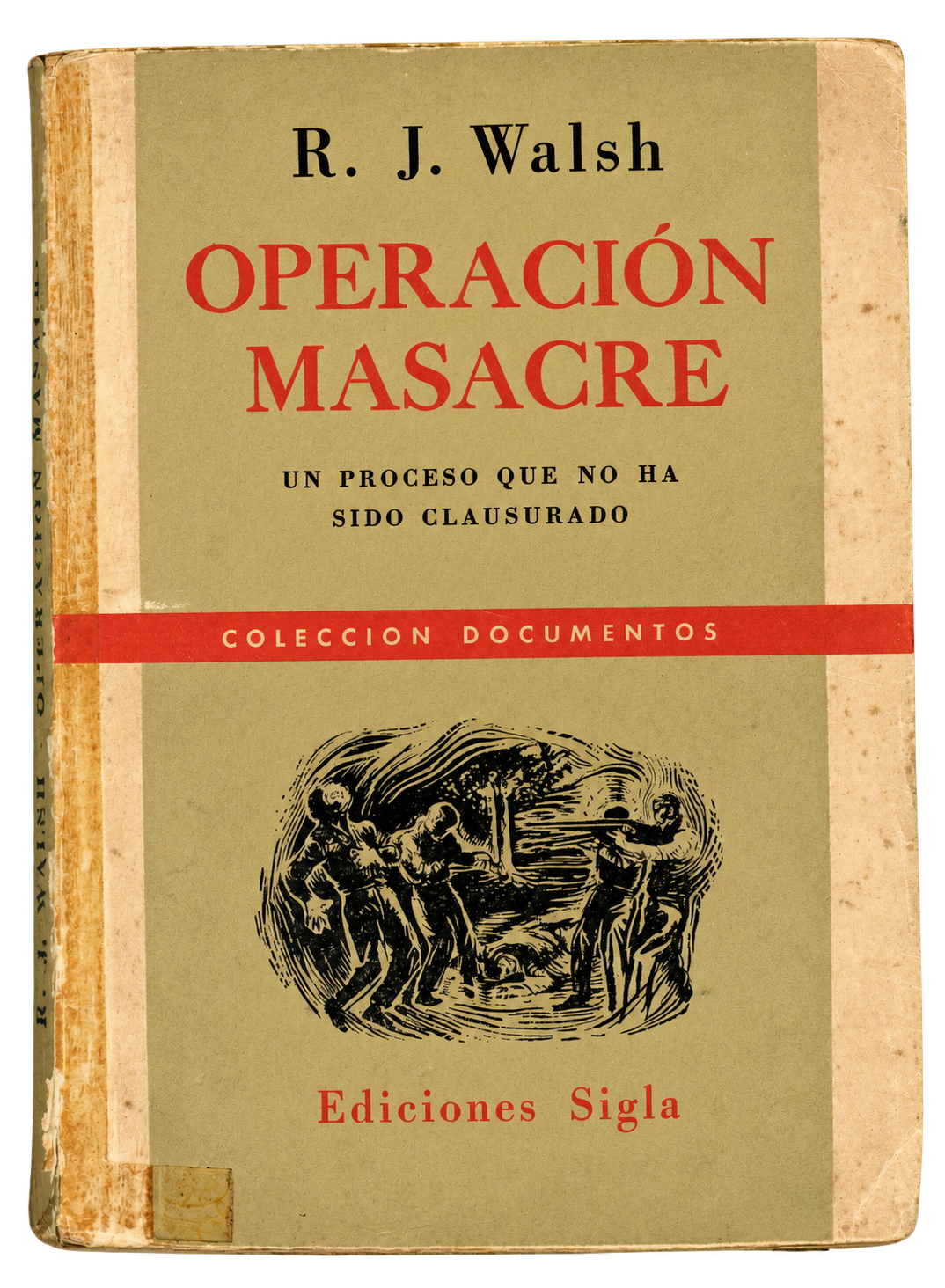
The Book: True first edition, first printing of Rodolfo J. Walsh’s Operación Masacre: Un proceso que no ha sido clausurado. The title page carries the correct Ediciones Sigla imprint, and the original publisher’s printed wrappers are present and consistent with the documented 1957 first edition. Wrapper design, typography, and publisher presentation correspond to the original Sigla issue, with no evidence of later publisher imprints, replacement wrappers, facsimile production, or rebinding. Prior bibliographic authentication conducted for this copy, together with its observable physical characteristics, supports identification as the true first edition, first printing.
Condition: Very Good+. The original printed wrappers remain complete and securely attached, with light to moderate age toning, modest rubbing along the spine and extremities, minor handling wear, and softened corners. The binding remains sound with a complete text block and clean interior. No ownership inscriptions, bookplates, institutional markings, library stamps, or evidence of restoration observed.
Story Of The Book
One man survived his execution. That single fact changed journalism forever.
When Rodolfo Walsh learned that a man had survived an illegal firing squad following Argentina’s failed June 1956 uprising, he refused to dismiss the story as rumor. His investigation led him to other survivors and witnesses and ultimately to evidence of clandestine executions carried out by the Argentine state.
Walsh reconstructed what happened through survivor interviews, eyewitness testimony, and documentary investigation, transforming accounts that could have disappeared into a permanent record. Published in Buenos Aires in 1957, Operación Masacre exposed the killings while many of those responsible remained in positions of authority.
The book became one of the foundational works of investigative narrative journalism, preceding the international emergence of the nonfiction novel by several years. But its importance extends beyond literary innovation. Walsh demonstrated that journalism could do more than report what institutions said had happened: it could independently reconstruct events and produce evidence capable of contradicting the state itself.
Walsh did not simply write about an official lie. He created a record that could survive it.
Why It’s In The Collection
Operación Masacre belongs near the center of the collection because it demonstrates how publication can challenge a government’s ability to control the truth about its own violence.
Walsh confronted an extraordinary imbalance of power. The state possessed police authority, political institutions, and the ability to construct an official account of what had occurred. The survivors possessed their testimony. Walsh transformed that testimony into documented evidence and publication gave that evidence an audience the government could no longer completely control.
That makes this first printing especially important. It does not preserve a later historical reconstruction produced after the facts had become broadly accepted. It preserves the original publication through which Walsh’s investigation entered public discourse while the controversy remained unresolved and many of those implicated remained in power.
The book therefore embodies one of the collection’s central ideas: printed objects can alter the balance between truth and power. Operación Masacre transformed survivor testimony into documentary evidence against the state and demonstrated that when authority attempts to erase an event, publication can make that erasure considerably more difficult.
Collection Categories: Publication-Event Object · Investigative Journalism · Witness Literature · Political Dissent · Anti-Authoritarianism · Human Rights · Political History
———
Authentication Evidence
• Correct title page identifying Operación Masacre by Rodolfo J. Walsh.
• Title page bears the correct Ediciones Sigla imprint, establishing the original publisher.
• Original publisher's printed wrappers are present and consistent with the documented first edition.
• Wrapper design, typography, and publisher presentation are consistent with the known 1957 Sigla issue.
• No evidence of later publisher imprints, replacement wrappers, or facsimile production is observed.
• Through prior bibliographic authentication conducted for this copy, this issue has been established as the true 1957 first edition, first printing. The supplied photographs are consistent with that conclusion.
• The observable bibliographic characteristics and previously established first-print authentication together support identification as the true first edition, first printing.