
The Cost of Conscience
What happens when doing what you believe is right becomes a crime? It's easy to stand by your convictions when doing so costs you nothing. The real test comes when holding on to them threatens your freedom, your future, or your life.
Throughout history, governments have imprisoned people for the truths they spoke, the beliefs they refused to abandon, and the demands of power they would not obey. The Cost of Conscience brings together books that bear witness to what happens when the price of remaining true to yourself becomes almost unbearable — and what happens when people choose to pay it anyway.

Martin Luther King, Jr.
Philadelphia: American Friends Service Committee, 1963
First Edition · Fourth Printing · July 1963
The Book:
An original 1963 American Friends Service Committee pamphlet edition of Martin Luther King Jr.’s Letter from Birmingham City Jail, issued only months after King wrote the letter during his imprisonment in Birmingham that April. The rear-wrapper production statement explicitly records the printing history and identifies this copy as “Fourth 7-63—30M,” establishing it as the July 1963 fourth printing from a 30,000-copy press run. The pamphlet retains its original illustrated self-wrappers and staple binding. Seller-reported provenance places this copy in the collection of Harlem Renaissance poet, scholar, and longtime Chelsea Hotel resident Helene Johnson, although that association remains undocumented beyond the bookseller’s attribution and should therefore be treated as reported rather than independently proven.
Condition:
Very Good. The pamphlet is complete, firmly stapled, and structurally sound, with no missing leaves or paper loss observed. Moderate age toning, light edge rubbing, and general handling wear are present throughout. The principal defect is a long, stable semi-closed tear to the rear wrapper with historic reinforcement. The pamphlet is preserved in an archival polyester sleeve with acid-free backing board and a rigid protective enclosure.
Story Of The Book
Martin Luther King Jr. turned a jail cell into one of the most influential classrooms of the twentieth century.
King was arrested during the Birmingham Campaign in April 1963 for participating in demonstrations against segregation. While confined, he responded to eight white Alabama religious leaders who had criticized the demonstrations as untimely and urged activists to pursue patience and negotiation instead of direct action. King’s answer became one of the defining arguments of the Civil Rights Movement: that injustice does not become tolerable merely because those suffering from it are asked to wait, and that individuals may have a moral obligation to resist unjust laws.
The importance of this copy lies not only in the text, but in the form through which that text moved. The American Friends Service Committee issued King’s letter as an inexpensive pamphlet designed for circulation. By July 1963, only a few months after the letter had been written, the AFSC was already printing another 30,000 copies. This fourth printing therefore belongs to the active life of the argument itself, when Birmingham was still reshaping the national civil-rights debate and King’s defense of nonviolent direct action was being placed physically into the hands of readers.
That makes the fourth printing especially meaningful to this collection. A first printing would ordinarily sit higher in the conventional rare-book hierarchy, but Consigned to Darkness values objects that participated in historical events. This July 1963 printing documents rapid dissemination: the argument had escaped the jail cell, entered print, and was being reproduced in tens of thousands of copies while the struggle that produced it was still unfolding.
The letter argued that justice could not wait. The pamphlet helped make sure the argument did not have to.
Why It’s In The Collection
Letter from Birmingham City Jail is one of the clearest publication-event objects in Consigned to Darkness because the physical pamphlet was itself part of the Civil Rights Movement’s strategy.
The collection does not preserve this copy simply because it contains famous words by Martin Luther King Jr. It preserves an original movement-era object through which those words were deliberately disseminated during the struggle itself. The American Friends Service Committee turned a letter written under confinement into a portable instrument of persuasion, allowing King’s argument about conscience, unjust law, and civil disobedience to circulate far beyond Birmingham.
The July 1963 fourth printing strengthens rather than weakens that story. Its 30,000-copy production statement is physical evidence that demand for the pamphlet was continuing only months after King wrote the letter. In conventional collecting, “fourth printing” may sound secondary. Here, it documents propagation. It shows the text becoming movement literature in real time.
The seller-reported Helene Johnson provenance adds a potentially significant association with African American literary history, but the evidence has limits. The inventory appropriately records the attribution while noting that no separate documentation establishes the chain of custody. It should therefore be presented as an intriguing reported provenance, not as an authenticated association.
This is exactly the kind of object the collection is built around: not merely a text that later became historically important, but a surviving piece of the mechanism by which the text became important in the first place.
King wrote from inside a jail. This pamphlet is part of how the argument got out.
Collection Categories: Civil Rights · Human Rights · Religious Conscience · Political Imprisonment · Political Dissent · Free Expression · Publication-Event Object
———
Authentication Evidence
• The front wrapper bears the correct title, Letter from Birmingham City Jail, and attributes the text to Martin Luther King, Jr.
• The rear wrapper identifies the American Friends Service Committee, its Philadelphia national office, and its regional offices, matching the recognized 1963 AFSC pamphlet edition. Library records identify this edition as published in Philadelphia by the American Friends Service Committee in 1963.
• The rear-wrapper production line explicitly records the first through fourth printings and identifies the fourth as 7-63—30M, directly establishing this copy’s July 1963 printing.
• The front-wrapper design, typography, AFSC emblem, office list, and production statement are internally consistent with the period edition.
• The paper toning, printing characteristics, edge wear, staple-bound pamphlet format, and aged pressure-sensitive repairs are consistent with an original 1963 object rather than a modern facsimile.
• No evidence of photographic reproduction, print-on-demand manufacture, or modern reprint typography is visible.
• Edition evidence: The AFSC imprint, wrapper design, and 1963 publication information establish this as part of the original American Friends Service Committee edition.
• Printing evidence: The rear-wrapper statement explicitly lists Fourth 7-63—30M, directly identifying the fourth printing.
Letter from Birmingham City Jail
Martin Luther King Jr. transformed a prison cell into one of the most influential classrooms of the twentieth century.
Written in response to clergymen who urged patience over justice, Letter from Birmingham City Jail became one of the defining philosophical defenses of nonviolent civil disobedience, arguing that individuals possess a moral obligation to oppose unjust laws. Distributed inexpensively as a pamphlet to reach the widest possible audience, the publication itself became part of the Civil Rights Movement's strategy for transforming public opinion through print, allowing King's words to circulate as freely as the movement they inspired. This copy is further distinguished by its reported provenance from the collection of poet, scholar, and Chelsea Hotel resident Helene Johnson, preserving a remarkable association between one of the movement's defining political voices and an important figure in twentieth-century African American literary history.
Martin Luther King, Jr.
American Friends Service Committee · Philadelphia · 1963
First Edition · Fourth Printing · July 1963

Aleksandr Solzhenitsyn
Translated by Max Hayward & Ronald Hingley
Frederick A. Praeger · New York · 1963
First English-Language Edition · First Printing
The Book:
The first English-language edition, first printing of Alexander Solzhenitsyn’s One Day in the Life of Ivan Denisovich, translated by Max Hayward and Ronald Hingley and published by Frederick A. Praeger in 1963. First published in the Soviet journal Novy Mir in November 1962, the novel drew upon Solzhenitsyn’s own imprisonment to depict a single day inside Stalin’s forced-labor camp system. Original black publisher’s cloth with gilt spine lettering and red topstain, retaining the original unclipped dust jacket priced $3.95.
Condition:
Near Fine+ book in a Near Fine dust jacket. The binding remains exceptionally square and clean, with bright black cloth, strong gilt spine lettering, vivid red topstain, and a fresh interior free of ownership markings. The original unclipped jacket shows light age toning, minor scattered surface soiling, and minimal handling and edge wear, with no significant chips or tears. No foxing, restoration, or structural defects are observed.
Story Of The Book
For years, millions of people had disappeared into Stalin’s prison camps. Then the Soviet Union itself briefly allowed one survivor to tell the world what a day inside them looked like.
Alexander Solzhenitsyn knew that world personally. Arrested in 1945 after criticizing Stalin in private correspondence, he spent eight years in prisons and labor camps before being sent into internal exile. His experiences became the foundation for Ivan Denisovich Shukhov, the prisoner whose ordinary winter day forms the entire architecture of this novel.
There is no dramatic escape. Shukhov wakes, works, searches for food, protects his possessions, navigates camp rules, endures the cold, and tries to preserve whatever fragments of dignity remain available to him.
That ordinariness was the revelation.
Solzhenitsyn did not need to describe the entire Gulag. He showed what a system of political repression looked like when surviving it had become routine.
What happened next was almost as remarkable as the novel itself. During Khrushchev’s limited campaign against Stalin’s legacy, Novy Mir editor Aleksandr Tvardovsky fought to publish the manuscript. Khrushchev ultimately approved it, and the story appeared in November 1962. Soviet readers suddenly encountered a work describing the camps not as an enemy accusation, but through literature officially permitted to circulate inside the Soviet Union.
The opening did not last. As the political climate hardened, Solzhenitsyn's work faced increasing suppression, and his relationship with the Soviet state ultimately became one of the defining literary confrontations of the Cold War.
Why It’s In The Collection
One Day in the Life of Ivan Denisovich belongs in Consigned to Darkness because one of the most powerful ways to challenge a system built on dehumanization is simply to restore the individual human being it tried to erase.
The Gulag operated on an enormous scale. Solzhenitsyn deliberately refused that scale. Instead of beginning with statistics, institutions, or ideology, he gave readers one prisoner, one camp, and one day.
That choice makes the novel an extraordinary piece of witness literature despite its fictional form. Shukhov is fictional, but the world surrounding him was reconstructed by a former prisoner from lived experience. The fiction becomes a vehicle for testimony.
This 1963 Praeger edition carries additional publication-event significance. It preserves the moment that testimony crossed into English-language publication, only months after its extraordinary appearance inside the Soviet Union and while the political consequences of Solzhenitsyn's emergence were still unfolding.
Later, The Gulag Archipelago would attempt to document the vast machinery of Soviet repression. One Day began somewhere smaller.
Before asking the world to understand millions of prisoners, Solzhenitsyn asked it to spend one day with one of them.
Collection Categories: Witness Literature · Anti-Totalitarianism · Political Imprisonment · Human Rights · Censorship · Free Expression · Political Dissent · Publication-Event Object · Cold War · Literature
———
Authentication Evidence
Title page identifies One Day in the Life of Ivan Denisovich by Alexander Solzhenitsyn and Frederick A. Praeger, New York, as publisher.
Translation is credited to Max Hayward and Ronald Hingley, with an introduction by Max Hayward and Leopold Labedz.
Copyright page records the 1963 Praeger publication, with no later-printing statement observed.
Contemporary publication records establish that the Praeger Hayward/Hingley translation and E. P. Dutton’s authorized Ralph Parker translation appeared simultaneously in the United States, making each a first English-language book edition rather than giving either sole chronological priority.
Contemporary reporting identifies the Praeger publication as the unauthorized English translation, distinguishing it bibliographically from the simultaneous authorized Dutton edition.
Original black publisher’s cloth with gilt spine lettering and red topstain is present.
Original dust jacket is present and remains unclipped at $3.95, consistent with documented first-printing Praeger copies.
No evidence of book-club manufacture, later printing, rebinding, facsimile jacket, or other bibliographic anomalies is observed.
Taken together, the 1963 Praeger imprint, Hayward/Hingley translation, absence of a later-printing statement, original binding and red topstain, and original $3.95 jacket support identification as an authentic First English-Language Edition · First Printing, representing Praeger’s unauthorized translation issued simultaneously with Dutton’s authorized English-language edition.
Aleksandr Solzhenitsyn
Translated by Max Hayward & Ronald Hingley
Frederick A. Praeger · New York · 1963
First English-Language Edition · First Printing
One Day in the Life of Ivan Denisovich
For decades, millions disappeared into Stalin's labor camps without leaving behind a public record of what life inside them actually felt like.
Then, astonishingly, the Soviet Union itself briefly allowed one survivor to speak. Rather than denouncing the Gulag through political argument, Alexander Solzhenitsyn simply followed one prisoner through a single ordinary winter day, revealing a world in which dignity survived despite systematic degradation. The novel shattered official silence surrounding the camps and became one of the defining literary indictments of twentieth-century totalitarianism. This first English-language book edition carried that testimony beyond the Soviet Union, transforming one prisoner's day into one of the modern world's most enduring witnesses against political repression.
Arthur Koestler
Translated by Daphne Hardy
New York: The Macmillan Company, 1941
First American Edition · Early Printing
The Book:
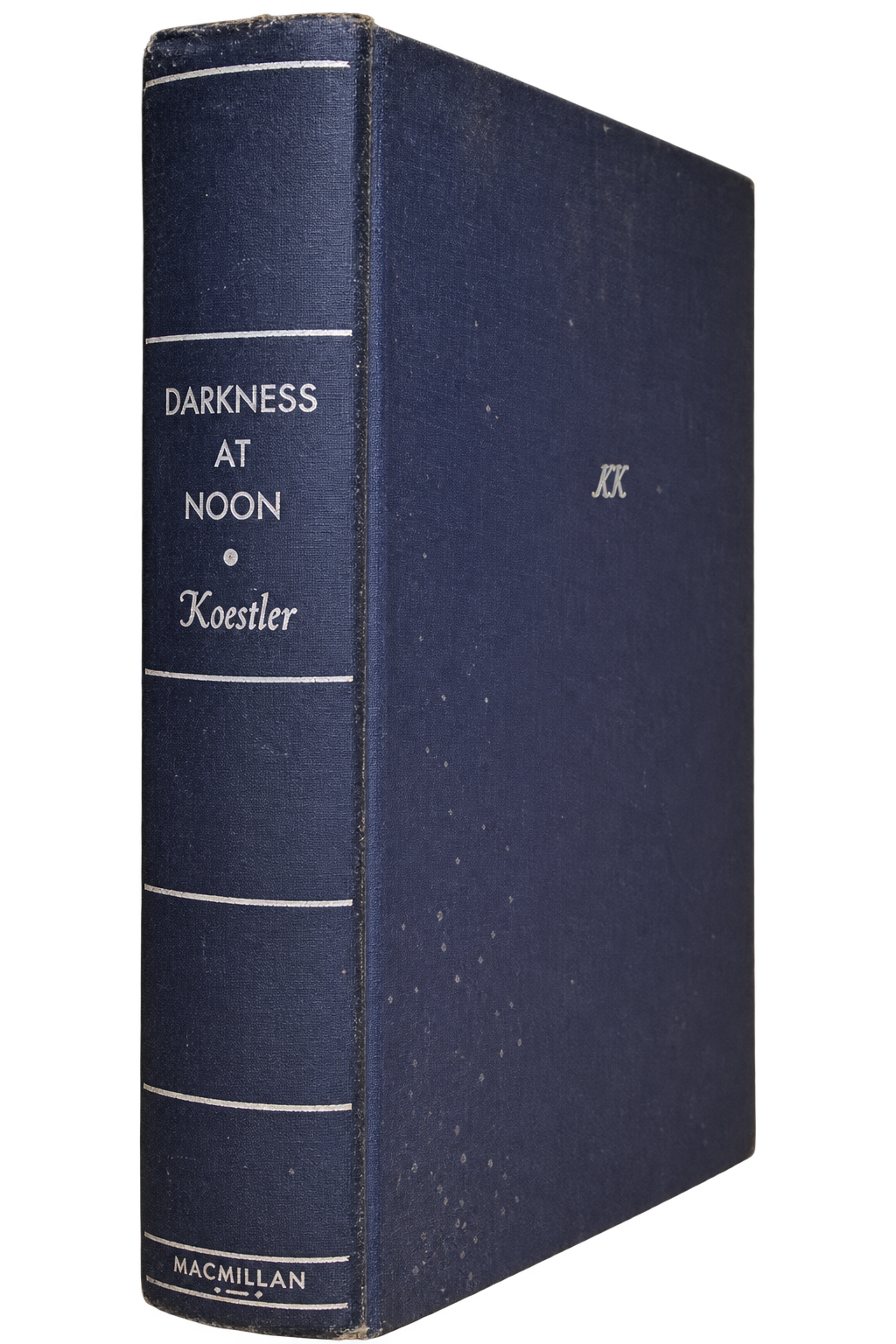
The first American edition and early printing of Arthur Koestler’s Darkness at Noon, published by The Macmillan Company in 1941. The title and copyright pages carry the correct 1941 Macmillan imprint; the copyright page includes “Set up and printed,” the H. Wolff printer statement, and no later-printing designation. This copy retains its original blue cloth with silver AK monogram on the front board and silver spine lettering. The original dust jacket is no longer present.
Condition:
Near Fine. The original blue cloth remains well preserved, with a clean, sound binding, light rubbing at the extremities, modest page-edge toning, and no significant structural defects documented. No evidence of book-club manufacture or later rebinding is present. The original dust jacket is absent, and no significant ownership provenance is recorded.
Story Of The Book
The original manuscript disappeared when France fell to the Nazis. Its warning survived.
Arthur Koestler wrote Darkness at Noon in exile in France as Europe was being consumed by totalitarianism from both directions. His subject was Stalinism and, more specifically, the political logic exposed by the Moscow Show Trials: a revolutionary system capable of forcing its own former leaders to confess publicly to crimes they had not committed and then destroying them in the name of the ideology they had helped build.
At the center of the novel is Rubashov, an aging revolutionary imprisoned by the regime he once served. Through interrogation, memory, ideological argument, and the gradual destruction of his certainty, Koestler examines one of totalitarianism’s most disturbing achievements: its ability to make political victims participate intellectually in the justification of their own destruction. The novel is therefore not simply about imprisonment. It is about what happens when an ideology claims authority over truth, morality, memory, and ultimately the individual conscience.
The publication history makes the book’s survival almost as extraordinary as its subject. Koestler’s original German typescript disappeared amid the collapse of France in 1940 and was believed lost for decades. Fortunately, Daphne Hardy had already translated the novel into English. Her translation became the form through which Darkness at Noon first reached readers and through which much of the world came to know Koestler’s indictment of Stalinist terror. This 1941 Macmillan edition brought that text to American readers during the Second World War.
The manuscript was lost. The warning wasn’t.
Why It’s In The Collection
Darkness at Noon is nearly a perfect expression of the thesis behind Consigned to Darkness: a book about revolutionary power turning against the individual, written by an exile while authoritarian regimes were consuming Europe, whose own manuscript nearly disappeared in the process.
Koestler’s target is particularly important to the collection because the novel refuses the comforting assumption that oppression belongs only to obviously reactionary regimes. Rubashov is destroyed by a political system built from ideas he once believed would liberate humanity. The book therefore examines one of the collection’s recurring questions: what happens when resistance becomes authority, and revolutionary conviction becomes justification for coercion?
This first American edition also belongs to the historical moment rather than looking backward at it. Published in 1941, it introduced American readers to Koestler’s warning while Stalin remained in power, the Soviet system remained largely opaque to outsiders, and the consequences of twentieth-century ideological totalitarianism were still unfolding. The inventory accordingly gives the book perfect scores for both thesis fit and story strength.
The missing dust jacket limits the copy’s conventional collector value, but the book underneath is the historically important object: an early American manifestation of the English text that survived when Koestler’s original manuscript apparently did not.
A totalitarian system tried to erase the individual inside the novel. War nearly erased the novel itself. Both survived long enough for the warning to reach us.
Collection Categories: Literature · Anti-Authoritarianism · Anti-Totalitarianism · Political Imprisonment · Political Fiction · Political Dissent · Exile & Refugees
———
Authentication Evidence
• Correct Macmillan Company title page, confirming first American edition
• Title page dated 1941, consistent with first American edition
• Copyright page dated 1941 by The Macmillan Company
• Translation credited to Daphne Hardy, consistent with the first American edition
• Copyright page includes "Set up and printed."
• H. Wolff printer statement present
• Original blue cloth binding with silver AK monogram present
• Silver spine lettering present
• No book club edition indicators observed
• First American edition characteristics consistent throughout
Arthur Koestler
Translated by Daphne Hardy
New York: The Macmillan Company, 1941
First American Edition · Early Printing
Darkness At Noon
The original manuscript of this book disappeared when France fell to the Nazis. Its warning survived.
Arthur Koestler wrote Darkness at Noon while living in exile in France, exposing the madness of Stalin's show trials at a moment when totalitarianism was consuming Europe from both east and west. When France collapsed in 1940, the original German manuscript vanished and was believed lost for decades. Fortunately, Daphne Hardy had already translated it into English, making this first American edition part of the version through which the world first encountered Koestler's warning. The manuscript was lost. The warning wasn't.
Full Title: Hobit (הוביט) — The Israeli POWs’ Hebrew Translation
J. R. R. Tolkien
Translated by Israeli Air Force POWs and their comrades
Zmora, Bitan, Modan Publishers · Israel · 1977
First Edition of the Israeli POWs’ Hebrew Translation · First Printing
The Book:
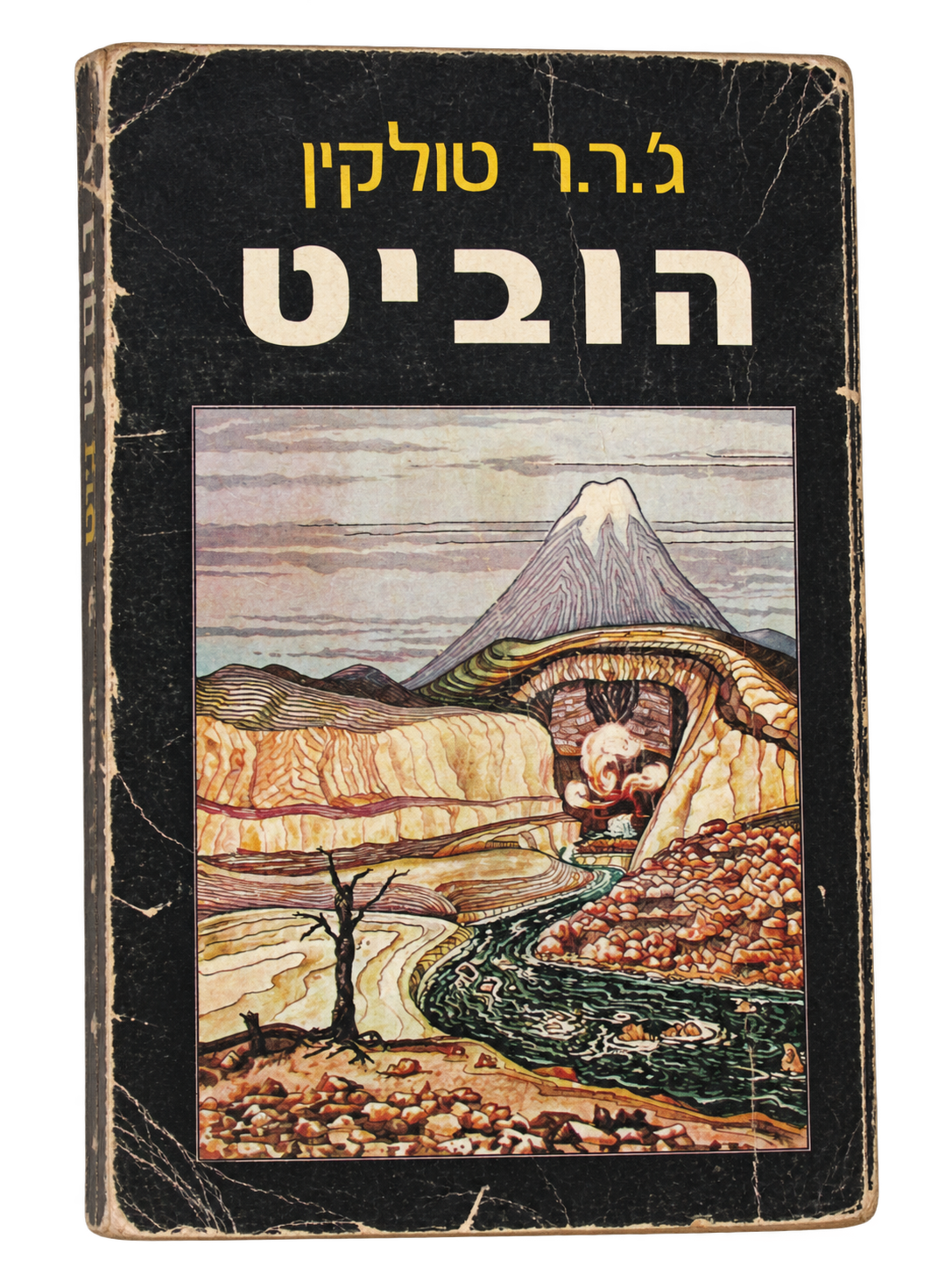
The First Edition · First Printing of the Israeli POWs’ Hebrew translation of J. R. R. Tolkien’s The Hobbit, created collaboratively by prisoners held at Abbassia Prison in Cairo between 1970 and 1973. Four captured Israeli pilots—Rami Harpaz, Menachem Eini, Yitzhak Pir, and Avinoam Kaldas—served as the principal translators, with fellow prisoners contributing to difficult passages and songs. Their completed translation filled seven handwritten notebooks and was brought home after their release. In 1977, with support from the Israeli Air Force, it was published as the celebrated “Pilots’ Translation.” 242 pp. Original black pictorial wrappers with Tolkien artwork retained.
Condition:
Very Good. Original black pictorial wrappers remain complete, with widespread but predominantly superficial rubbing and scuffing, several vertical and diagonal creases, moderate edge and corner wear, and localized loss to the black printed surface at the extremities. Spine remains intact and fully legible; binding is sound. Interior is clean and complete with moderate uniform age toning and no significant ownership markings observed.
Story Of The Book
They didn't know if they would ever make it back home, so they translated a book about going home.
Ten Israeli prisoners of war spent years together in Cairo’s Abbassia Prison after being captured during the War of Attrition. After months of interrogation, solitary confinement, and isolation, they were eventually placed together and faced a captivity with no clear end in sight.
Then an English copy of J. R. R. Tolkien’s The Hobbit reached the prisoners through the Red Cross.
Several of the men could not read English well enough to share in the escape the book offered. So four of the captured pilots—Rami Harpaz, Menachem Eini, Yitzhak Pir, and Avinoam Kaldas—began translating it for them.
For roughly four months, the prisoners read aloud, translated, debated words, edited one another, and eventually filled seven handwritten notebooks with Bilbo’s journey. Translation became part of the communal life they built inside captivity.
The men returned to Israel in 1973 carrying the battered English book and their handwritten translation. Four years later, their version was published.
Men who could not leave their prison had found a way for everyone in the cell to leave with Bilbo for a few hours.
Why It’s In The Collection
Hobit belongs in Consigned to Darkness because sometimes a book does not merely bear witness to captivity. Sometimes a book helps people survive it.
The prisoners did not translate Tolkien for publication, recognition, or literary prestige. They translated it because some of their friends could not read the English book that had become a source of escape. What began as an act of inclusion became months of shared intellectual work under conditions designed to strip prisoners of control over their lives.
Then something extraordinary happened: the private object they created to endure captivity became a public book.
This 1977 first printing preserves that transformation—from one English book entering a prison, to seven handwritten Hebrew notebooks leaving it, to a published edition that allowed the prisoners’ act of mutual aid to outlive their captivity.
They translated a story about getting home. Then they brought their translation home with them.
Collection Categories: Publication-Event Object · Witness Literature · Political Imprisonment · War & Conflict · Human Rights · Political History · Literature
———
Authentication Evidence
Hebrew title page identifies the work as הוביט (Hobit) by J. R. R. Tolkien.
Title-page subtitle identifies the work as translated collaboratively by Israeli Air Force pilots and their comrades while imprisoned at Abbassia Prison in Cairo, 1970–1973.
Copyright page gives the Hebrew publication year 1977 / תשל״ז and identifies Zmora, Bitan, Modan as publisher.
Copyright page explicitly states in English: “Hebrew Rights by Zmora, Bitan, Modan—Publishers.”
Copyright page explicitly states “Printed in Israel, 1977.”
Copyright page explicitly states “Translated into Hebrew by the P.O.W. of the Israeli Air-Force Pilots and their comrades in Abbassya Prison, Cairo, 1970–1973.”
Copyright page records the underlying Tolkien copyright to George Allen & Unwin Ltd., London.
Original publisher’s black pictorial wrappers remain present.
Front wrapper retains yellow author lettering, large white Hebrew title, and Tolkien artwork.
Spine retains the Hebrew author and title together with the Zmora-Bitan-Modan publisher’s device and imprint.
Rear wrapper identifies the volume as a special edition translated by Israeli Air Force pilots and their comrades during Egyptian captivity at Abbassia Prison between 1970 and 1973.
Contents page records seventeen chapters extending through page 235.
Volume concludes on page 242, matching independent bibliographic descriptions of the 1977 Pilots’ Translation.
Independent Israeli bibliographic records identify the publisher as Zmora-Bitan/Modan, publication year as 1977, format as softcover, and translation as the collaborative work of Israeli Air Force POWs and their comrades.
The National Library of Israel documents that the translation was completed during captivity, preserved in seven notebooks, and subsequently published by Zmora Bitan in 1977.
Independent bibliographic evidence identifies the 1977 publication as the first published edition of the Pilots’ Translation.
This edition is not claimed as the first Hebrew translation of The Hobbit; a separate Hebrew translation by Moshe Hana’ami appeared in 1976.
The 1977 volume therefore represents the first edition of the independently created Israeli POWs’ Hebrew translation.
Copyright page carries a single 1977 publication statement with no indication of a subsequent impression.
Wrapper, pagination, imprint, and translation statement correspond with independently documented copies of the original 1977 issue.
No later-printing statement is present.
No evidence of facsimile manufacture, later publisher issue, replacement wrappers, or rebinding is observed.
Observable physical and bibliographic evidence supports identification as the 1977 First Edition of the Israeli POWs’ Hebrew Translation · First Printing.
Full Title: Hobit (הוביט) — The Israeli POWs’ Hebrew Translation
J. R. R. Tolkien
Translated by Israeli Air Force POWs and their comrades
Zmora, Bitan, Modan Publishers · Israel · 1977
First Edition of the Israeli POWs’ Hebrew Translation · First Printing
Hobit (Hebrew)
They did not know when they were going home. So they translated a book about going home.
Held captive in an Egyptian prison after the War of Attrition, ten Israeli prisoners of war faced years of uncertainty, isolation, and confinement. When a copy of J. R. R. Tolkien’s The Hobbit was delivered to the prison by the Red Cross, four captured pilots began translating it into Hebrew so their fellow prisoners could share in its escape. For four months, they worked together, filling seven handwritten notebooks with Bilbo’s journey.
Released in 1973, they returned home carrying both the English book and their translation on loose papers, which was published four years later. What they had created was more than another edition of The Hobbit: it was a way for ten men who could not leave their prison cell to journey somewhere else together — and, for a few hours each day, find their way home.

Tshenuwani Simon Farisani
Fortress Press, Philadelphia · 1987
First Edition · First Printing
The Book: True first edition, first printing of Tshenuwani Simon Farisani’s Diary from a South African Prison, edited by John A. Evenson. The copyright page bears the original 1987 Fortress Press copyright and the printer’s code 3004E87, with no statement of a later printing, subsequent impression, revised edition, or reissue. Original publisher’s pictorial paper wrappers as issued. No evidence of later issue points, book-club manufacture, or subsequent reprint observed.
Condition: Very Good+. The original pictorial wrappers exhibit moderate edge wear, light rubbing, minor creasing, and small areas of chipping. The binding remains tight and the interior clean, with no ownership markings observed.
Story Of The Book
Apartheid tried to isolate its prisoners from the world. Tshenuwani Simon Farisani turned imprisonment into testimony.
A Lutheran pastor and anti-apartheid activist, Farisani was repeatedly imprisoned, interrogated, and tortured by South African authorities. Diary from a South African Prison records that experience from inside the system itself, preserving not a later historian’s reconstruction but the voice of someone who personally endured the machinery of political repression.
Published in 1987, while apartheid still remained in force, the book brought Farisani’s account of detention and abuse into international circulation. His testimony reveals political imprisonment not simply as confinement, but as an attempt to break the individual psychologically, morally, and spiritually—to make continued opposition appear impossible.
Farisani’s religious identity gives the book another dimension. His resistance was inseparable from conscience: the state could control his physical circumstances, but it could not easily dictate the moral obligations by which he understood them.
The book therefore preserves the collision between two forms of authority—one enforced by prisons and coercion, the other grounded in conscience.
Why It’s In The Collection
Diary from a South African Prison belongs in the collection because it documents authoritarian power from the perspective of the person subjected to it.
Farisani does not describe political imprisonment as an abstraction. He records what interrogation, torture, detention, and state intimidation actually do to a human being. That makes the book an especially direct form of witness literature: the institutions of apartheid appear not merely as laws or historical structures, but as forces acting upon an individual body and conscience.
Its publication date matters as well. This was not testimony assembled after apartheid had fallen. The first edition appeared while the system Farisani condemned still possessed the power to imprison its opponents. Publication therefore carried his experience beyond the institutions attempting to contain him and placed that testimony before readers elsewhere in the world.
Within the collection, the book demonstrates one of the essential functions of witness: power may control a prisoner’s circumstances, but publication can prevent it from controlling the final account of what happened there.
Collection Categories: Political Imprisonment · Witness Literature · Memoir & Testimony · Human Rights · Anti-Authoritarianism · Religious Conscience
———
Authentication Evidence
• Title page identifies Fortress Press, Philadelphia, consistent with the original publisher of the work.
• Copyright page bears the original 1987 Fortress Press copyright with no indication of a later edition, revised edition, or reissue.
• The book was originally published by Fortress Press in 1987, consistent with the first edition.
• Copyright page contains the original printer's code 3004E87, consistent with the initial printing.
• Copyright page contains no statement of a later printing, subsequent impression, or reprint.
• The original pictorial paper wrappers match those found on documented first-printing examples.
• No evidence of later issue points, book club manufacture, or subsequent reprint observed.
• The observed bibliographic evidence is consistent with a true first edition, first printing.
Tshenuwani Simon Farisani
Fortress Press · Philadelphia · 1987
First Edition · First Printing
Diary from a South African Prison
Apartheid sought to isolate its prisoners from the world. Ruth First transformed imprisonment itself into testimony.
Written after her release from detention without trial, Diary from a South African Prison reconstructs the psychological reality of arbitrary imprisonment under apartheid while exposing the mechanisms through which authoritarian governments attempt to silence political opposition. Rather than depicting resistance solely through dramatic confrontation, First reveals the quiet endurance required to preserve one's humanity under systematic repression. This first edition preserves one of the defining firsthand accounts of political imprisonment in apartheid South Africa.
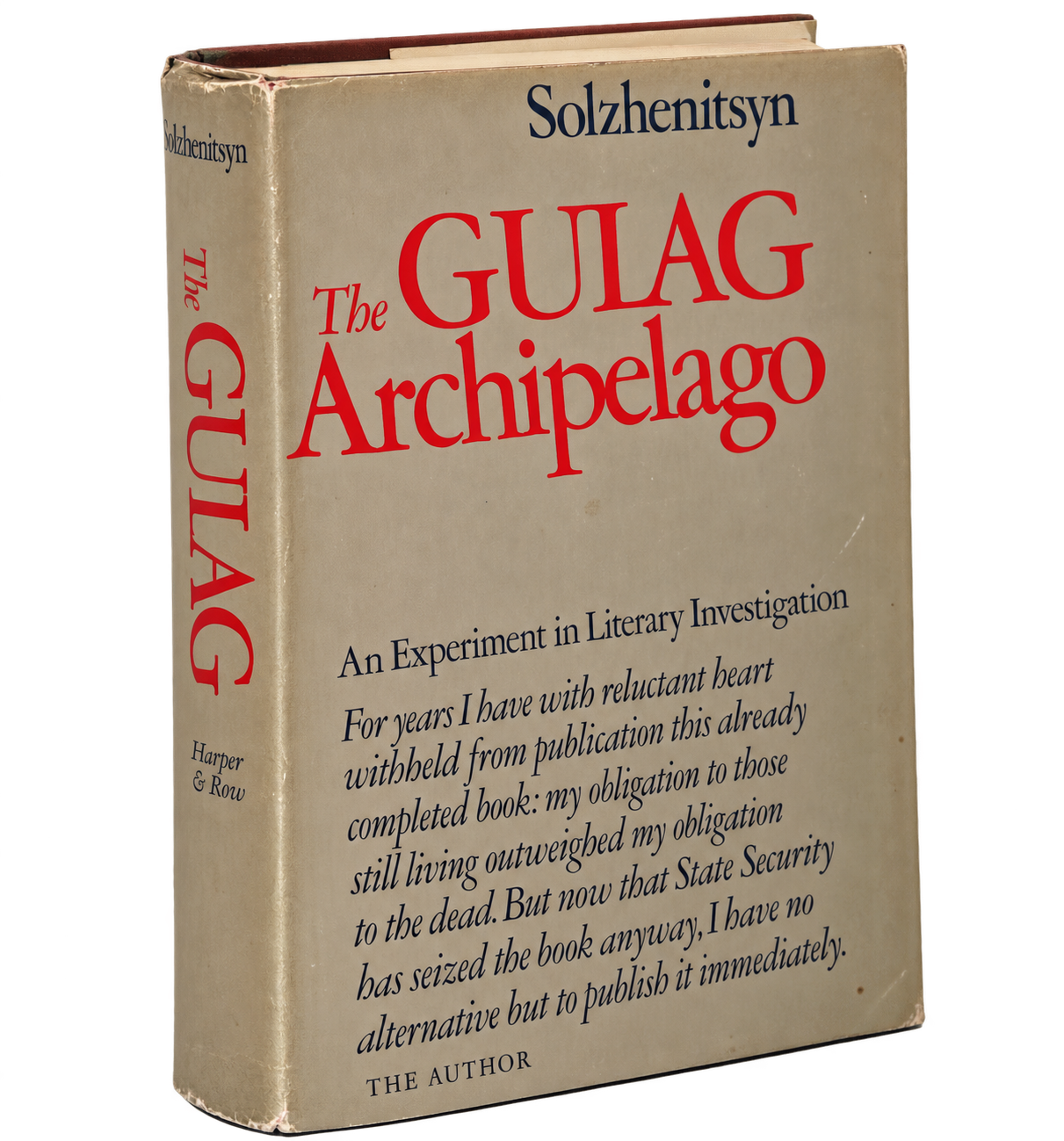
Full Title: The Gulag Archipelago, 1918–1956: An Experiment in Literary Investigation (Volumes I–II)
Aleksandr Solzhenitsyn
Translated from the Russian by Thomas P. Whitney
Harper & Row, Publishers · New York · 1974
First American Edition · First Printing
The Book:
The first American edition, first printing of Aleksandr Solzhenitsyn’s The Gulag Archipelago, 1918–1956: An Experiment in Literary Investigation, containing Volumes I–II of the larger work in a single physical hardcover volume, translated from the Russian by Thomas P. Whitney and published by Harper & Row in 1974. Combining Solzhenitsyn’s own experience of imprisonment with historical investigation and testimony gathered from former prisoners, the book reconstructs the Soviet system of arrest, interrogation, imprisonment, forced labor, and exile. xii, 660 pp. Original black publisher’s cloth with gilt spine lettering, retaining the original unclipped dust jacket priced $12.50.
Condition:
Near Fine+ book in a Near Fine dust jacket. The original black cloth remains exceptionally fresh, with bright gilt spine lettering, a square binding, crisp pages, and no ownership markings, foxing, restoration, or structural defects observed. The original unclipped jacket retains excellent color with light age toning, faint rubbing, minimal edge wear, and a few tiny closed tears, but no significant chips or paper loss.
Story Of The Book
The Soviet Union built an enormous system of political imprisonment. Solzhenitsyn set out to reconstruct the world it tried to keep hidden.
The Gulag Archipelago grew from Solzhenitsyn’s own imprisonment and years of clandestine research. But unlike One Day in the Life of Ivan Denisovich, it does not confine itself to one prisoner or one camp. Solzhenitsyn combined personal experience, historical investigation, and the testimony of former prisoners to document how repression operated across decades of Soviet rule.
The result was neither conventional history nor memoir. Solzhenitsyn called it an “experiment in literary investigation.” Arrests, interrogations, transportation, forced labor, prisons, exile, executions, and survival become parts of a vast system reconstructed through the people who experienced it.
The achievement of the book was to transform millions of individual disappearances into evidence of a system.
Solzhenitsyn kept the manuscript secret because publication inside the Soviet Union was impossible and possession endangered the people who had helped him. After Soviet security discovered a hidden copy in 1973, he authorized publication abroad. The Russian edition appeared in Paris at the end of that year; translations quickly followed. Soon afterward, Solzhenitsyn was arrested, stripped of Soviet citizenship, and expelled from the country.
Why It’s In The Collection
The Gulag Archipelago belongs in Consigned to Darkness because authoritarian power depends not only on the ability to imprison people, but on the ability to control what the rest of society knows about their imprisonment.
For decades, the Gulag existed alongside official narratives that concealed, minimized, or justified political repression. Solzhenitsyn attacked that secrecy by assembling the experiences of people the system had scattered across prisons, camps, and exile.
The book therefore represents more than testimony. It is an attempt to defeat institutional forgetting.
This 1974 first American edition preserves the moment that investigation entered American public life. Published only months after the Russian edition appeared abroad—and amid the confrontation that led to Solzhenitsyn’s expulsion from the Soviet Union—it carried evidence gathered in secrecy into unrestricted circulation.
Within the collection, it also completes an important progression in Solzhenitsyn’s work. One Day in the Life of Ivan Denisovich asks readers to experience political imprisonment through one person. Cancer Ward examines what repression leaves behind. The Gulag Archipelago reconstructs the machinery that produced both.
A state could imprison its witnesses. Solzhenitsyn built a book from their voices that the state could no longer contain.
Collection Categories: Witness Literature · Anti-Totalitarianism · Political Imprisonment · Human Rights · Censorship · Free Expression · Political Dissent · Publication-Event Object · Documentary Literature · Anti-Authoritarianism
———
Authentication Evidence
Title page identifies The Gulag Archipelago, 1918–1956: An Experiment in Literary Investigation and specifies Volumes I–II.
In this Harper & Row edition, Volumes I–II are contained together in one physical hardcover book rather than issued as two separate books.
Translation is credited to Thomas P. Whitney.
Copyright page identifies the Harper & Row first American publication and contains the publisher’s first-printing statement.
Original black publisher’s cloth with gilt spine lettering is present.
Original dust jacket is present and remains unclipped at $12.50.
No evidence of book-club manufacture, later printing, rebinding, facsimile jacket, or other bibliographic anomalies is observed.
Taken together, the first-printing statement, Harper & Row imprint, Thomas P. Whitney translation, original publisher’s binding, and original priced jacket support identification as an authentic 1974 First American Edition · First Printing of Volumes I–II, issued together in a single hardcover volume.
Full Title: The Gulag Archipelago, 1918–1956: An Experiment in Literary Investigation (Volumes I–II)
Aleksandr Solzhenitsyn
Translated from the Russian by Thomas P. Whitney
Harper & Row, Publishers · New York · 1974
First American Edition · First Printing
The Gulag Archipelago (Vol. I-II)
Governments have hidden atrocities before. Few had ever been confronted by a book assembled from hundreds of surviving witnesses determined to make concealment impossible.
Drawing upon his own imprisonment, years of investigation, and the testimony of more than two hundred former prisoners, Aleksandr Solzhenitsyn transformed the Soviet labor camp system into one of the twentieth century's greatest documentary indictments of state power. The Gulag Archipelago did not simply describe the machinery of repression—it reconstructed an entire hidden civilization built upon fear, forced labor, secrecy, and human suffering. This first American edition preserves the moment that one of history's most consequential acts of literary witness entered the English-speaking world, ensuring that the experiences the Soviet state had attempted to erase could no longer be denied.
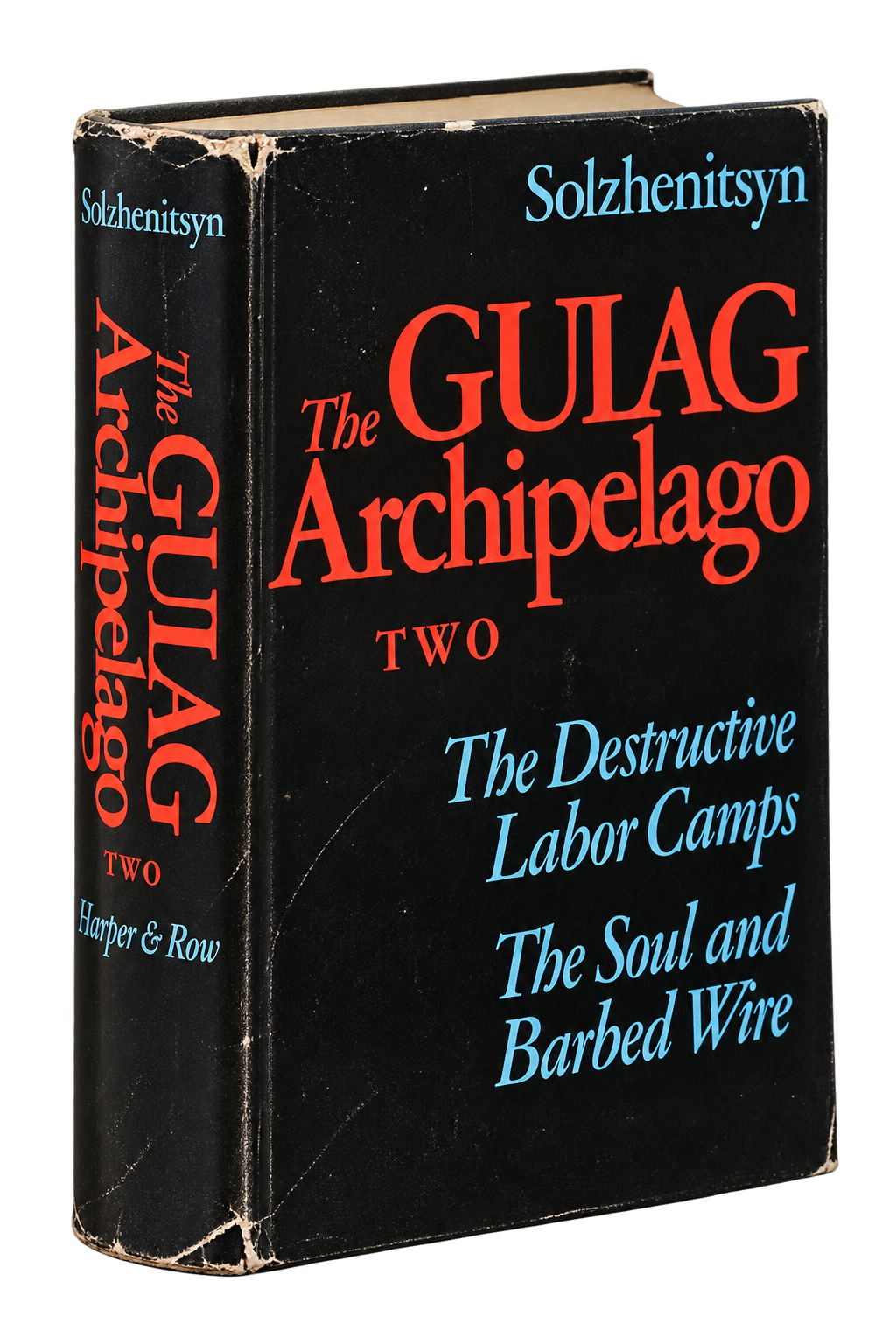
Full Title: The Gulag Archipelago, 1918–1956: An Experiment in Literary Investigation (Volumes III–IV)
Aleksandr Solzhenitsyn
Translated from the Russian by Thomas P. Whitney
Harper & Row, Publishers · New York · 1975
First American Edition · First Printing
The Book:
The first American edition, first printing of Aleksandr Solzhenitsyn’s The Gulag Archipelago, 1918–1956: An Experiment in Literary Investigation, containing Volumes III–IV of the larger work in a single physical hardcover volume. Harper & Row published Volumes I–II in one hardcover in 1974, followed by this companion volume containing Volumes III–IV in 1975. Together, the two separately published Harper & Row hardcovers form the complete first American publication of Volumes I–IV. Translated from the Russian by Thomas P. Whitney. Original black publisher’s cloth with gilt spine lettering, retaining the original unclipped dust jacket.
Condition:
Near Fine+ book in a Very Good+ dust jacket. The original black cloth remains exceptionally fresh, with bright gilt spine lettering, a square binding, crisp pages, and no ownership markings, foxing, restoration, or structural defects observed. The original jacket remains complete with moderate rubbing, scattered edge wear, minor chipping at the extremities, and light handling wear, but no significant tears or major paper loss.
Story Of The Book
The first part of The Gulag Archipelago exposed a hidden system. The concluding volume asked how that system endured.
Solzhenitsyn had already reconstructed the machinery of arrest, interrogation, imprisonment, and forced labor. Here, his investigation expands outward, examining the development of the camps across decades of Soviet rule and the lives of the people forced to inhabit them.
Again, the evidence comes from more than Solzhenitsyn himself. Personal experience is joined by the testimony of former prisoners and years of clandestine research, allowing individual stories to accumulate into a history of political repression.
The Gulag was not simply a collection of brutal prisons. Solzhenitsyn presented it as a system sustained by institutions, ideology, secrecy, and human choices.
By the time this American edition appeared in 1975, the consequences of publishing the work were already unmistakable. Solzhenitsyn had been arrested, stripped of his Soviet citizenship, and expelled from the country. The investigation the Soviet state could not permit at home was now circulating internationally.
Why It’s In The Collection
Volumes III–IV belong in Consigned to Darkness because they complete one of the twentieth century’s most consequential attempts to reconstruct a history that political power had tried to suppress.
The significance of The Gulag Archipelago lies partly in scale. Solzhenitsyn took experiences scattered across decades, prisons, labor camps, and individual memories and assembled them into a record capable of revealing the system connecting them.
Testimony became evidence; evidence became history.
Harper & Row issued the American publication in two physical books: Volumes I–II in 1974, followed by Volumes III–IV in this 1975 companion volume. Preserved together in the collection, RB-0107 and RB-0108 represent the complete first American publication of Volumes I–IV.
Within the collection’s larger Solzhenitsyn sequence, the progression is deliberate: One Day in the Life of Ivan Denisovich gives political imprisonment a human face. Cancer Ward examines what repression leaves behind. The Gulag Archipelago reconstructs the system itself.
The state had scattered its prisoners across an archipelago. Solzhenitsyn gathered their experiences back together.
Collection Categories: Witness Literature · Anti-Totalitarianism · Political Imprisonment · Human Rights · Censorship · Free Expression · Political Dissent · Publication-Event Object · Documentary Literature
———
Authentication Evidence
Title page identifies The Gulag Archipelago, 1918–1956: An Experiment in Literary Investigation, Volumes III–IV, by Aleksandr Solzhenitsyn and Harper & Row, Publishers, as publisher.
Volumes III–IV are contained together in this single physical hardcover.
Harper & Row had previously issued Volumes I–II together in a separate physical hardcover in 1974; this 1975 companion volume continues and completes the first American publication of Volumes I–IV.
Translation is credited to Thomas P. Whitney.
Copyright page identifies the publication as “First Edition” and contains the complete number line 15 16 17 18 19 10 9 8 7 6 5 4 3 2 1, directly establishing first-printing status.
Copyright page is dated 1974; the physical Harper & Row volume was published in 1975.
Original black publisher’s cloth with gilt spine lettering is present.
Original unclipped dust jacket is present and corresponds to the Harper & Row first American issue.
No evidence of book-club manufacture, later printing, rebinding, facsimile jacket, or other bibliographic anomalies is observed.
Taken together, the explicit First Edition statement, complete number line ending in 1, Harper & Row imprint, Thomas P. Whitney translation, original binding, and original dust jacket support identification as an authentic 1975 First American Edition · First Printing of Volumes III–IV, issued as the second physical volume of Harper & Row’s two-book American publication of Volumes I–IV.
The The Gulag Archipelago (Vol. III-IV)
The first volumes of The Gulag Archipelago exposed the hidden machinery of repression. The concluding volumes asked an even larger question: how could an entire political system be built upon it?
Drawing upon years of investigation, personal experience, official documents, and testimony from hundreds of former prisoners, Aleksandr Solzhenitsyn expanded his work beyond individual camps into a comprehensive history of the Soviet security state. The final volumes trace the evolution of political terror across generations while confronting the moral choices that allowed repression to endure. Published shortly after the first volumes, this first American edition completed one of the twentieth century's greatest documentary investigations, ensuring that a hidden history survived beyond the reach of censorship.
Full Title: The Gulag Archipelago, 1918–1956: An Experiment in Literary Investigation (Volumes III–IV)
Aleksandr Solzhenitsyn
Translated from the Russian by Thomas P. Whitney
Harper & Row, Publishers · New York · 1975
First American Edition · First Printing
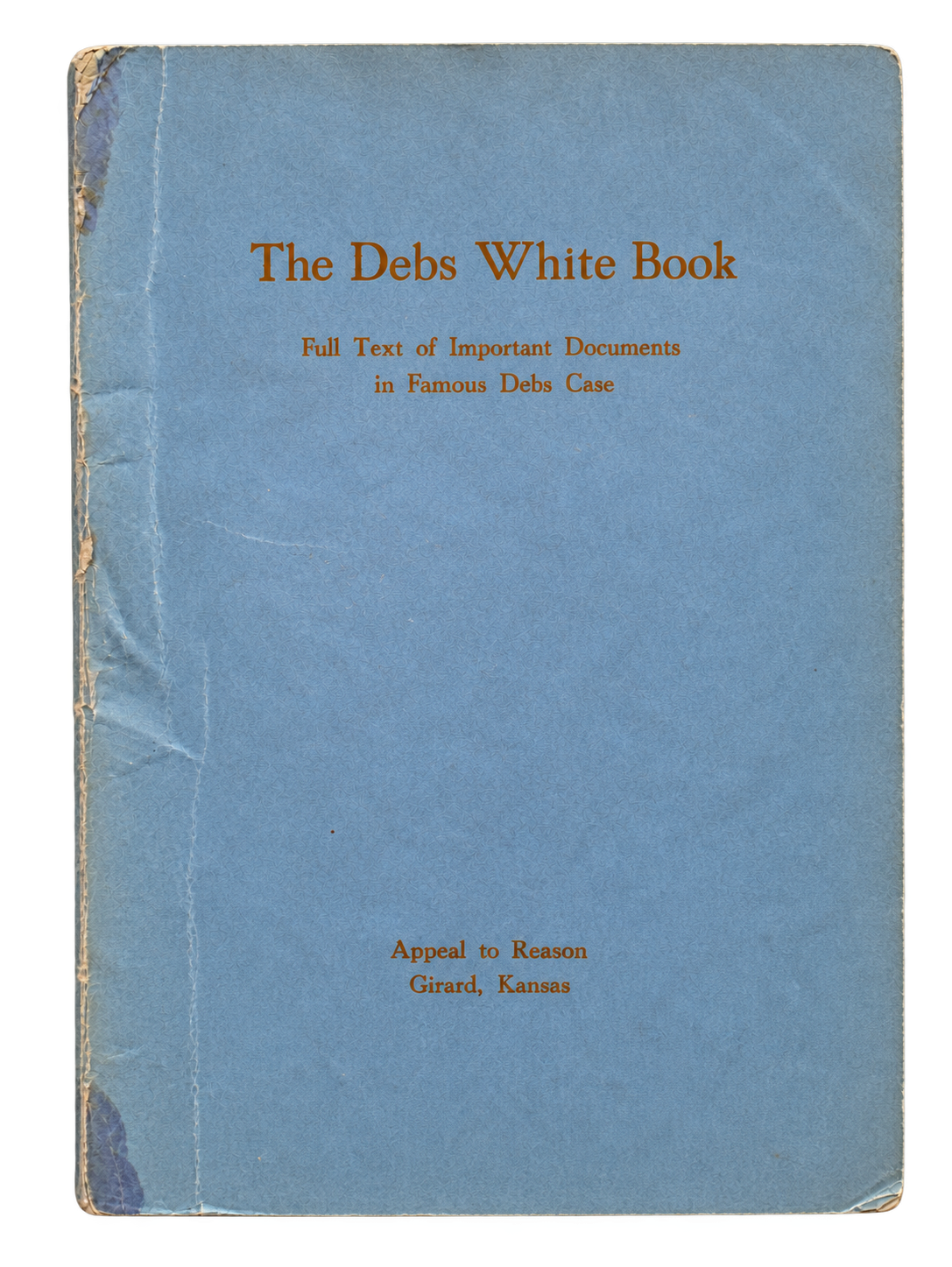
Full Title:The Debs White Book: Full Text of Important Documents in the Famous Debs Case
Eugene V. Debs
Appeal to Reason, Girard, Kansas · 1919
First Edition · First Printing
The Book: True first edition, first printing of The Debs White Book: Full Text of Important Documents in the Famous Debs Case. Published by the socialist newspaper Appeal to Reason in Girard, Kansas, in 1919, the volume retains its original blue printed paper wrappers. Its contents begin with the publisher’s Foreword and include Debs’s Canton Speech, the legal proceedings arising from his prosecution, and related documents from the case. The physical format, typography, wrappers, and contents are consistent with documented copies of the original issue, with no evidence of a later edition, subsequent impression, replacement wrappers, rebinding, facsimile production, ex-library provenance, or restoration observed.
Condition: Very Good. The original blue printed wrappers exhibit moderate age toning, rubbing, light edge wear, and vertical reading creases along the spine. The staples remain secure and the text is complete. The interior is generally clean with scattered foxing and light age toning. No significant ownership provenance or restoration documented.
Story Of The Book
Eugene V. Debs was sent to prison for a speech.
In June 1918, Debs addressed a crowd in Canton, Ohio, condemning the First World War and criticizing the government’s treatment of anti-war activists. Federal authorities prosecuted him under the Espionage Act, arguing that his words unlawfully interfered with the war effort. Debs was convicted, sentenced to ten years in prison, and his conviction was subsequently upheld by the Supreme Court.
The Debs White Book emerged directly from that conflict.
Published in 1919 while Debs remained imprisoned, the volume assembled his Canton Speech together with the legal proceedings, arguments, and official documents surrounding his prosecution. Rather than merely telling readers that Debs had been punished for political speech, the publishers gave them the documentary record and invited them to examine the controversy themselves.
That distinction makes the book fundamentally different from a later biography or historical account. It was produced while the consequences of Debs’s prosecution remained immediate and while Americans were still arguing over how far the government could go in suppressing political opposition during wartime.
The book was not simply about the free-speech controversy. It became part of it.
Why It’s In The Collection
The Debs White Book belongs near the historical center of the collection because it demonstrates how publication can challenge the government’s ability to control the record of its own prosecution of dissent.
The federal government possessed prosecutors, courts, prisons, and the authority to characterize Debs’s speech as criminal. Appeal to Reason possessed a printing press. By assembling Debs’s words alongside the documents used to prosecute him, the book created an alternative public archive through which citizens could evaluate one of the defining American conflicts over wartime expression for themselves.
That makes this first printing particularly important. It does not commemorate a famous free-speech case after constitutional history had already assigned it significance. It preserves a printed object produced from inside the controversy itself, while Debs was still incarcerated and the boundaries of permissible political dissent remained actively contested.
Within the collection, the volume therefore sits at the intersection of free expression, censorship, political dissent, labor activism, and state power. It records what can happen when opposition to government policy becomes grounds for imprisonment—and how print can answer coercive authority by preserving the very words and evidence around which that authority attempted to construct a crime.
Collection Categories: Free Expression · Censorship · Publication-Event Object · Political Imprisonment · Political Dissent · Political History · Labor & Economic Justice
———
Authentication Evidence
• Title page reads "The Debs White Book: Full Text of Important Documents in Famous Debs Case" with publisher Appeal to Reason, Girard, Kansas, consistent with the original 1919 publication.
• First Edition Evidence: Published by Appeal to Reason in 1919, the original publisher of the work, with no indication of a later edition, revised edition, or subsequent issue. Physical format, typography, wrappers, and contents are consistent with documented first-edition copies.
• First Printing Evidence: This publication is bibliographically recognized as having been issued in a single initial printing by Appeal to Reason in 1919. No evidence of a later printing, subsequent impression, or reprint is present.
• Original blue printed paper wrappers match known first-issue examples.
• Contents begin with the publisher's Foreword, followed by Debs's Canton Speech and the complete documentary record of the Debs case, consistent with the original issue.
• No evidence of rebinding, replacement wrappers, facsimile production, ex-library provenance, or restoration observed.
• The observed bibliographic evidence is consistent with a true first edition, first printing.
The Debs White Book
Full Title: The Debs White Book: Full Text of Important Documents in the Famous Debs Case
Eugene V. Debs
Appeal to Reason · Kansas · 1919
First Edition · First Printing
When Eugene V. Debs was imprisoned for opposing the First World War, the government sought not only to punish a political opponent but to define the limits of permissible dissent during wartime.
Published while Debs remained behind bars, The Debs White Book assembles the speeches, court documents, legal arguments, and official records surrounding one of the most consequential free speech prosecutions in American history. Rather than allowing the state alone to define the controversy, the volume preserves the documentary record through which readers could judge the case for themselves. This first edition preserves one of the foundational publication-objects in the history of American political dissent and freedom of expression.