
 Image 1 of 1
Letter from Birmingham City Jail — Martin Luther King, Jr.
Martin Luther King, Jr.
Philadelphia: American Friends Service Committee, 1963
First Edition · Fourth Printing · July 1963
The Book:
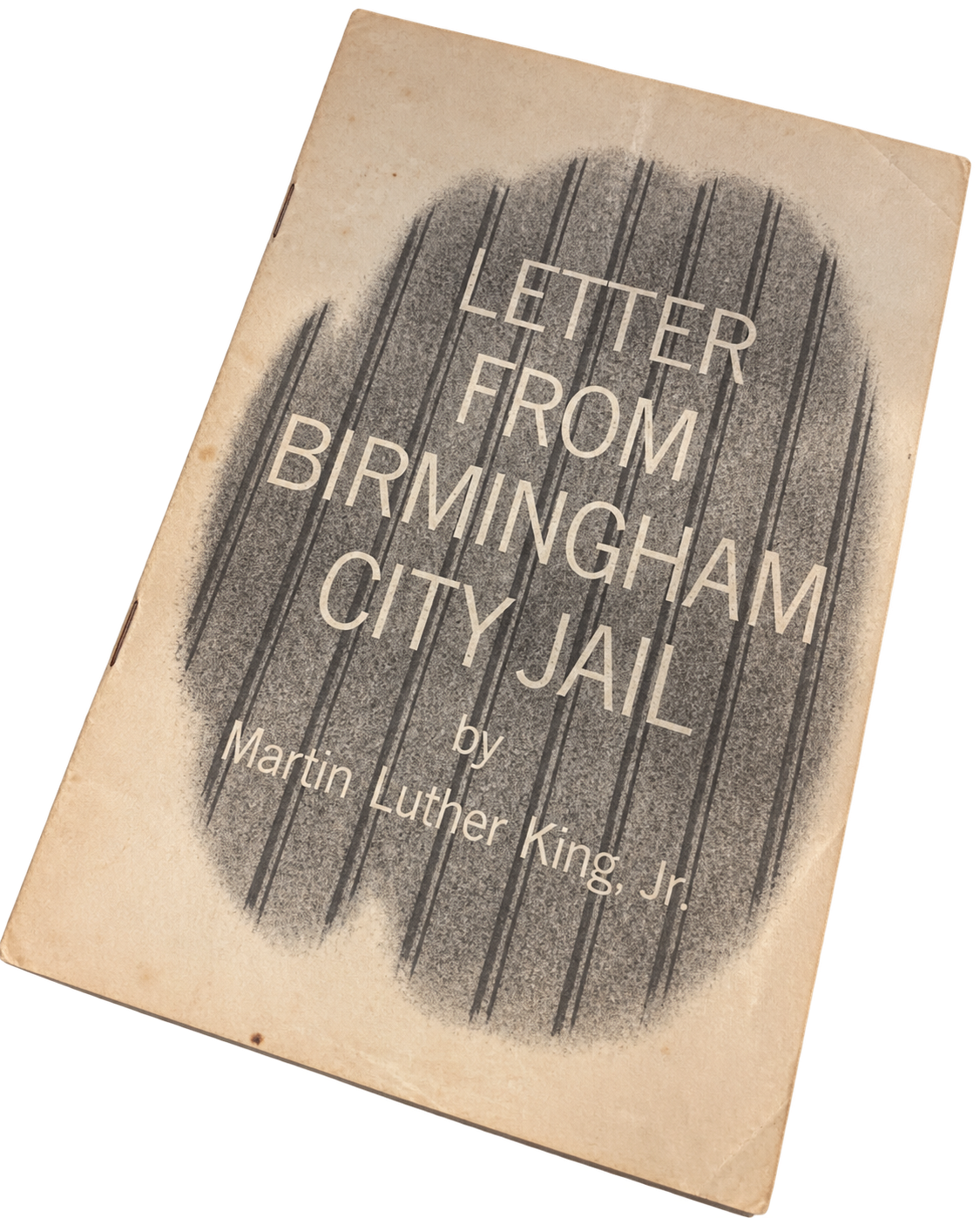
An original 1963 American Friends Service Committee pamphlet edition of Martin Luther King Jr.’s Letter from Birmingham City Jail, issued only months after King wrote the letter during his imprisonment in Birmingham that April. The rear-wrapper production statement explicitly records the printing history and identifies this copy as “Fourth 7-63—30M,” establishing it as the July 1963 fourth printing from a 30,000-copy press run. The pamphlet retains its original illustrated self-wrappers and staple binding. Seller-reported provenance places this copy in the collection of Harlem Renaissance poet, scholar, and longtime Chelsea Hotel resident Helene Johnson, although that association remains undocumented beyond the bookseller’s attribution and should therefore be treated as reported rather than independently proven.
Condition:
Very Good. The pamphlet is complete, firmly stapled, and structurally sound, with no missing leaves or paper loss observed. Moderate age toning, light edge rubbing, and general handling wear are present throughout. The principal defect is a long, stable semi-closed tear to the rear wrapper with historic reinforcement. The pamphlet is preserved in an archival polyester sleeve with acid-free backing board and a rigid protective enclosure.
Story Of The Book
Martin Luther King Jr. turned a jail cell into one of the most influential classrooms of the twentieth century.
King was arrested during the Birmingham Campaign in April 1963 for participating in demonstrations against segregation. While confined, he responded to eight white Alabama religious leaders who had criticized the demonstrations as untimely and urged activists to pursue patience and negotiation instead of direct action. King’s answer became one of the defining arguments of the Civil Rights Movement: that injustice does not become tolerable merely because those suffering from it are asked to wait, and that individuals may have a moral obligation to resist unjust laws.
The importance of this copy lies not only in the text, but in the form through which that text moved. The American Friends Service Committee issued King’s letter as an inexpensive pamphlet designed for circulation. By July 1963, only a few months after the letter had been written, the AFSC was already printing another 30,000 copies. This fourth printing therefore belongs to the active life of the argument itself, when Birmingham was still reshaping the national civil-rights debate and King’s defense of nonviolent direct action was being placed physically into the hands of readers.
That makes the fourth printing especially meaningful to this collection. A first printing would ordinarily sit higher in the conventional rare-book hierarchy, but Consigned to Darkness values objects that participated in historical events. This July 1963 printing documents rapid dissemination: the argument had escaped the jail cell, entered print, and was being reproduced in tens of thousands of copies while the struggle that produced it was still unfolding.
The letter argued that justice could not wait. The pamphlet helped make sure the argument did not have to.
Why It’s In The Collection
Letter from Birmingham City Jail is one of the clearest publication-event objects in Consigned to Darkness because the physical pamphlet was itself part of the Civil Rights Movement’s strategy.
The collection does not preserve this copy simply because it contains famous words by Martin Luther King Jr. It preserves an original movement-era object through which those words were deliberately disseminated during the struggle itself. The American Friends Service Committee turned a letter written under confinement into a portable instrument of persuasion, allowing King’s argument about conscience, unjust law, and civil disobedience to circulate far beyond Birmingham.
The July 1963 fourth printing strengthens rather than weakens that story. Its 30,000-copy production statement is physical evidence that demand for the pamphlet was continuing only months after King wrote the letter. In conventional collecting, “fourth printing” may sound secondary. Here, it documents propagation. It shows the text becoming movement literature in real time.
The seller-reported Helene Johnson provenance adds a potentially significant association with African American literary history, but the evidence has limits. The inventory appropriately records the attribution while noting that no separate documentation establishes the chain of custody. It should therefore be presented as an intriguing reported provenance, not as an authenticated association.
This is exactly the kind of object the collection is built around: not merely a text that later became historically important, but a surviving piece of the mechanism by which the text became important in the first place.
King wrote from inside a jail. This pamphlet is part of how the argument got out.
Collection Categories: Civil Rights · Human Rights · Religious Conscience · Political Imprisonment · Political Dissent · Free Expression · Publication-Event Object
———
Authentication Evidence
• The front wrapper bears the correct title, Letter from Birmingham City Jail, and attributes the text to Martin Luther King, Jr.
• The rear wrapper identifies the American Friends Service Committee, its Philadelphia national office, and its regional offices, matching the recognized 1963 AFSC pamphlet edition. Library records identify this edition as published in Philadelphia by the American Friends Service Committee in 1963.
• The rear-wrapper production line explicitly records the first through fourth printings and identifies the fourth as 7-63—30M, directly establishing this copy’s July 1963 printing.
• The front-wrapper design, typography, AFSC emblem, office list, and production statement are internally consistent with the period edition.
• The paper toning, printing characteristics, edge wear, staple-bound pamphlet format, and aged pressure-sensitive repairs are consistent with an original 1963 object rather than a modern facsimile.
• No evidence of photographic reproduction, print-on-demand manufacture, or modern reprint typography is visible.
• Edition evidence: The AFSC imprint, wrapper design, and 1963 publication information establish this as part of the original American Friends Service Committee edition.
• Printing evidence: The rear-wrapper statement explicitly lists Fourth 7-63—30M, directly identifying the fourth printing.