
 Image 1 of 1
Hobit (Hebrew) — J. R. R. Tolkien
Full Title: Hobit (הוביט) — The Israeli POWs’ Hebrew Translation
J. R. R. Tolkien
Translated by Israeli Air Force POWs and their comrades
Zmora, Bitan, Modan Publishers · Israel · 1977
First Edition of the Israeli POWs’ Hebrew Translation · First Printing
The Book:
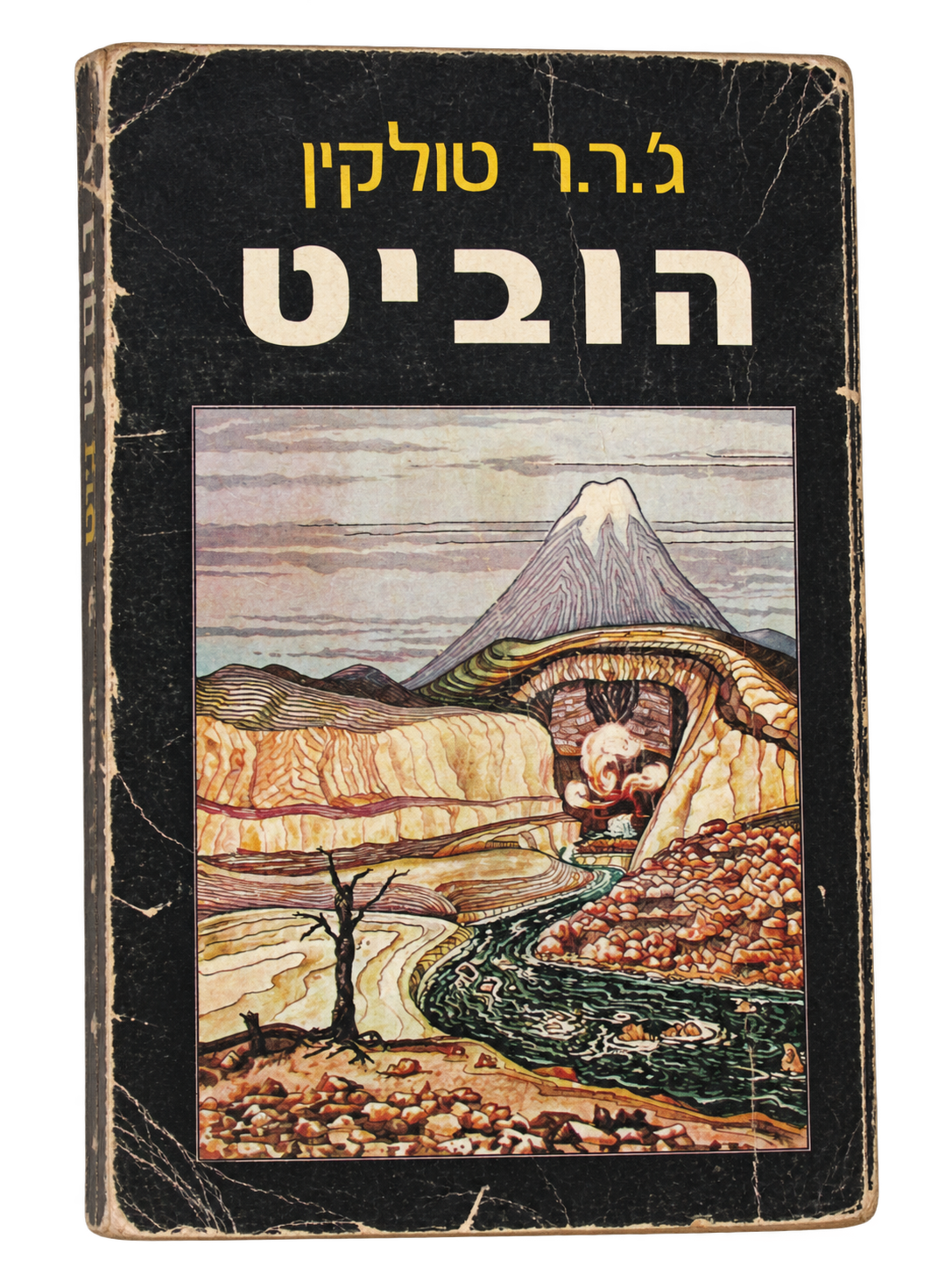
The First Edition · First Printing of the Israeli POWs’ Hebrew translation of J. R. R. Tolkien’s The Hobbit, created collaboratively by prisoners held at Abbassia Prison in Cairo between 1970 and 1973. Four captured Israeli pilots—Rami Harpaz, Menachem Eini, Yitzhak Pir, and Avinoam Kaldas—served as the principal translators, with fellow prisoners contributing to difficult passages and songs. Their completed translation filled seven handwritten notebooks and was brought home after their release. In 1977, with support from the Israeli Air Force, it was published as the celebrated “Pilots’ Translation.” 242 pp. Original black pictorial wrappers with Tolkien artwork retained.
Condition:
Very Good. Original black pictorial wrappers remain complete, with widespread but predominantly superficial rubbing and scuffing, several vertical and diagonal creases, moderate edge and corner wear, and localized loss to the black printed surface at the extremities. Spine remains intact and fully legible; binding is sound. Interior is clean and complete with moderate uniform age toning and no significant ownership markings observed.
Story Of The Book
They didn't know if they would ever make it back home, so they translated a book about going home.
Ten Israeli prisoners of war spent years together in Cairo’s Abbassia Prison after being captured during the War of Attrition. After months of interrogation, solitary confinement, and isolation, they were eventually placed together and faced a captivity with no clear end in sight.
Then an English copy of J. R. R. Tolkien’s The Hobbit reached the prisoners through the Red Cross.
Several of the men could not read English well enough to share in the escape the book offered. So four of the captured pilots—Rami Harpaz, Menachem Eini, Yitzhak Pir, and Avinoam Kaldas—began translating it for them.
For roughly four months, the prisoners read aloud, translated, debated words, edited one another, and eventually filled seven handwritten notebooks with Bilbo’s journey. Translation became part of the communal life they built inside captivity.
The men returned to Israel in 1973 carrying the battered English book and their handwritten translation. Four years later, their version was published.
Men who could not leave their prison had found a way for everyone in the cell to leave with Bilbo for a few hours.
Why It’s In The Collection
Hobit belongs in Consigned to Darkness because sometimes a book does not merely bear witness to captivity. Sometimes a book helps people survive it.
The prisoners did not translate Tolkien for publication, recognition, or literary prestige. They translated it because some of their friends could not read the English book that had become a source of escape. What began as an act of inclusion became months of shared intellectual work under conditions designed to strip prisoners of control over their lives.
Then something extraordinary happened: the private object they created to endure captivity became a public book.
This 1977 first printing preserves that transformation—from one English book entering a prison, to seven handwritten Hebrew notebooks leaving it, to a published edition that allowed the prisoners’ act of mutual aid to outlive their captivity.
They translated a story about getting home. Then they brought their translation home with them.
Collection Categories: Publication-Event Object · Witness Literature · Political Imprisonment · War & Conflict · Human Rights · Political History · Literature
———
Authentication Evidence
Hebrew title page identifies the work as הוביט (Hobit) by J. R. R. Tolkien.
Title-page subtitle identifies the work as translated collaboratively by Israeli Air Force pilots and their comrades while imprisoned at Abbassia Prison in Cairo, 1970–1973.
Copyright page gives the Hebrew publication year 1977 / תשל״ז and identifies Zmora, Bitan, Modan as publisher.
Copyright page explicitly states in English: “Hebrew Rights by Zmora, Bitan, Modan—Publishers.”
Copyright page explicitly states “Printed in Israel, 1977.”
Copyright page explicitly states “Translated into Hebrew by the P.O.W. of the Israeli Air-Force Pilots and their comrades in Abbassya Prison, Cairo, 1970–1973.”
Copyright page records the underlying Tolkien copyright to George Allen & Unwin Ltd., London.
Original publisher’s black pictorial wrappers remain present.
Front wrapper retains yellow author lettering, large white Hebrew title, and Tolkien artwork.
Spine retains the Hebrew author and title together with the Zmora-Bitan-Modan publisher’s device and imprint.
Rear wrapper identifies the volume as a special edition translated by Israeli Air Force pilots and their comrades during Egyptian captivity at Abbassia Prison between 1970 and 1973.
Contents page records seventeen chapters extending through page 235.
Volume concludes on page 242, matching independent bibliographic descriptions of the 1977 Pilots’ Translation.
Independent Israeli bibliographic records identify the publisher as Zmora-Bitan/Modan, publication year as 1977, format as softcover, and translation as the collaborative work of Israeli Air Force POWs and their comrades.
The National Library of Israel documents that the translation was completed during captivity, preserved in seven notebooks, and subsequently published by Zmora Bitan in 1977.
Independent bibliographic evidence identifies the 1977 publication as the first published edition of the Pilots’ Translation.
This edition is not claimed as the first Hebrew translation of The Hobbit; a separate Hebrew translation by Moshe Hana’ami appeared in 1976.
The 1977 volume therefore represents the first edition of the independently created Israeli POWs’ Hebrew translation.
Copyright page carries a single 1977 publication statement with no indication of a subsequent impression.
Wrapper, pagination, imprint, and translation statement correspond with independently documented copies of the original 1977 issue.
No later-printing statement is present.
No evidence of facsimile manufacture, later publisher issue, replacement wrappers, or rebinding is observed.
Observable physical and bibliographic evidence supports identification as the 1977 First Edition of the Israeli POWs’ Hebrew Translation · First Printing.