
 Image 1 of 2
 Image 2 of 2
The Debs White Book — Eugene V. Debs
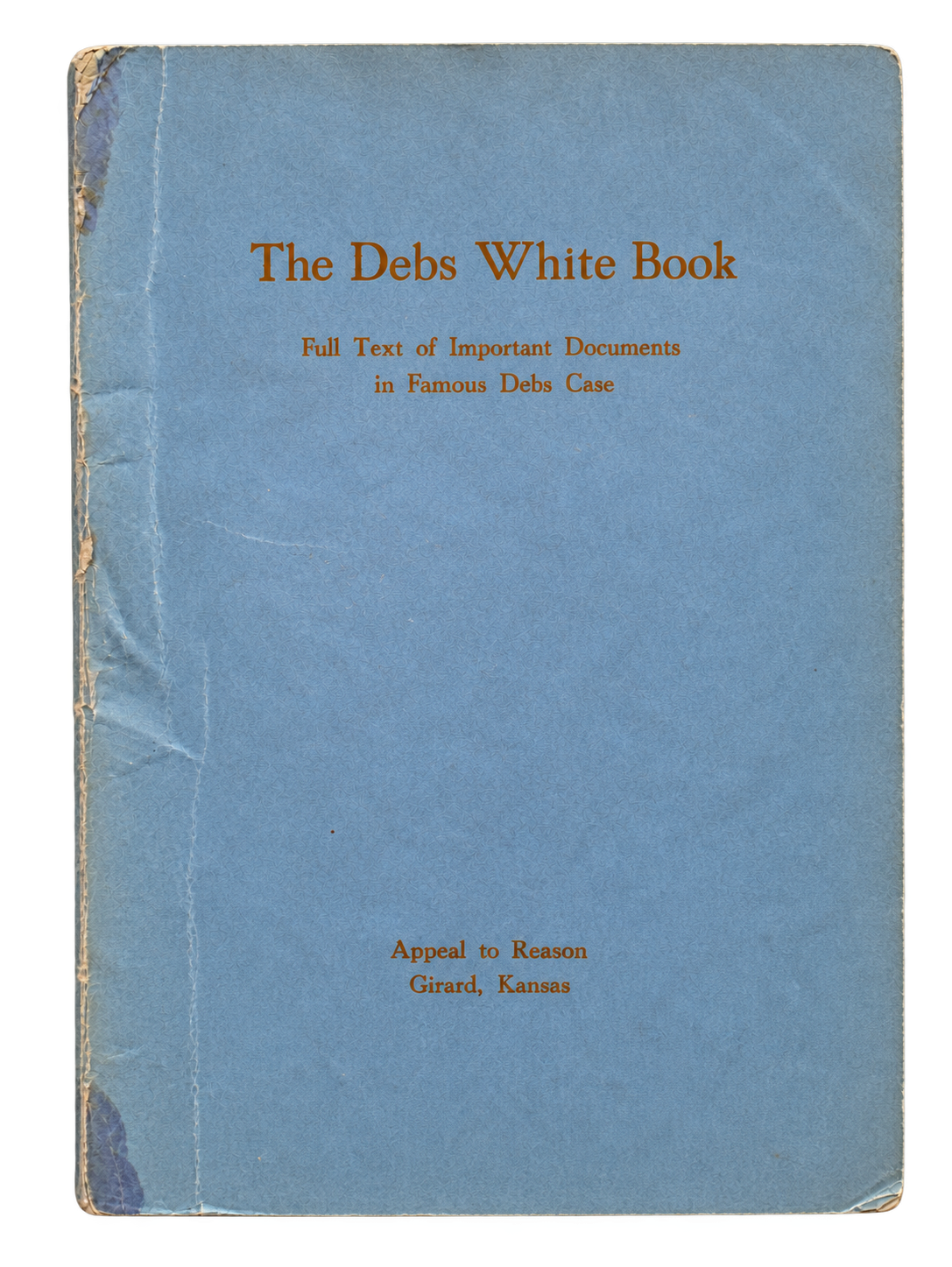
Full Title:The Debs White Book: Full Text of Important Documents in the Famous Debs Case
Eugene V. Debs
Appeal to Reason, Girard, Kansas · 1919
First Edition · First Printing
The Book: True first edition, first printing of The Debs White Book: Full Text of Important Documents in the Famous Debs Case. Published by the socialist newspaper Appeal to Reason in Girard, Kansas, in 1919, the volume retains its original blue printed paper wrappers. Its contents begin with the publisher’s Foreword and include Debs’s Canton Speech, the legal proceedings arising from his prosecution, and related documents from the case. The physical format, typography, wrappers, and contents are consistent with documented copies of the original issue, with no evidence of a later edition, subsequent impression, replacement wrappers, rebinding, facsimile production, ex-library provenance, or restoration observed.
Condition: Very Good. The original blue printed wrappers exhibit moderate age toning, rubbing, light edge wear, and vertical reading creases along the spine. The staples remain secure and the text is complete. The interior is generally clean with scattered foxing and light age toning. No significant ownership provenance or restoration documented.
Story Of The Book
Eugene V. Debs was sent to prison for a speech.
In June 1918, Debs addressed a crowd in Canton, Ohio, condemning the First World War and criticizing the government’s treatment of anti-war activists. Federal authorities prosecuted him under the Espionage Act, arguing that his words unlawfully interfered with the war effort. Debs was convicted, sentenced to ten years in prison, and his conviction was subsequently upheld by the Supreme Court.
The Debs White Book emerged directly from that conflict.
Published in 1919 while Debs remained imprisoned, the volume assembled his Canton Speech together with the legal proceedings, arguments, and official documents surrounding his prosecution. Rather than merely telling readers that Debs had been punished for political speech, the publishers gave them the documentary record and invited them to examine the controversy themselves.
That distinction makes the book fundamentally different from a later biography or historical account. It was produced while the consequences of Debs’s prosecution remained immediate and while Americans were still arguing over how far the government could go in suppressing political opposition during wartime.
The book was not simply about the free-speech controversy. It became part of it.
Why It’s In The Collection
The Debs White Book belongs near the historical center of the collection because it demonstrates how publication can challenge the government’s ability to control the record of its own prosecution of dissent.
The federal government possessed prosecutors, courts, prisons, and the authority to characterize Debs’s speech as criminal. Appeal to Reason possessed a printing press. By assembling Debs’s words alongside the documents used to prosecute him, the book created an alternative public archive through which citizens could evaluate one of the defining American conflicts over wartime expression for themselves.
That makes this first printing particularly important. It does not commemorate a famous free-speech case after constitutional history had already assigned it significance. It preserves a printed object produced from inside the controversy itself, while Debs was still incarcerated and the boundaries of permissible political dissent remained actively contested.
Within the collection, the volume therefore sits at the intersection of free expression, censorship, political dissent, labor activism, and state power. It records what can happen when opposition to government policy becomes grounds for imprisonment—and how print can answer coercive authority by preserving the very words and evidence around which that authority attempted to construct a crime.
Collection Categories: Free Expression · Censorship · Publication-Event Object · Political Imprisonment · Political Dissent · Political History · Labor & Economic Justice
———
Authentication Evidence
• Title page reads "The Debs White Book: Full Text of Important Documents in Famous Debs Case" with publisher Appeal to Reason, Girard, Kansas, consistent with the original 1919 publication.
• First Edition Evidence: Published by Appeal to Reason in 1919, the original publisher of the work, with no indication of a later edition, revised edition, or subsequent issue. Physical format, typography, wrappers, and contents are consistent with documented first-edition copies.
• First Printing Evidence: This publication is bibliographically recognized as having been issued in a single initial printing by Appeal to Reason in 1919. No evidence of a later printing, subsequent impression, or reprint is present.
• Original blue printed paper wrappers match known first-issue examples.
• Contents begin with the publisher's Foreword, followed by Debs's Canton Speech and the complete documentary record of the Debs case, consistent with the original issue.
• No evidence of rebinding, replacement wrappers, facsimile production, ex-library provenance, or restoration observed.
• The observed bibliographic evidence is consistent with a true first edition, first printing.