
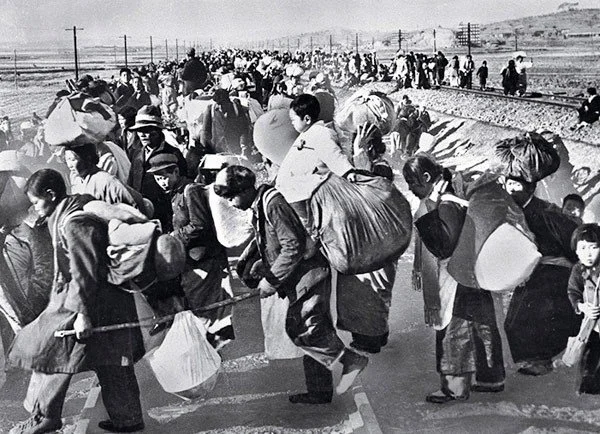
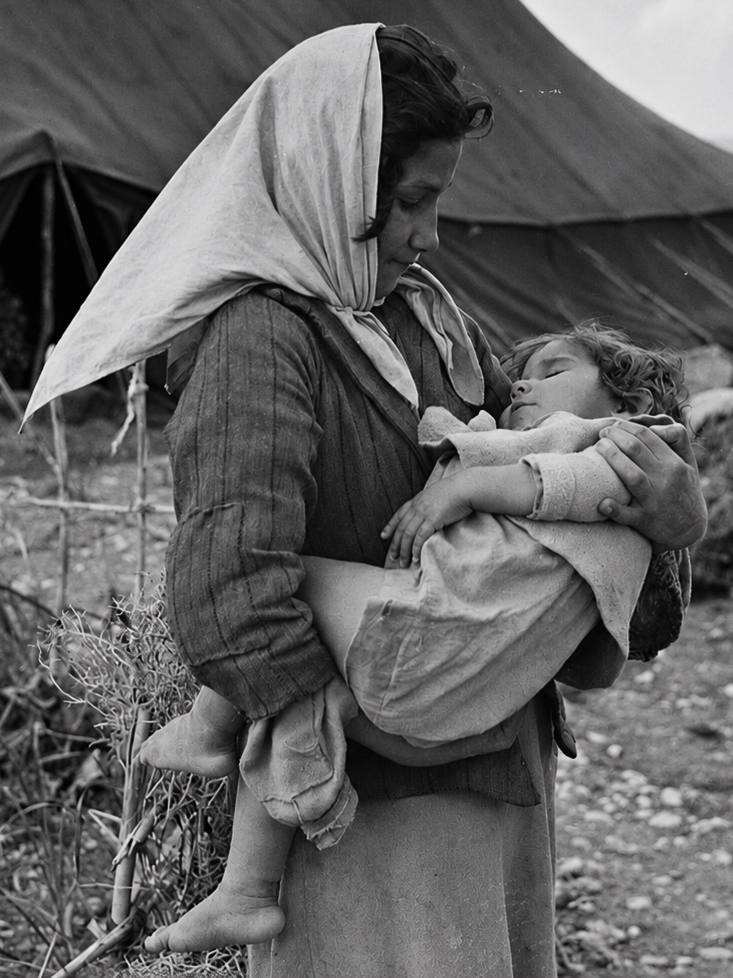
No Way Home
War doesn't always end when the fighting stops, and displacement doesn't always begin when someone is forced to leave. For those whose homes become places of persecution, violence, and fear, the world they once knew can disappear long before they do. Some flee across borders, others are driven from their communities, imprisoned, or deported to places from which they may never return.
For those who survive, finding refuge doesn't always mean finding home. The people, places, and communities that once gave their lives meaning may be gone forever, and even those who return can discover that home is no longer the place they remember. This room examines the experiences of those uprooted by war and persecution, confronting a devastating truth about displacement — that sometimes there is no way home, even when the road back still exists.
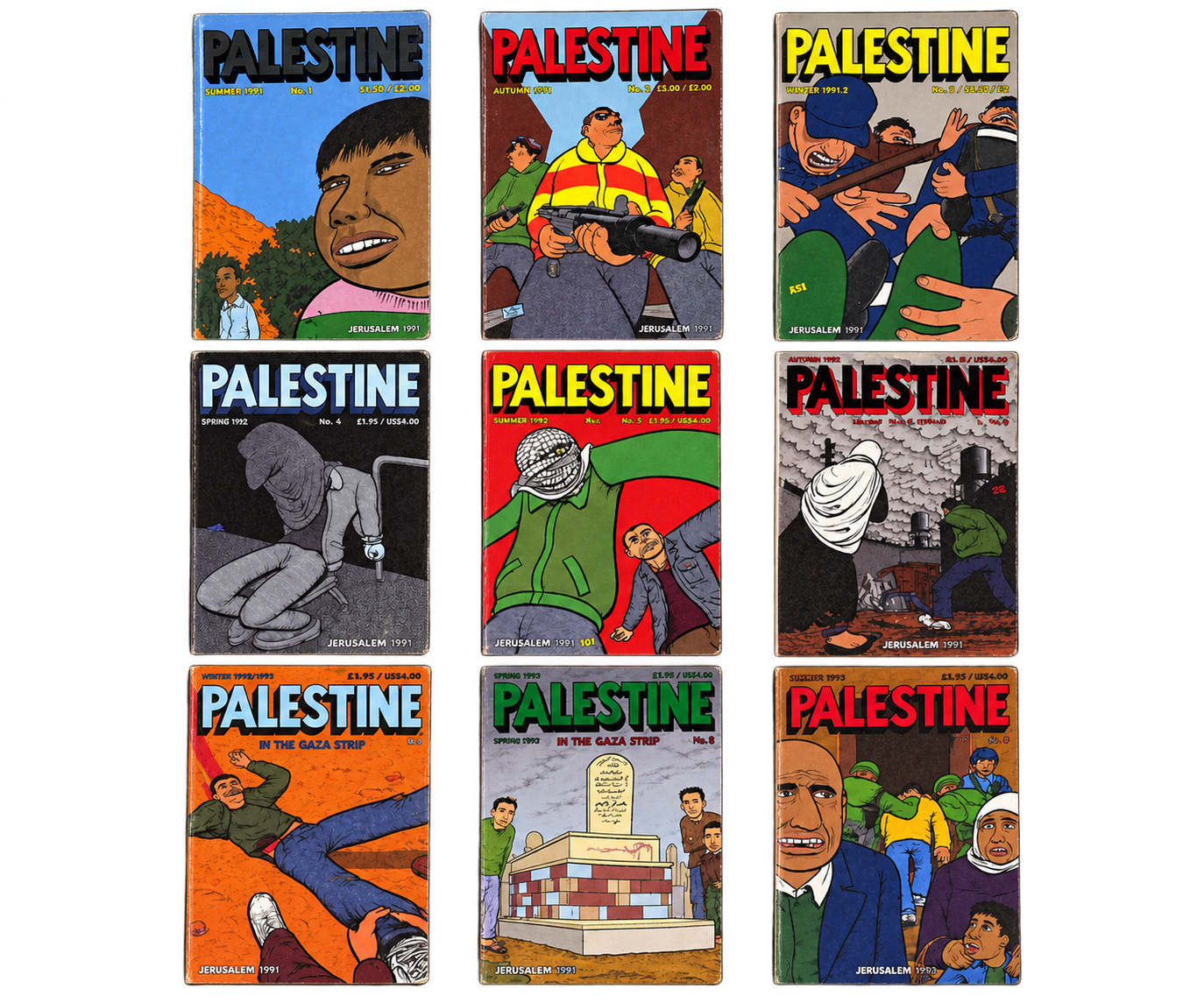
Full Title: The Palestine Set — The Complete Original Serialization, Issues #1–9
Joe Sacco
Fantagraphics Books · Seattle · 1993–1995
Original Serialization · First Editions · First Printings· Signed
The Set:
The complete original serialization of Joe Sacco’s Palestine, comprising all nine Fantagraphics issues published between 1993 and 1995, each in its original publisher’s wrappers and verified as a first printing. Rather than a later collected edition, this set preserves Palestine exactly as it first entered the world—issue by issue, across its original two-year publication sequence. Issue #1 bears a signature attributed to Joe Sacco.
Condition:
Very Good+ overall. All nine issues remain complete in their original Fantagraphics wrappers, preserving the full publication sequence from Issue #1 through Issue #9. Each issue is individually protected in an archival Mylar sleeve with an acid-free backing board, with the complete set housed together in an archival folio.
Included in the Set:
Palestine #1 — 1993 · First Edition · First Printing · Signed by Joe Sacco
Palestine #2 — 1993 · First Edition · First Printing
Palestine #3 — 1993 · First Edition · First Printing
Palestine #4 — 1993 · First Edition · First Printing
Palestine #5 — 1994 · First Edition · First Printing
Palestine #6 — 1994 · First Edition · First Printing
Palestine #7 — 1995 · First Edition · First Printing
Palestine #8 — 1995 · First Edition · First Printing
Palestine #9 — 1995 · First Edition · First Printing
Story Of The Set
War does not happen all at once. It unfolds through ordinary days, interrupted lives, and individual stories that history has a habit of reducing to abstractions.
Joe Sacco traveled to the West Bank and Gaza during the First Intifada and turned his attention toward ordinary Palestinians—their conversations, memories, routines, displacement, imprisonment, humor, and experiences of life under occupation.
Then he drew what he had witnessed.
Between 1993 and 1995, Fantagraphics published that work across these nine individual comic-book issues. Sacco combined interviews, observation, history, and sequential art into a form of reporting that would help establish what became known as comics journalism.
Sacco was not illustrating history after it happened. He was using comics to report on people living inside it.
The later collected editions made Palestine widely known. These nine issues preserve something different: the work as readers originally encountered it, one installment at a time, while both Sacco’s investigation and the history surrounding it were still unfolding.
Why It’s In The Collection
The Palestine Set belongs in Consigned to Darkness because witness begins by refusing to let human beings disappear into someone else’s narrative.
Sacco turned toward people whose experiences he believed were insufficiently represented in the American media and gave their voices sustained space on the page. Whatever a reader’s politics, the underlying journalistic act is fundamental: replacing abstractions with names, faces, memories, contradictions, and individual lives.
This set was intentionally assembled issue by issue in first-printing state rather than represented by a later collected edition. Together, the nine original issues preserve the publication-event object through which one of the defining works of graphic journalism first entered public life.
Before Palestine became a book, it was reporting arriving one issue at a time.
Collection Categories: Graphic Literature · Witness Literature · Investigative Journalism · Anti-Colonialism · Anti-Apartheid
———
Authentication Evidence
Complete original Fantagraphics serialization is present, comprising Palestine Issues #1 through #9, published between 1993 and 1995.
All nine individual issues are present, establishing a complete publication sequence with no missing issue.
Individual indicia have been verified for issue number, publication date, and first-printing status.
Issues #1 through #4 correspond to the original 1993 publication sequence.
Issues #5 and #6 correspond to the original 1994 publication sequence.
Issues #7 through #9 correspond to the original 1995 publication sequence.
All nine issues retain their original Fantagraphics publisher’s wrappers.
No evidence of later-printing substitutions, facsimile issues, reproductions, or replacement copies is observed.
Issue #1 bears a signature attributed to Joe Sacco; the signature is physically present on the copyright page.
Publisher, indicia, wrappers, issue sequence, and physical production characteristics are consistent with the original 1993–1995 Fantagraphics serialization.
Archival Mylar sleeves, acid-free backing boards, and the archival folio are later preservation materials and are not original components of publication.
Taken together, the complete issue sequence, verified indicia, original publisher’s wrappers, and first-printing characteristics support identification as the authentic complete original 1993–1995 Fantagraphics serialization of Palestine, Issues #1–9 · First Editions · First Printings.
Palestine
Full Title: The Palestine Set — The Complete Original Serialization, Issues #1–9
Joe Sacco
Fantagraphics Books · Seattle · 1993–1995
Original Serialization · First Editions · First Printings· Signed
War does not happen all at once. It unfolds through ordinary days, interrupted lives, and countless individual stories that rarely survive history's simplifications. Originally published across nine comic-book issues between 1993 and 1995, Joe Sacco's Palestine transformed comics into a form of immersive journalism at a moment when the Israeli–Palestinian conflict was being reshaped by the Oslo peace process but remained marked by occupation, violence, displacement, and competing historical narratives. Rather than documenting military campaigns or diplomatic negotiations from a distance, Sacco embedded himself among ordinary Palestinians, recording conversations, memories, daily routines, and personal testimonies that conventional reporting often overlooked. The complete original serialization preserves the work exactly as readers first encountered it—issue by issue, as its investigation unfolded over two years. Long before graphic journalism became widely recognized as a serious documentary medium, Palestine demonstrated that sequential art could bear witness with the depth, complexity, and moral force traditionally associated with literature and investigative reporting.
Arthur Koestler
New York: The Macmillan Company, 1943
First American Edition · First Printing
The Book:
The true first American edition, first printing of Arthur Koestler’s Arrival and Departure, published by The Macmillan Company in 1943. Unlike the collection’s early printing of Darkness at Noon, the printing status here is explicit: the copyright page states “First Printing” and carries the original 1943 copyright. The title page bears the correct Macmillan 1943 imprint, and the book retains its original light gray publisher’s cloth with red spine lettering. No evidence of book-club manufacture, rebinding, ex-library provenance, or facsimile components is present. The original dust jacket is no longer present.
Condition:
Very Good+. The original gray cloth remains clean and attractive, with a square, structurally sound binding, sharp spine lettering, and only light wear at the extremities. The interior is clean with expected age toning. No notable ownership provenance or restoration is documented. The original dust jacket is no longer present.
Story Of The Book
Most stories end when freedom arrives. Arthur Koestler insisted that the harder story begins afterward.
Published during the Second World War, Arrival and Departure follows Peter Slavek, a young revolutionary refugee who has escaped a fascist dictatorship and reached neutral territory. Physically, he is free. Psychologically, the dictatorship has followed him.
That distinction is the heart of the novel. Koestler had already used Darkness at Noon to examine the machinery of totalitarian power: imprisonment, interrogation, ideology, and the destruction of individual conscience. Arrival and Departure asks what remains after someone escapes that machinery. Fear, guilt, trauma, political conviction, and fractured identity do not disappear simply because the prison gates have opened.
Koestler therefore moves the anti-authoritarian argument inward. Political liberation is necessary, but it may not be sufficient. A dictatorship can exercise power long after its direct authority over an individual has ended because years of coercion can reshape the way a person understands himself, other people, and freedom itself. The inventory identifies precisely this psychological aftermath as the book’s defining contribution to the collection.
Published in 1943, the novel was not written with the comfortable distance of hindsight. Europe was still at war, fascist governments still controlled millions of lives, refugees were still fleeing political persecution, and the ultimate fate of the continent remained unresolved. Koestler was asking what survival from authoritarianism might mean before the authoritarian systems consuming Europe had even been defeated.
Authoritarianism does not always end when the prison gates open.
Why It’s In The Collection
Arrival and Departure belongs in Consigned to Darkness because it expands the collection’s definition of what authoritarian power can do to a human being.
Many objects in the collection document visible repression: imprisonment, censorship, violence, forced labor, exile, and state terror. Koestler confronts something less visible but equally important—the possibility that coercive power can become internalized. A person can cross a border and escape the state while continuing to carry the state’s fear, assumptions, and psychological damage within him.
That makes the book a particularly strong companion to Darkness at Noon. The earlier novel asks what totalitarianism does to people under its control. Arrival and Departure asks what it leaves inside people after they escape. Together, the two works broaden the collection’s treatment of authoritarianism from political institutions to their consequences for individual conscience and identity. The inventory specifically identifies the book as strengthening the collection by documenting “not only resistance to tyranny, but the lasting internal scars authoritarian systems leave upon those who survive them.”
The physical edition matters as well. Unlike the collection’s Darkness at Noon, this copy is an unambiguous first American edition, first printing, with “First Printing” stated directly on the copyright page. It therefore preserves the original American publication of Koestler’s wartime argument while the historical crisis that shaped it remained unresolved.
The original dust jacket is absent, limiting the copy’s conventional collector desirability, but the underlying first printing remains an authentic publication-event object from 1943.
Escaping a dictatorship can free the body. Koestler wanted to know what it takes to free the person who survives it.
Collection Categories: Anti-Authoritarianism · Anti-Totalitarianism · Political Fiction · Political Dissent · Literature · Exile & Refugees · War & Conflict
———
Authentication Evidence
• Title page identifies Arrival and Departure by Arthur Koestler, published by The Macmillan Company, New York, 1943.
• First Edition Evidence: Title page bears the correct Macmillan 1943 imprint consistent with the first American edition.
• First Printing Evidence: Copyright page states "First Printing", consistent with Macmillan's first-printing designation for this title.
• Copyright page carries the original 1943 copyright.
• Original publisher's light gray cloth binding matches the known first American issue.
• No evidence of book-club manufacture, rebinding, ex-library provenance, or facsimile components observed.
• The observed bibliographic evidence is fully consistent with an authentic First American Edition, First Printing.
Arrival and Departure
Some tyrannies imprison the body. Others see people to imprison themselves.
Written while Europe was engulfed by the Second World War, Arrival and Departure follows a refugee escaping fascism only to discover that political liberation alone cannot heal psychological captivity. Koestler turned from exposing totalitarian systems to asking a more unsettling question: after dictatorship has shaped a person's mind, what does freedom actually require? Rather than celebrating liberation, Arthur Koestler confronts the quieter violence of dictatorship—the fear, guilt, and fractured identity that survive long after political freedom has been won. The novel broadened the anti-authoritarian conversation beyond governments and into conscience itself, arguing that the deepest victories over tyranny must also occur within the individual. Authoritarianism doesn't always end when the prison gates open.
Arthur Koestler
The Macmillan Company · New York · 1943
First American Edition · First Printing
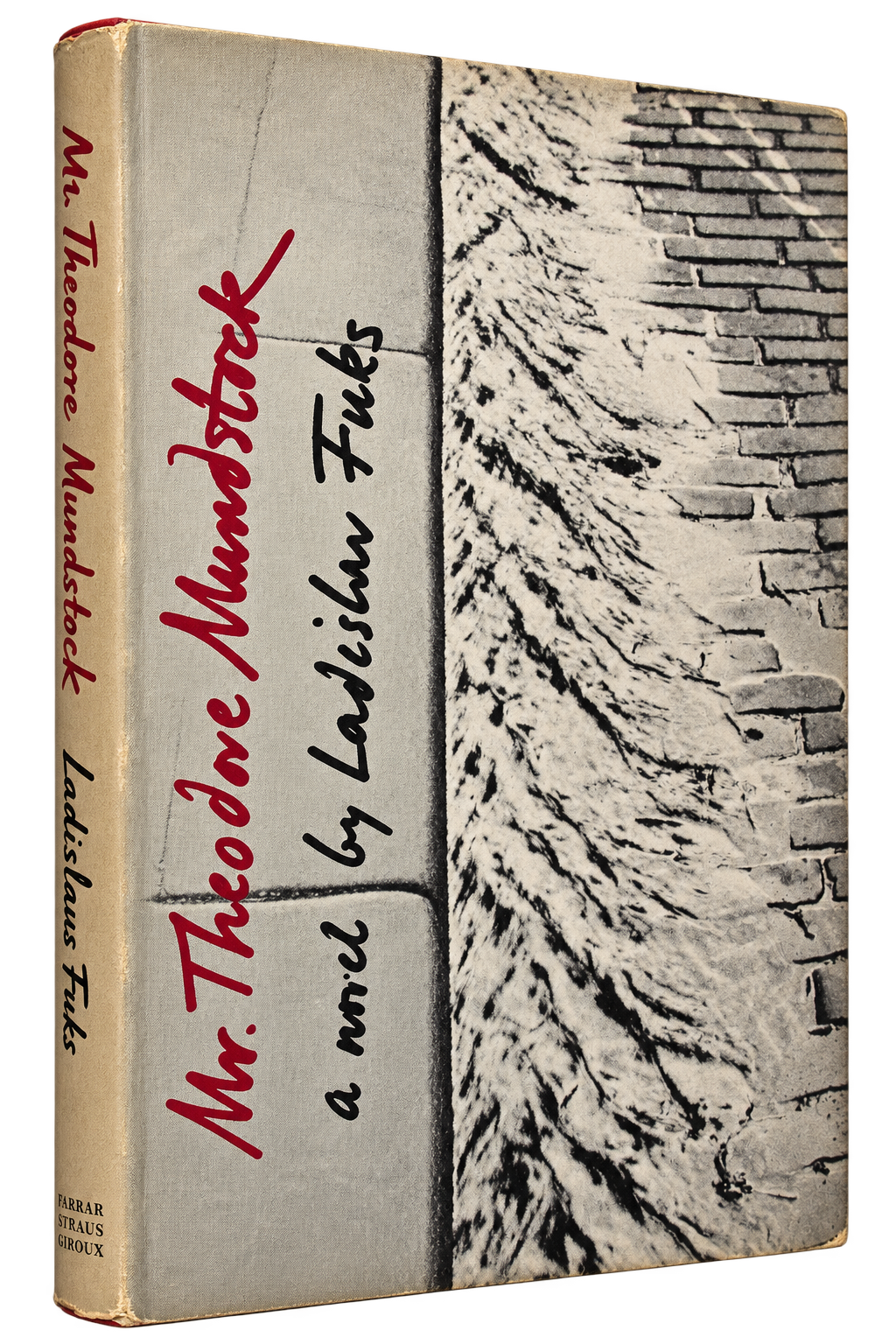
Ladislav Fuks
New York: The Orion Press, 1968
First American Edition · First Printing
The Book:
The first American edition, first printing of Ladislav Fuks’s Mr. Theodore Mundstock, translated from the Czech by Iris Urwin. The copyright page explicitly states “First printing,” and this copy retains its original black cloth binding and original unclipped dust jacket priced at $4.95. It represents the novel’s first English-language publication, bringing Fuks’s psychological portrait of Nazi occupation to an American readership.
Condition:
Near Fine in a Very Good dust jacket. The book is square and exceptionally clean, with bright spine lettering, well-preserved black cloth, and a clean interior. The jacket is complete and highly presentable, showing light age toning, minor edge wear, and small chips at the spine ends. A previous owner’s ink notation appears on the front panel of the jacket.
Story Of The Book
Before the Holocaust destroyed millions of lives, it first transformed ordinary existence into a condition of constant fear.
Theodore Mundstock is a Jewish man living in Nazi-occupied Prague. He has not yet been deported. He has not yet entered a concentration camp.
But the possibility governs everything.
Mundstock becomes obsessed with preparing himself for the catastrophe he believes is coming. He rehearses deprivation, imagines the routines of camp life, and attempts to train himself for humiliation, hunger, violence, and confinement—as though preparation might give him some measure of control over a system designed to strip control away.
That is what makes Fuks’s novel so psychologically devastating.
Rather than beginning with the machinery of extermination, Mr. Theodore Mundstock examines what persecution does before the transport, before the camp, before the final act of violence. It shows a human being reorganizing his entire interior life around the expectations imposed by a totalitarian state.
Fear becomes routine. Dehumanization begins in anticipation.
Published in English in 1968, the novel introduced readers to one of the most penetrating literary examinations of life under Nazi occupation, focusing not on battlefield resistance or historical spectacle but on the quiet erosion of ordinary existence under systematic persecution.
The Nazis had not yet taken Mundstock to the camp. They had already forced him to begin living inside it.
Why It’s In The Collection
Mr. Theodore Mundstock belongs in Consigned to Darkness because authoritarian power does not begin when prison doors close.
It begins earlier—when fear changes behavior, when identity becomes dangerous, when ordinary choices disappear, and when people begin organizing their lives around what the state might do to them next.
That makes this novel particularly important within the collection’s Holocaust holdings. Many works document what totalitarian systems physically did to their victims. Fuks examines what those systems did to the mind before the final violence arrived.
The collection acquired this first American edition, first printing because it preserves the original English-language introduction of that perspective: persecution not merely as an event, but as a condition that colonizes anticipation, conscience, routine, and selfhood. The inventory specifically identifies the book as a major literary exploration of psychological oppression and the individual struggle against authoritarian power.
Read beside firsthand testimony and documentary accounts of the Holocaust, Mr. Theodore Mundstock contributes something different but essential: an interior anatomy of what it means to live under a regime that has made terror ordinary.
Totalitarianism does not wait until it imprisons the body. It begins when it teaches the mind to live in captivity first.
Collection Categories: Literature · Holocaust & Genocide · Anti-Authoritarianism · Witness Literature
———
Authentication Evidence
• Title page identifies Ladislav Fuks, Mr. Theodore Mundstock, published by The Orion Press, New York.
• First Edition Evidence: This is the First American Edition, representing the first English-language publication of Mr. Theodore Mundstock in Iris Urwin's translation.
• First Printing Evidence: Copyright page explicitly states "First printing," confirming first-printing status.
• Copyright page records the original 1968 translation copyright by Grossman Publishers, Inc. and notes first publication in Czechoslovakia under the title Pan Theodor Mundstock.
• Original unclipped dust jacket retains the correct $4.95 publisher's price.
• Original black cloth binding matches known first-printing copies.
• Previous owner's writing appears on the front panel of the dust jacket; no author signature or inscription observed.
• No evidence of book club manufacture, rebinding, ex-library provenance, or facsimile dust jacket observed.
• The observed bibliographic evidence is fully consistent with an authentic First American Edition, First Printing.
Mr. Theodore Mundstock
Before the Holocaust destroyed millions of lives, it first transformed ordinary existence into a condition of constant fear.
Ladislav Fuks follows Theodore Mundstock, a Jewish man in Nazi-occupied Prague, as he obsessively prepares himself for the concentration camps he expects will soon consume him. Rather than depicting the Holocaust through its physical atrocities alone, the novel examines the psychological destruction inflicted long before deportation begins. This first edition preserves one of the most profound literary explorations of fear, anticipation, and survival under totalitarian persecution.
Ladislav Fuks
The Orion Press · New York · 1968
First American Edition · First Printing
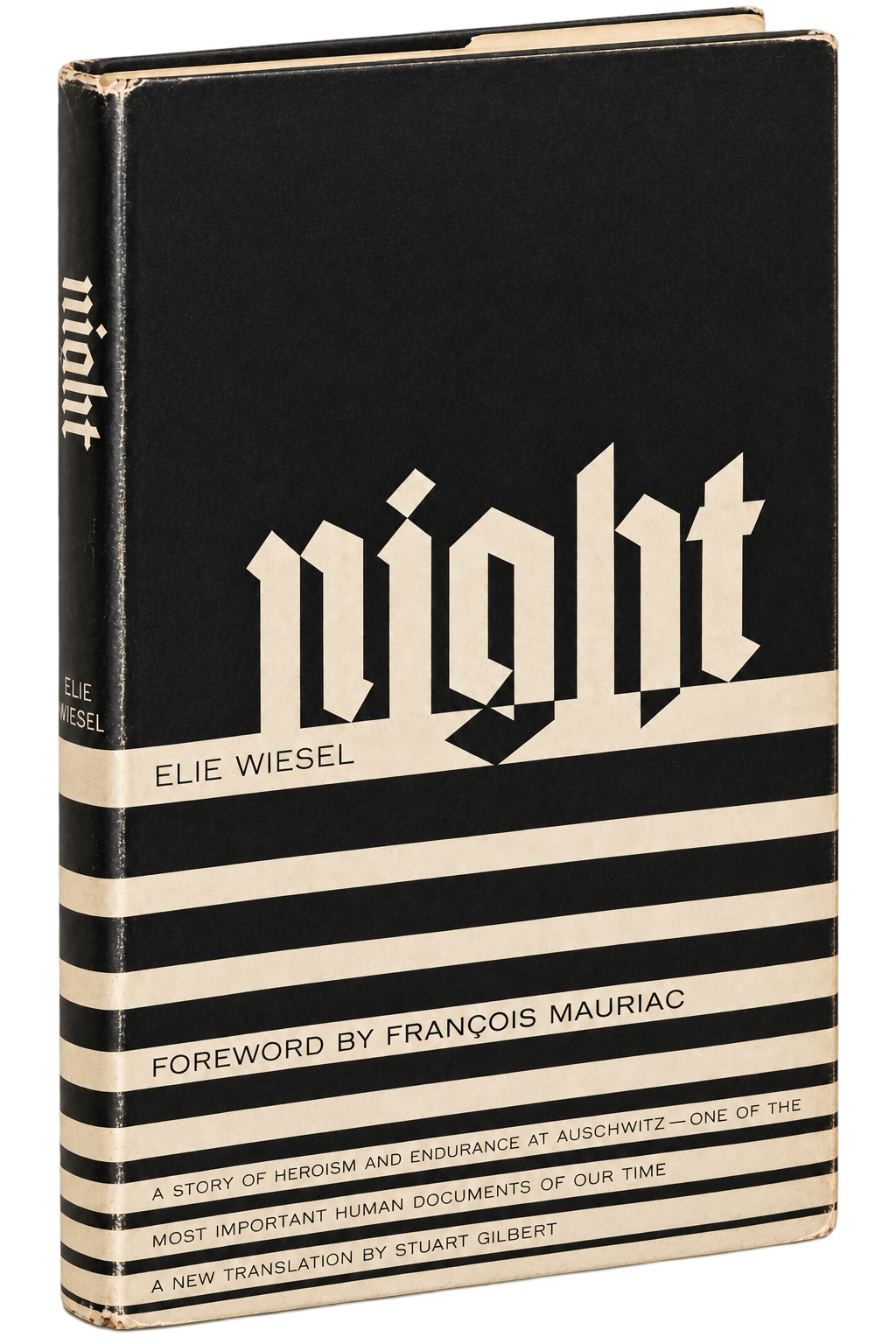
Elie Wiesel
Foreword by François Mauriac
Translated from the French by Stella Rodway
Hill and Wang · New York · 1961
First American Edition · Second Printing · January 1961
The Book:
The Second Printing of the First American Edition of Elie Wiesel’s Night, issued by Hill and Wang in January 1961, only four months after the September 1960 American first printing. Translated from the French by Stella Rodway, with a foreword by François Mauriac, Night transformed Wiesel’s memories of Auschwitz and Buchenwald into one of the defining works of Holocaust witness literature. Octavo; 116 pp. This copy retains its original gray publisher’s cloth and original unclipped early-state Hill and Wang dust jacket with the characteristic black-and-cream striped design.
Condition:
Near Fine book in a Very Good+ original dust jacket. Gray publisher’s cloth remains clean and the binding square and tight, with an exceptionally clean interior and no foxing, restoration, or institutional markings observed. A faint previous owner’s pencil notation appears on the front free endpaper. The original unclipped jacket remains highly presentable, showing moderate chipping at the head of the spine, light rubbing, mild age toning, and a short closed tear to the lower front panel.
Story Of The Book
Before Night became one of the defining testimonies of the Holocaust, Elie Wiesel had to find a form capable of carrying what he remembered.
In 1954, Wiesel completed an 862-page Yiddish manuscript about his experiences in Auschwitz and Buchenwald. Published in Argentina two years later as Un di velt hot geshvign—And the World Remained Silent—it had become 245 pages.
Then came Les Éditions de Minuit, the publishing house born clandestinely under Nazi occupation. Working with editor Jérôme Lindon, Wiesel reshaped his testimony into the French La Nuit: 178 pages published in 1958 by a press that had once risked its existence publishing against the regime Wiesel had survived.
Stella Rodway translated that text into English. When Hill and Wang introduced Night to American readers in 1960, it was 116 pages.
862 pages became 245. Then 178. Then 116.
What remained was extraordinarily concentrated: a teenager’s deportation from Sighet, Auschwitz, the destruction of his family and faith, his father’s death, and finally liberation. Wiesel stripped away almost everything that could stand between the reader and the experience itself.
This January 1961 second printing appeared only four months after the first American edition—before Night became canonical and before Wiesel became an international voice of Holocaust memory.
Hundreds of pages disappeared. What survived became Night.
Why It’s In The Collection
Night belongs in Consigned to Darkness because genocide reduces human beings to categories, statistics, and numbers. Witness gives them their names back.
Wiesel took an event almost incomprehensible in its scale and forced readers to experience it through one teenager, one father, one family. Memory became testimony; testimony became resistance to forgetting.
Its publication history creates an extraordinary connection within this collection. Les Éditions de Minuit—the clandestine Resistance press represented elsewhere in Consigned to Darkness—helped shape Night. A publisher created to resist Nazi control of the written word became, little more than a decade later, the publisher of testimony from someone who survived the world the Nazis created.
Two generations of the same struggle meet there: writers refusing silence during the occupation, and a survivor refusing silence afterward.
The Nazis tried to reduce people to numbers. Wiesel answered by making one human voice impossible to ignore.
Collection Categories: Witness Literature · Holocaust Studies · Human Rights · Religious Conscience · Anti-Authoritarianism · Anti-Totalitarianism · Literature · Memoir & Testimony
———
Authentication Evidence
Title page identifies the work as Night by Elie Wiesel.
Title page credits Stella Rodway as translator from the French.
Volume retains the original foreword by François Mauriac.
Publisher is correctly identified as Hill and Wang · New York.
Copyright page records the original 1958 Les Éditions de Minuit copyright for La Nuit.
Copyright page records the 1960 MacGibbon & Kee English translation copyright.
Copyright page explicitly states “First American Edition September 1960,” directly establishing First American Edition status.
Copyright page explicitly states “Second Printing January 1961,” directly establishing this copy’s printing and date.
Volume collates to 116 pages, consistent with bibliographic records for the original Hill and Wang English-language edition.
Original gray publisher’s cloth with black spine lettering remains present and is consistent with the early Hill and Wang issue.
Original Hill and Wang dust jacket remains present.
Original jacket retains the characteristic black-and-cream striped design associated with the early American issue.
Dust jacket is unclipped.
The faint writing on the front free endpaper is consistent with a previous owner’s pencil notation and is not attributable to Elie Wiesel.
Publisher imprint, typography, binding, and jacket configuration are internally consistent with documented early Hill and Wang copies.
No evidence of book-club manufacture, ex-library ownership, remainder marking, rebinding, facsimile dust jacket, or replacement components is observed.
Observable physical and bibliographic evidence supports identification as the First American Edition · Second Printing, January 1961.
Night
Some books describe suffering. Night changed how the world remembered it.
Drawing upon his survival of Auschwitz and Buchenwald, Elie Wiesel transformed personal memory into one of the defining testimonies of the Holocaust. Published only fifteen years after the liberation of the camps, Night confronted readers with the moral, spiritual, and human consequences of genocide at a time when many preferred silence. This early American printing preserves one of the twentieth century's most important acts of witness, ensuring that memory itself became a form of resistance against forgetting.
Elie Wiesel
Foreword by François Mauriac
Translated from the French by Stella Rodway
Hill and Wang · New York · 1961
First American Edition · Second Printing · January 1961
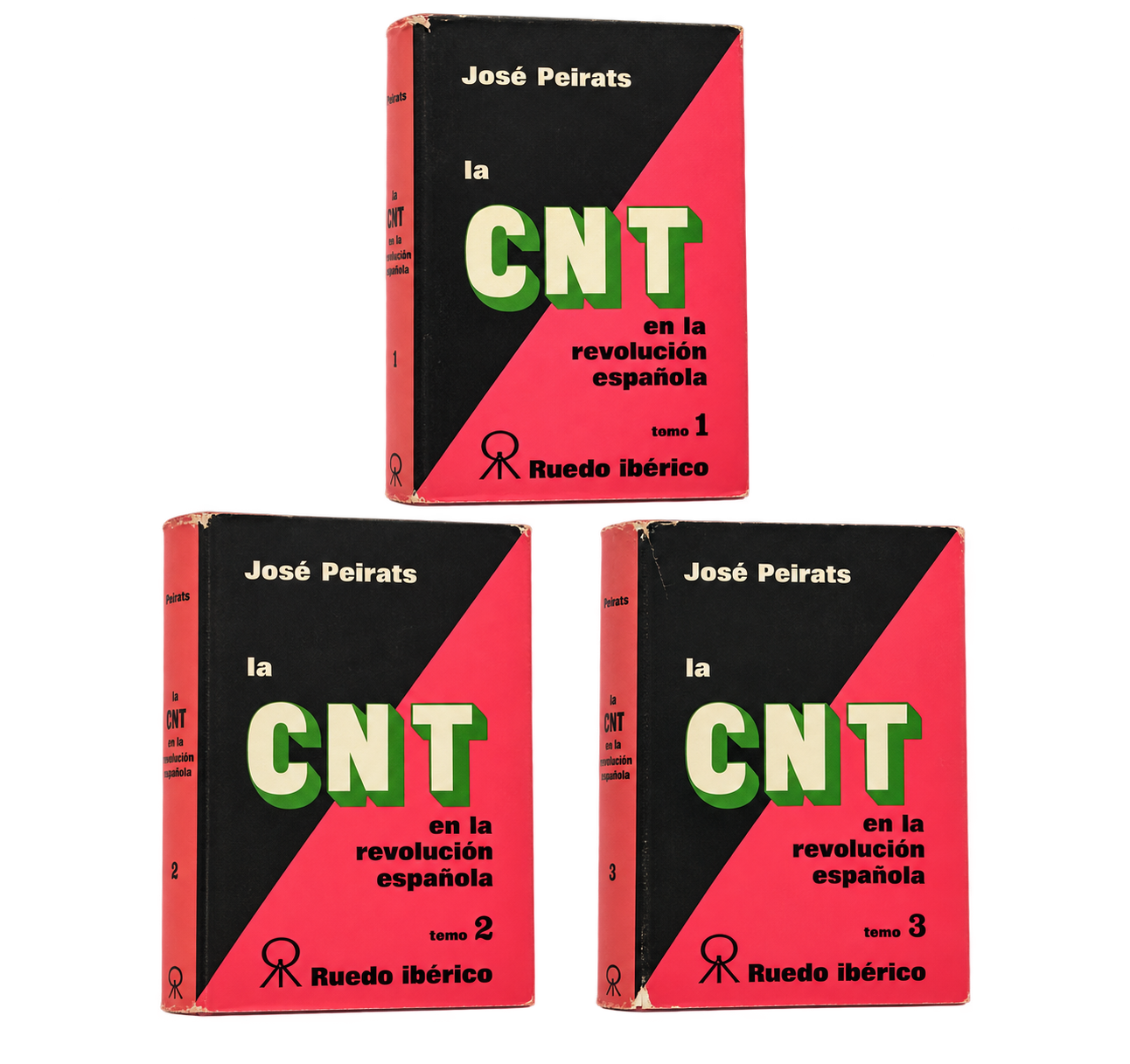
Complete Three-Volume Set
José Peirats
Ruedo Ibérico · Paris · 1971
First Ruedo Ibérico Edition · First Printing
Complete Three-Volume Set
The Set:
The complete 1971 Ruedo Ibérico edition, first printing, of José Peirats’s monumental history of the Confederación Nacional del Trabajo (CNT) and the Spanish Revolution, complete in three volumes. Published in Paris by the Spanish exile press Ruedo Ibérico while Franco remained in power, the set comprises approximately 1,118 pages with illustrations. All three volumes retain their original glossy pictorial wrappers and original pictorial dust jackets, with cover designs by José Martínez.
Included Volumes:
La CNT en la revolución española — Tomo 1 — José Peirats
Ruedo Ibérico · Paris · 1971
First Ruedo Ibérico Edition · First Printing
Original pictorial wrappers · Original pictorial dust jacketLa CNT en la revolución española — Tomo 2 — José Peirats
Ruedo Ibérico · Paris · 1971
First Ruedo Ibérico Edition · First Printing
Original pictorial wrappers · Original pictorial dust jacketLa CNT en la revolución española — Tomo 3 — José Peirats
Ruedo Ibérico · Paris · 1971
First Ruedo Ibérico Edition · First Printing
Original pictorial wrappers · Original pictorial dust jacket
Condition:
Near Fine volumes in Very Good+ original dust jackets. All three books remain clean, square, tightly bound, and internally unmarked. The jackets are bright and structurally complete, showing light rubbing, superficial scratching, and minor wear at the corners and spine ends, with no significant tears or paper loss. No mixed-edition volumes, replacement jackets, rebinding, or restoration are observed.
Story Of The Set
Franco’s dictatorship did not merely defeat the Spanish Revolution. It attempted to control what future generations would be permitted to remember about it.
José Peirats had participated in the anarcho-syndicalist movement whose history he later documented. His three-volume study reconstructs the rise of the CNT, its revolutionary ambitions, and its role in the Spanish Civil War from within a political tradition driven into exile after Franco’s victory.
Ruedo Ibérico made that exile part of the publication itself. Operating from Paris, the press published histories, arguments, and political traditions that could not circulate freely inside Francoist Spain. When it issued Peirats’s complete three-volume history in 1971, preserving the story of the defeated anarchist movement became a way of resisting the dictatorship’s control over historical memory.
Franco controlled Spain. Ruedo Ibérico refused to let him control its past.
Why It’s In The Collection
La CNT en la revolución española belongs in Consigned to Darkness because the physical set embodies the relationship between exile, censorship, witness, and historical memory.
Peirats was not a later historian approaching the CNT solely from archival distance. He had participated in the movement whose history he documented. His account therefore preserves a political tradition through the work of someone who had lived within it.
The importance of this particular edition lies equally with its publisher. Ruedo Ibérico operated beyond the reach of Francoist censorship and used that freedom to preserve political histories the dictatorship had marginalized or suppressed. Publishing Peirats from exile transformed historical preservation itself into an act of dissent.
As a complete three-volume set, the object preserves the full work as Ruedo Ibérico issued it while Franco was still alive and his dictatorship still governed Spain.
The movement had been defeated. Its history had not.
Collection Categories: Anti-Authoritarianism · Censorship · Political Dissent · Political Movements · Witness Literature · Exile & Émigré Literature · Political History · Publication-Event Object
———
Authentication Evidence
All three volumes retain their original Ruedo Ibérico title pages identifying José Peirats as author and La CNT en la revolución española as title.
Individual title pages carry the correct volume designations of Tomo 1, Tomo 2, and Tomo 3, establishing the complete three-volume sequence.
Each volume identifies Ruedo Ibérico as publisher and bears the publisher’s device and Paris address at 6 rue de Latran, Paris 5.
Each copyright page bears the original 1971 Ruedo Ibérico copyright and publication information.
No later-printing, revised-impression, or subsequent-printing statement appears in any of the three volumes.
Original glossy pictorial wrappers are present on all three volumes and are correctly numbered Tomo 1, Tomo 2, and Tomo 3.
Original pictorial dust jackets are retained on all three volumes.
Typography, wrappers, publisher devices, dimensions, and production characteristics are uniform across the complete set and consistent with documented 1971 Ruedo Ibérico publications.
Pagination, contents, and physical construction correspond with published bibliographic descriptions of the complete three-volume 1971 Ruedo Ibérico issue.
No evidence of facsimile production, print-on-demand manufacture, replacement wrappers, mixed editions, institutional rebinding, or ex-library provenance is observed.
The 1971 publication is the first edition of Peirats’s work issued by Ruedo Ibérico; an earlier edition was published in Toulouse between 1951 and 1953.
Observable bibliographic evidence supports authentication as a complete 1971 Ruedo Ibérico First Edition · First Printing, complete in three volumes.
La CNT en la Revolución Española (Set)
Complete Three-Volume Set
José Peirats
Ruedo Ibérico · Paris · 1971
First Ruedo Ibérico Edition · First Printing
Franco’s dictatorship did not merely defeat the Spanish Revolution. It attempted to control what future generations would be permitted to remember about it.
From exile in Paris, Ruedo Ibérico answered that attempted erasure with books. The Ruedo publishers gathered the histories, arguments, testimonies, and political traditions that Francoist Spain had driven underground and printed them openly beyond the dictatorship’s reach. This three volume set, José Peirats’s monumental history of the CNT Spanish Anarchist movement, gave the press one of its most formidable weapons: three volumes reconstructing the anarchist movement’s role in the Spanish Revolution from the perspective of someone who had participated in it. This 1971 edition therefore preserves more than Peirats’s history of the CNT. It preserves an exiled publisher turning forbidden memory into organized resistance—printing, in full public view, the history an authoritarian regime wanted silenced. Franco controlled Spain. Ruedo Ibérico refused to let him control its past.
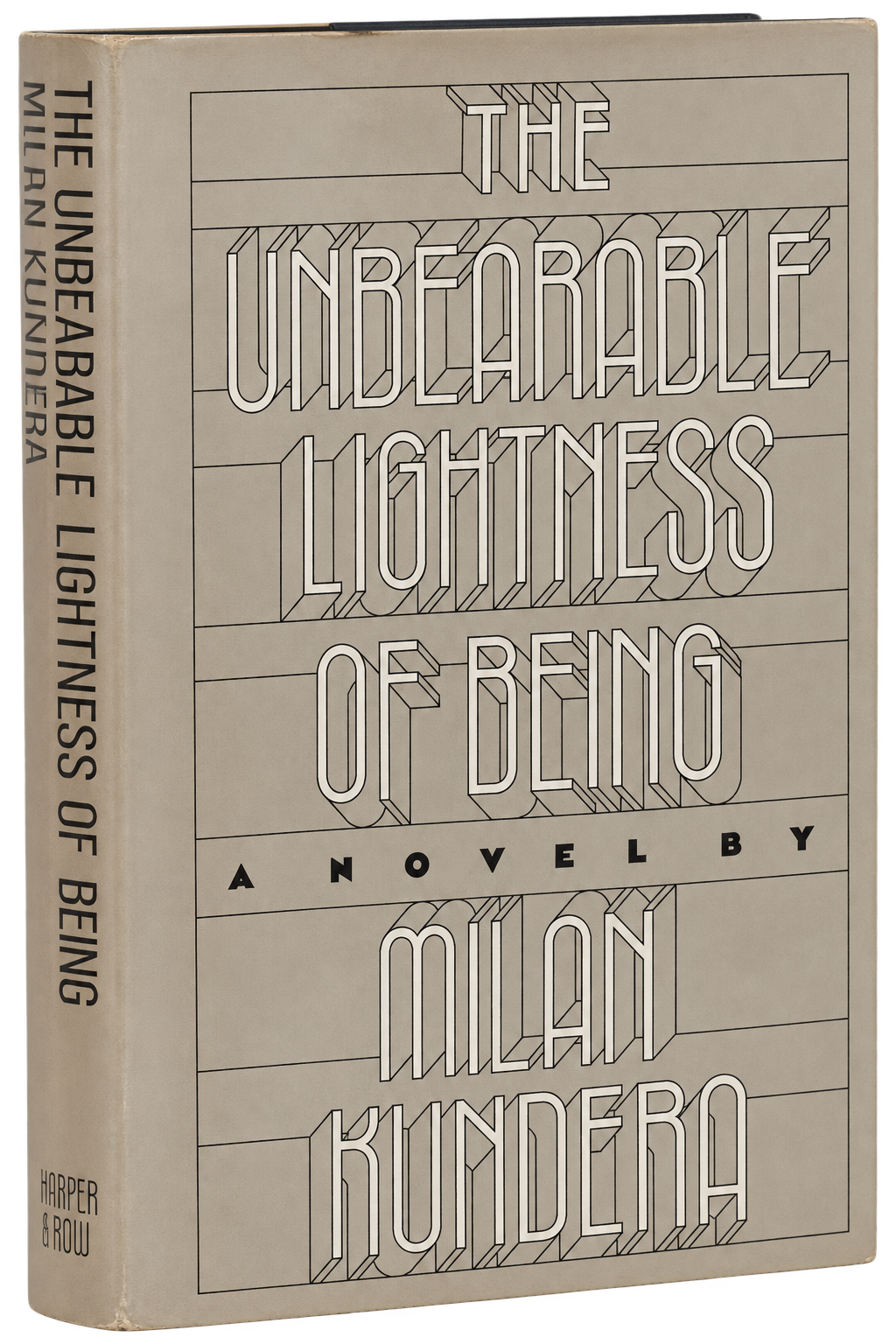
Milan Kundera
Translated from the Czech by Michael Henry Heim
New York: Harper & Row, Publishers, 1984
First American Edition · First Printing
The Book:
The true first American edition, first printing of Milan Kundera’s The Unbearable Lightness of Being, published by Harper & Row in 1984. The copyright page explicitly states “FIRST EDITION” and carries a complete first-printing number line ending in 1. This copy retains its original black paper-covered boards over beige cloth spine with gilt lettering and its original unclipped dust jacket priced at $15.95. No evidence of book-club manufacture, later printing, rebinding, facsimile jacket, or other bibliographic anomaly is present.
Condition:
Near Fine+ in a Near Fine dust jacket. The book itself is exceptionally clean, with a square binding, bright gilt spine lettering, a fresh text block, and no foxing, restoration, remainder marks, or structural defects observed. The jacket remains complete and attractive, showing light age toning, minor rubbing, several small chips and short closed tears concentrated around the head of the spine and upper edges, and slight creasing. A contemporary bookseller’s pencil notation appears on the front free endpaper.
Story Of The Book
Some governments ban books because of what they say. Kundera wrote about what happens after governments succeed in controlling what people are allowed to remember.
Set in the political aftermath of the 1968 Prague Spring and its suppression, The Unbearable Lightness of Being examines authoritarianism not primarily through prisons, interrogations, or formal censorship, but through the way political power enters ordinary life. Memory, love, sex, identity, exile, professional life, and even private moral choices become inseparable from the larger ideological system surrounding the characters.
That is what makes the novel especially powerful within Kundera’s body of work. He does not reduce life under Soviet domination to slogans or political allegory. Instead, he shows how ideology penetrates the intimate. A regime can shape where someone works, whether someone may return home, what can be publicly remembered, and which compromises become necessary simply to continue living. The political therefore becomes personal not as a metaphor, but as a condition of existence.
The novel also belongs to Kundera’s broader history as an exile writer. By the time this American edition appeared, he had already become one of the most internationally important literary voices associated with the experience of Communist Czechoslovakia. This first American edition introduced U.S. readers to the work through Michael Henry Heim’s translation and helped establish the novel as Kundera’s best-known book internationally.
The novel’s warning is not simply that authoritarian governments control public life. It is that, given enough power, they can make private life impossible to separate from politics.
Why It’s In The Collection
The Unbearable Lightness of Being belongs in Consigned to Darkness because it expands the collection’s understanding of authoritarianism beyond overt repression.
Many objects in the collection document obvious collisions between the individual and the state: censorship, imprisonment, exile, political violence, and forced confession. Kundera shows something quieter and, in some ways, more pervasive—the gradual invasion of ideology into memory, relationships, identity, and personal choice.
That makes the novel an important counterpart to the collection’s firsthand witness literature. A memoir can tell us what happened under an authoritarian system. Kundera asks what it feels like when the political system has become so embedded in daily existence that even love and memory carry political consequences.
The first American edition is particularly collection-relevant because it preserves the publication through which this meditation on freedom, exile, and Soviet domination entered the American literary landscape. The inventory specifically identifies the book as a publication-event object complementing firsthand testimony with a philosophical exploration of how ideological power transforms private life.
Placed beside The Book of Laughter and Forgetting and The Joke, it also strengthens a coherent Kundera section. Those books examine censorship, historical erasure, political persecution, and the recovery of an author’s intended text. The Unbearable Lightness of Being adds another dimension: what happens when history enters so deeply into the individual that there is no clean boundary between political freedom and personal freedom.
A government does not need to occupy every room to shape what happens inside it. Sometimes it is enough to occupy memory, possibility, and choice.
Collection Categories: Literature · Anti-Authoritarianism · Anti-Totalitarianism · Exile & Émigré Literature · Political Fiction · Political Dissent · Publication-Event Object
———
Authentication Evidence
• Correct title page identifying The Unbearable Lightness of Being by Milan Kundera, translated from the Czech by Michael Henry Heim, published by Harper & Row, Publishers, New York.
• Copyright page dated 1984.
• Copyright page explicitly states "FIRST EDITION."
• Complete first-printing number line ending in 1 is present, establishing first-printing status.
• Original black boards over beige cloth spine with gilt spine lettering are present and consistent with the publisher's first edition binding.
• Original unclipped dust jacket retaining the correct $15.95 price is present.
• Jacket design, typography, ISBN, and publisher information are internally consistent with the first issue.
• No evidence of book-club manufacture, later printing statement, rebound binding, facsimile jacket, or other bibliographic anomalies is observed.
• Edition evidence: The stated "FIRST EDITION" on the copyright page establishes this as the first American edition.
• Printing evidence: The complete number line ending in 1 establishes this as the first printing of the first American edition.
The Unbearable Lightness of Being
Milan Kundera
Translated from the Czech by Michael Henry Heim
New York: Harper & Row, Publishers, 1984
First American Edition · First Printing
Some governments banned books because of what they said. Milan Kundera wrote one about what happens when governments succeed.
Set in the shadow of the Prague Spring and its suppression, The Unbearable Lightness of Being explores how political power reshapes memory, love, identity, and even the private choices that seem least political. Kundera rejected propaganda in favor of something more unsettling: showing how authoritarianism quietly invades ordinary human lives until even intimacy becomes inseparable from history. This first American edition preserves the moment one of the defining literary reflections on life under Soviet domination entered the English-speaking world.

Full Title: Once Upon a Country: A Palestinian Life
Sari Nusseibeh, with Anthony David
Farrar, Straus and Giroux · New York · 2007
First Edition · First Printing · Signed
The Book:
The First Edition · First Printing of Sari Nusseibeh’s Once Upon a Country, his memoir of a Palestinian life intertwined with war, occupation, imprisonment, resistance, negotiation, and the pursuit of Israeli-Palestinian coexistence. Written with Anthony David, the book traces Nusseibeh’s life from his Jerusalem childhood through the aftermath of 1948 and 1967, the First Intifada, his 1991 imprisonment, Palestinian politics and state-building, and his evolution toward nonviolent resistance and a negotiated peace. viii, 542 pp., plus eight unnumbered pages of plates. This copy is signed by Sari Nusseibeh on the title page and retains its original unclipped $27.50 dust jacket.
Condition:
Fine book in a Fine original dust jacket. Original gray paper-covered boards over a darker gray spine with gilt spine lettering remain exceptionally well preserved. The original jacket is unclipped at $27.50, with no significant chips, tears, fading, or material wear observed. Nusseibeh’s signature appears clearly in black ink on the title page beneath his printed name. A small pencil notation appears on the rear free endpaper; otherwise exceptionally clean. No evidence of book-club manufacture, rebinding, restoration, or facsimile jacket observed.
Story Of The Book
Sari Nusseibeh spent his life arguing that Palestinians could resist occupation without surrendering either their humanity or Israel’s right to exist—and discovered that moderation could make enemies on both sides.
Born into one of Jerusalem’s oldest Palestinian families, Nusseibeh lived through war, occupation, uprising, imprisonment, failed negotiations, and the rise and fracture of the Palestinian national movement. His memoir moves between personal memory and political history because, in his life, the two were rarely separable.
Nusseibeh opposed Israeli occupation and settlement policy, advocated Palestinian self-determination, and was imprisoned in 1991. But he also condemned suicide bombings, criticized corruption and failures within Palestinian leadership, and argued for coexistence when compromise itself could be treated as betrayal.
That refusal to make the conflict morally simple is what gives the memoir its force. Nusseibeh writes as a Palestinian participant with unmistakable commitments, but not with unquestioning loyalty to any political authority.
He resisted occupation without romanticizing resistance—and pursued peace without pretending either side was innocent.
Why It’s In The Collection
Once Upon a Country belongs in Consigned to Darkness because dissent becomes especially difficult when it requires challenging not only an adversary, but your own side.
Nusseibeh was not merely a witness to Palestinian history. He repeatedly tried to change its course: advocating nonviolent resistance, participating in political life, enduring imprisonment, confronting Israeli authority, and challenging Palestinian violence and political absolutism.
That makes his memoir an important companion to the collection’s other Palestinian witness objects. It restores the conflict to the scale of an individual life while preserving a political position that refuses the demand for uncomplicated allegiance.
This signed first printing carries that testimony in the hand of one of its participants: a Palestinian intellectual arguing simultaneously for national freedom, human dignity, nonviolence, and coexistence.
For Nusseibeh, dissent meant refusing to let either side decide which truths he was permitted to tell.
Collection Categories: Witness Literature · Memoir & Testimony · Political Dissent · Political Imprisonment · Human Rights · Anti-Authoritarianism · Anti-Colonialism · Political Movements · Political History · War & Conflict · Peace & Nonviolence · Signed
———
Authentication Evidence
Title page identifies the work as Once Upon a Country: A Palestinian Life by Sari Nusseibeh with Anthony David.
Title page bears the Farrar, Straus and Giroux · New York publisher imprint.
Copyright page states “Copyright © 2007 by Sari Nusseibeh.”
Copyright page explicitly states “First edition, 2007,” directly establishing First Edition status.
Copyright page carries the complete number line 10 9 8 7 6 5 4 3 2 1, directly establishing First Printing status.
Copyright page gives ISBN 978-0-374-29950-7, matching bibliographic records for the 2007 Farrar, Straus and Giroux hardcover first edition.
Institutional cataloging collates the first edition as viii, 542 pages plus eight unnumbered pages of plates.
Original gray publisher’s binding with darker gray spine and gilt spine lettering remains present.
Original Farrar, Straus and Giroux dust jacket remains present.
Dust jacket is unclipped and retains the original $27.50 publisher’s price.
Title page bears Sari Nusseibeh’s signature in black ink beneath his printed name.
No presentation inscription or documented association provenance is present.
No evidence of book-club manufacture, later printing, rebinding, restoration, facsimile dust jacket, or replacement components is observed.
Observable physical and bibliographic evidence supports identification as the 2007 First Edition · First Printing · Signed.
Once Upon a Country
Full Title: Once Upon a Country: A Palestinian Life
Sari Nusseibeh, with Anthony David
Farrar, Straus and Giroux · New York · 2007
First Edition · First Printing · Signed
Sari Nusseibeh spent his life arguing that Palestinians could resist occupation without surrendering either their humanity or Israel's right to exist—and discovered that moderation could make enemies on both sides.
Born into one of Jerusalem's oldest Palestinian families, Nusseibeh lived through war, occupation, uprising, imprisonment, failed negotiations, and the rise and fracture of the Palestinian national movement. He advocated nonviolent resistance, condemned suicide bombings, criticized Israeli occupation and settlement policy, challenged Palestinian leaders, and continued arguing for coexistence when compromise itself could be treated as betrayal. This signed first printing preserves that history in the voice of someone who did not merely witness the conflict, but repeatedly tried to change its course.
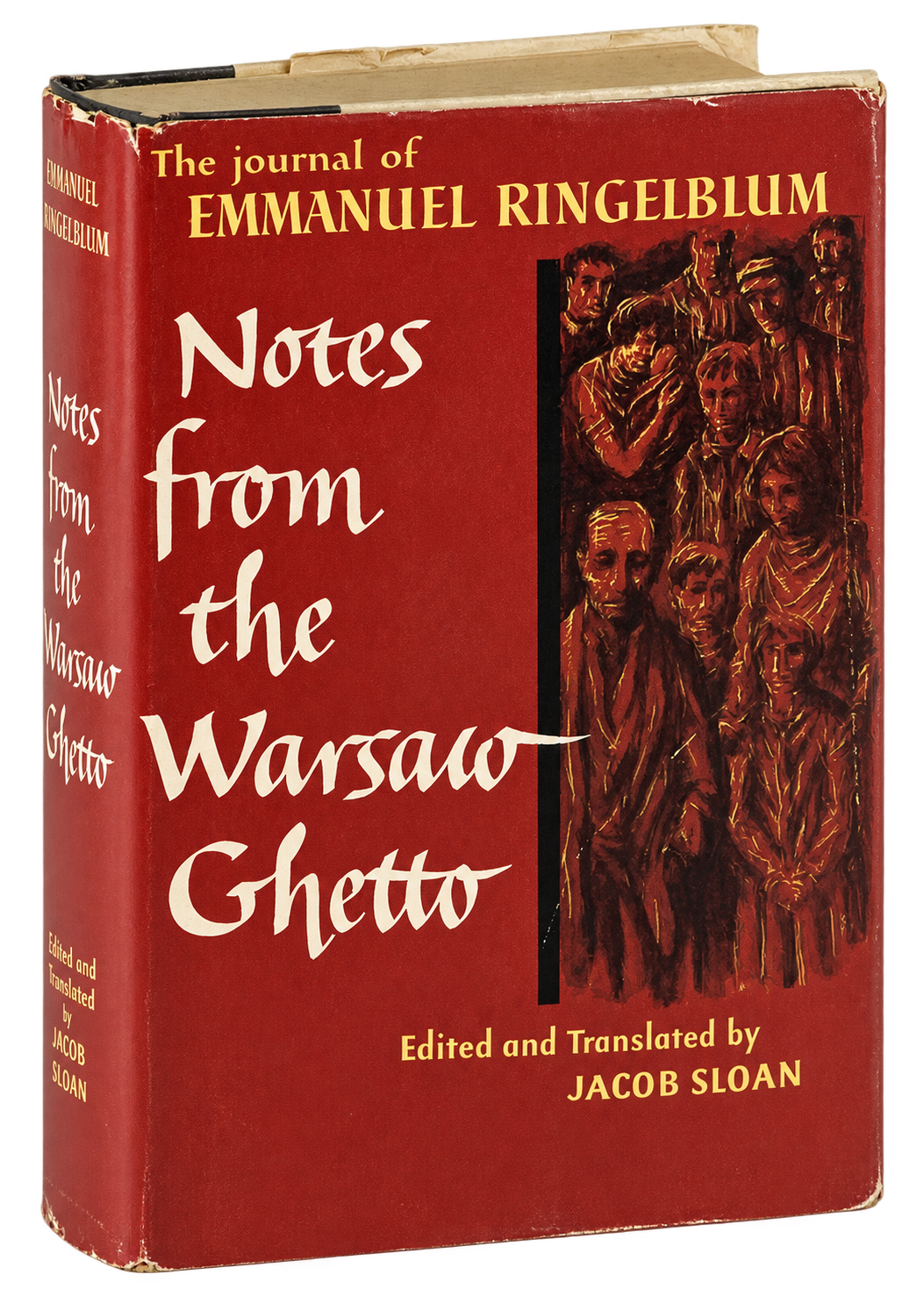
Full Title: Notes from the Warsaw Ghetto: The Journal of Emmanuel Ringelblum
Emmanuel Ringelblum
McGraw-Hill Book Company, Inc. · New York · 1958
First American Edition · First Printing
The Book:
The first American edition, first English-language edition, and first printing of Emanuel Ringelblum’s Notes from the Warsaw Ghetto: The Journal of Emanuel Ringelblum, edited and translated by Jacob Sloan and published by McGraw-Hill in 1958. One of the earliest English-language presentations of Ringelblum’s wartime journal, this copy retains its original black cloth spine over patterned paper-covered boards, original unclipped $5.95 dust jacket, and the original folding map of the Warsaw Ghetto.
Condition:
Near Fine book in a Good+ dust jacket. The binding remains square and firm with exceptionally clean boards, bright lettering, and a fresh interior free of ownership markings or structural defects. The original dust jacket remains complete with moderate chipping and edge wear concentrated at the spine ends and corners, while retaining strong color and attractive overall presentation. The jacket is protected in archival polyester. The original folding map of the Warsaw Ghetto is present and complete.
Story Of The Book
Some regimes destroy people. Others attempt to erase the evidence that they ever lived.
While imprisoned inside the Warsaw Ghetto, historian Emanuel Ringelblum organized the clandestine Oyneg Shabbes archive, assembling diaries, reports, newspapers, official documents, children’s writings, and eyewitness testimony into one of history’s greatest acts of documentary resistance.
Ringelblum understood that the Nazis were not simply murdering a community. They were destroying the people capable of recording what had happened to it. Knowing that the archive—and likely its creators—would not survive, the group buried its records beneath the streets of Warsaw so that a future generation might know not merely that millions died, but how they lived.
Murder could erase witnesses. It could not be allowed to erase memory.
Recovered from the ruins of the ghetto after the war, the archive preserved a record the Nazis had attempted to destroy alongside the people who created it. Published by McGraw-Hill in 1958, Notes from the Warsaw Ghetto brought Ringelblum’s wartime journal to English-language readers, transforming an act of secret wartime preservation into permanent public history.
Why It’s In The Collection
Notes from the Warsaw Ghetto belongs in Consigned to Darkness because few objects embody the idea of witness as resistance more completely.
Ringelblum and the Oyneg Shabbes archivists confronted a form of authoritarian power that sought control not only over human lives, but over what history would eventually remember about them. Their answer was documentation: preserve the names, voices, newspapers, testimony, ordinary experiences, and physical evidence that would prevent the victims from disappearing into the historical record their killers intended to leave behind.
This 1958 first American and first English-language edition preserves the next stage of that extraordinary act of resistance—the moment Ringelblum’s secretly preserved testimony entered the English-speaking historical record. The survival of the original folding Warsaw Ghetto map further strengthens this copy as a physical record of that publication.
The Nazis could destroy the witnesses. Ringelblum made sure they could not destroy the evidence.
Collection Categories: Witness Literature · Holocaust · Anti-Authoritarianism · Free Expression
———
Authentication Evidence
Title page identifies the work as Notes from the Warsaw Ghetto: The Journal of Emmanuel Ringelblum by Emanuel Ringelblum, edited and translated by Jacob Sloan.
Title page identifies McGraw-Hill Book Company, Inc., New York, Toronto, and London as publisher.
Copyright page records Copyright © 1958 by Jacob Sloan and explicitly states “FIRST EDITION.”
The 1958 McGraw-Hill publication represents the First American Edition and First English-Language Edition; earlier editions of Ringelblum’s journal were published in other languages.
No later-printing statement, subsequent-impression statement, or revised-edition designation appears on the copyright page.
McGraw-Hill’s explicit “FIRST EDITION” statement, together with the absence of any subsequent-printing designation, supports identification as the First Printing.
Original black cloth spine over patterned paper-covered boards is present and corresponds to documented first-issue examples of the 1958 McGraw-Hill publication.
Original Warsaw Ghetto map endpapers are present and complete.
Original unclipped dust jacket is present and retains the correct $5.95 publisher’s price.
Dust-jacket design, publisher imprint, typography, and binding correspond to documented first American issue copies.
No evidence of book-club manufacture, rebinding, ex-library provenance, facsimile dust jacket, or later-issue characteristics is observed.
Taken together, the observable bibliographic evidence supports identification as an authentic 1958 McGraw-Hill First American Edition · First English-Language Edition · First Printing.
Notes from the Warsaw Ghetto
Emmanuel Ringelblum
McGraw-Hill Book Company, Inc. · New York · 1958
First American Edition · First Printing
Full Title: Notes from the Warsaw Ghetto: The Journal of Emmanuel Ringelblum
Some regimes destroy people. Others attempt to erase the evidence that they ever lived.
While imprisoned inside the Warsaw Ghetto, historian Emanuel Ringelblum organized the clandestine Oyneg Shabbes archive, assembling diaries, reports, newspapers, official documents, children's writings, and eyewitness testimony into one of history's greatest acts of documentary resistance. Knowing the archive—and likely its creators—would not survive, Ringelblum buried the record beneath the streets of Warsaw so that future generations might know not merely that millions died, but how they lived. Murder could erase witnesses; it could not be allowed to erase memory. Published only eight years after portions of the archive were recovered from the ruins of the ghetto, this true first edition, first printing preserves one of the earliest book-length presentations of Ringelblum's testimony, transforming an act of secret wartime preservation into permanent public history.
Paul Rusesabagina (with Tom Zoellner)
Viking · New York · 2006
First Edition · Second Printing · Signed by Paul Rusesabagina
Full Title: An Ordinary Man: An Autobiography
History often remembers genocide through numbers. Paul Rusesabagina insisted that it should also remember individual choices.
Recounting the events that inspired the Academy Award-nominated film Hotel Rwanda, An Ordinary Man returns one of the twentieth century's most devastating genocides to the perspective of the man whose actions saved more than 1,200 lives inside the Hôtel des Mille Collines. Rather than presenting heroism as the work of extraordinary individuals alone, the memoir argues that moral courage is built from ordinary decisions repeated under unimaginable pressure. In doing so, it restores human agency to a history often overwhelmed by statistics and unimaginable violence. Signed by Rusesabagina himself, this first edition preserves not only one of the defining firsthand accounts of the Rwandan genocide but also a direct physical connection to one of its most widely recognized witnesses, allowing the testimony and the witness to endure together.
A government can erase a man from a photograph. Milan Kundera understood that the harder task was keeping him erased from memory.
Written in exile after Kundera’s books had been removed from Czechoslovak libraries and he had been stripped of his citizenship, The Book of Laughter and Forgetting turned forgetting into an instrument of political power. Across seven interlocking narratives, private memories collide with official history, erotic life with ideological control, and laughter with the machinery of humiliation. This first American printing carried Kundera’s forbidden Czech-language novel into the United States at the moment his work was becoming an international argument against enforced amnesia. Totalitarian power depends upon controlling what a society remembers. Kundera’s answer was to make forgetting impossible.
An Ordinary Man

Full Title: An Ordinary Man: An Autobiography
Paul Rusesabagina (with Tom Zoellner)
Viking · New York · 2006
First Edition · Second Printing · Signed by Paul Rusesabagina
The Book:
The first edition, second printing of Paul Rusesabagina’s An Ordinary Man, written with Tom Zoellner and published by Viking in 2006. Signed by Rusesabagina on the title page, this copy preserves the firsthand account of the man whose actions during the 1994 Rwandan genocide became internationally known through Hotel Rwanda. Original quarter black paper over gray paper-covered boards, retaining the original unclipped dust jacket priced $32.95.
Condition:
Fine book in a Near Fine+ dust jacket. The binding is square and tight with exceptionally clean boards, bright gilt spine lettering, and a fresh interior free from ownership markings or structural defects. The jacket retains bright colors, excellent gloss, and sharp edges, with only trivial handling wear preventing a Fine designation. Protected in an archival polyester jacket. The title page bears Paul Rusesabagina’s signature.
Story Of The Book
History often remembers genocide through numbers. Paul Rusesabagina insisted that it should also remember individual choices.
In 1994, Rwanda descended into one of the most concentrated campaigns of mass killing in modern history. Over approximately one hundred days, hundreds of thousands of people were murdered as extremist forces targeted the country’s Tutsi population and others who resisted the violence.
Rusesabagina was the manager of the Hôtel des Mille Collines in Kigali. As the killing spread, the hotel became a refuge. Rusesabagina recounts using the tools available to him—relationships, negotiation, persuasion, telephone calls, favors, alcohol, and an intimate understanding of how powerful people behaved—to protect more than 1,200 people sheltering inside the hotel.
His story later became internationally famous through the film Hotel Rwanda. But An Ordinary Man returned that story to Rusesabagina himself. Published in 2006, the memoir allowed the person behind the dramatization to describe the genocide, the people trapped inside the hotel, and the decisions he made while violence consumed the world outside it.
The title contains the book’s central argument. Rusesabagina did not present courage as something reserved for extraordinary people. He presented it as a succession of ordinary decisions made when refusing to act would have been easier.
Why It’s In The Collection
An Ordinary Man belongs in Consigned to Darkness because witness literature does more than document what power did. It preserves what individual human beings chose to do in response.
The Rwandan genocide demonstrates the catastrophic endpoint of authoritarian propaganda, ethnic dehumanization, organized political violence, and the collapse of institutions capable of protecting human life. Rusesabagina’s memoir approaches that history from inside one small refuge, where survival depended not on abstract principles but on individual decisions made under extraordinary pressure.
This particular copy strengthens that connection because Rusesabagina himself signed the title page. The signature physically joins the testimony to the person giving it: the witness whose recollections fill the book has left his own hand inside the object preserving them.
Although this copy is a second printing rather than the first, it remains an early printing of the original 2006 Viking edition in exceptional condition. More importantly for this collection, it preserves something that printing priority alone cannot provide: a direct physical connection between an account of mass violence and the witness who survived to tell it.
Collection Categories: Witness Literature · Civil Rights · Anti-Authoritarianism · Political Movements · War & Conflict · Signed
———
Authentication Evidence
Title page identifies the work as An Ordinary Man: An Autobiography by Paul Rusesabagina with Tom Zoellner.
Copyright page identifies Viking as publisher and states “First published in 2006 by Viking, a member of Penguin Group (USA) Inc.”
The first-publication statement and absence of any revised-edition or later-edition designation support identification as part of the original First Edition.
Copyright-page number line reads 3 5 7 9 10 8 6 4 2.
The lowest number present in the number line is 2, positively identifying this copy as the Second Printing; the number 1 is absent.
Original quarter black paper over gray paper-covered boards is present.
Original unclipped dust jacket retains the publisher’s prices of U.S. $32.95 and Canada $39.00.
Jacket publisher information, ISBN 0-670-03752-4, Viking imprint, binding, typography, and production details are consistent with the 2006 Viking First Edition.
Title page bears a handwritten signature attributed to Paul Rusesabagina, the named author and central witness whose account the book preserves.
The photographs establish the presence of the signature, but no independent third-party autograph authentication or documented signing provenance has been established.
No evidence of book-club manufacture, ex-library provenance, rebinding, facsimile dust jacket, or later-edition alteration is observed.
Taken together, the observable bibliographic evidence supports identification as an authentic 2006 Viking First Edition · Second Printing, signed by Paul Rusesabagina.
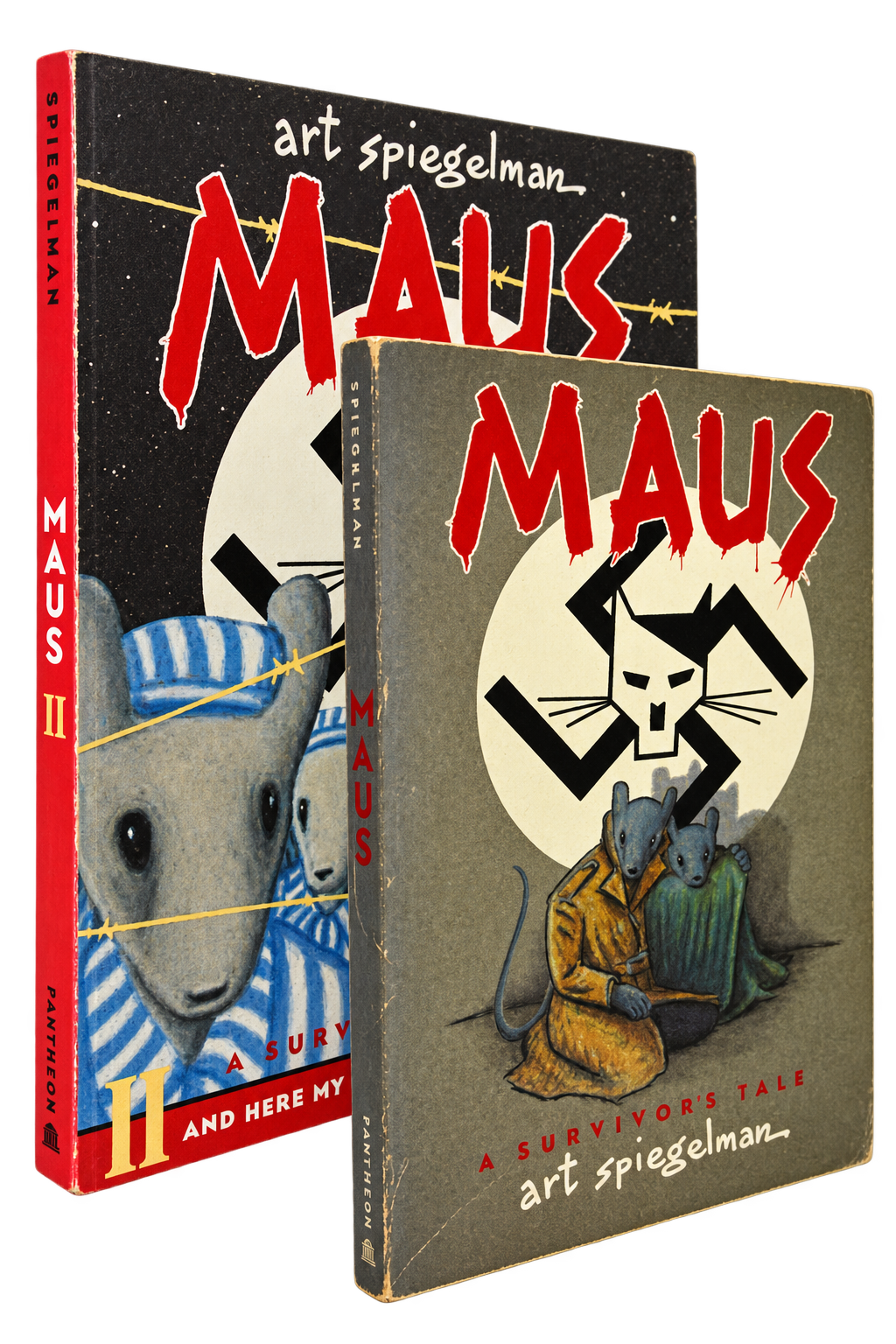
Maus: A Survivor’s Tale & Maus II: A Survivor’s Tale: And Here My Troubles Began
Art Spiegelman
Pantheon Books · New York · 1986–1991
First Editions · First Printings
Curated Two-Volume Publication-Event Set
The Set:
A curated pairing of the true first edition, first printing of Maus: A Survivor’s Tale (1986) and the first edition, first printing of Maus II: A Survivor’s Tale: And Here My Troubles Began (1991). The first volume retains its original French wrappers and $8.95 rear-cover price; Maus II retains its original dust jacket. Together, the two volumes preserve Art Spiegelman’s Holocaust narrative in the original book-form editions through which the complete work first entered the world.
Included Titles:
Maus: A Survivor’s Tale — Art Spiegelman
Pantheon Books · New York · 1986
First Edition · First Printing
Original French wrappers · $8.95 rear-cover priceMaus II: A Survivor’s Tale: And Here My Troubles Began — Art Spiegelman
Pantheon Books · New York · 1991
First Edition · First Printing
Original hardcover binding · Original dust jacket
Condition:
Very Good to Near Fine overall. Maus: A Survivor’s Tale grades Very Good, retaining its original French wrappers. Maus II grades Near Fine in a Near Fine original dust jacket. Both volumes retain their original publisher-issued formats with no evidence of rebinding or replacement components observed.
Story Of The Set
Art Spiegelman used the visual language of comics to tell a story many believed the medium was incapable of carrying.
Maus reconstructs the Holocaust through Spiegelman’s conversations with his father, Vladek, a Polish Jew who survived Auschwitz. But the work is not simply Vladek’s testimony. Spiegelman also records the difficult process of receiving that testimony: the gaps in memory, inherited trauma, family conflict, and the burden placed on a son trying to transform another person’s survival into history.
The story first developed serially in RAW, but Pantheon’s 1986 Maus: A Survivor’s Tale transformed it into a book that reached a far larger audience. Five years later, Maus II completed the narrative.
Its impact extended far beyond comics. In 1992, the completed Maus received a special Pulitzer Prize, an extraordinary recognition for a work that had challenged assumptions about what comics could accomplish as literature, history, memoir, and witness.
The form once associated with disposable entertainment had become a vessel for one of history’s most difficult acts of remembrance.
Why It’s In The Collection
The Maus Set belongs in Consigned to Darkness because witness does not end with the person who experienced an atrocity. It also depends on whether someone preserves the testimony—and whether another generation is willing to receive it.
Spiegelman transformed his father’s memories into something deliberately difficult to categorize: biography, autobiography, oral history, graphic literature, and Holocaust testimony exist simultaneously on the page. The result preserves not only what happened to Vladek, but what happened when his son tried to understand it.
That makes these particular editions important. Later boxed sets and collected editions preserve the text, but this pairing preserves the original book-form publication events: the 1986 volume through which Maus first reached readers as a book and the 1991 volume that completed the work.
Together, they document both an act of historical witness and a transformation in the possibilities of printed storytelling.
Vladek Spiegelman survived the history. Art Spiegelman, his son, made sure his testimony survived him.
Collection Categories: Graphic Literature · Holocaust & Genocide · Witness Literature · Memoir & Testimony · Publication-Event Object · Literature · Anti-Authoritarianism · Multi-Volume Set
———
Authentication Evidence
Maus: A Survivor’s Tale copyright page ends “Manufactured in U.S.A. // First Edition,” the diagnostic formulation identifying the first edition and distinguishing it from later printings that retain the original copyright date.
Maus: A Survivor’s Tale retains its original French-flap wrappers.
The original $8.95 U.S. price remains present on the rear wrapper.
The wrapper is the early publication design and lacks the later “Volume I: My Father Bleeds History” designation.
Taken together, the copyright-page formulation, original wrapper configuration, and pricing support identification of Maus: A Survivor’s Tale as the 1986 First Edition · First Printing.
Maus II: A Survivor’s Tale: And Here My Troubles Began copyright page explicitly states “First Edition.”
Maus II retains the complete first-printing number line ending in 1, directly establishing first-printing status.
Maus II is the stand-alone hardcover first edition, rather than the contemporaneous paperback issue or a volume supplied as part of a later pairing or boxed set.
Original publisher’s hardcover binding remains present on Maus II.
Original unclipped dust jacket remains present on Maus II.
First-printing jackets are documented with the original $18.00 U.S.A. / $23.50 Canada price; the jacket price on this copy should be stated as a physical authentication point only where directly confirmed.
Maus II collates to 135 pages, consistent with documented copies of the 1991 first edition.
Pantheon imprints, typography, bindings, and publication details are consistent with the respective original editions.
No evidence of book-club manufacture, facsimile components, remainder marks, rebinding, or replacement wrappers is observed.
Observable and independently corroborated bibliographic evidence supports identification of both volumes as First Edition · First Printing copies.
The two volumes are curatorially paired; no claim is made that these copies were originally issued or marketed together as a publisher-issued set.
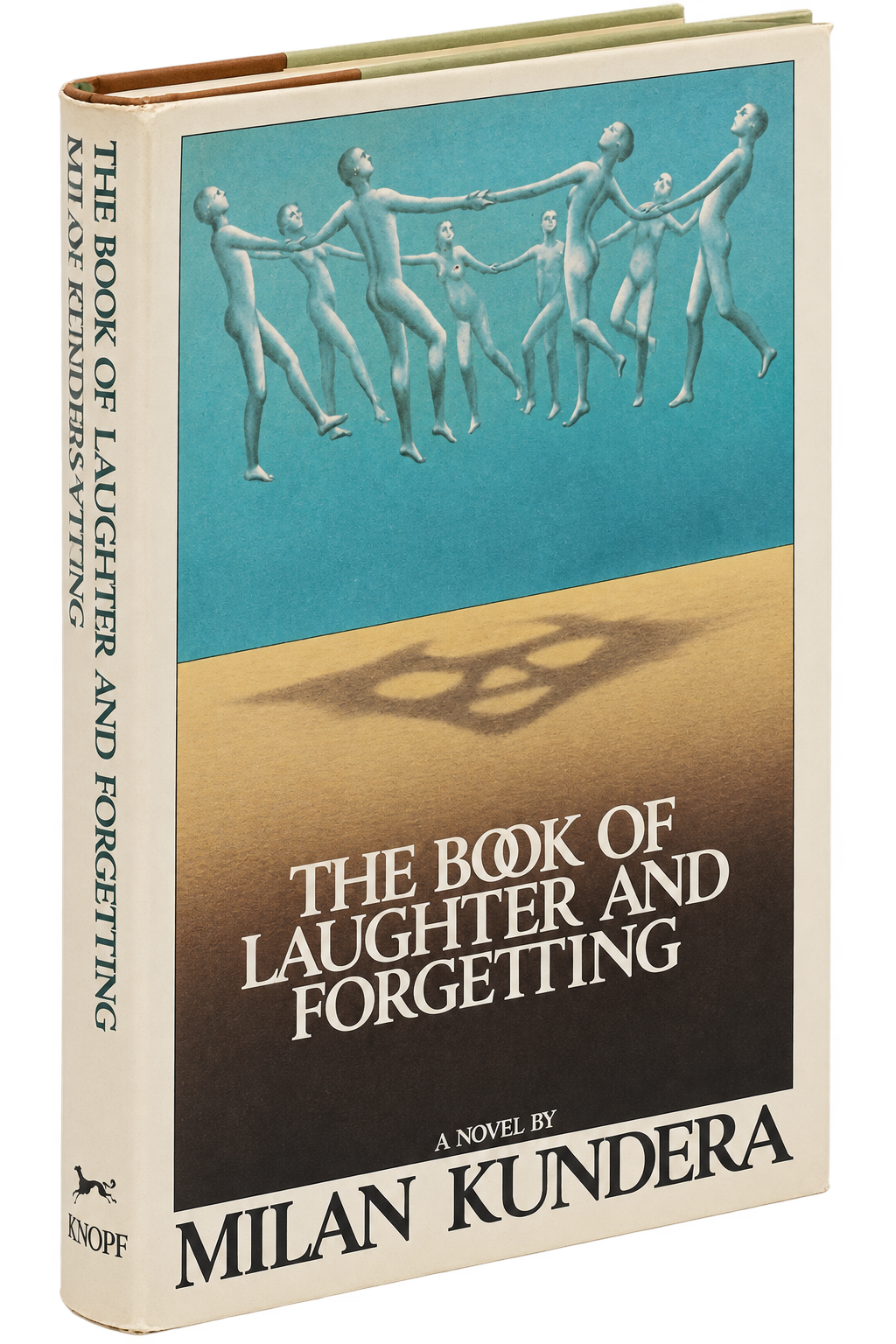
Milan Kundera
Translated from the Czech by Michael Henry Heim
New York: Alfred A. Knopf, 1980
First American Edition · First Printing
The Book:
The true first American edition, first printing of Milan Kundera’s The Book of Laughter and Forgetting, published by Alfred A. Knopf in 1980. The copyright page explicitly states “FIRST AMERICAN EDITION” and contains no subsequent-printing notice, consistent with Knopf’s first-printing practice for the period. The book retains its original pale blue paper-covered boards over brown cloth, with gilt decoration and lettering, and its original Fred Marcellino pictorial dust jacket. The volume collates to 228 pages. The front-flap price cannot be confirmed from the available photographs.
Condition:
Very Good in a Very Good dust jacket. The binding remains square and structurally sound with clean interior pages. The boards show moderate fading and the spine gilt noticeable rubbing. The original jacket exhibits moderate age toning, light rubbing, scattered surface scratches, several short closed tears, and small chips at the extremities, with no major loss affecting the principal design.
Story Of The Book
A government can erase a man from a photograph. Milan Kundera understood that the harder task was keeping him erased from memory.
Kundera wrote The Book of Laughter and Forgetting in exile after his writings had been suppressed in Czechoslovakia, removed from public libraries, and barred from domestic publication. By then he was living in France, and the Czechoslovak government had stripped him of his citizenship. The novel first appeared in French in 1979 before reaching American readers through this Knopf edition the following year.
Across seven connected sections, Kundera moves between exile, sexuality, loss, laughter, private memory, and political history. But running through them is a distinctly authoritarian problem: who controls what a society is allowed to remember? The novel’s famous image of a Communist official disappearing from an altered photograph transforms historical revisionism into something immediately comprehensible. Totalitarian power does not merely punish an opponent in the present. It can attempt to rewrite the past until the opponent appears never to have existed at all.
That idea makes forgetting political. Memory becomes a form of resistance because remembering people, events, betrayals, and inconvenient truths denies authority complete control over history. Kundera’s achievement was to connect that enormous political struggle to the fragility of individual memory: governments forget deliberately, while human beings forget naturally, and somewhere between the two lies the possibility that truth can disappear.
This first American edition carried that argument into the United States at precisely the moment Kundera was becoming one of the defining émigré literary voices of postwar Europe. The physical object therefore represents the American transmission of a work that could not legally circulate in the country whose political history it confronted.
Totalitarian power depends upon controlling what a society remembers. Kundera’s answer was to make forgetting impossible.
Why It’s In The Collection
The Book of Laughter and Forgetting belongs in Consigned to Darkness because it identifies a form of authoritarian power that extends beyond censorship: the power to manipulate collective memory itself.
Censorship tries to prevent people from encountering an idea. Historical revisionism goes further. It attempts to alter the record from which people understand what happened at all. A disappeared photograph, an erased dissident, a rewritten political history—these are attempts not merely to defeat opposition but to deprive future generations of the evidence that opposition ever existed.
Kundera had experienced that machinery personally. His books had been suppressed in Czechoslovakia, and he wrote the novel from exile. This 1980 first American edition is therefore especially meaningful to the collection: it carried the work of a suppressed émigré writer into another country while the political system he was criticizing still governed his homeland.
The book also occupies an important position within the collection’s Kundera holdings. The Joke documents both political persecution and the later restoration of a text compromised in its earlier American publication. The Unbearable Lightness of Being explores authoritarian power invading private life. The Book of Laughter and Forgetting supplies the third dimension: power over memory—the attempt to determine not simply what people may say or do, but what society will be permitted to remember.
That makes the first American edition a particularly strong publication-event object. It is not simply a later edition of an important anti-totalitarian novel. It is part of the international route by which writing suppressed at home escaped the jurisdiction of the state that wanted it silenced.
A regime can remove a writer from its libraries. It becomes much harder to remove him from history once his books have crossed the border.
Collection Categories: Anti-Totalitarianism · Political Dissent · Anti-Authoritarianism · Exile & Émigré Literature · Political History · Literature · Publication-Event Object · Censorship
———
Authentication Evidence
• The title page identifies the work as The Book of Laughter and Forgetting by Milan Kundera and states that it was translated from the Czech by Michael Henry Heim.
• The title page bears the Alfred A. Knopf imprint, New York, and the date 1980, establishing the American publisher, place, and year of publication.
• The copyright page explicitly states FIRST AMERICAN EDITION, directly establishing the edition represented by this copy.
• The copyright page records the original Czech title as Kniha smíchu a zapomnění, copyright ©1978 by Milan Kundera, French publication by Éditions Gallimard, and English translation copyright ©1979 by Éditions Gallimard.
• The copyright page gives ISBN 0-394-50896-3, matching institutional and dealer records for the 1980 Knopf first American edition.
• The photographed volume contains the documented publisher’s binding of pale blue paper-covered boards over brown cloth, with gilt decoration and lettering. Independent specialist descriptions identify the same construction for the first American edition.
• The original Fred Marcellino pictorial jacket is present and corresponds in design, typography, author photograph, and flap text to documented first American copies.
• The photographed copyright page contains no later-printing statement, reprint designation, book-club notice, or subsequent-edition language.
• The book’s 228-page collation agrees with institutional and specialist records for the edition.
• No evidence of rebinding, facsimile production, replacement title or copyright leaves, or a modern reproduction is visible.
• The explicit FIRST AMERICAN EDITION statement establishes the edition. Under Knopf’s publishing practice for this period, that statement in the absence of any subsequent-printing notice supports first-printing status.
The Maus Set
Maus: A Survivor’s Tale & Maus II: A Survivor’s Tale: And Here My Troubles Began
Art Spiegelman
Pantheon Books · New York · 1986–1991
First Editions · First Printings
Curated Two-Volume Publication-Event Set
The defeat of an army can alter the course of empires.
Bernard Fall's meticulous reconstruction of the 1954 Battle of Dien Bien Phu documents not only the military collapse of French colonial rule in Indochina but the beginning of a geopolitical transformation that would eventually draw the United States into Vietnam. Combining battlefield analysis with firsthand observation, the book became the definitive account of one of the twentieth century's most consequential military campaigns. This first edition preserves the landmark history of the battle that marked the beginning of the end of European colonialism in Southeast Asia.
The Book of Laughter and Forgetting
Milan Kundera
Translated from the Czech by Michael Henry Heim
New York: Alfred A. Knopf, 1980
First American Edition · First Printing