
 Image 1 of 1
Night — Elie Wiesel
Elie Wiesel
Foreword by François Mauriac
Translated from the French by Stella Rodway
Hill and Wang · New York · 1961
First American Edition · Second Printing · January 1961
The Book:
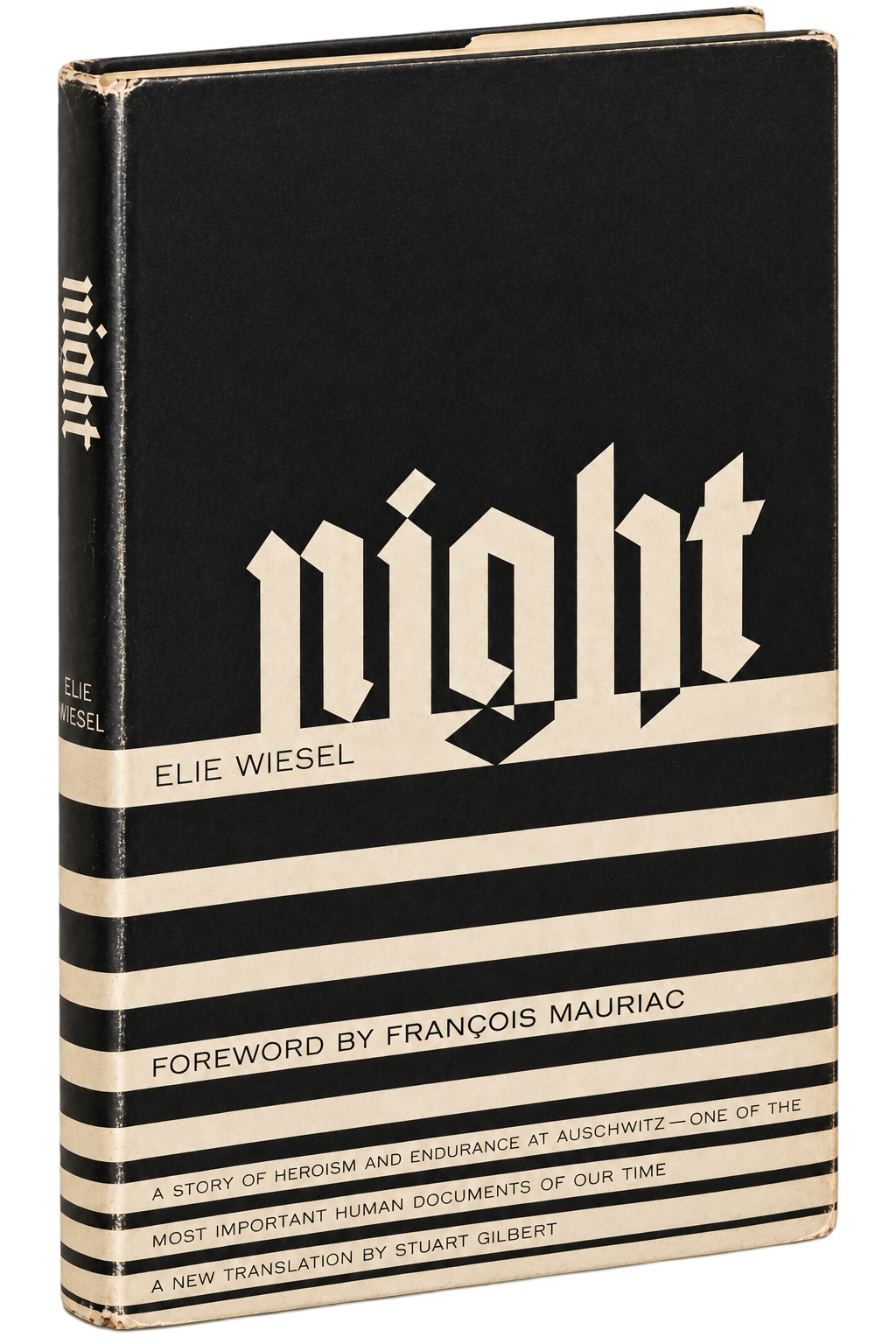
The Second Printing of the First American Edition of Elie Wiesel’s Night, issued by Hill and Wang in January 1961, only four months after the September 1960 American first printing. Translated from the French by Stella Rodway, with a foreword by François Mauriac, Night transformed Wiesel’s memories of Auschwitz and Buchenwald into one of the defining works of Holocaust witness literature. Octavo; 116 pp. This copy retains its original gray publisher’s cloth and original unclipped early-state Hill and Wang dust jacket with the characteristic black-and-cream striped design.
Condition:
Near Fine book in a Very Good+ original dust jacket. Gray publisher’s cloth remains clean and the binding square and tight, with an exceptionally clean interior and no foxing, restoration, or institutional markings observed. A faint previous owner’s pencil notation appears on the front free endpaper. The original unclipped jacket remains highly presentable, showing moderate chipping at the head of the spine, light rubbing, mild age toning, and a short closed tear to the lower front panel.
Story Of The Book
Before Night became one of the defining testimonies of the Holocaust, Elie Wiesel had to find a form capable of carrying what he remembered.
In 1954, Wiesel completed an 862-page Yiddish manuscript about his experiences in Auschwitz and Buchenwald. Published in Argentina two years later as Un di velt hot geshvign—And the World Remained Silent—it had become 245 pages.
Then came Les Éditions de Minuit, the publishing house born clandestinely under Nazi occupation. Working with editor Jérôme Lindon, Wiesel reshaped his testimony into the French La Nuit: 178 pages published in 1958 by a press that had once risked its existence publishing against the regime Wiesel had survived.
Stella Rodway translated that text into English. When Hill and Wang introduced Night to American readers in 1960, it was 116 pages.
862 pages became 245. Then 178. Then 116.
What remained was extraordinarily concentrated: a teenager’s deportation from Sighet, Auschwitz, the destruction of his family and faith, his father’s death, and finally liberation. Wiesel stripped away almost everything that could stand between the reader and the experience itself.
This January 1961 second printing appeared only four months after the first American edition—before Night became canonical and before Wiesel became an international voice of Holocaust memory.
Hundreds of pages disappeared. What survived became Night.
Why It’s In The Collection
Night belongs in Consigned to Darkness because genocide reduces human beings to categories, statistics, and numbers. Witness gives them their names back.
Wiesel took an event almost incomprehensible in its scale and forced readers to experience it through one teenager, one father, one family. Memory became testimony; testimony became resistance to forgetting.
Its publication history creates an extraordinary connection within this collection. Les Éditions de Minuit—the clandestine Resistance press represented elsewhere in Consigned to Darkness—helped shape Night. A publisher created to resist Nazi control of the written word became, little more than a decade later, the publisher of testimony from someone who survived the world the Nazis created.
Two generations of the same struggle meet there: writers refusing silence during the occupation, and a survivor refusing silence afterward.
The Nazis tried to reduce people to numbers. Wiesel answered by making one human voice impossible to ignore.
Collection Categories: Witness Literature · Holocaust Studies · Human Rights · Religious Conscience · Anti-Authoritarianism · Anti-Totalitarianism · Literature · Memoir & Testimony
———
Authentication Evidence
Title page identifies the work as Night by Elie Wiesel.
Title page credits Stella Rodway as translator from the French.
Volume retains the original foreword by François Mauriac.
Publisher is correctly identified as Hill and Wang · New York.
Copyright page records the original 1958 Les Éditions de Minuit copyright for La Nuit.
Copyright page records the 1960 MacGibbon & Kee English translation copyright.
Copyright page explicitly states “First American Edition September 1960,” directly establishing First American Edition status.
Copyright page explicitly states “Second Printing January 1961,” directly establishing this copy’s printing and date.
Volume collates to 116 pages, consistent with bibliographic records for the original Hill and Wang English-language edition.
Original gray publisher’s cloth with black spine lettering remains present and is consistent with the early Hill and Wang issue.
Original Hill and Wang dust jacket remains present.
Original jacket retains the characteristic black-and-cream striped design associated with the early American issue.
Dust jacket is unclipped.
The faint writing on the front free endpaper is consistent with a previous owner’s pencil notation and is not attributable to Elie Wiesel.
Publisher imprint, typography, binding, and jacket configuration are internally consistent with documented early Hill and Wang copies.
No evidence of book-club manufacture, ex-library ownership, remainder marking, rebinding, facsimile dust jacket, or replacement components is observed.
Observable physical and bibliographic evidence supports identification as the First American Edition · Second Printing, January 1961.