
 Image 1 of 1
Mr. Theodore Mundstock — Ladislav Fuks
Ladislav Fuks
New York: The Orion Press, 1968
First American Edition · First Printing
The Book:
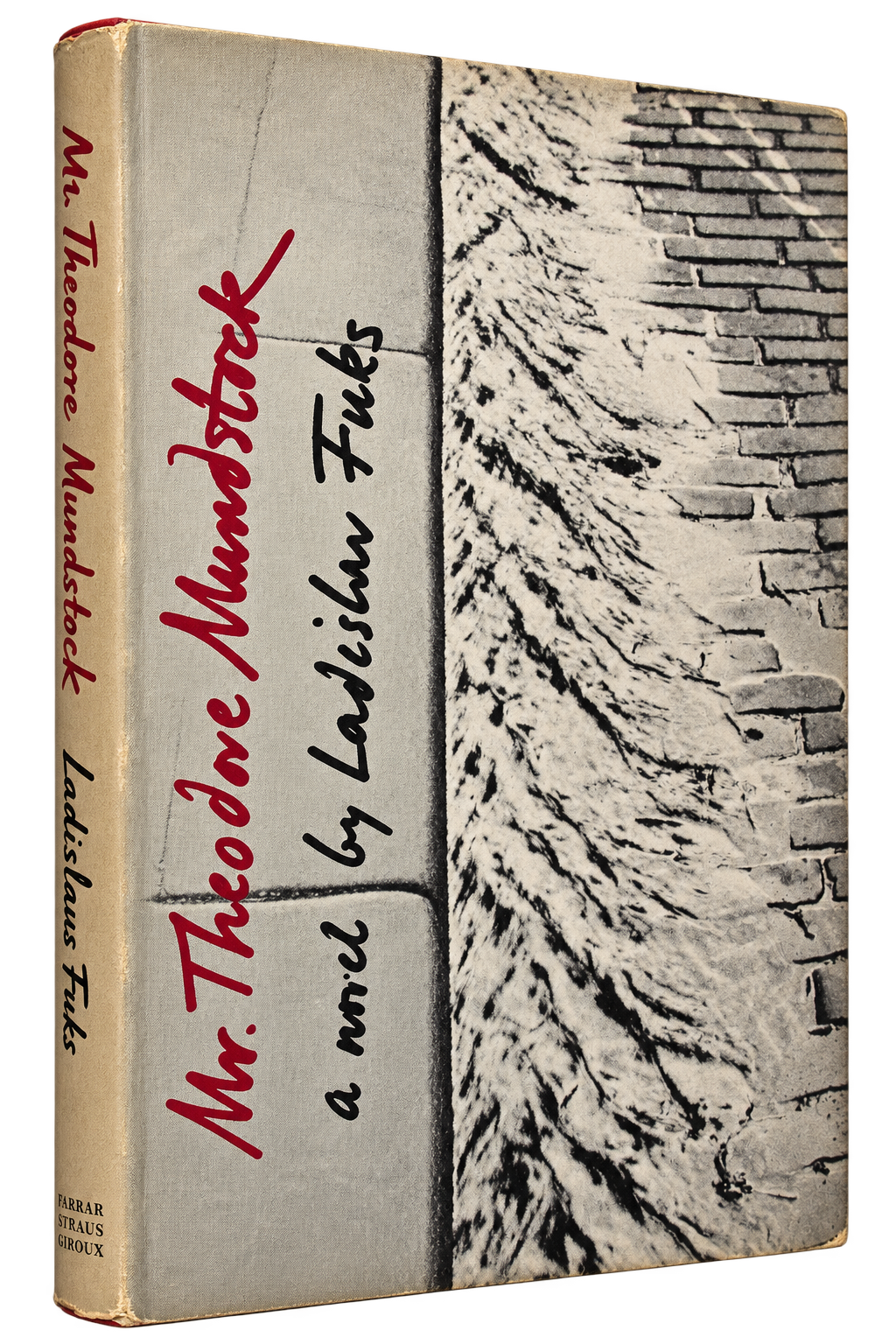
The first American edition, first printing of Ladislav Fuks’s Mr. Theodore Mundstock, translated from the Czech by Iris Urwin. The copyright page explicitly states “First printing,” and this copy retains its original black cloth binding and original unclipped dust jacket priced at $4.95. It represents the novel’s first English-language publication, bringing Fuks’s psychological portrait of Nazi occupation to an American readership.
Condition:
Near Fine in a Very Good dust jacket. The book is square and exceptionally clean, with bright spine lettering, well-preserved black cloth, and a clean interior. The jacket is complete and highly presentable, showing light age toning, minor edge wear, and small chips at the spine ends. A previous owner’s ink notation appears on the front panel of the jacket.
Story Of The Book
Before the Holocaust destroyed millions of lives, it first transformed ordinary existence into a condition of constant fear.
Theodore Mundstock is a Jewish man living in Nazi-occupied Prague. He has not yet been deported. He has not yet entered a concentration camp.
But the possibility governs everything.
Mundstock becomes obsessed with preparing himself for the catastrophe he believes is coming. He rehearses deprivation, imagines the routines of camp life, and attempts to train himself for humiliation, hunger, violence, and confinement—as though preparation might give him some measure of control over a system designed to strip control away.
That is what makes Fuks’s novel so psychologically devastating.
Rather than beginning with the machinery of extermination, Mr. Theodore Mundstock examines what persecution does before the transport, before the camp, before the final act of violence. It shows a human being reorganizing his entire interior life around the expectations imposed by a totalitarian state.
Fear becomes routine. Dehumanization begins in anticipation.
Published in English in 1968, the novel introduced readers to one of the most penetrating literary examinations of life under Nazi occupation, focusing not on battlefield resistance or historical spectacle but on the quiet erosion of ordinary existence under systematic persecution.
The Nazis had not yet taken Mundstock to the camp. They had already forced him to begin living inside it.
Why It’s In The Collection
Mr. Theodore Mundstock belongs in Consigned to Darkness because authoritarian power does not begin when prison doors close.
It begins earlier—when fear changes behavior, when identity becomes dangerous, when ordinary choices disappear, and when people begin organizing their lives around what the state might do to them next.
That makes this novel particularly important within the collection’s Holocaust holdings. Many works document what totalitarian systems physically did to their victims. Fuks examines what those systems did to the mind before the final violence arrived.
The collection acquired this first American edition, first printing because it preserves the original English-language introduction of that perspective: persecution not merely as an event, but as a condition that colonizes anticipation, conscience, routine, and selfhood. The inventory specifically identifies the book as a major literary exploration of psychological oppression and the individual struggle against authoritarian power.
Read beside firsthand testimony and documentary accounts of the Holocaust, Mr. Theodore Mundstock contributes something different but essential: an interior anatomy of what it means to live under a regime that has made terror ordinary.
Totalitarianism does not wait until it imprisons the body. It begins when it teaches the mind to live in captivity first.
Collection Categories: Literature · Holocaust & Genocide · Anti-Authoritarianism · Witness Literature
———
Authentication Evidence
• Title page identifies Ladislav Fuks, Mr. Theodore Mundstock, published by The Orion Press, New York.
• First Edition Evidence: This is the First American Edition, representing the first English-language publication of Mr. Theodore Mundstock in Iris Urwin's translation.
• First Printing Evidence: Copyright page explicitly states "First printing," confirming first-printing status.
• Copyright page records the original 1968 translation copyright by Grossman Publishers, Inc. and notes first publication in Czechoslovakia under the title Pan Theodor Mundstock.
• Original unclipped dust jacket retains the correct $4.95 publisher's price.
• Original black cloth binding matches known first-printing copies.
• Previous owner's writing appears on the front panel of the dust jacket; no author signature or inscription observed.
• No evidence of book club manufacture, rebinding, ex-library provenance, or facsimile dust jacket observed.
• The observed bibliographic evidence is fully consistent with an authentic First American Edition, First Printing.