
 Image 1 of 1
The Unbearable Lightness of Being — Milan Kundera
Milan Kundera
Translated from the Czech by Michael Henry Heim
New York: Harper & Row, Publishers, 1984
First American Edition · First Printing
The Book:
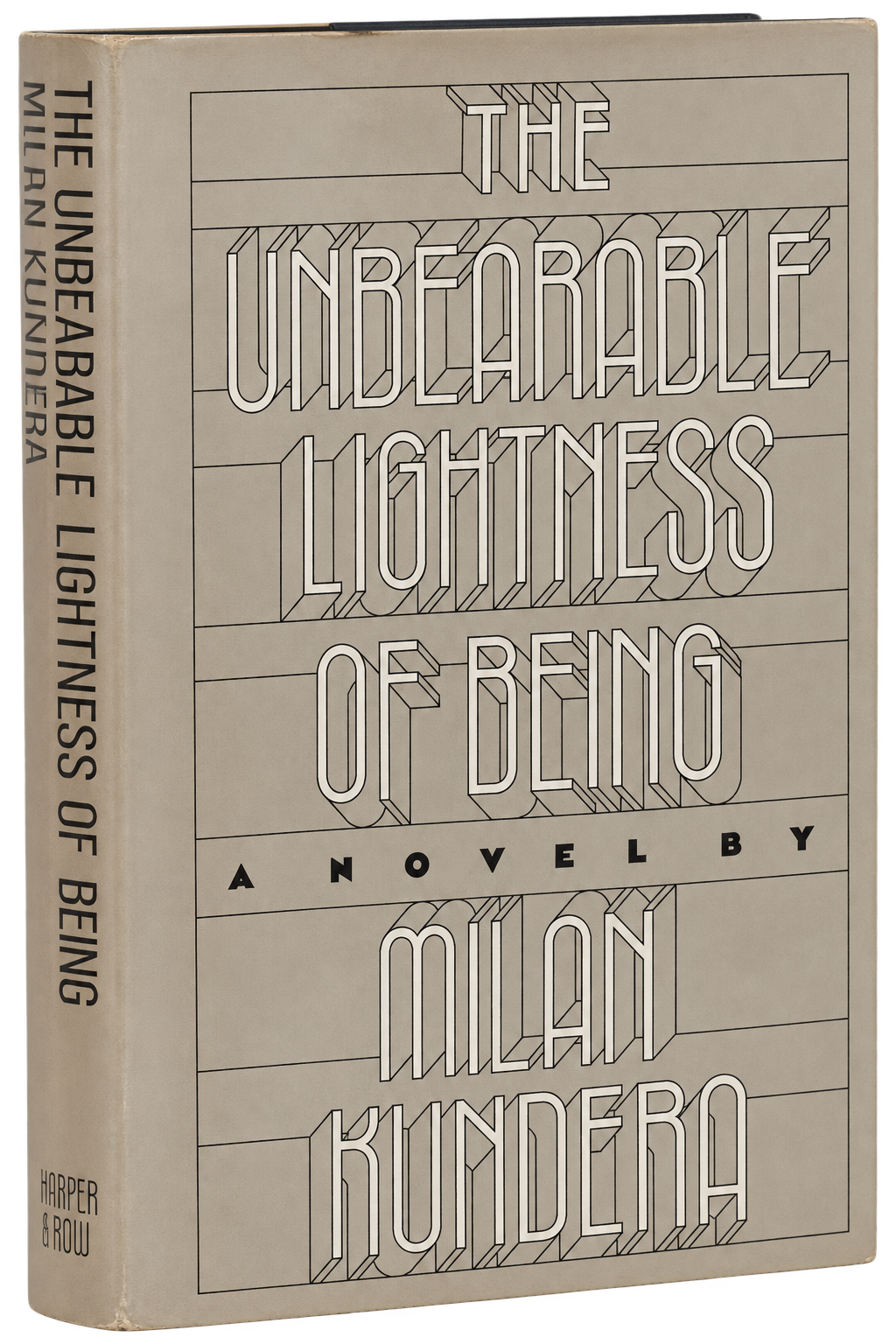
The true first American edition, first printing of Milan Kundera’s The Unbearable Lightness of Being, published by Harper & Row in 1984. The copyright page explicitly states “FIRST EDITION” and carries a complete first-printing number line ending in 1. This copy retains its original black paper-covered boards over beige cloth spine with gilt lettering and its original unclipped dust jacket priced at $15.95. No evidence of book-club manufacture, later printing, rebinding, facsimile jacket, or other bibliographic anomaly is present.
Condition:
Near Fine+ in a Near Fine dust jacket. The book itself is exceptionally clean, with a square binding, bright gilt spine lettering, a fresh text block, and no foxing, restoration, remainder marks, or structural defects observed. The jacket remains complete and attractive, showing light age toning, minor rubbing, several small chips and short closed tears concentrated around the head of the spine and upper edges, and slight creasing. A contemporary bookseller’s pencil notation appears on the front free endpaper.
Story Of The Book
Some governments ban books because of what they say. Kundera wrote about what happens after governments succeed in controlling what people are allowed to remember.
Set in the political aftermath of the 1968 Prague Spring and its suppression, The Unbearable Lightness of Being examines authoritarianism not primarily through prisons, interrogations, or formal censorship, but through the way political power enters ordinary life. Memory, love, sex, identity, exile, professional life, and even private moral choices become inseparable from the larger ideological system surrounding the characters.
That is what makes the novel especially powerful within Kundera’s body of work. He does not reduce life under Soviet domination to slogans or political allegory. Instead, he shows how ideology penetrates the intimate. A regime can shape where someone works, whether someone may return home, what can be publicly remembered, and which compromises become necessary simply to continue living. The political therefore becomes personal not as a metaphor, but as a condition of existence.
The novel also belongs to Kundera’s broader history as an exile writer. By the time this American edition appeared, he had already become one of the most internationally important literary voices associated with the experience of Communist Czechoslovakia. This first American edition introduced U.S. readers to the work through Michael Henry Heim’s translation and helped establish the novel as Kundera’s best-known book internationally.
The novel’s warning is not simply that authoritarian governments control public life. It is that, given enough power, they can make private life impossible to separate from politics.
Why It’s In The Collection
The Unbearable Lightness of Being belongs in Consigned to Darkness because it expands the collection’s understanding of authoritarianism beyond overt repression.
Many objects in the collection document obvious collisions between the individual and the state: censorship, imprisonment, exile, political violence, and forced confession. Kundera shows something quieter and, in some ways, more pervasive—the gradual invasion of ideology into memory, relationships, identity, and personal choice.
That makes the novel an important counterpart to the collection’s firsthand witness literature. A memoir can tell us what happened under an authoritarian system. Kundera asks what it feels like when the political system has become so embedded in daily existence that even love and memory carry political consequences.
The first American edition is particularly collection-relevant because it preserves the publication through which this meditation on freedom, exile, and Soviet domination entered the American literary landscape. The inventory specifically identifies the book as a publication-event object complementing firsthand testimony with a philosophical exploration of how ideological power transforms private life.
Placed beside The Book of Laughter and Forgetting and The Joke, it also strengthens a coherent Kundera section. Those books examine censorship, historical erasure, political persecution, and the recovery of an author’s intended text. The Unbearable Lightness of Being adds another dimension: what happens when history enters so deeply into the individual that there is no clean boundary between political freedom and personal freedom.
A government does not need to occupy every room to shape what happens inside it. Sometimes it is enough to occupy memory, possibility, and choice.
Collection Categories: Literature · Anti-Authoritarianism · Anti-Totalitarianism · Exile & Émigré Literature · Political Fiction · Political Dissent · Publication-Event Object
———
Authentication Evidence
• Correct title page identifying The Unbearable Lightness of Being by Milan Kundera, translated from the Czech by Michael Henry Heim, published by Harper & Row, Publishers, New York.
• Copyright page dated 1984.
• Copyright page explicitly states "FIRST EDITION."
• Complete first-printing number line ending in 1 is present, establishing first-printing status.
• Original black boards over beige cloth spine with gilt spine lettering are present and consistent with the publisher's first edition binding.
• Original unclipped dust jacket retaining the correct $15.95 price is present.
• Jacket design, typography, ISBN, and publisher information are internally consistent with the first issue.
• No evidence of book-club manufacture, later printing statement, rebound binding, facsimile jacket, or other bibliographic anomalies is observed.
• Edition evidence: The stated "FIRST EDITION" on the copyright page establishes this as the first American edition.
• Printing evidence: The complete number line ending in 1 establishes this as the first printing of the first American edition.