
 Image 1 of 1
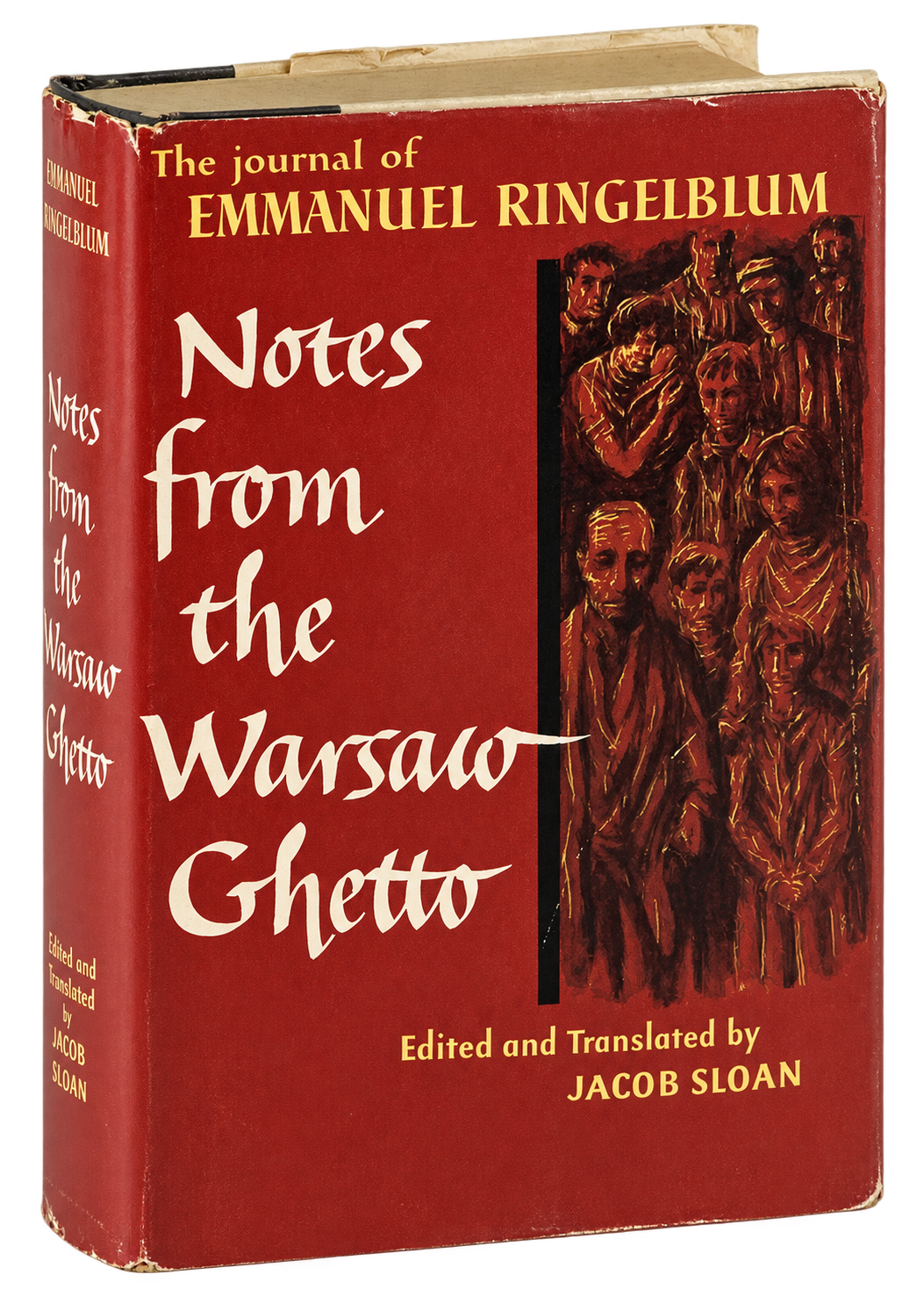
Notes from the Warsaw Ghetto — Emmanuel Ringelblum
Full Title: Notes from the Warsaw Ghetto: The Journal of Emmanuel Ringelblum
Emmanuel Ringelblum
McGraw-Hill Book Company, Inc. · New York · 1958
First American Edition · First Printing
The Book:
The first American edition, first English-language edition, and first printing of Emanuel Ringelblum’s Notes from the Warsaw Ghetto: The Journal of Emanuel Ringelblum, edited and translated by Jacob Sloan and published by McGraw-Hill in 1958. One of the earliest English-language presentations of Ringelblum’s wartime journal, this copy retains its original black cloth spine over patterned paper-covered boards, original unclipped $5.95 dust jacket, and the original folding map of the Warsaw Ghetto.
Condition:
Near Fine book in a Good+ dust jacket. The binding remains square and firm with exceptionally clean boards, bright lettering, and a fresh interior free of ownership markings or structural defects. The original dust jacket remains complete with moderate chipping and edge wear concentrated at the spine ends and corners, while retaining strong color and attractive overall presentation. The jacket is protected in archival polyester. The original folding map of the Warsaw Ghetto is present and complete.
Story Of The Book
Some regimes destroy people. Others attempt to erase the evidence that they ever lived.
While imprisoned inside the Warsaw Ghetto, historian Emanuel Ringelblum organized the clandestine Oyneg Shabbes archive, assembling diaries, reports, newspapers, official documents, children’s writings, and eyewitness testimony into one of history’s greatest acts of documentary resistance.
Ringelblum understood that the Nazis were not simply murdering a community. They were destroying the people capable of recording what had happened to it. Knowing that the archive—and likely its creators—would not survive, the group buried its records beneath the streets of Warsaw so that a future generation might know not merely that millions died, but how they lived.
Murder could erase witnesses. It could not be allowed to erase memory.
Recovered from the ruins of the ghetto after the war, the archive preserved a record the Nazis had attempted to destroy alongside the people who created it. Published by McGraw-Hill in 1958, Notes from the Warsaw Ghetto brought Ringelblum’s wartime journal to English-language readers, transforming an act of secret wartime preservation into permanent public history.
Why It’s In The Collection
Notes from the Warsaw Ghetto belongs in Consigned to Darkness because few objects embody the idea of witness as resistance more completely.
Ringelblum and the Oyneg Shabbes archivists confronted a form of authoritarian power that sought control not only over human lives, but over what history would eventually remember about them. Their answer was documentation: preserve the names, voices, newspapers, testimony, ordinary experiences, and physical evidence that would prevent the victims from disappearing into the historical record their killers intended to leave behind.
This 1958 first American and first English-language edition preserves the next stage of that extraordinary act of resistance—the moment Ringelblum’s secretly preserved testimony entered the English-speaking historical record. The survival of the original folding Warsaw Ghetto map further strengthens this copy as a physical record of that publication.
The Nazis could destroy the witnesses. Ringelblum made sure they could not destroy the evidence.
Collection Categories: Witness Literature · Holocaust · Anti-Authoritarianism · Free Expression
———
Authentication Evidence
Title page identifies the work as Notes from the Warsaw Ghetto: The Journal of Emmanuel Ringelblum by Emanuel Ringelblum, edited and translated by Jacob Sloan.
Title page identifies McGraw-Hill Book Company, Inc., New York, Toronto, and London as publisher.
Copyright page records Copyright © 1958 by Jacob Sloan and explicitly states “FIRST EDITION.”
The 1958 McGraw-Hill publication represents the First American Edition and First English-Language Edition; earlier editions of Ringelblum’s journal were published in other languages.
No later-printing statement, subsequent-impression statement, or revised-edition designation appears on the copyright page.
McGraw-Hill’s explicit “FIRST EDITION” statement, together with the absence of any subsequent-printing designation, supports identification as the First Printing.
Original black cloth spine over patterned paper-covered boards is present and corresponds to documented first-issue examples of the 1958 McGraw-Hill publication.
Original Warsaw Ghetto map endpapers are present and complete.
Original unclipped dust jacket is present and retains the correct $5.95 publisher’s price.
Dust-jacket design, publisher imprint, typography, and binding correspond to documented first American issue copies.
No evidence of book-club manufacture, rebinding, ex-library provenance, facsimile dust jacket, or later-issue characteristics is observed.
Taken together, the observable bibliographic evidence supports identification as an authentic 1958 McGraw-Hill First American Edition · First English-Language Edition · First Printing.