
 Image 1 of 1
La CNT en la Revolución Española (Set) — José Peirats
Complete Three-Volume Set
José Peirats
Ruedo Ibérico · Paris · 1971
First Ruedo Ibérico Edition · First Printing
Complete Three-Volume Set
The Set:
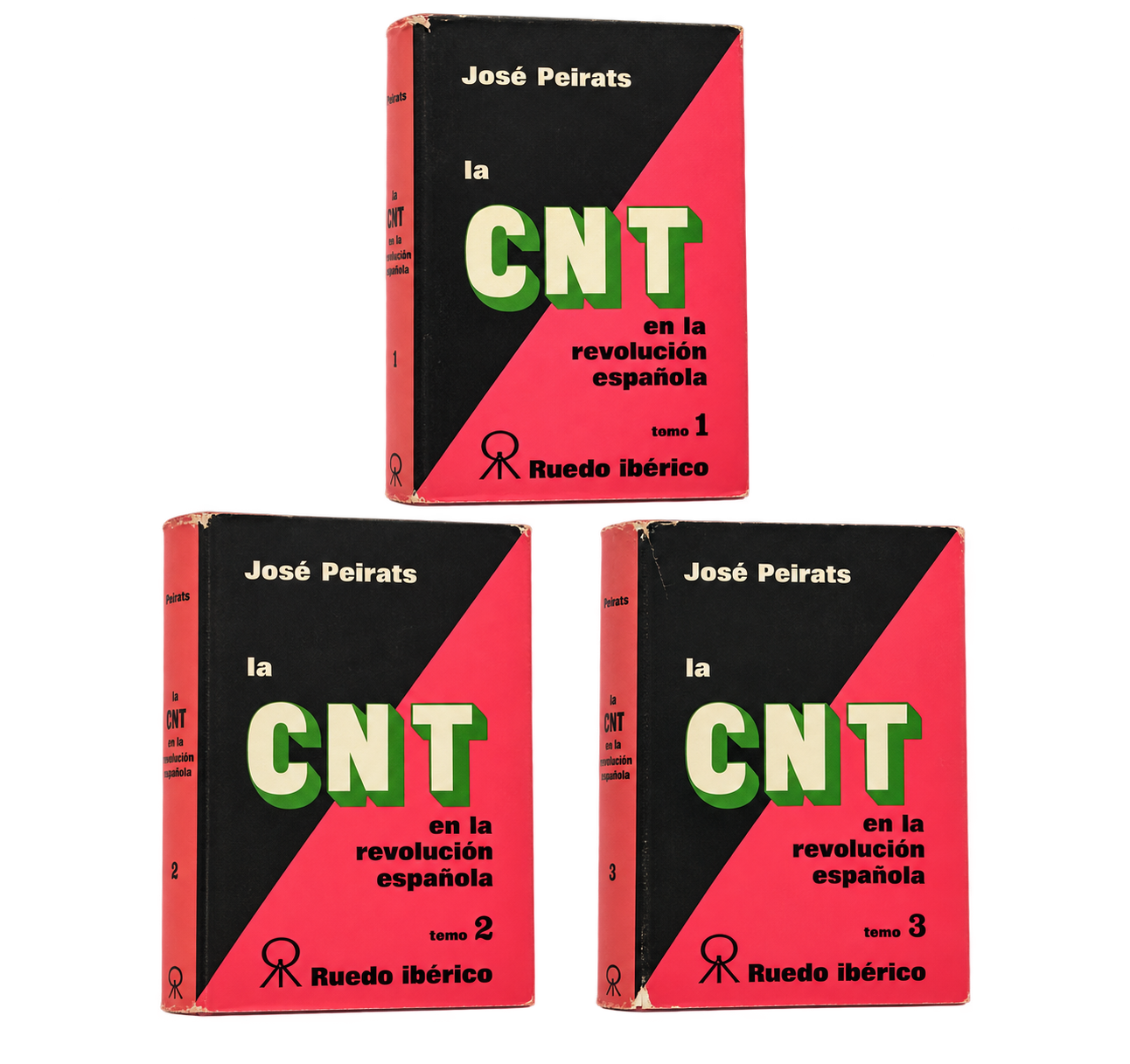
The complete 1971 Ruedo Ibérico edition, first printing, of José Peirats’s monumental history of the Confederación Nacional del Trabajo (CNT) and the Spanish Revolution, complete in three volumes. Published in Paris by the Spanish exile press Ruedo Ibérico while Franco remained in power, the set comprises approximately 1,118 pages with illustrations. All three volumes retain their original glossy pictorial wrappers and original pictorial dust jackets, with cover designs by José Martínez.
Included Volumes:
La CNT en la revolución española — Tomo 1 — José Peirats
Ruedo Ibérico · Paris · 1971
First Ruedo Ibérico Edition · First Printing
Original pictorial wrappers · Original pictorial dust jacketLa CNT en la revolución española — Tomo 2 — José Peirats
Ruedo Ibérico · Paris · 1971
First Ruedo Ibérico Edition · First Printing
Original pictorial wrappers · Original pictorial dust jacketLa CNT en la revolución española — Tomo 3 — José Peirats
Ruedo Ibérico · Paris · 1971
First Ruedo Ibérico Edition · First Printing
Original pictorial wrappers · Original pictorial dust jacket
Condition:
Near Fine volumes in Very Good+ original dust jackets. All three books remain clean, square, tightly bound, and internally unmarked. The jackets are bright and structurally complete, showing light rubbing, superficial scratching, and minor wear at the corners and spine ends, with no significant tears or paper loss. No mixed-edition volumes, replacement jackets, rebinding, or restoration are observed.
Story Of The Set
Franco’s dictatorship did not merely defeat the Spanish Revolution. It attempted to control what future generations would be permitted to remember about it.
José Peirats had participated in the anarcho-syndicalist movement whose history he later documented. His three-volume study reconstructs the rise of the CNT, its revolutionary ambitions, and its role in the Spanish Civil War from within a political tradition driven into exile after Franco’s victory.
Ruedo Ibérico made that exile part of the publication itself. Operating from Paris, the press published histories, arguments, and political traditions that could not circulate freely inside Francoist Spain. When it issued Peirats’s complete three-volume history in 1971, preserving the story of the defeated anarchist movement became a way of resisting the dictatorship’s control over historical memory.
Franco controlled Spain. Ruedo Ibérico refused to let him control its past.
Why It’s In The Collection
La CNT en la revolución española belongs in Consigned to Darkness because the physical set embodies the relationship between exile, censorship, witness, and historical memory.
Peirats was not a later historian approaching the CNT solely from archival distance. He had participated in the movement whose history he documented. His account therefore preserves a political tradition through the work of someone who had lived within it.
The importance of this particular edition lies equally with its publisher. Ruedo Ibérico operated beyond the reach of Francoist censorship and used that freedom to preserve political histories the dictatorship had marginalized or suppressed. Publishing Peirats from exile transformed historical preservation itself into an act of dissent.
As a complete three-volume set, the object preserves the full work as Ruedo Ibérico issued it while Franco was still alive and his dictatorship still governed Spain.
The movement had been defeated. Its history had not.
Collection Categories: Anti-Authoritarianism · Censorship · Political Dissent · Political Movements · Witness Literature · Exile & Émigré Literature · Political History · Publication-Event Object
———
Authentication Evidence
All three volumes retain their original Ruedo Ibérico title pages identifying José Peirats as author and La CNT en la revolución española as title.
Individual title pages carry the correct volume designations of Tomo 1, Tomo 2, and Tomo 3, establishing the complete three-volume sequence.
Each volume identifies Ruedo Ibérico as publisher and bears the publisher’s device and Paris address at 6 rue de Latran, Paris 5.
Each copyright page bears the original 1971 Ruedo Ibérico copyright and publication information.
No later-printing, revised-impression, or subsequent-printing statement appears in any of the three volumes.
Original glossy pictorial wrappers are present on all three volumes and are correctly numbered Tomo 1, Tomo 2, and Tomo 3.
Original pictorial dust jackets are retained on all three volumes.
Typography, wrappers, publisher devices, dimensions, and production characteristics are uniform across the complete set and consistent with documented 1971 Ruedo Ibérico publications.
Pagination, contents, and physical construction correspond with published bibliographic descriptions of the complete three-volume 1971 Ruedo Ibérico issue.
No evidence of facsimile production, print-on-demand manufacture, replacement wrappers, mixed editions, institutional rebinding, or ex-library provenance is observed.
The 1971 publication is the first edition of Peirats’s work issued by Ruedo Ibérico; an earlier edition was published in Toulouse between 1951 and 1953.
Observable bibliographic evidence supports authentication as a complete 1971 Ruedo Ibérico First Edition · First Printing, complete in three volumes.
Complete Three-Volume Set
José Peirats
Ruedo Ibérico · Paris · 1971
First Ruedo Ibérico Edition · First Printing
Complete Three-Volume Set
The Set:
The complete 1971 Ruedo Ibérico edition, first printing, of José Peirats’s monumental history of the Confederación Nacional del Trabajo (CNT) and the Spanish Revolution, complete in three volumes. Published in Paris by the Spanish exile press Ruedo Ibérico while Franco remained in power, the set comprises approximately 1,118 pages with illustrations. All three volumes retain their original glossy pictorial wrappers and original pictorial dust jackets, with cover designs by José Martínez.
Included Volumes:
La CNT en la revolución española — Tomo 1 — José Peirats
Ruedo Ibérico · Paris · 1971
First Ruedo Ibérico Edition · First Printing
Original pictorial wrappers · Original pictorial dust jacketLa CNT en la revolución española — Tomo 2 — José Peirats
Ruedo Ibérico · Paris · 1971
First Ruedo Ibérico Edition · First Printing
Original pictorial wrappers · Original pictorial dust jacketLa CNT en la revolución española — Tomo 3 — José Peirats
Ruedo Ibérico · Paris · 1971
First Ruedo Ibérico Edition · First Printing
Original pictorial wrappers · Original pictorial dust jacket
Condition:
Near Fine volumes in Very Good+ original dust jackets. All three books remain clean, square, tightly bound, and internally unmarked. The jackets are bright and structurally complete, showing light rubbing, superficial scratching, and minor wear at the corners and spine ends, with no significant tears or paper loss. No mixed-edition volumes, replacement jackets, rebinding, or restoration are observed.
Story Of The Set
Franco’s dictatorship did not merely defeat the Spanish Revolution. It attempted to control what future generations would be permitted to remember about it.
José Peirats had participated in the anarcho-syndicalist movement whose history he later documented. His three-volume study reconstructs the rise of the CNT, its revolutionary ambitions, and its role in the Spanish Civil War from within a political tradition driven into exile after Franco’s victory.
Ruedo Ibérico made that exile part of the publication itself. Operating from Paris, the press published histories, arguments, and political traditions that could not circulate freely inside Francoist Spain. When it issued Peirats’s complete three-volume history in 1971, preserving the story of the defeated anarchist movement became a way of resisting the dictatorship’s control over historical memory.
Franco controlled Spain. Ruedo Ibérico refused to let him control its past.
Why It’s In The Collection
La CNT en la revolución española belongs in Consigned to Darkness because the physical set embodies the relationship between exile, censorship, witness, and historical memory.
Peirats was not a later historian approaching the CNT solely from archival distance. He had participated in the movement whose history he documented. His account therefore preserves a political tradition through the work of someone who had lived within it.
The importance of this particular edition lies equally with its publisher. Ruedo Ibérico operated beyond the reach of Francoist censorship and used that freedom to preserve political histories the dictatorship had marginalized or suppressed. Publishing Peirats from exile transformed historical preservation itself into an act of dissent.
As a complete three-volume set, the object preserves the full work as Ruedo Ibérico issued it while Franco was still alive and his dictatorship still governed Spain.
The movement had been defeated. Its history had not.
Collection Categories: Anti-Authoritarianism · Censorship · Political Dissent · Political Movements · Witness Literature · Exile & Émigré Literature · Political History · Publication-Event Object
———
Authentication Evidence
All three volumes retain their original Ruedo Ibérico title pages identifying José Peirats as author and La CNT en la revolución española as title.
Individual title pages carry the correct volume designations of Tomo 1, Tomo 2, and Tomo 3, establishing the complete three-volume sequence.
Each volume identifies Ruedo Ibérico as publisher and bears the publisher’s device and Paris address at 6 rue de Latran, Paris 5.
Each copyright page bears the original 1971 Ruedo Ibérico copyright and publication information.
No later-printing, revised-impression, or subsequent-printing statement appears in any of the three volumes.
Original glossy pictorial wrappers are present on all three volumes and are correctly numbered Tomo 1, Tomo 2, and Tomo 3.
Original pictorial dust jackets are retained on all three volumes.
Typography, wrappers, publisher devices, dimensions, and production characteristics are uniform across the complete set and consistent with documented 1971 Ruedo Ibérico publications.
Pagination, contents, and physical construction correspond with published bibliographic descriptions of the complete three-volume 1971 Ruedo Ibérico issue.
No evidence of facsimile production, print-on-demand manufacture, replacement wrappers, mixed editions, institutional rebinding, or ex-library provenance is observed.
The 1971 publication is the first edition of Peirats’s work issued by Ruedo Ibérico; an earlier edition was published in Toulouse between 1951 and 1953.
Observable bibliographic evidence supports authentication as a complete 1971 Ruedo Ibérico First Edition · First Printing, complete in three volumes.