
 Image 1 of 1
The Luminous Darkness — Howard Thurman
Full Title:The Luminous Darkness: A Personal Interpretation of the Anatomy of Segregation and the Ground of Hope
Howard Thurman
Harper & Row, Publishers · New York · 1965
First Edition · First Printing
The Book:
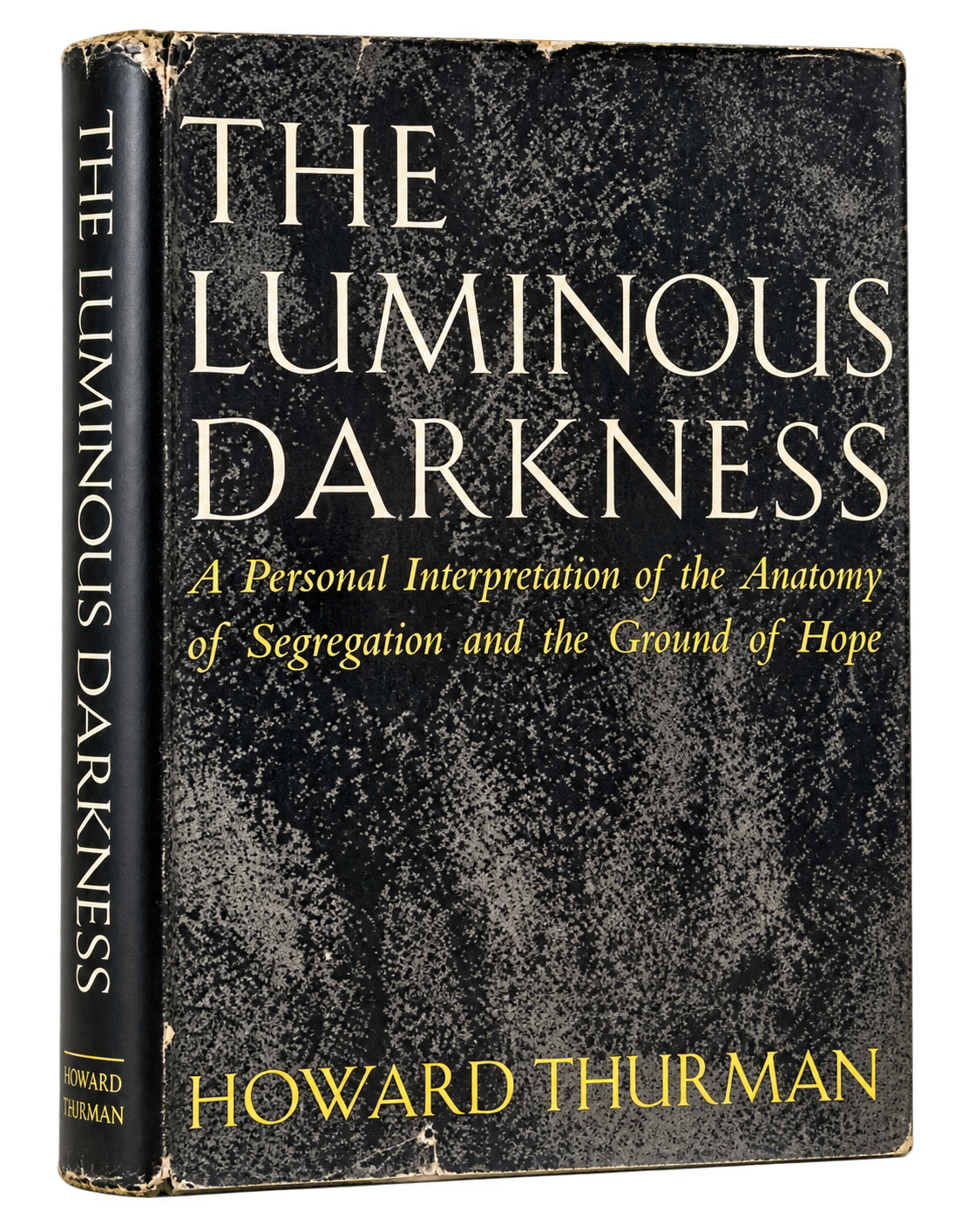
The first edition, first printing of Howard Thurman’s The Luminous Darkness: A Personal Interpretation of the Anatomy of Segregation and the Ground of Hope, published by Harper & Row in 1965. Written during a defining year of the American Civil Rights Movement, the book examines segregation through Thurman’s own experiences and his larger philosophy of human dignity, racial division, and reconciliation. Original black publisher’s cloth with gilt spine lettering, retaining the original unclipped dust jacket priced $3.00.
Condition:
Near Fine book in a Very Good+ dust jacket. The original black cloth remains exceptionally clean, with bright gilt spine lettering, a square and sound binding, and a bright interior free of ownership markings, foxing, restoration, or structural defects. The original unclipped jacket remains substantially complete with light edge wear, minor chipping at the spine ends, and gentle toning to the flaps.
Story Of The Book
Published in 1965, The Luminous Darkness asked what segregation had done not only to American institutions, but to the people living inside them.
Howard Thurman wrote from decades of personal experience with racial discrimination and from a career spent thinking about dignity, nonviolence, and human relationship. Rather than offering a program of protest or legal reform, he examined the psychological, moral, and spiritual consequences of segregation.
The book appeared during a defining year of the Civil Rights Movement, when the struggle over voting rights, public accommodations, and racial violence remained immediate.
Thurman’s contribution was different from that of movement organizers and political leaders. He focused on the inner effects of racial hierarchy: fear, humiliation, anger, estrangement, and the difficulty of imagining genuine relationship across a system built on separation.
His central question was what hope could mean in a society still structured by segregation.
That made The Luminous Darkness less a movement manifesto than a contemporary moral interpretation of the world the movement was trying to change.
Why It’s In The Collection
The Luminous Darkness belongs in Consigned to Darkness because systems of oppression exercise power not only through laws and institutions, but through what they teach people to believe about themselves and each other.
Thurman understood that changing the law was indispensable. But legal equality alone could not automatically repair the psychological and moral damage created by generations of racial hierarchy.
That makes this book an important companion to the collection’s more directly activist Civil Rights objects. Where those books document confrontation with discriminatory institutions, Thurman examines the human consequences those institutions leave behind.
Published in 1965, this first printing preserves Thurman’s interpretation of segregation while the Civil Rights struggle was still unfolding. Thurman was an important religious and intellectual influence on figures including Martin Luther King Jr., but this book is best understood on its own terms: a contemporary reflection on the human consequences of racial division and the moral conditions required to move beyond it.
Political freedom can dismantle the structure of segregation. Thurman asked what it would take to dismantle its presence inside us.
Collection Categories: Civil Rights · Human Rights · Anti-Authoritarianism · Political Dissent · Social Justice · Religion & Conscience · Literature
———
Authentication Evidence
Title page identifies The Luminous Darkness by Howard Thurman and Harper & Row, Publishers, as publisher.
Copyright page carries the original 1965 copyright and explicitly states “FIRST EDITION.”
Copyright page carries the Harper & Row code “E-P,” identified by specialist first-edition dealers as the code used on the first printing of this title.
Documented later copies include an explicitly stated second printing, distinguishing the first-printing state from later impressions.
Original binding is quarter black cloth over mustard/yellow paper-covered boards, with gilt spine lettering.
Deckled fore-edge is present.
Original dust jacket is present and remains unclipped at $3.00.
Collation is xi, 113 pp., consistent with documented copies of the 1965 first edition.
Jacket design, typography, publisher imprint, and binding configuration correspond to documented first-printing copies.
No rebinding, facsimile jacket, remainder marking, or other bibliographic alteration is observed.
Taken together, the FIRST EDITION statement, E-P code, original quarter-cloth binding, deckled edge, $3.00 jacket, and correct collation support identification as an authentic 1965 First Edition · First Printing.