
 Image 1 of 2
 Image 2 of 2
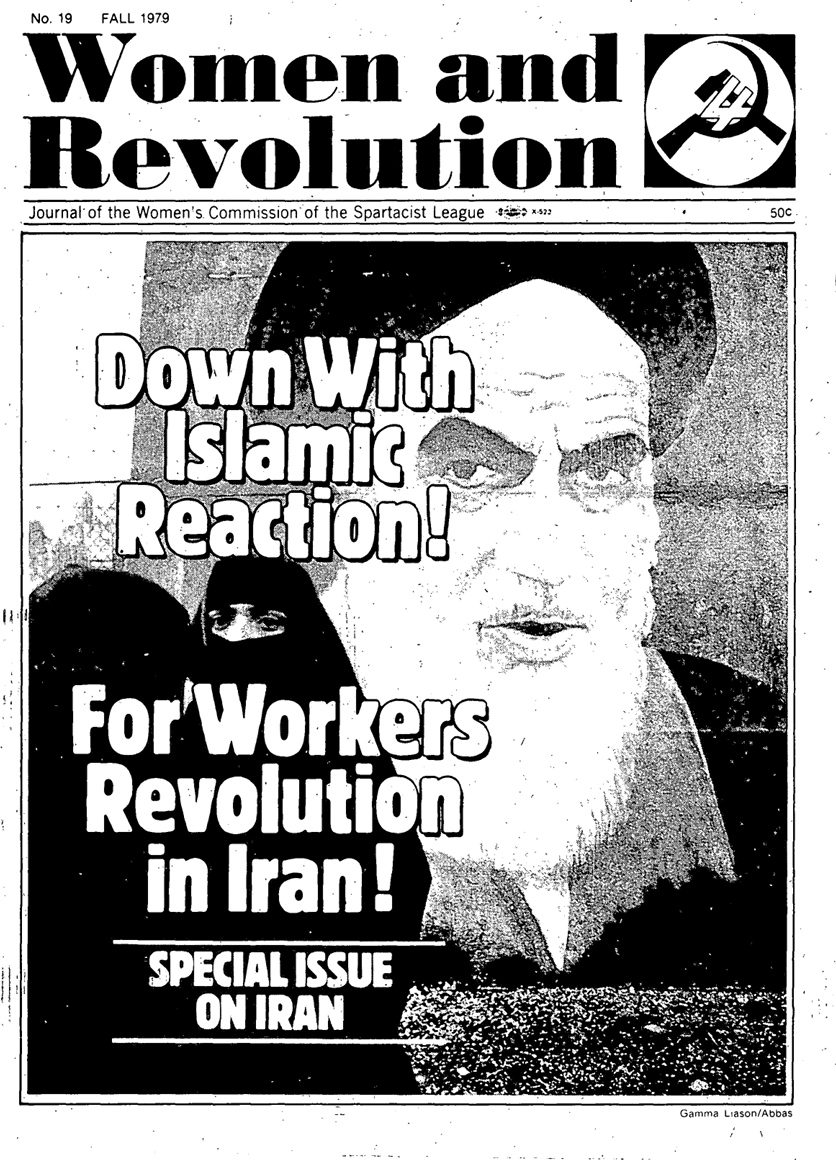
Women and Revolution (No. 19, Fall ‘79) — D. L. Reissner (Ed.)
Special Issue on Iran · Fall 1979
Journal of the Women’s Commission of the Spartacist League
Edited by D. L. Reissner
Spartacist Publishing Company · New York · 1979
No. 19
First Edition · First Printing
The Magazine:
The original Fall 1979 issue of Women and Revolution, designated on the front wrapper as a “Special Issue on Iran.” Published during the first year of Ayatollah Khomeini’s Islamic Republic, the issue is devoted largely to the political consequences of the Iranian Revolution for women, workers, political dissidents, and the Iranian left. Principal contents include “Down With Islamic Reaction! For Workers Revolution in Iran!,” “No to the Veil!,” and “Fatima Khalil Tour: The Truth About Iran.” Combining political analysis, photographs, and firsthand testimony, the issue documents compulsory veiling, repression of the Iranian left, and disputes within the international socialist movement over support for the new regime. Original printed self-wrappers retaining the 50¢ cover price.
Condition:
Very Good+. Original printed self-wrappers remain complete and firmly attached, with light uniform age toning, faint handling wear, minor corner softening, and a small penciled notation near the upper-right corner of the front wrapper. Interior remains clean and securely bound, with no significant tears, chips, staining, or institutional markings observed. Original 50¢ cover price remains present.
Story Of The Magazine
Revolutions often promise freedom. By Fall 1979, Women and Revolution was asking whether Iran’s had delivered the opposite.
Only months earlier, Iranian women had taken to the streets against compulsory veiling and the rapid erosion of rights following the overthrow of the Shah. No. 18 of Women and Revolution documented that first resistance while the political direction of the revolution remained uncertain.
By the time No. 19 appeared, the journal’s tone had changed. This was no longer simply a warning that clerical authority might become repressive. Its writers were documenting the consolidation of the Islamic Republic and arguing that women’s freedom, workers’ rights, and political dissent were being subordinated to a new authoritarian order.
The issue’s significance also lies in whom it criticizes. Women and Revolution did not only attack the Islamic Republic; it also challenged sections of the international left that had supported Khomeini because they viewed the revolution primarily through the lens of anti-imperialism.
That made the argument unusually difficult: a revolution could overthrow one form of domination and still build another.
No. 18 preserved the warning. No. 19 preserved the moment when the warning had become an indictment.
Why It’s In The Collection
Women and Revolution No. 19 belongs in Consigned to Darkness because opposition to authoritarianism loses its meaning if repression is excused merely because it comes from the “right” side of a revolution.
The journal was openly Marxist and revolutionary, yet it refused to treat anti-imperialist credentials as a defense for compulsory religious conformity, political repression, or the narrowing of women’s freedom.
That makes this issue especially important as a publication-event object. It was not written decades later, after the nature of the Islamic Republic had become obvious. Its writers were documenting and interpreting the transformation while it was still taking place.
Together with No. 18, the two issues form a contemporaneous sequence: first resistance, then consolidation. One records uncertainty about what the revolution might become; the other records the recognition that a new structure of power was already taking shape.
The collection preserves both moments because the distance between them is the history.
Collection Categories: Women’s History & Feminism · Witness Literature · Human Rights · Political Dissent · Political Movements · Anti-Authoritarianism · Anti-Totalitarianism · Religious Conscience · Free Expression · Publication-Event Object
———
Authentication Evidence
Front wrapper identifies the publication as Women and Revolution.
Front wrapper identifies the issue as No. 19 and dates it Fall 1979.
Front wrapper designates the issue as a “Special Issue on Iran.”
Original printed 50¢ cover price remains present.
Front wrapper identifies the publication as the Journal of the Women’s Commission of the Spartacist League.
Internal masthead identifies the publication more fully as the Journal of the Spartacist League Central Committee Commission for Work Among Women.
Masthead identifies Spartacist Publishing Company as publisher and provides the New York publication address.
Principal article “No to the Veil!” begins on page 2, corresponding to the issue’s cover theme.
“Fatima Khalil Tour: The Truth About Iran” appears within the issue and is consistent with the special-issue designation.
Running headers consistently identify Women and Revolution · Fall 1979.
Typography, wrapper design, publisher information, paper stock, pagination, and editorial structure are internally consistent throughout.
An archived original issue reproduces the identical cover, issue designation, contents, and publication data, independently corroborating the bibliographic identity of this copy.
No evidence of facsimile production, replacement wrappers, altered publication information, or later reissue is observed.
Observed and independently corroborated evidence supports identification as the original Women and Revolution, No. 19 · Fall 1979 · First Edition · First Printing.