
 Image 1 of 2
 Image 2 of 2
Women and Revolution (No. 18, Spring '79) — D. L. Reissner (Ed.)
Spring 1979
Journal of the Women’s Commission of the Spartacist League
Edited by D. L. Reissner
Spartacist Publishing Company · New York · 1979
No. 18
First Edition · First Printing
The Magazine:
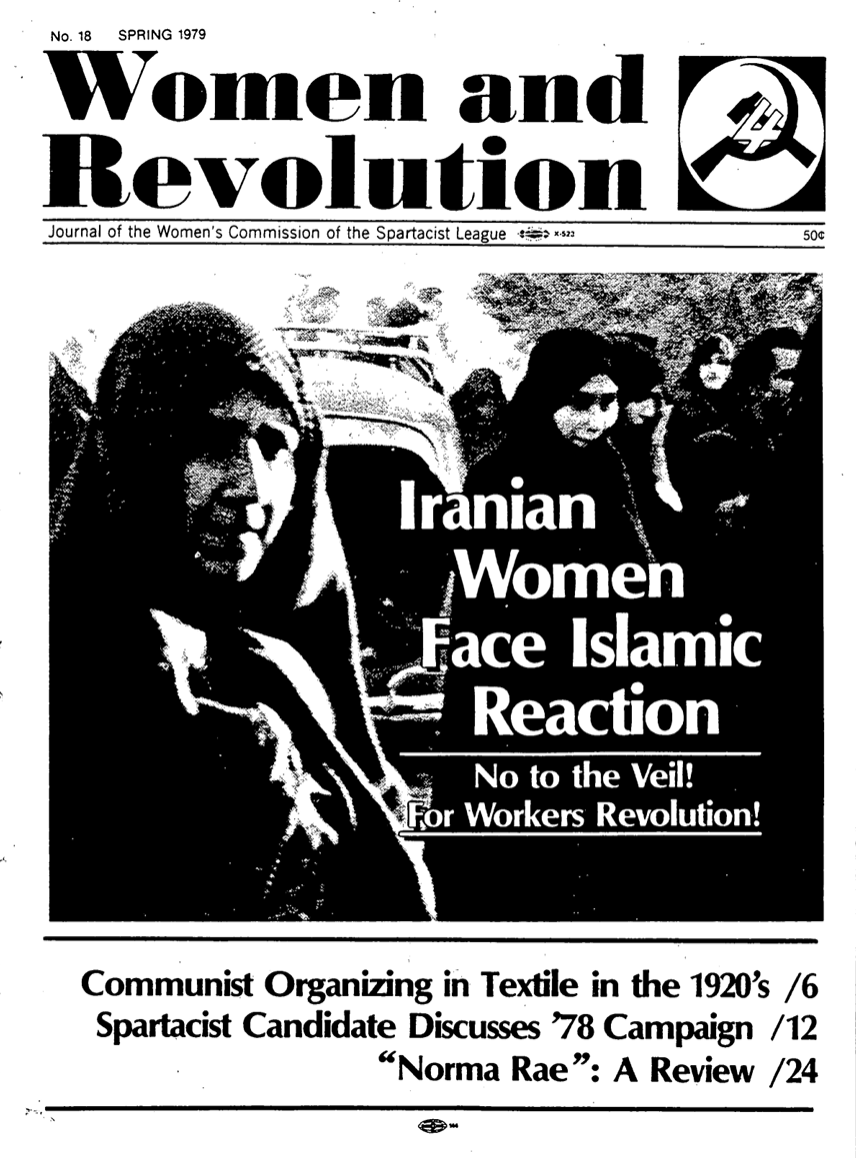
The original Spring 1979 issue of Women and Revolution, published during the first months of the Iranian Revolution. Its principal feature, “Iranian Women Face Islamic Reaction,” documents the March 1979 demonstrations by Iranian women against compulsory veiling and the emerging rollback of women's rights following the overthrow of the Shah. Combining contemporary reporting, political analysis, and photography, the issue captures the conflict between revolutionary expectations and the consolidation of clerical authority while Iran’s political future remained unsettled. Additional contents include “Communist Organizing in Textile in the 1920’s,” “Spartacist Candidate Discusses ’78 Campaign,” and “‘Norma Rae’: A Review.” Original printed self-wrappers retaining the 50¢ cover price.
Condition:
Very Good+. Original printed self-wrappers remain complete and firmly attached, with light uniform age toning, minor handling wear, and slight corner softening. No significant tears, chips, or detached leaves are observed. Interior remains clean and securely bound. Original 50¢ cover price remains present.
Story Of The Magazine
The Shah had fallen. Many believed a revolution had brought freedom to Iran. Within weeks, Iranian women were already fighting over what that freedom would mean for them.
On March 8, 1979—International Women’s Day—thousands of women demonstrated in Tehran amid mounting pressure to impose Islamic dress and growing uncertainty over women's legal and social status under the new revolutionary government.
Women and Revolution No. 18 appeared that spring. Its lead article, “Iranian Women Face Islamic Reaction,” treated the demonstrations not as a secondary dispute over clothing, but as an early test of the revolution itself.
That distinction matters because the outcome was not yet settled. Ayatollah Khomeini had returned to Iran only months earlier. The institutions of the Islamic Republic were still taking shape, and many on the international left continued to understand the revolution primarily as the overthrow of the authoritarian, U.S.-backed Shah.
This magazine argued that another form of power was already emerging—and that women were among the first to confront it publicly.
Before history made the direction of the Iranian Revolution clear, these pages preserved the warning while it was still possible to dismiss it.
Why It’s In The Collection
Women and Revolution No. 18 belongs in Consigned to Darkness because overthrowing an authoritarian government does not guarantee that what replaces it will be free.
The magazine is openly revolutionary and Marxist. That makes its criticism especially revealing. Its writers could celebrate the fall of the Shah while refusing to treat anti-imperialism as an excuse for compulsory religious conformity or the erosion of women's freedom.
And because this is the original Spring 1979 issue, its significance lies partly in timing. The writers were not looking backward at the Islamic Republic after decades of clerical rule. They were reporting and arguing while the new political order was still being constructed.
The collection deepens that story by preserving No. 19, Fall 1979, alongside it. No. 18 records the first resistance and uncertainty; No. 19 records the point at which the journal's early warning had developed into a sustained indictment of the emerging clerical state.
Together they preserve something retrospective history cannot reproduce: the distance between warning that authoritarianism may be coming and realizing that it has arrived.
Collection Categories: Women’s History & Feminism · Witness Literature · Human Rights · Political Dissent · Political Movements · Anti-Authoritarianism · Anti-Totalitarianism · Religious Conscience · Labor & Economic Justice · Free Expression · Publication-Event Object
———
Authentication Evidence
Front wrapper identifies the publication as Women and Revolution.
Front wrapper identifies the issue as No. 18 and dates it Spring 1979.
Original printed 50¢ cover price remains present.
Wrapper identifies the publication as the Journal of the Women’s Commission of the Spartacist League.
Internal masthead identifies the journal more fully as the Journal of the Spartacist League Central Committee Commission for Work Among Women.
Masthead identifies D. L. Reissner as editor and lists Helene Brosius, Helen Cantor, Liz Gordon, Elizabeth Kendall, Nancy Rossi, and Michael Weinstein on the editorial board.
Masthead identifies Spartacist Publishing Company, New York, as publisher.
Principal cover article “Iranian Women Face Islamic Reaction” begins on page 2 and corresponds to the headline and photograph advertised on the wrapper.
Running headers identify Women and Revolution · Spring 1979, confirming correspondence between wrapper and interior.
Additional advertised contents, including “Communist Organizing in Textile in the 1920’s,” “Spartacist Candidate Discusses ’78 Campaign,” and “‘Norma Rae’: A Review,” correspond to the contents of the issue.
An archival digital reproduction independently reproduces the same cover, issue designation, and principal contents.
Original typography, photographic reproduction, newsprint stock, staple-bound construction, masthead, pagination, publisher information, and issue data remain internally consistent.
No evidence of facsimile production, replacement wrappers, later reissue, or altered publication information is observed.
Observed and independently corroborated evidence supports identification as the original Women and Revolution, No. 18 · Spring 1979 · First Edition · First Printing.