
 Image 1 of 1
Why Men Rebel — Ted Robert Gurr
Ted Robert Gurr
Princeton, New Jersey: Princeton University Press, 1970
First Edition · First Printing
The Book:
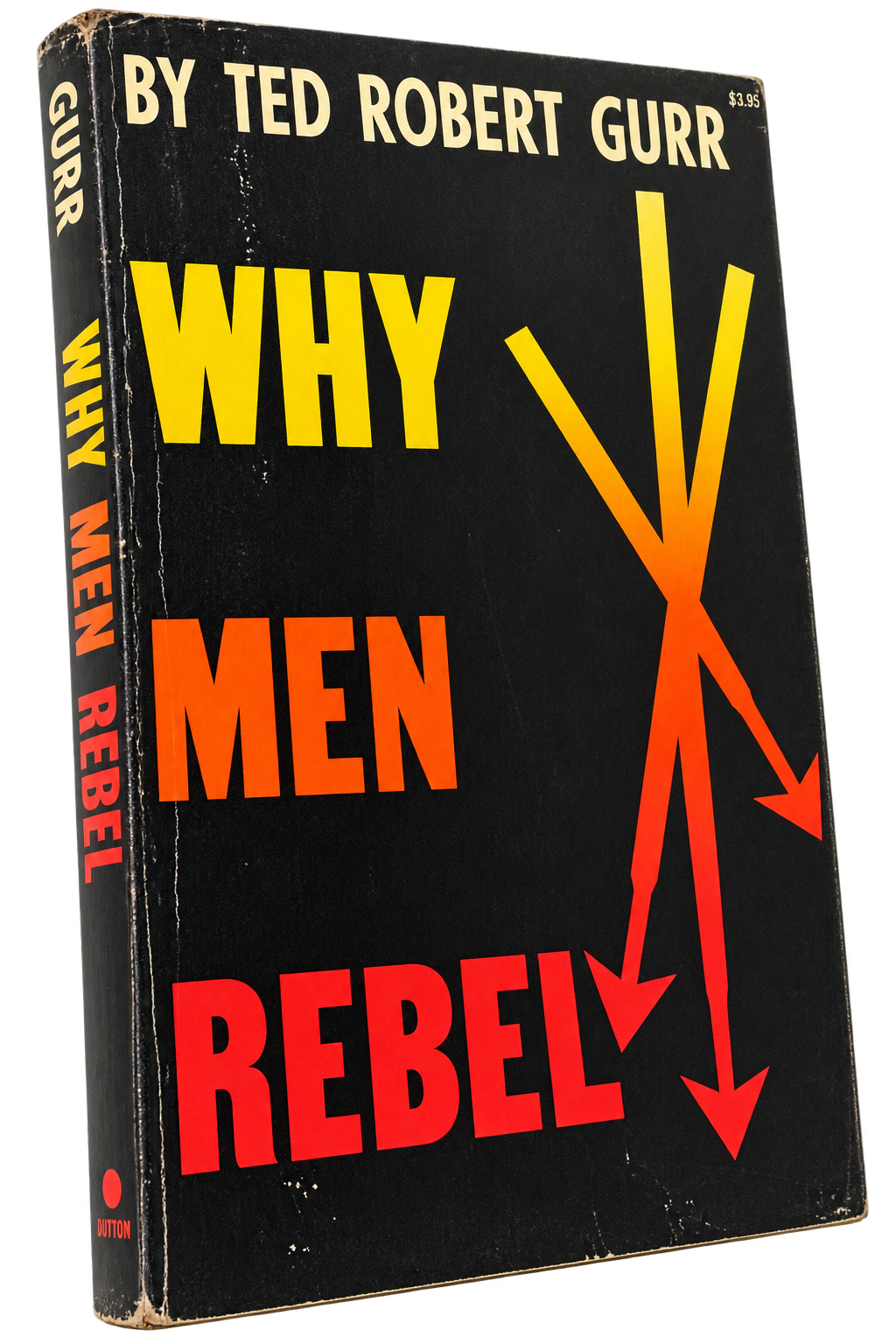
The true first edition, first printing of Ted Robert Gurr’s Why Men Rebel, one of the foundational modern studies of political violence, revolution, insurgency, and collective dissent. The title page carries the correct Princeton University Press 1970 imprint, while the copyright page bears only the original 1970 copyright with no later printing statement or revised-edition notice, consistent with the first printing. This copy retains its original publisher’s black cloth binding with orange endpapers and its original unclipped dust jacket priced at $12.50.
Condition:
Near Fine in a Very Good dust jacket. The book is exceptionally clean, with bright black cloth boards, crisp spine lettering, a tight binding, and a clean interior. Minor pencil notations appear on the rear pastedown/endpaper. The original jacket is complete, retaining its $12.50 price, with moderate edge wear, small chips at the spine ends, and light age toning to the rear panel and flaps.
Story Of The Book
Revolutions rarely begin with weapons. They begin with grievance.
Published in 1970, amid civil-rights struggle, antiwar protest, decolonization, Cold War insurgency, and widespread political upheaval, Why Men Rebel attempted to answer one of the most consequential questions in political life:
Why do people who have lived under an existing system of authority eventually decide they will no longer accept it?
Ted Robert Gurr rejected simple explanations that treated rebels either as irrational fanatics or romantic heroes. Instead, he tried to identify the conditions that make political violence more likely.
At the center of his argument was the concept of relative deprivation: the gap between what people believe they are entitled to expect from life and what they believe they are actually able to obtain.
The important word is relative.
People do not necessarily rebel because they are objectively the poorest, most oppressed, or most desperate. Rebellion can become more likely when expectations rise faster than reality—when people come to believe that something they should possess has been denied, withdrawn, or placed beyond reach.
That grievance alone does not mechanically produce revolution. But Gurr argued that accumulated frustration could create the psychological conditions from which protest, political violence, insurgency, and rebellion might emerge. The inventory identifies the book as one of the foundational modern attempts to explain precisely this passage from grievance to political violence.
The influence of that argument extended well beyond universities. Why Men Rebel became an important framework for scholars, policymakers, intelligence analysts, and governments trying to understand why political systems lose legitimacy and why some societies fracture into organized resistance.
Gurr’s question was not whether rebellion was justified. It was what has to happen before ordinary people begin to believe rebellion is possible—or necessary.
Why It’s In The Collection
Why Men Rebel occupies an unusual but important place in Consigned to Darkness.
Many objects in the collection were created inside acts of dissent or resistance. They are speeches, testimonies, revolutionary manuals, underground publications, censored books, political arguments, and firsthand accounts produced by people challenging power.
Gurr stands one step removed.
He studies the phenomenon itself.
That makes Why Men Rebel an intellectual companion to objects such as La Guerra de Guerrillas. Guevara tells the reader how an insurgency might be organized. Gurr asks why a population becomes receptive to insurgency in the first place.
The distinction is important because anti-authoritarianism cannot be understood only through the people who resist authority. It also requires understanding why authority loses legitimacy—why obedience gives way to grievance, grievance to dissent, and sometimes dissent to political violence.
This first edition preserves the original publication of Gurr’s theory of relative deprivation at the moment it entered modern political science. The inventory therefore treats the book not as documentation of one revolution, but as a foundational theoretical framework for understanding many of them.
In a collection filled with the artifacts of rebellion, Why Men Rebel asks the question that comes before almost all of them:
What makes people stop accepting the world they have been given?
Collection Categories: Political Movements · Political Philosophy · Anti-Authoritarianism · Revolution & Insurgency · Political Violence · War & Conflict · Political History
———
Authentication Evidence
• Title page identifies Ted Robert Gurr, Why Men Rebel, published by Princeton University Press, Princeton, New Jersey.
• First Edition Evidence: Title page bears the correct Princeton University Press, Princeton, New Jersey · 1970 imprint, consistent with the original first edition.
• First Printing Evidence: Copyright page carries only the original 1970 copyright with no subsequent printing statements, revised edition notice, or indication of a later impression, consistent with Princeton University Press's first-printing practice for this title.
• Copyright page carries the original 1970 copyright.
• Original unclipped dust jacket retains the correct $12.50 publisher's price.
• Original publisher's black cloth binding with orange endpapers matches the known first issue.
• No evidence of book-club manufacture, rebinding, ex-library provenance, facsimile dust jacket, or restoration observed.
• The observed bibliographic evidence is fully consistent with an authentic First Edition, First Printing.