
 Image 1 of 1
Where Do We Go from Here? — Martin Luther King, Jr.
Full Title:Where Do We Go from Here: Chaos or Community?
Martin Luther King, Jr.
New York: Harper & Row, Publishers, 1967
First Edition · First Printing
The Book:
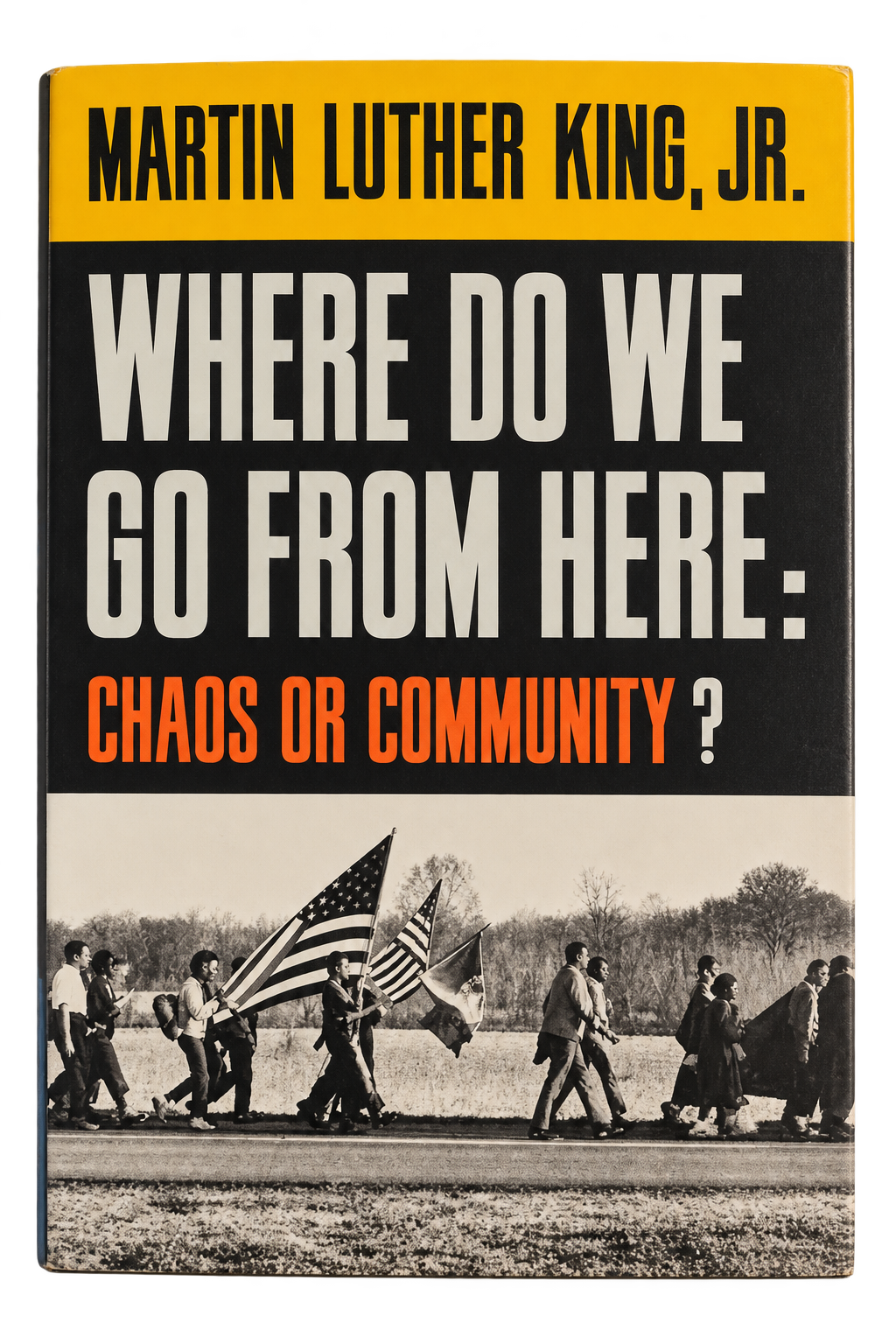
The true first edition, first printing of Martin Luther King Jr.’s Where Do We Go from Here: Chaos or Community?, his final book published during his lifetime. The copyright page explicitly states “FIRST EDITION,” with no later printing or impression indicated. This copy retains its original mustard-yellow cloth over black cloth spine, gilt spine lettering, and original unclipped first-issue dust jacket priced at $4.95. Published in 1967, less than a year before King’s assassination, the book preserves one of his final comprehensive statements on the future of the Civil Rights Movement and American democracy.
Condition:
Near Fine in a Very Good+ dust jacket. The book has a square binding, exceptionally clean boards, crisp gilt lettering, a clean interior, and only light age toning. The original jacket remains bright and well preserved, with minor edge wear and a short closed tear at the upper rear panel. It is protected in archival polyester. No ownership inscriptions, bookplates, ex-library markings, remainder marks, or restoration are documented.
Story Of The Book
The great civil-rights victories had been won. Martin Luther King Jr. was worried that victory would not be enough.
By 1967, the Civil Rights Movement had achieved changes that had seemed nearly impossible only a decade earlier. Segregation had been directly challenged, and landmark federal legislation had transformed the legal architecture of American racial discrimination. King had received the Nobel Peace Prize and become the most internationally recognizable leader of the movement.
Yet Where Do We Go from Here is not a victory lap. King looked beyond the dismantling of explicitly discriminatory laws and confronted the harder question of what genuine equality would require afterward. Poverty, economic inequality, racism, militarism, political resentment, and persistent social division could not be solved merely by removing legal barriers. In King’s argument, America faced a choice between building a deeper form of democratic community or allowing unresolved injustice to produce alienation, anger, and violence.
That makes the timing of this first edition particularly powerful. King was not yet a martyr whose words could be safely commemorated after death. He was a living political dissenter pressing the country beyond reforms it had already accepted and toward economic and social demands that were considerably more difficult. Published less than a year before his assassination, the book captures a leader who understood that the next phase of the struggle might prove harder than the one that had produced its most celebrated victories.
King’s question was no longer simply whether America would abolish segregation. It was whether America was willing to build the kind of society in which equality could actually be lived.
Why It’s In The Collection
Where Do We Go from Here is one of the defining Civil Rights objects in Consigned to Darkness because it preserves Martin Luther King Jr. not as history remembers him, but as he was still confronting power.
This distinction matters. King’s assassination in April 1968 transformed him into a national symbol, and later remembrance has often concentrated on the victories and language that became most universally celebrated. This first printing predates that transformation. It preserves King during his lifetime, arguing that legal equality represented the beginning rather than the completion of the struggle and insisting that American democracy still had to confront poverty, racism, economic injustice, militarism, and the limits of its own commitment to equality.
For the collection, it also provides an important complement to Letter from Birmingham City Jail. The earlier text belongs to the struggle against an openly discriminatory legal order. Where Do We Go from Here asks what happens after some of those laws have been defeated—when injustice becomes harder to isolate, resistance becomes more politically complicated, and the movement must decide what freedom actually requires.
The physical copy strengthens that significance. This is the true first edition and first printing, issued during King’s lifetime, retaining its original unclipped $4.95 jacket. It is therefore not a later memorialization of King’s final political philosophy but the original publication object through which that philosophy entered the world. The inventory appropriately identifies it as King’s final book published during his lifetime and one of the essential printed statements of the American Civil Rights Movement.
King had helped America change its laws. His final book asked whether Americans were prepared to change the society those laws governed.
Collection Categories: Civil Rights · Free Expression · Political Dissent · Human Rights · Anti-Authoritarianism
———
Authentication Evidence
• Title page identifies Where Do We Go from Here: Chaos or Community? by Martin Luther King, Jr., published by Harper & Row, Publishers, New York, Evanston, and London.
• First Edition Evidence: Copyright page explicitly states "FIRST EDITION."
• First Printing Evidence: Copyright page bears the original 1967 copyright with First Edition statement and no later printing or impression indicated, consistent with Harper & Row's first-printing practice for this title.
• Original unclipped dust jacket retains the correct $4.95 publisher's price.
• Jacket design, author photograph, and publisher's binding match known first-issue examples.
• No evidence of book-club manufacture, rebinding, ex-library provenance, remainder marking, or facsimile dust jacket observed.
• The observed bibliographic evidence is fully consistent with an authentic First Edition, First Printing.