
 Image 1 of 1
Warszawskie Getto: 1943–1988 — Ruta Sakowska et al.
Full Title: Warszawskie Getto: 1943–1988. W 45 Rocznicę Powstania
English Title: Warsaw Ghetto: 1943–1988. On the 45th Anniversary of the Uprising
Ruta Sakowska et al.
Scientific consultation by Tomasz Szarota
Wydawnictwo Interpress · Warszawa · 1988
First Edition · First Printing
The Book:
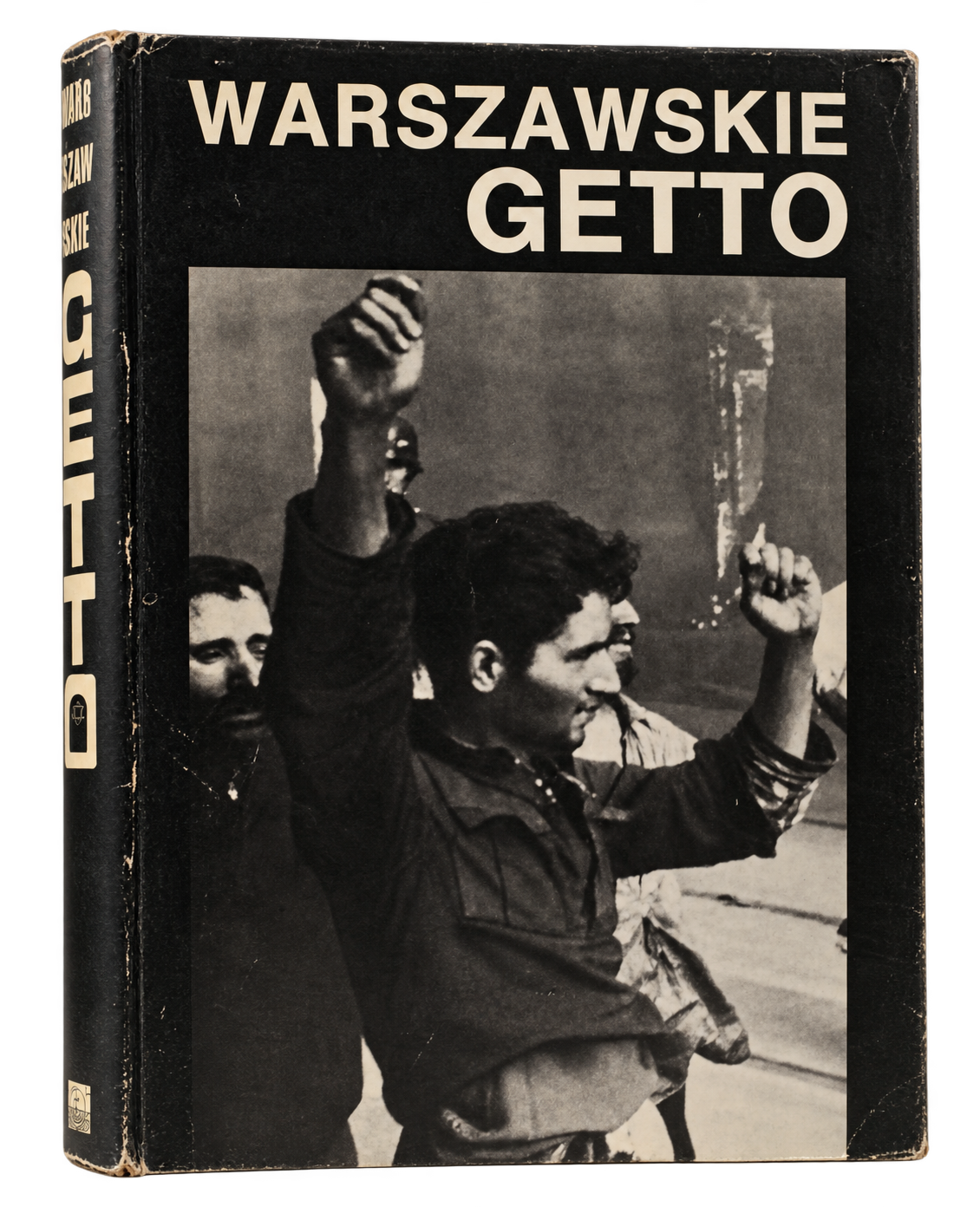
The first edition, first printing of this large-format Polish commemoration of the forty-fifth anniversary of the Warsaw Ghetto Uprising. With texts by Ruta Sakowska and other contributors, the volume combines historical writing with an extensive documentary record of photographs, illustrations, and archival material. 79, [2] pp., [206] pages of plates, 2 plans; 29 cm. Original black publisher’s boards in the original illustrated dust jacket. ISBN 83-223-2465-0.
Condition:
Near Fine book in a Very Good dust jacket. Clean, square, and tightly bound, with a bright interior. Jacket with moderate rubbing and scratching, edge wear, and several small chips at the spine ends and corners. Former institutional date stamp “29 IV 1992” on the front free endpaper. A separately published English-language version, sometimes found accompanying the Polish volume, is not present. Presence of the two plans recorded in the bibliographic collation has not yet been physically verified.
Story Of The Book
The Warsaw Ghetto Uprising lasted only weeks. Forty-five years later, Poland was still deciding how it would be remembered.
In April 1943, Jewish resistance organizations fought German forces attempting to complete the destruction of the Warsaw Ghetto. The uprising could not defeat the occupying forces, but it became an enduring symbol of resistance to Nazi persecution and extermination.
Published in 1988, Warszawskie Getto returned to that history through photographs, documents, art, and historical interpretation.
But 1988 matters almost as much to this object as 1943. The book appeared during the final years of Communist Poland, when public memory of the Holocaust—and particularly its Jewish history—had developed within a state that shaped how the wartime past was presented.
Within a year, that political order would begin to give way.
The book therefore preserves not only the memory of the uprising, but a particular moment in Poland’s history of remembering it.
Why It’s In The Collection
Warszawskie Getto belongs in Consigned to Darkness because the history of resistance includes the struggle over whether resistance will be remembered.
This is not contemporaneous testimony from 1943. It is a commemorative publication created forty-five years later, assembling historical evidence into a public record of Jewish persecution and resistance.
Its contributors connect that act of remembrance directly to the history it preserves. They include Warsaw Ghetto historian Ruta Sakowska, uprising survivor Marek Edelman, and wartime courier Jan Karski.
That makes the first edition a document of two moments:
1943 is the history it remembers.
1988 is the history of remembrance it preserves.
Collection Categories: Holocaust & Genocide · Human Rights · Anti-Authoritarianism · War & Conflict · Publication-Event Object
———
Authentication Evidence
Title page identifies Warszawskie Getto: 1943–1988. W 45 Rocznicę Powstania.
Publication information identifies Wydawnictwo Interpress, Warszawa, 1988.
ISBN 83-223-2465-0 corresponds to the documented Polish-language edition.
Texts are credited to Ruta Sakowska and other contributors, with scientific consultation by Tomasz Szarota.
Bibliographic collation is 79, [2] pp., [206] pages of plates, 2 plans; 29 cm.
Original black publisher’s boards and illustrated dust jacket are present.
No later-printing or subsequent-edition designation is observed.
A separately published English-language edition is not present with this copy.
Presence of the two plans recorded in the bibliographic collation has not yet been physically verified; complete collation is therefore not claimed.
No evidence of facsimile production, rebinding, replacement leaves, or restoration is observed.
Observed bibliographic and physical characteristics support identification as the 1988 First Edition · First Printing.