
 Image 1 of 1
Ulysses — James Joyce
James Joyce
New York: Random House, 1934
First American Edition · First Printing
The Book:
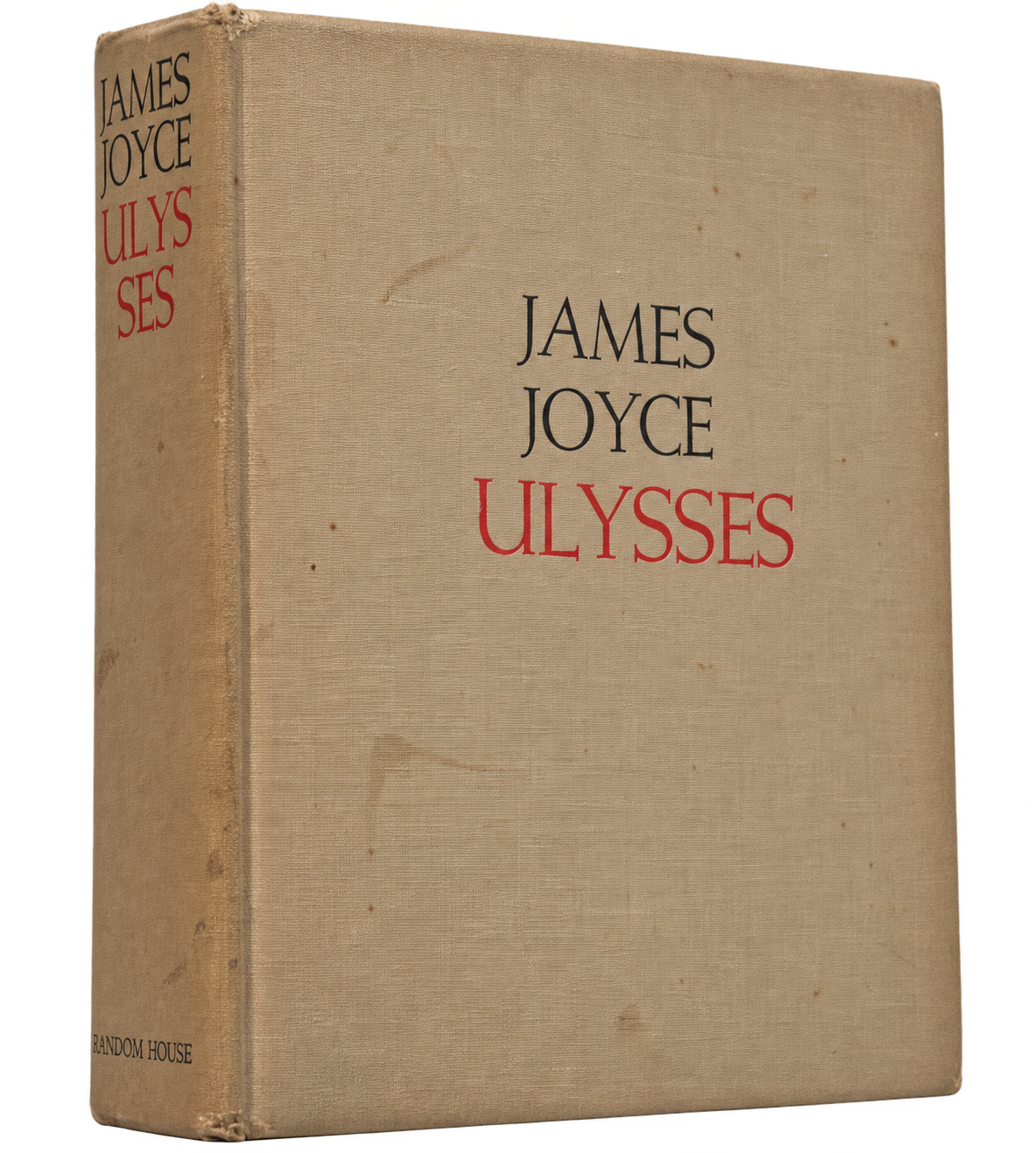
The true first American edition, first printing of James Joyce’s Ulysses, published by Random House in 1934. The copyright page explicitly states “FIRST AMERICAN EDITION, PUBLISHED BY RANDOM HOUSE, NEW YORK, 1934,” with no indication of later printings or subsequent impressions. The copy retains its original cream cloth binding stamped in black and red, designed by Ernst Reichl. The original dust jacket is no longer present.
Condition:
Very Good. The binding remains square and structurally sound, with moderate soiling and scattered foxing to the cream cloth and light rubbing at the extremities. The interior is clean with light, expected age toning. No ownership inscriptions, bookplates, ex-library markings, rebinding, or restoration are documented.
Story Of The Book
For years, Americans could read about Ulysses. They could not legally buy it.
James Joyce’s novel had already transformed modern literature by the time Random House published this edition in 1934. But in the United States, its reputation had been shaped as much by censorship as by literary innovation. Earlier attempts to circulate the work had run into obscenity law, making Ulysses not merely a difficult novel but a prohibited one.
That changed with Judge John M. Woolsey’s landmark federal decision permitting the book’s legal publication in the United States. Random House’s 1934 edition was the physical consequence of that victory: the moment a work that had effectively existed as contraband entered ordinary American commercial publication. The inventory therefore treats this copy not simply as an important modernist first, but as one of the collection’s defining publication-event objects.
That distinction is central to why this edition matters. The earlier Paris editions preserve the novel’s original publication history. This first American edition preserves something different: the moment American censorship failed to keep the book outside the legal marketplace.
The significance of this copy is not simply that Americans could finally read Ulysses. It is that the law had finally lost the power to stop them from buying it.
Why It’s In The Collection
Ulysses belongs in Consigned to Darkness because this edition preserves one of the clearest examples of a court decision directly changing what literature could legally circulate.
The collection acquired the 1934 Random House first American edition specifically for that reason. Rather than functioning merely as a celebrated literary object, it documents the expansion of free expression through the courts: a prohibited novel becoming a lawful commercial book as the result of a landmark legal challenge.
That makes the object especially powerful within the collection’s broader censorship holdings. Some books here record suppression while it is occurring. Others record publishers resisting it. Ulysses records the next stage: the moment censorship was defeated and the newly protected work physically entered the market.
The missing dust jacket limits the copy’s conventional collector appeal, but it does not diminish the central historical fact preserved by the book itself. Underneath the absent jacket remains the authentic first American printing—the edition through which one of the twentieth century’s most important novels became legally available in the United States.
For nearly a generation, American law treated Ulysses as something readers should not have. This is the edition that marks the moment they finally could.
Collection Categories: Free Expression · Censorship · Literature · Anti-Authoritarianism · Modernism · Obscenity Law & Court History
———
Authentication Evidence
• Title page identifies James Joyce, Ulysses, published by Random House, New York.
• First Edition Evidence: Copyright page states "FIRST AMERICAN EDITION, PUBLISHED BY RANDOM HOUSE, NEW YORK, 1934," the definitive first-edition statement for the Random House issue.
• First Printing Evidence: The copyright page bears the original first American edition statement with no indication of later printings or subsequent impressions, consistent with the true first printing.
• Copyright page carries the original 1934 Random House copyright alongside the earlier serial copyrights held by Margaret Caroline Anderson.
• Original publisher's cream cloth binding with black and red lettering matches the known first American issue designed by Ernst Reichl.
• No evidence of rebinding, book-club manufacture, ex-library provenance, or facsimile production observed.
• The observed bibliographic evidence is fully consistent with an authentic First American Edition, First Printing.