
 Image 1 of 1
Tropic of Capricorn — Henry Miller
Henry Miller
The Obelisk Press · Paris · 1939
First Edition · First Printing
The Book:
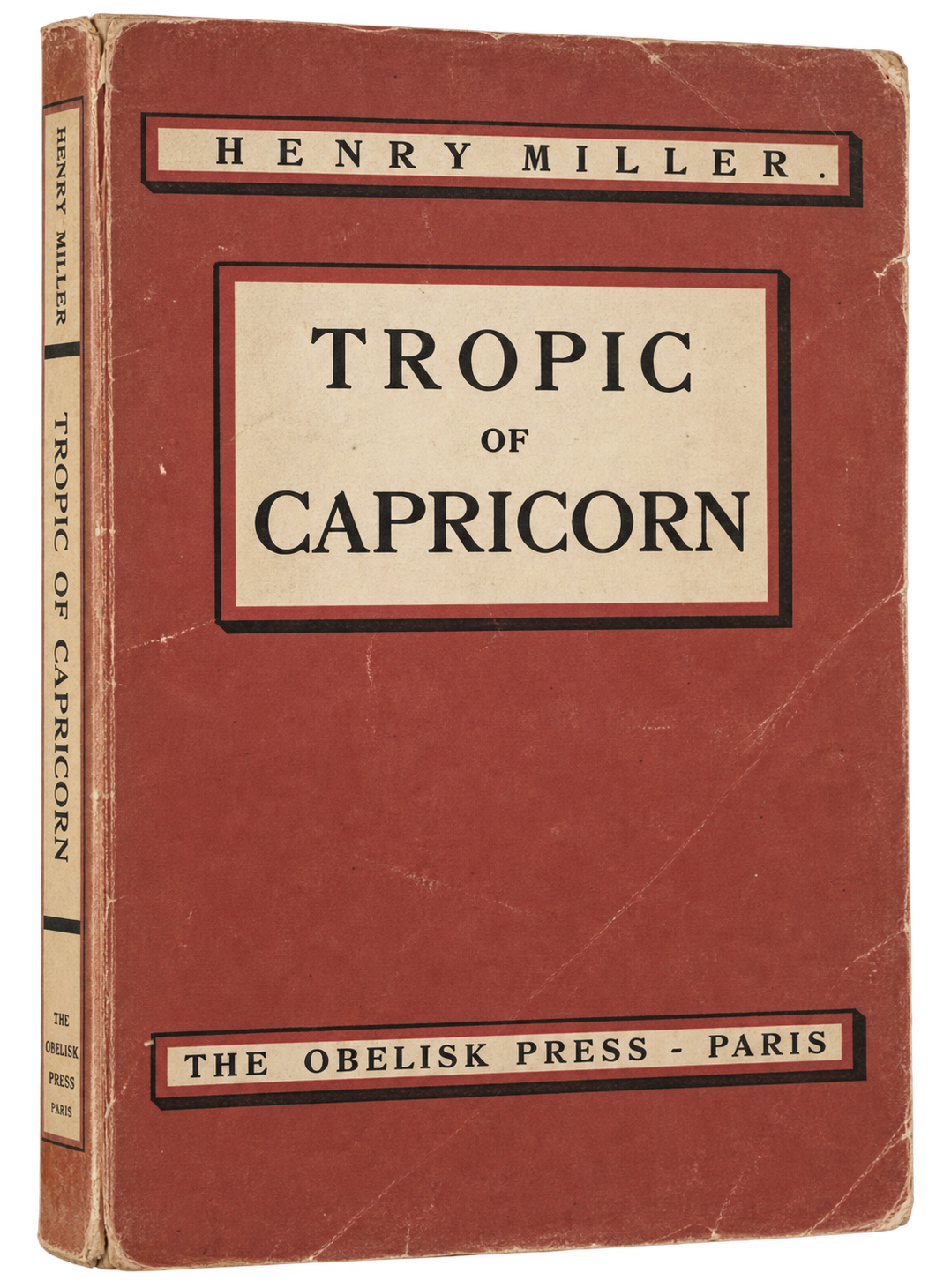
The first edition, first printing of Henry Miller’s Tropic of Capricorn, published in Paris by The Obelisk Press in 1939. This copy remains in its original publisher’s printed paper wrappers with the original spine substantially preserved and retains the original tipped-in yellow errata slip found in first-printing copies.
The title page identifies The Obelisk Press at 16 Place Vendôme, Paris, and is dated 1939. The final printed page is dated September 1938 at Villa Seurat, Paris, with the Société Industrielle d’Imprimerie printer’s imprint.
Condition:
Very Good. The original wrappers and spine remain substantially intact, with age-appropriate rubbing, creasing, edge wear, small chips at the spine ends, and localized paper loss to the lower rear wrapper. The interior is complete with moderate age toning and a previous owner’s signature on the preliminary blank leaf. One gathering near the rear has begun to separate at the sewing but remains attached and complete. The wrappers are now protected in removable archival Mylar. No restoration or rebinding is observed.
Story Of The Book
America tried to ban Henry Miller for what he wrote. France published him anyway.
Completed while Miller was living in Paris, Tropic of Capricorn followed Tropic of Cancer as his second major expatriate novel. Drawing on his earlier life in New York, Miller attacked conventional morality, respectable society, work, sexuality, and the assumptions governing what serious literature was permitted to say.
For American readers, however, the issue was not merely literary taste. Miller’s sexually explicit work remained effectively excluded from legitimate publication in the United States, forcing his books into expatriate, imported, and underground channels. The Obelisk Press gave him the publishing freedom that American institutions would not.
That history makes this 1939 first printing fundamentally different from the later Grove editions that eventually became part of the American obscenity battles. This is the novel before legal vindication—before American courts, publishers, and booksellers transformed Miller into a test case for literary freedom.
The censorship story did not begin when America finally published Miller. It began while America was still refusing to.
Why It’s In The Collection
Tropic of Capricorn belongs in Consigned to Darkness because this copy is the original publication-event object itself.
It preserves the novel at the moment when Miller’s work could be published openly in Paris but not legitimately in the United States. The circumstances of its publication therefore embody the censorship history that later made Miller central to twentieth-century debates over obscenity and freedom of expression.
That also gives this copy a particularly strong relationship to the collection’s 1961 Grove Press Tropic of Cancer. The Grove edition records the later American confrontation with censorship; this Obelisk Press first records the earlier world in which an American writer had to publish abroad to reach readers at all.
Later editions tell the story of Miller’s eventual legal acceptance. This one comes from the period when acceptance was still unimaginable.
Collection Categories: Free Expression · Censorship · Literature · Publication-Event Object · Sexual Expression & Obscenity · Legal History · Obscenity Law & Court History
———
Authentication Evidence
Correct title page identifies Tropic of Capricorn by Henry Miller as published by The Obelisk Press, 16 Place Vendôme, Paris.
Title page is dated 1939, consistent with the original publication.
Original publisher’s printed paper wrappers are present and match the characteristic Obelisk Press first-edition design.
Original spine is substantially preserved and remains integral to the publisher’s wrappers.
Original yellow errata slip is present before the title page, consistent with documented first-printing copies.
Final printed page is dated September 1938 at Villa Seurat, Paris, with the Société Industrielle d’Imprimerie printer’s imprint.
Text block, typography, paper stock, and wrapper construction are internally consistent with an original Obelisk Press copy of this edition.
No evidence of rebinding, facsimile wrappers, modern reproduction, or replacement components is observed.
The 1939 Obelisk Press title page, Paris imprint, original publisher’s wrappers, printer’s imprint, and tipped-in errata slip support identification as the first edition, first printing.
No “60 FRS” price is presently discernible on the surviving original spine; accordingly, the 60-franc first-issue state is not claimed for this copy.
Observable bibliographic evidence supports identification as the 1939 Obelisk Press first edition, first printing, with issue state unconfirmed.