
 Image 1 of 1
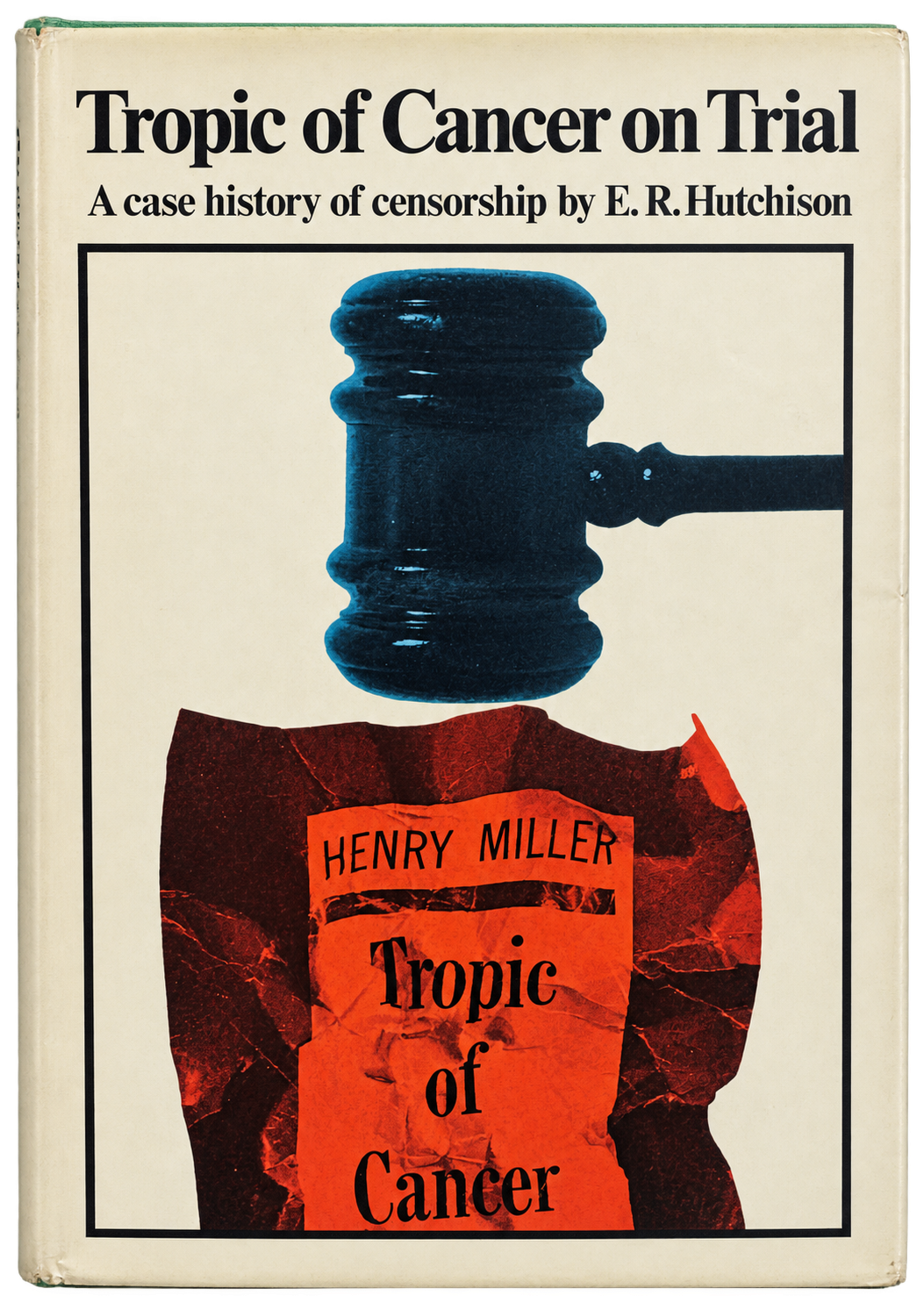
Tropic of Cancer on Trial — E. R. Hutchison
Full Title:Tropic of Cancer on Trial: A Case History of Censorship
E. R. Hutchison
New York: Grove Press, Inc., 1968
First Edition · First Printing
The Book:
The true first edition, first printing of E. R. Hutchison’s Tropic of Cancer on Trial: A Case History of Censorship, Grove Press’s contemporary account of the legal battles surrounding Henry Miller’s Tropic of Cancer. The copyright page explicitly states “First Printing.” This copy retains its original green publisher’s cloth with gilt spine lettering and its original unclipped pictorial dust jacket priced at $6.50, with the correct GP-437 designation. No evidence of book-club manufacture, remainder marking, rebinding, or restoration is present.
Condition:
Near Fine in a Near Fine dust jacket. The book is square and clean, with bright cloth, a clean text block, and only minimal shelf wear. The original jacket shows light age toning and trivial edge wear, with no significant tears or losses. No ownership inscriptions or restoration are documented.
Story Of The Book
Some books become court cases. Very few court cases change what books are allowed to exist.
When Grove Press published Henry Miller’s Tropic of Cancer in the United States in 1961, it knowingly reopened a censorship fight that had kept the novel out of legal American publication for nearly three decades.
The consequences were immediate. Obscenity prosecutions and legal challenges spread across the country, forcing judges to confront a question that reached far beyond Miller’s novel:
Could a serious literary work be suppressed because its sexual language offended prevailing standards?
Tropic of Cancer on Trial preserves that battle.
Published by Grove Press in 1968, Hutchison’s account draws upon court records, judicial opinions, interviews, and contemporary commentary to reconstruct the litigation surrounding the novel and the broader transformation of American obscenity law.
That makes this book more than a retrospective history. It was published by the same press that had taken the original risk. Grove Press first put Tropic of Cancer into American circulation. Then, after years of litigation, it published the documentary history of the fight that followed. The two books therefore perform different historical functions.
The 1961 Tropic of Cancer is the publication-event object. This 1968 volume is the case record. One challenged the law. The other preserved the arguments, rulings, and conflict through which the law changed. The novel forced the constitutional question. This book preserves the answer.
Why It’s In The Collection
Tropic of Cancer on Trial belongs in Consigned to Darkness because censorship history is not complete if we preserve only the censored book.
We also need the struggle over it.
That is why the collection treats this volume as the companion to its 1961 Grove Press first American edition of Tropic of Cancer. Together they form The Tropic of Cancer Set. The pairing is deliberate. The first book preserves the moment Grove Press challenged American obscenity law by publishing Miller’s novel. The second preserves the legal history that followed—the prosecutions, arguments, judicial reasoning, and eventual constitutional protection that transformed the book from contraband into protected literature. Either volume alone tells part of the story. Together they preserve the act and the consequence.
That makes Tropic of Cancer on Trial especially valuable to a collection concerned with publication events. It shows that free expression is not secured merely when someone prints a forbidden book. Sometimes the real historical consequence comes afterward, in the years of litigation required to establish whether the state can suppress it.
The inventory accordingly treats the set as more complete than either component alone: one preserves the publication that provoked the censorship battle, while the other preserves the contemporary record of how that battle reshaped constitutional protection for literary expression.
Grove Press published the book the law said Americans should not read. Then it published the history of the fight that proved they could.
Collection Categories: Free Expression · Censorship · Publication-Event Object · Literature · Curated Set Component · Obscenity Law & Court History
———
Authentication Evidence
• Correct Grove Press title page, confirming first edition.
• Copyright page explicitly states "First Printing," confirming first printing.
• Copyright page bears the 1968 Grove Press copyright consistent with first publication.
• Original publisher's green cloth binding present.
• Original unclipped dust jacket present.
• Dust jacket retains the correct $6.50 price.
• Dust jacket carries the correct GP-437 designation.
• Grove Press imprint, typography, and binding consistent throughout.
• No evidence of book-club manufacture, remainder markings, or later rebinding observed.
• First edition, first printing characteristics consistent throughout.