
 Image 1 of 1
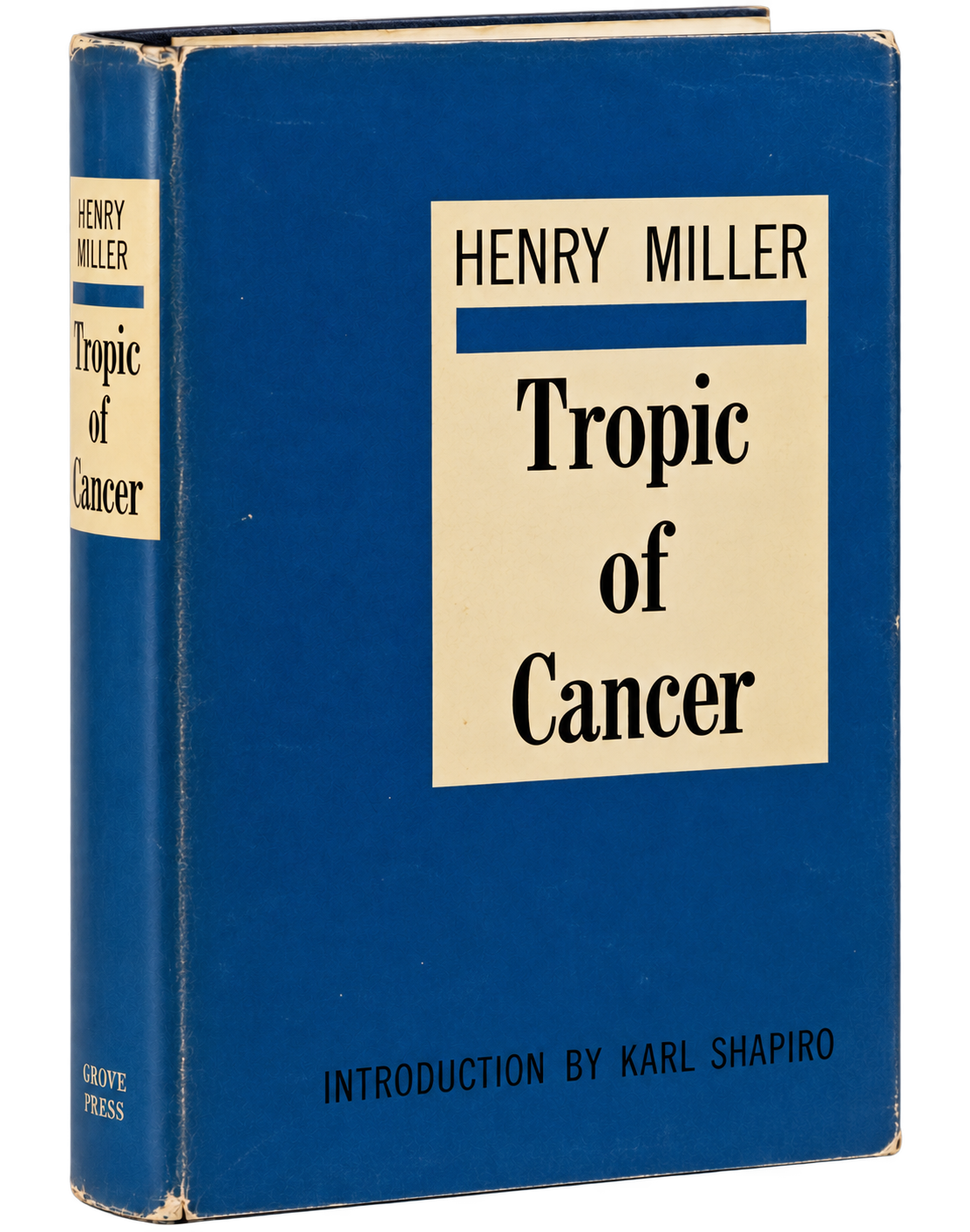
Tropic of Cancer — Henry Miller
Henry Miller
Grove Press, Inc. · New York · 1961
First US Edition · First Printing
The Book:
The first US edition, first printing of Henry Miller’s Tropic of Cancer, published by Grove Press in 1961—twenty-seven years after the novel’s original 1934 publication in Paris. The copyright page states “First Printing,” and this copy retains its original cloth-backed boards and original unclipped $7.50 dust jacket.
The jacket is the correct first issue, without Roman numerals on the rear panel or letter/number codes on the spine. Those points distinguish the earliest jacket state accompanying Grove’s first American trade printing.
Condition:
Very Good+ in a Very Good original dust jacket. The book remains square and sound, with the original binding and topstain intact. The unclipped $7.50 first-issue jacket shows moderate rubbing, edge wear, and age-related handling but remains complete and presents well.
Story Of The Book
For twenty-seven years, Americans could read Tropic of Cancer only by getting around the law.
Henry Miller first published the novel in Paris in 1934, where its sexually explicit language and rejection of conventional literary morality immediately made American publication effectively impossible. Copies nevertheless entered the United States privately and clandestinely, turning Miller’s novel into contraband long before most Americans could legally buy it.
In 1961, Barney Rosset and Grove Press decided to force the issue. Grove published the complete, unexpurgated novel in the United States and openly invited the confrontation that followed. The reaction was immediate. Booksellers were arrested, copies were seized, and obscenity prosecutions erupted around the country. Grove’s own contemporary press releases document the campaign almost in real time: publication on May 15, a Boston ban by July, and the federal government abandoning its case against the book in August.
The fight continued through dozens of cases until the Supreme Court’s 1964 decision in Grove Press, Inc. v. Gerstein, applying the Court’s evolving obscenity doctrine to overturn a Florida judgment against the novel. What had entered America as forbidden literature became part of the legal transformation of what American publishers and readers were permitted to print, sell, and read.
Grove did not wait for the law to change before publishing Tropic of Cancer. Publishing it helped force the law to change.
Why It’s In The Collection
Tropic of Cancer is one of the clearest publication-event objects in Consigned to Darkness.
The significance of this copy is not simply that it contains a historically censored novel. This is the edition that triggered the American confrontation. Grove knowingly published a book that had been kept out of legitimate American commerce for nearly three decades, then defended its publication as booksellers, prosecutors, judges, and ultimately the Supreme Court fought over whether it could legally circulate.
That makes the 1961 first American printing fundamentally different from a later edition commemorating a censorship victory. When this copy was printed, there was no settled victory. Grove was putting the disputed work into circulation and accepting the legal consequences of doing so. Contemporary reporting from May 1961 records readers rushing to purchase copies precisely because further legal action was anticipated.
The object therefore preserves the moment censorship stopped being merely part of Tropic of Cancer’s history and became a battle over its American future.
For twenty-seven years, America kept Miller’s book outside the law. This is the edition that walked through the door anyway.
Collection Categories: Free Expression · Censorship · Literature · Publication-Event Object · Sexual Expression & Obscenity · Legal History · Obscenity Law & Court History
———
Authentication Evidence
Copyright page states “First Printing,” directly confirming first-printing status.
Title page identifies Grove Press, Inc., New York, consistent with the 1961 first American trade edition.
Original trade-issue publisher’s binding is present.
Original blue topstain is present.
Original dust jacket is retained.
Dust jacket retains the original $7.50 price on the front flap.
Dust jacket lacks Roman numerals on the rear panel, consistent with the first issue.
Dust jacket lacks letter/number codes on the spine, consistent with the first issue.
Introduction by Karl Shapiro and preface by Anaïs Nin are present, consistent with the first American edition.
Collation of xxxiii, 318 pages is consistent with documented first-printing copies.
No book-club binding characteristics are observed.
Copy is the regular trade issue and not one of Grove Press's 100 numbered signed copies.
Observable bibliographic evidence supports identification as the first American trade edition, first printing, in the first-issue dust jacket.