
 Image 1 of 1
Touch and Go — D. H. Lawrence
Full Title:Touch and Go: A Play in Three Acts
D. H. Lawrence
London: C. W. Daniel, Ltd., 1920
First Edition · First Printing
The Book:
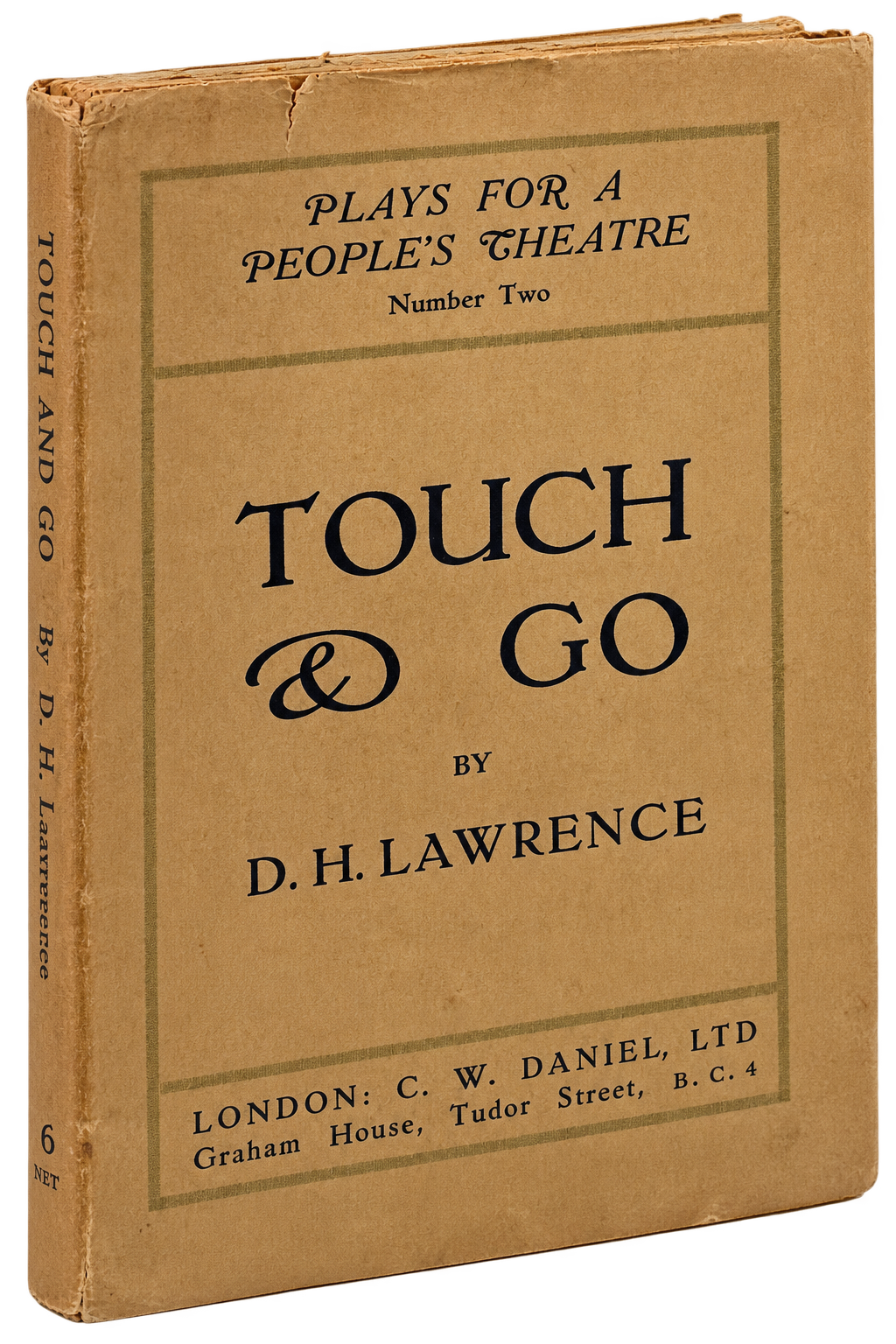
The true first edition, first printing of D. H. Lawrence’s Touch and Go: A Play in Three Acts, published in London by C. W. Daniel in 1920 during Lawrence’s lifetime. The title page carries the correct 1920 date and publisher’s imprint, while the facing copyright leaf bears the contemporary United States copyright and performing-rights notice. This copy retains its original stiff orange card/paper binding with blue printed paper title label and, importantly, its original publisher’s dust jacket, which advertises contemporary titles in the Plays for a People’s Theatre series. Bibliographically identified as Roberts A14a, the C. W. Daniel issue is the true first edition; the separately published Thomas Seltzer edition of 1920 is the First American Edition.
Condition:
Near Fine in a Good+ dust jacket. The book itself is unusually well preserved, with a square, tight binding, clean interior, and only light, uniform age toning and handling wear. The original jacket remains substantially complete with both principal panels and spine present, but shows moderate edge wear, rubbing, scattered chipping, and small areas of paper loss concentrated at the spine ends and extremities. It is protected in an archival polyester jacket. An old pencil price notation appears on the rear pastedown but establishes no significant ownership provenance.
Story Of The Book
D. H. Lawrence turned the stage into a battleground between labor and capital.
Published in the turbulent aftermath of the First World War, Touch and Go confronts one of the defining social conflicts of industrial Britain: the struggle between workers and the people who owned the industries upon which their lives depended. Rather than treating class conflict as an abstract political argument, Lawrence places competing ideas about labor, ownership, economic inequality, and social responsibility into the lives of people forced to coexist within the same industrial system.
The play belongs to the progressive Plays for a People’s Theatre series, an important context for understanding the physical book. This was socially engaged drama intended not simply as private literary reading but as material for a public theatrical culture in which contemporary political and economic questions could be argued before an audience. The inexpensive format helped place those arguments outside the conventional prestige world of literary publishing.
Lawrence refuses to make the conflict comfortable. Workers have legitimate grievances; industrial power produces genuine inequality; yet anger and ideological certainty do not automatically produce justice. The play is interested in what happens when distrust becomes mutual and social groups begin seeing one another primarily as representatives of opposing systems rather than as individuals.
That makes Touch and Go less a manifesto than an argument about the human consequences of economic conflict. Lawrence uses drama to ask whether a society divided between labor and capital can resolve its grievances without allowing class identity to consume the people trapped inside it.
The question is not simply who possesses economic power. It is what prolonged conflict over that power does to everyone involved.
Why It’s In The Collection
Touch and Go belongs in Consigned to Darkness because the collection’s treatment of authority includes economic as well as governmental power.
Many objects here document individuals confronting states, censors, prisons, police, and political movements. Lawrence examines another structure capable of determining the conditions of ordinary life: industrial ownership. The play asks what obligations accompany economic power and what happens when workers conclude that the institutions governing their livelihoods no longer deserve their trust.
Its 1920 first edition, first printing makes that story considerably stronger. This is not a later literary recovery of Lawrence’s politics. It is a lifetime publication produced amid the postwar labor tensions that gave its arguments contemporary urgency, and its inclusion in the Plays for a People’s Theatre series places the physical object within an effort to use drama as a forum for public engagement with social questions.
The original dust jacket adds unusual value to the object as a historical publication. Its advertisements preserve the book’s relationship to the broader theatrical series rather than leaving only the underlying Lawrence text. Survival of this fragile jacket is one of the copy’s principal bibliographic advantages.
This is not one of the collection’s most direct anti-authoritarian objects, which is why its Supporting status makes sense. But it expands the collection in a useful direction by documenting an early twentieth-century attempt to make questions of labor, class, economic inequality, and institutional power subjects for public art.
Political power governs through laws. Economic power can govern through the conditions under which people are allowed to live and work. Lawrence put that power onstage.
Collection Categories: Literature · Labor & Economic Justice · Political Dissent · Socialism & Labor Movements · Anti-Authoritarianism
———
Authentication Evidence
• Correct title page observed directly, identifying Touch and Go: A Play in Three Acts by D. H. Lawrence.
• Title page bears the C. W. Daniel, Ltd. London imprint and the publication date 1920.
• Publisher address given as Graham House, Tudor Street, E.C.4, consistent with the original C. W. Daniel issue.
• Facing copyright leaf states “Copyright in the United States of America.”
• Facing copyright leaf carries the contemporary performing-rights notice naming Lawrence’s sole agent, R. Golding Bright of 20 Green Street, Leicester Square, London.
• Original stiff orange card/paper boards present.
• Original blue printed paper title label to the front board present and consistent with documented first-edition copies.
• Original publisher’s dust jacket present.
• No later-printing statement observed.
• Physical and bibliographic characteristics conform to the C. W. Daniel first edition, first printing identified bibliographically as Roberts A14a.
• The separately published Thomas Seltzer, New York, 1920 issue is identified bibliographically as the First American Edition.
• No evidence of later issue, book-club manufacture, rebinding, substituted leaves, facsimile components, or ex-library provenance observed.