
 Image 1 of 1
Time of Silence — Luis Martín-Santos
Luis Martín-Santos
Harcourt, Brace & World, Inc. · New York · 1964
First American Edition · First Printing · First English-Language Edition
The Book:
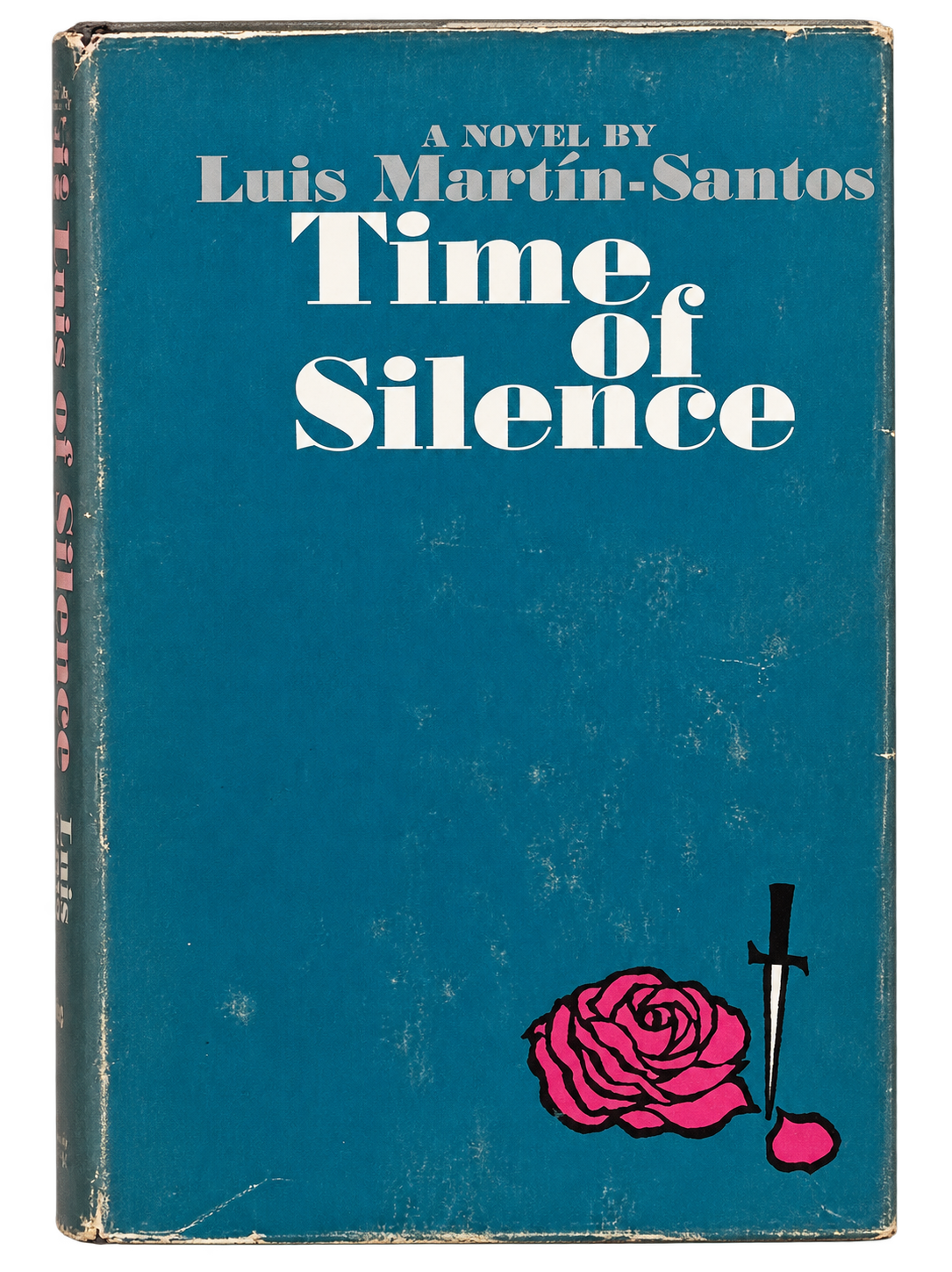
The first American edition, first printing—and first English-language edition—of Luis Martín-Santos’s Time of Silence, published by Harcourt, Brace & World in 1964 as a Helen and Kurt Wolff Book. Translated by George Leeson from Tiempo de Silencio, first published in Spain by Seix Barral in 1962, this copy retains its original blue publisher’s cloth and original unclipped $4.50 dust jacket.
The copyright page explicitly states “First American edition 1964,” with no later-printing designation present. This edition brought Martín-Santos’s landmark novel of Franco-era Spain into English for the first time.
Condition:
Near Fine in a Very Good original dust jacket. The book is clean, square, and tight, with bright silver spine lettering and an unmarked interior. The original unclipped $4.50 jacket remains complete, showing moderate rubbing, light soiling, and minor chipping at the spine head and corners, and is now protected in a modern archival sleeve.
Story Of The Book
Silence was not merely the novel’s title. It was a condition of life under Francisco Franco.
When Tiempo de Silencio appeared in Spain in 1962, Martín-Santos was writing within a dictatorship that controlled what could be published. Rather than produce a conventional political novel, he turned experimentation itself into a means of describing a society constrained by authoritarianism. Following Pedro, a young cancer researcher moving through radically different levels of Madrid society, the novel exposes poverty, intellectual stagnation, institutional repression, and the moral compromises produced by the world around him.
Its form was as disruptive as its subject. Martín-Santos broke sharply with the social realism that had dominated postwar Spanish fiction, drawing upon modernist techniques, shifting perspectives, interior monologue, irony, and linguistic experimentation. The result transformed the possibilities of the Spanish novel while allowing Martín-Santos to examine a political reality that could not always be confronted openly.
The novel itself did not escape that reality. Its original Spanish publication was subjected to Francoist censorship, making the silences surrounding the text inseparable from the society the text describes.
Martín-Santos wrote about a country in which much could not be said—and made that silence speak.
Why It’s In The Collection
Time of Silence belongs in Consigned to Darkness because it demonstrates what literature can become when expression must find its way through an authoritarian system.
Unlike the collection’s overt confrontations with censorship—books seized at borders, prosecuted in court, or published with government-mandated deletions—Martín-Santos represents a different relationship between literature and power. Francoist censorship formed part of the environment in which Spanish writers worked. The resulting novel shows how artistic experimentation, indirection, irony, and literary form could expose conditions that political language could not always address directly.
This particular edition adds another dimension to that history. Published only two years after the Spanish original, the 1964 Harcourt edition was the novel’s first appearance in English, carrying Martín-Santos’s portrayal of Francoist Spain beyond the linguistic and national environment in which it had first been written and censored.
The dictatorship constrained the novel’s original voice. Translation helped carry that voice beyond the dictatorship’s reach.
Collection Categories: Literature · Anti-Authoritarianism · Witness Literature · Free Expression · Censorship · Publication-Event Object · Latin American Literature
———
Authentication Evidence
Copyright page states “First American edition 1964,” directly establishing edition status.
Copyright page records English translation © 1964 by Harcourt, Brace & World, Inc., consistent with the first English-language publication.
Copyright page notes the original Spanish publication as Tiempo de Silencio by Editorial Seix Barral in 1962, matching the known publication history.
Original unclipped dust jacket retains the publisher’s printed price of $4.50, consistent with the first issue.
Title page identifies the work as a Helen and Kurt Wolff Book, consistent with Harcourt’s first American publication.
No indication of later printings, book club issue, or revised edition is present.
Original publisher’s blue cloth binding remains intact with no evidence of rebinding.
Observable bibliographic evidence supports identification as the first American edition, first printing.