
 Image 1 of 1
The Well of Loneliness — Radclyffe Hall
Radclyffe Hall
New York: Covici-Friede Publishers, 1929
First American Edition · Ninth Printing
The Book:
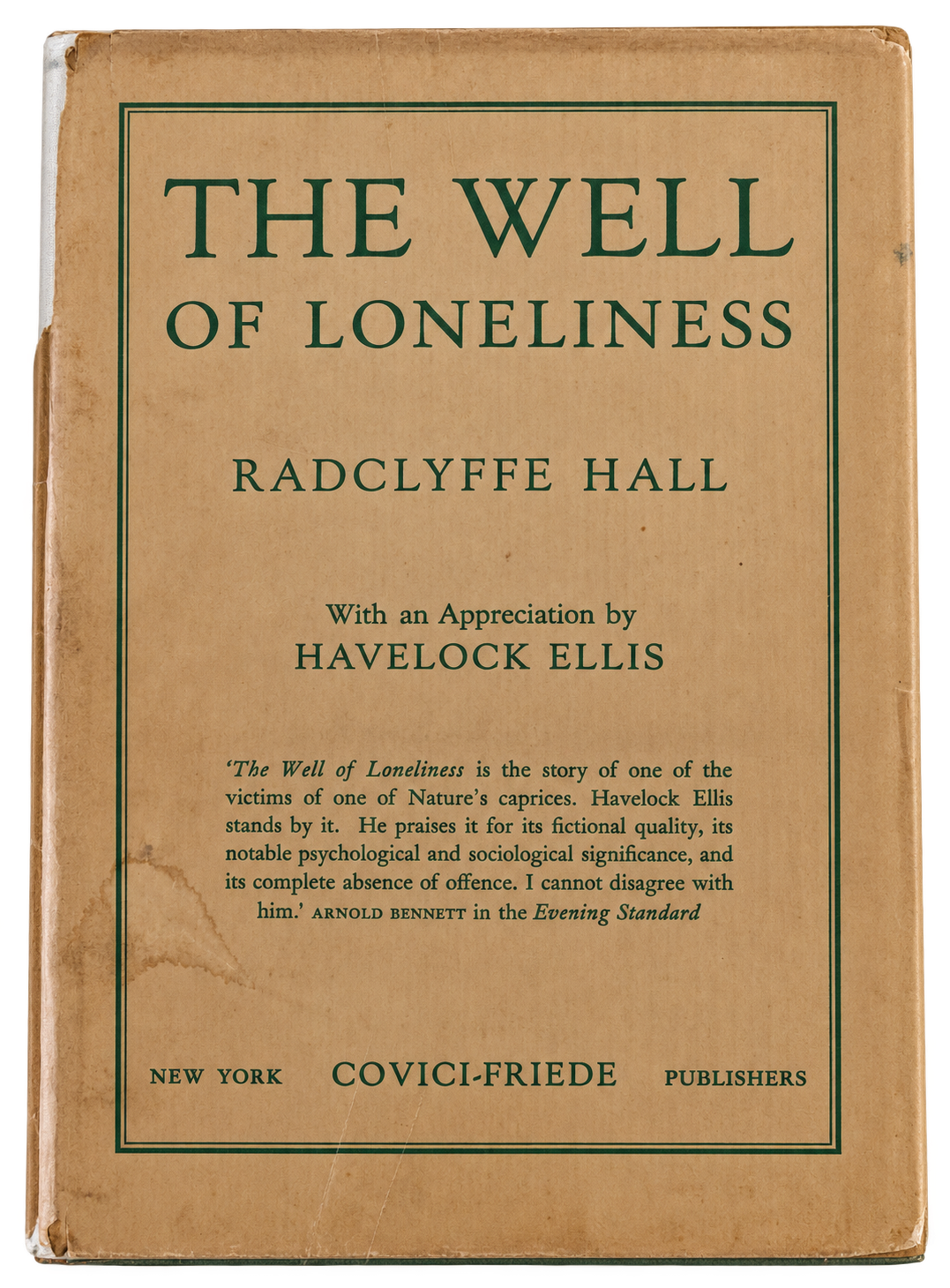
The first American edition, ninth printing of Radclyffe Hall’s The Well of Loneliness, issued in May 1929, while the novel remained at the center of one of the twentieth century’s defining censorship controversies. The copyright page records printings through “Ninth Printing, May, 1929,” confirming the state. This copy retains its original green publisher’s cloth, its original first-state American dust jacket priced at $5.00, and the original publisher’s promotional bookmark/advertising insert.
For most rare books, an earlier printing is automatically more desirable.
For this collection, that logic is reversed.
The ninth printing is the version Consigned to Darkness values most because it is not merely an early appearance of the text. It is a defendant printing: a copy produced while The Well of Loneliness was still actively being fought over in courts, newspapers, bookstores, and public culture. The first printing records the book’s arrival. The ninth printing records the censorship battle failing to stop it.
Condition:
Very Good+ in a Good dust jacket. The book itself is well preserved in its original green cloth. The jacket shows moderate toning, significant edge wear, and notable loss at the upper spine, with additional chipping and wear along the edges. The original publisher’s promotional bookmark is retained. No rebinding, facsimile jacket, or replacement components are evident.
Story Of The Book
Radclyffe Hall did not merely publish a novel. She challenged the belief that certain lives should remain invisible.
First published in 1928, The Well of Loneliness became one of the most consequential literary works in the history of LGBTQ+ representation and censorship.
Hall treated lesbian identity seriously, sympathetically, and as part of a fully human life. That alone was enough to make the book politically explosive.
The novel quickly became the subject of obscenity prosecutions and public campaigns seeking to suppress it, transforming The Well of Loneliness into a test of whether literature portraying lesbian life deserved legal and cultural legitimacy. The controversy became inseparable from the book itself.
This copy belongs to that active period.
By May 1929, the American edition had already reached its ninth printing. That repeated demand matters because the book was not simply surviving controversy. It was continuing to circulate through it.
Readers kept buying it.
Booksellers kept stocking it.
The publisher kept printing it.
That is why this ninth printing matters more to Consigned to Darkness than an earlier printing normally would.
In conventional rare-book collecting, primacy usually dominates. The first printing is the trophy copy because it is the earliest. But this collection is not organized around primacy alone. It is organized around historical participation.
The ninth printing participated in the censorship event.
It was produced after suppression had already become part of the book’s public life, while the legal and cultural fight was still unfolding and while continued demand was proving that the controversy had failed to erase the work.
The first printing tells us when the book appeared. The ninth tells us that attempts to silence it did not work.
Why It’s In The Collection
The Well of Loneliness belongs in Consigned to Darkness because the struggle over who is allowed to appear in literature is also a struggle over who is permitted to appear in public life.
The collection’s copy is intentionally not the earliest possible printing.
It is the defendant printing.
That distinction is central to why the object is here.
This ninth printing was issued during the height of the controversy surrounding the novel, when repeated printings reflected sustained public demand despite organized attempts to suppress the book. The inventory explicitly treats the copy as an active censorship-era manifestation rather than merely a later impression.
The original $5.00 dust jacket and publisher’s promotional bookmark make the object even more compelling. They preserve not only Hall’s text, but the commercial apparatus through which Covici-Friede continued to market and circulate the novel while the controversy was still active.
That is the story this collection values most.
Not simply the moment a controversial book was born, but the moment suppression tried and failed to stop it from reaching readers.
In the traditional rare-book market, an earlier printing would usually outrank this one.
In Consigned to Darkness, this is the printing with the better story.
Because this copy does not merely represent publication.
It represents persistence under pressure.
They tried to make lesbian life unprintable. The ninth printing is evidence that readers kept asking for the book anyway.
Collection Categories: LGBTQ+ History · Free Expression · Censorship · Obscenity Law & Court History · Anti-Authoritarianism · Literature
———
Authentication Evidence
• Covici-Friede title page dated 1929, confirming the first American edition.
• Copyright page lists printings through "Ninth Printing, May, 1929," confirming ninth-printing state.
• Original publisher's green cloth binding present.
• Original first-state American dust jacket retained with $5.00 price.
• Original promotional bookmark/advertising insert retained.
• Covici-Friede imprint, typography, and binding consistent throughout.
• No evidence of rebinding, facsimile jacket, or replacement components observed.
• First American edition, ninth-printing characteristics consistent throughout.