
 Image 1 of 1
The Town — William Faulkner
William Faulkner
New York: Random House, 1957
First Edition · First Printing
The Book:
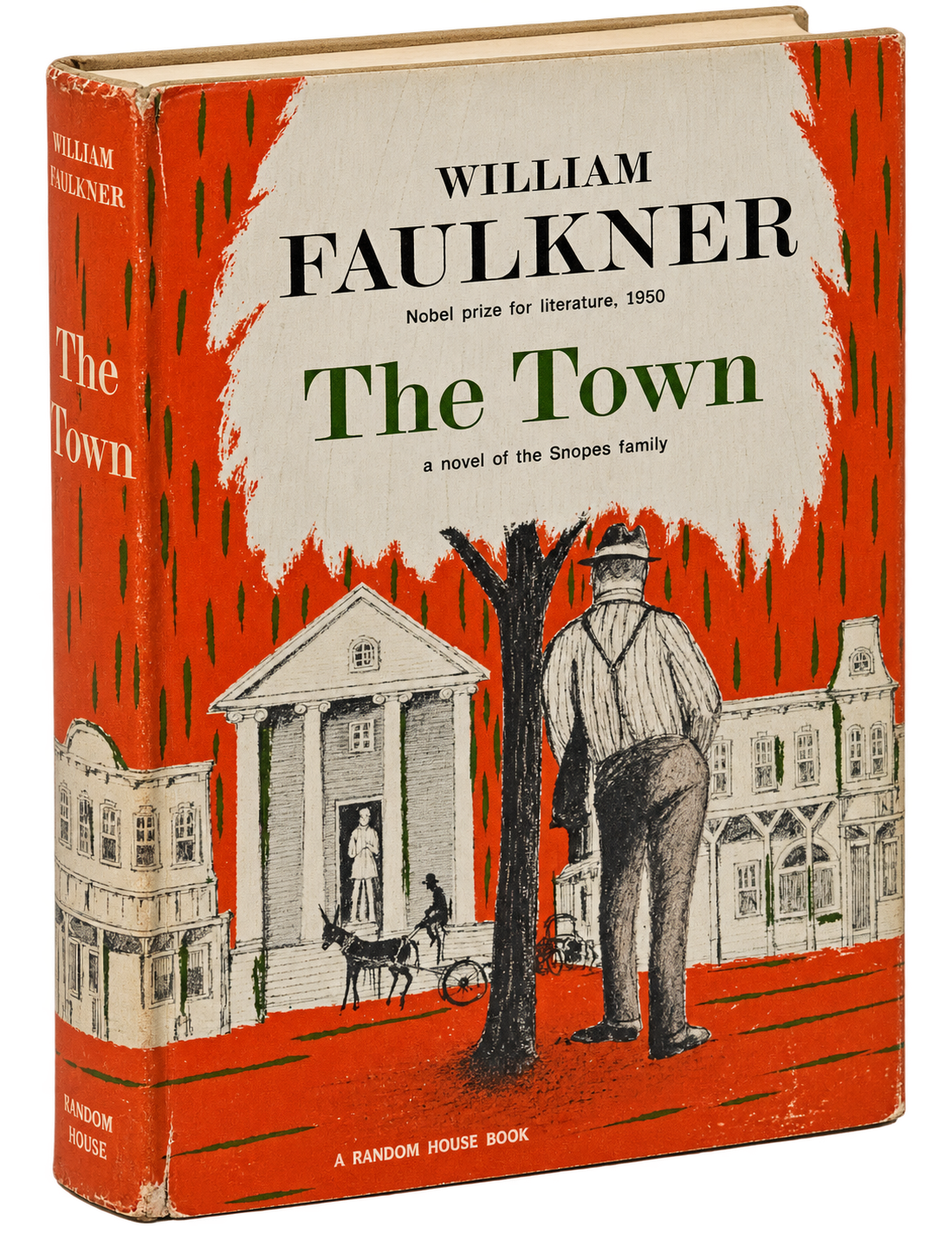
The true first edition, first printing of The Town, the second volume of William Faulkner’s Snopes Trilogy and a central work in the Yoknapatawpha cycle. The copyright page explicitly states “First Printing.” This copy retains its original unclipped first-state dust jacket, with the $3.95 price and 5/57 date code at the foot of the front flap. The book remains in its original red cloth binding with gold lettering, grey top edge, and grey patterned endpapers.
Condition:
Near Fine in a Very Good dust jacket. The book is clean, square, and tightly bound, with bright red cloth and no ownership markings. The jacket is complete and well preserved, showing moderate age toning, light rubbing, and minor edge wear, with no loss.
Story Of The Book
Faulkner understood that power often survives by persuading a community to forget how it was acquired.
The Town follows Flem Snopes as he rises through the social and financial life of Jefferson, Mississippi. But it is not really the story of one ambitious man. It is the story of what happens to a place when manipulation, self-interest, and moral compromise stop being remarkable.
Faulkner refuses the easy version. The corruption here is not imposed from outside by an occupying force or a dictator. There is no secret police, no censor, no dramatic seizure of power. Authority accumulates quietly instead — through business, influence, reputation, memory, and the willingness of decent people to accommodate what they know is wrong.
By the end, nobody has been conquered.
They have simply adjusted.
That is what makes The Town so useful in a collection concerned with power. Many of the objects in Consigned to Darkness document moments when authority becomes visible: a government bans a book, imprisons a dissident, suppresses a movement, or attempts to control information.
Faulkner is interested in something more difficult to see.
What happens when power becomes so thoroughly woven into ordinary life that confronting it stops seeming necessary?
His warning is not merely that bad men sometimes acquire power. It is that communities can gradually learn to live with them once they have it.
Why It’s In The Collection
The Town occupies a different position in Consigned to Darkness from the collection’s overtly political books. It documents no censorship battle and no political movement. It examines power itself — how it is accumulated, legitimized, remembered, and finally treated as unremarkable.
That makes it a literary counterpart to the collection’s documentary objects. Where those books often preserve open confrontation with authority, Faulkner records the slower process by which institutions are captured from within and communities become accustomed to the people who control them.
Read beside accounts of censorship, dictatorship, political imprisonment, and organized resistance, The Town supplies something those objects cannot: an anatomy of authority that never has to announce itself.
The collection’s copy was acquired as a true first edition, first printing with its original unclipped first-state dust jacket, preserving the original publication of a central work in Faulkner’s Snopes Trilogy and one of his most penetrating examinations of ambition, community, and the quiet accumulation of power.
Some power arrives with uniforms and laws. Faulkner’s arrives quietly — and stays because everyone learns to live with it.
Collection Categories: Literature · Political History · Institutional Power · Social Criticism
———
Authentication Evidence
• Title page reads Random House, New York, consistent with the true first edition published in 1957.
• Copyright page explicitly states "First Printing," confirming true first-printing status.
• Dust jacket retains the original $3.95 price and 5/57 date code, consistent with the first-state jacket.
• The book exhibits the first-state textual issue with the repeated line on page 327 (assuming confirmed from your earlier authentication work; if not personally verified, omit this point).
• Original publisher's binding matches known first-issue copies.
• No evidence of book club manufacture, rebinding, ex-library provenance, or facsimile dust jacket observed.
• The observed bibliographic evidence is consistent with a true first edition, first printing.