
 Image 1 of 1
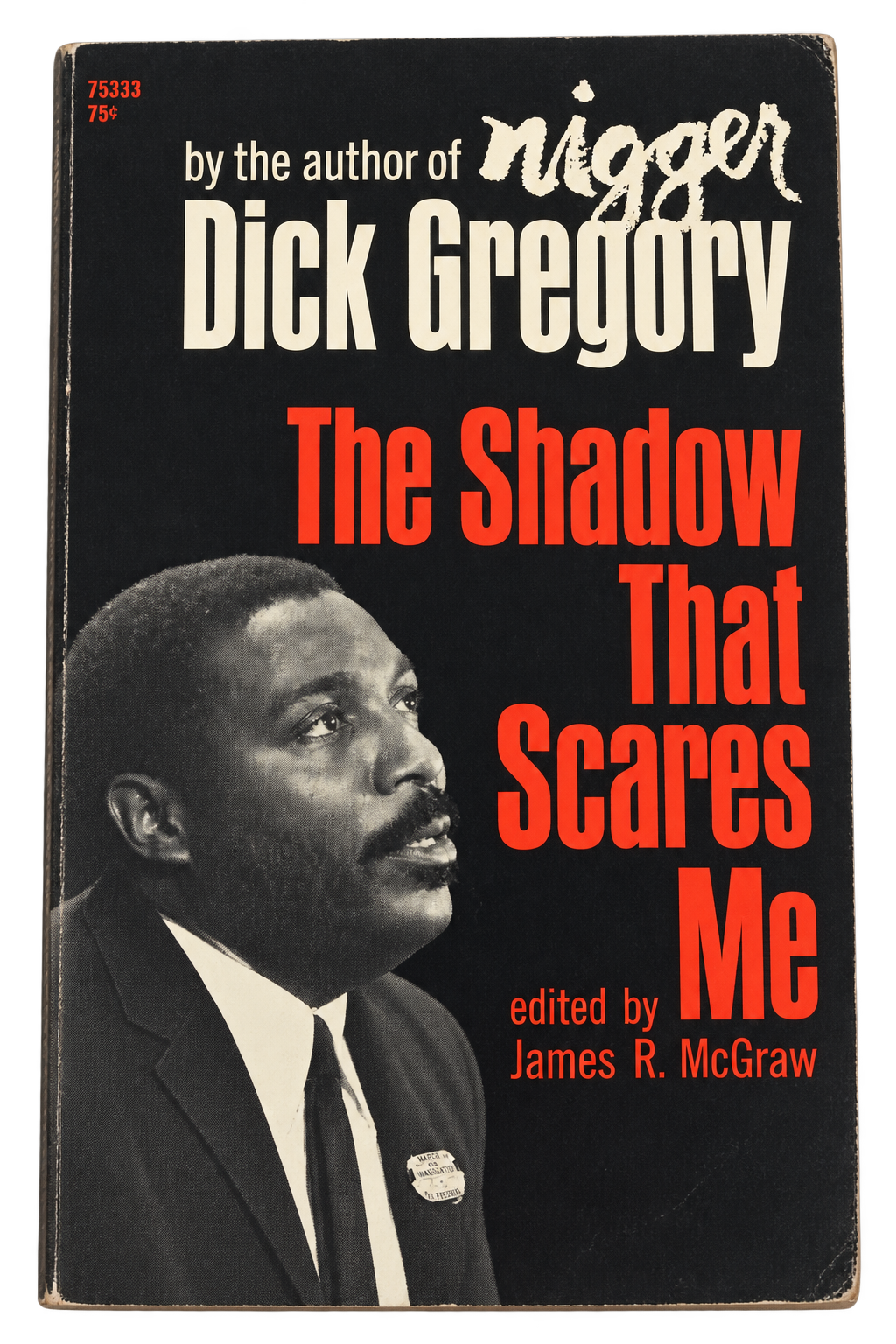
The Shadow That Scares Me — Dick Gregory
Dick Gregory
New York: Pocket Books, 1968
First Pocket Books Edition · First Printing · Signed and Inscribed by Dick Gregory
The Book:
The first Pocket Books edition, first printing of Dick Gregory’s The Shadow That Scares Me, edited by James R. McGraw and published in December 1968. The copyright page explicitly states “1st printing … December, 1968” and notes that the Pocket Books edition reproduces the complete text of the January 1968 Doubleday edition. Pocket Books number 15325 appears on the cover and spine. This copy is signed and inscribed by Gregory on the opening page: “To Ted — Dick Gregory.”
Condition:
Very Good+. The original pictorial wrappers remain bright and structurally sound, with moderate rubbing and edge wear consistent with age and use. The interior is generally clean, with expected age toning and foxing concentrated primarily on the signed preliminary page. The binding remains sound. Gregory’s inscription appears contemporaneous and natural from photographic examination, though it has not been independently authenticated by a third party.
Story Of The Book
Dick Gregory understood that laughter could expose injustice. He also understood that laughter alone could not change it.
By 1968, Gregory was no longer simply one of America’s most successful comedians. He had become one of the most recognizable public figures of the Civil Rights Movement, using the visibility comedy had given him to speak about segregation, racial violence, policing, poverty, war, protest, and nonviolent resistance.
The Shadow That Scares Me captures that transformation.
The book combines autobiography, political commentary, and firsthand reflection from a man who refused to separate entertainment from moral responsibility. Gregory understood that humor could make an audience listen to things it might otherwise resist hearing. He used that opening to confront subjects much larger than comedy itself.
The timing matters.
This Pocket Books edition appeared in December 1968, only months after the assassinations of Martin Luther King Jr. and Robert F. Kennedy, at the end of one of the most violent and politically consequential years in modern American history. Gregory was writing not as a historian looking back on the Civil Rights Movement, but as one of its visible participants while its struggles were still active.
And this edition changed the scale of that voice.
The earlier Doubleday hardcover had introduced the book. Pocket Books made it inexpensive, portable, and available to a mass audience.
That distinction is central to this copy.
Gregory had already learned how to turn a nightclub microphone into a political platform. The paperback helped turn the bookstore rack into one too.
Why It’s In The Collection
The Shadow That Scares Me belongs in Consigned to Darkness because dissent depends not only on having something to say, but on gaining access to an audience large enough to hear it.
Gregory’s career demonstrates that unusually clearly.
He took a form associated with entertainment and used it to challenge racism, inequality, war, and political hypocrisy before national audiences. The authority of his voice came partly from the fact that he refused the boundaries others might have preferred for him: comedian here, activist there.
For Gregory, they were inseparable.
That is also why this first Pocket Books printing matters to the collection. It is not the true first edition, but it represents the moment his memoir and political testimony moved into inexpensive national mass-market circulation. The inventory specifically identifies that expanded readership as central to the copy’s significance.
Gregory’s personal inscription adds another layer. This is not merely a mass-market copy carrying his ideas into wider circulation. It is a copy that also carries his own hand.
The object therefore preserves both sides of his public life: the scale of the audience and the individual voice behind it.
Dick Gregory made people laugh so they would listen. Then he used the attention to say things America did not want to hear.
Collection Categories: Civil Rights · Memoir & Testimony · Political Movements · Human Rights · Free Expression · Social Justice · Publication-Event Object
———
Authentication Evidence
• Title page identifies Dick Gregory, edited by James R. McGraw, published by Pocket Books, New York.
• First Edition Evidence: Copyright page identifies this as the Pocket Book edition following the January 1968 Doubleday edition.
• First Printing Evidence: Copyright page explicitly states "1st printing ... December, 1968."
• Pocket Books number 15325 present on the cover and spine, consistent with the original issue.
• Copyright page states the Pocket Book edition reproduces the complete Doubleday text.
• Physical format, typography, and cover design are consistent with documented first Pocket Book issue.
• Signed "To Ted — Dick Gregory" on the opening page. Signature appears contemporaneous and natural from the available photographs but has not been independently authenticated.
• No evidence of later reprint indicators observed.