
 Image 1 of 1
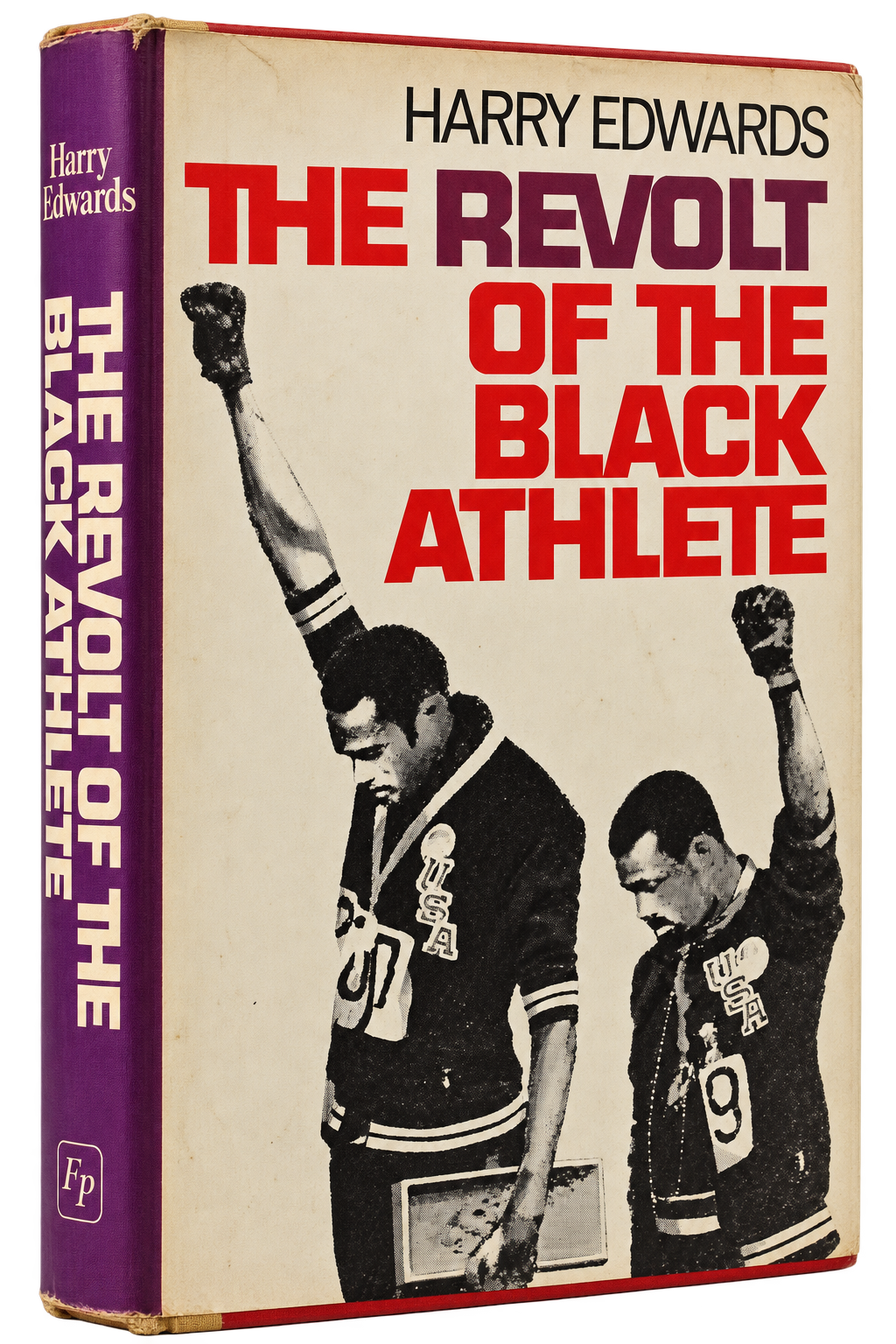
The Revolt of the Black Athlete — Harry Edwards
Harry Edwards
New York: The Free Press, 1969
First Edition · First Printing
The Book:
The first edition, first printing of Harry Edwards’ landmark study of Black athlete activism, published in the immediate aftermath of the 1968 Mexico City Olympics. The book grew directly out of the political world of the Olympic Project for Human Rights and examines race, institutional power, civil rights, and the role of Black athletes within American sport. This copy retains the original unclipped dust jacket and the original black publisher’s cloth with red topstain.
Condition:
Near Fine in a Very Good+ dust jacket. The book is exceptionally clean and square, with bright gilt spine lettering, sharp corners, red topstain, and an unmarked interior. The jacket shows moderate toning and light surface soiling to the white front panel, minor edge wear, shallow chipping at the spine head, light corner wear, and a vertical crease along the front flap fold. No restoration or structural defects are evident.
Story Of The Book
Jackie Robinson proved that a Black athlete could enter professional sports. Harry Edwards asked whether entering was enough.
By the late 1960s, integration had changed American athletics, but Harry Edwards argued that access alone did not equal power. Black athletes could star on the field while remaining largely powerless over the institutions that employed them, profited from them, disciplined them, and controlled the terms on which they could speak.
That argument became inseparable from the Olympic Project for Human Rights, the movement Edwards helped organize around the 1968 Olympic Games. The raised-fist protest of Tommie Smith and John Carlos in Mexico City became its most enduring image, but The Revolt of the Black Athlete preserves the larger intellectual argument behind that moment: sport was not separate from American conflicts over race, citizenship, labor, media, and political power.
Published in 1969, the book arrived while those arguments were still unfolding. Edwards was not looking back on athlete activism after it had become an accepted part of American culture. He was helping define it.
That is what makes this first printing especially important.
It preserves the moment when Black athletes stopped asking only for the right to play—and began asking who held the power once they got on the field.
Why It’s In The Collection
The Revolt of the Black Athlete belongs in Consigned to Darkness because it examines a form of power that can be easy to overlook: institutional power exercised through systems that appear open while still limiting the voice, autonomy, and influence of the people inside them.
Edwards’ argument was not simply about sports. It was about whether symbolic inclusion could substitute for structural change. His work placed athletes inside the broader Civil Rights and Black Power movements and asked whether institutions could call themselves integrated while leaving existing hierarchies largely intact.
The collection acquired this copy specifically because it preserves the original intellectual framework of the Olympic Project for Human Rights and the emerging political role of Black athletes during the Civil Rights era. Paired with Jackie Robinson’s I Never Had It Made, it documents an important historical evolution: from breaking the barrier to questioning the institution behind it.
Integration answered the question of who was allowed in. Edwards asked the harder question: what power did they have once they arrived?
Collection Categories: Civil Rights · Political Movements · Human Rights · Political History · Anti-Authoritarianism · Free Expression · Labor & Economic Justice · Publication-Event Object
———
Authentication Evidence
• Title page identifies the work as The Revolt of the Black Athlete by Harry Edwards.
• Copyright page records Copyright © 1969 by The Free Press.
• Copyright page explicitly states "First Printing."
• Publisher identified as The Free Press, a division of The Macmillan Company, New York.
• Original dust jacket is present with the correct first-issue design and publisher information.
• Original black cloth binding with red topstain is consistent with the first issue.
• No evidence of book-club manufacture, rebinding, remainder marking, or later printing observed.
• Edition evidence: The copyright page establishes the original 1969 Free Press edition.
• Printing evidence: The explicit "First Printing" statement directly establishes first-printing status.