
 Image 1 of 1
The Playboy Forum — Hugh M. Hefner (ed.)
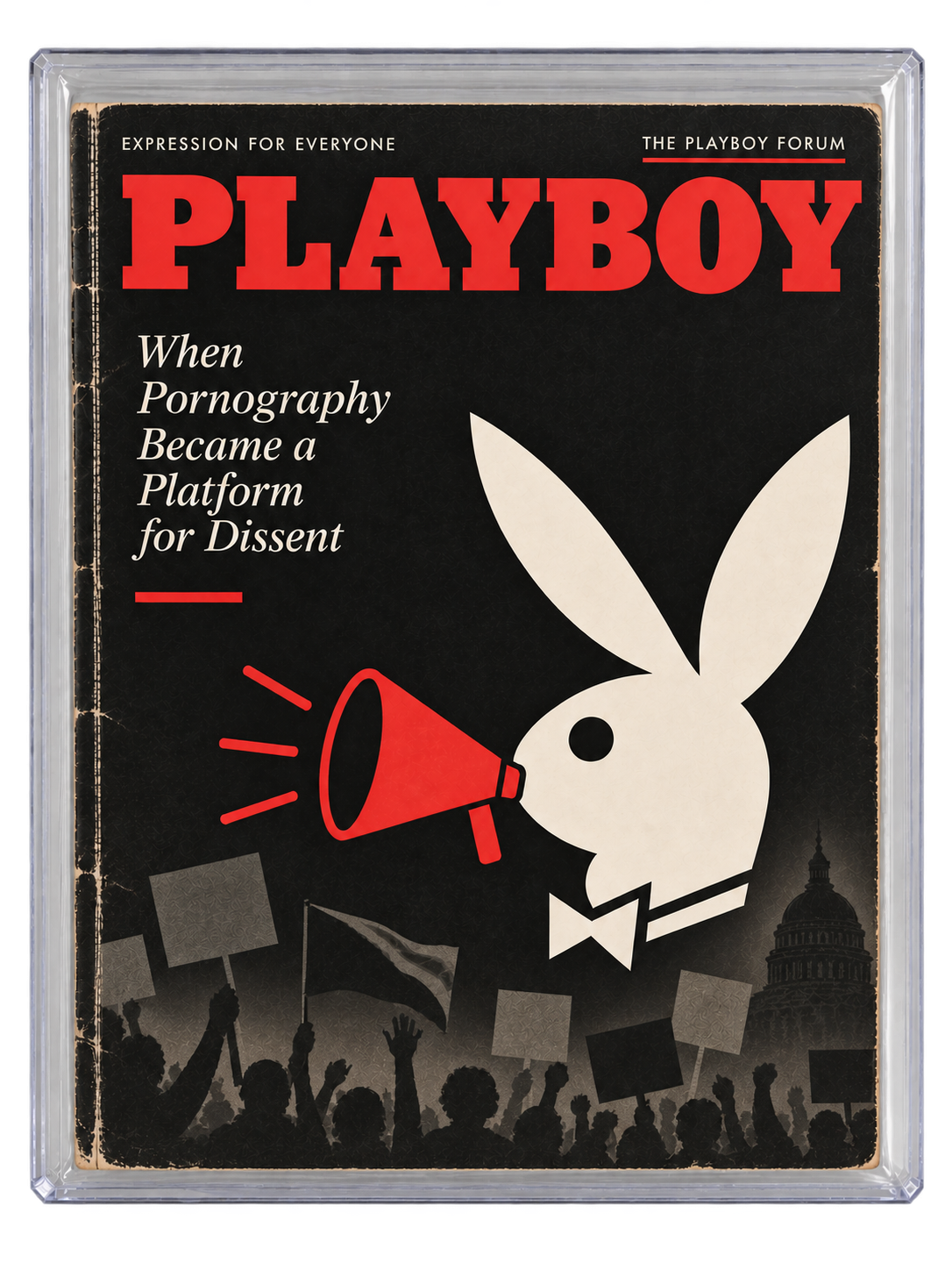
Full Title: The Playboy Forum: When Pornography Became a Platform for Dissent
Hugh M. Hefner (ed.) · Various Contributors
HMH Publishing Co., Inc. / Playboy · Chicago · 1965–1976
Ten Original First-Printing Issues
Curated Publication-Event Collection
The Collection:
A curatorially assembled collection of ten original Playboy magazines selected to preserve an unusual chapter in the history of American dissent: the moment when one of the country’s largest commercial entertainment publications became a mass-market platform for philosophers, civil-rights voices, antiwar clergy, reformers, revolutionaries, and political outsiders. The collection is intentionally selective rather than sequential. Each issue preserves a different way dissent entered Playboy’s enormous readership between 1965 and 1976.
Included Issues:
May 1965 · Vol. 12, No. 5 — Jean-Paul Sartre
Philosophical and political dissent enters the pages of a mass-market American magazine.December 1966 · Vol. 13, No. 12 — James Baldwin & Budd Schulberg
Racial injustice and the failures of the American democratic conscience move to the center of the conversation.January 1968 · Vol. 15, No. 1 — Norman Mailer
The politically engaged writer moves beyond commentary and into direct political confrontation.August 1968 · Vol. 15, No. 8 — William Sloane Coffin Jr.
Religious conscience becomes an argument against war, conscription, and obedience to the state.September 1968 · Vol. 15, No. 9 — Nat Hentoff, “The War on Dissent”
Playboy turns directly toward the legitimacy—and vulnerability—of dissent itself.October 1968 · Vol. 15, No. 10 — Ralph Nader
Evidence-driven reform challenges concentrated corporate power and the institutions meant to regulate it.December 1968 · Vol. 15, No. 12 — Eldridge Cleaver
Revolutionary Black dissent reaches an enormous mainstream commercial audience.January 1969 · Vol. 16, No. 1 — Martin Luther King Jr. / Civil Liberties
Racial justice becomes inseparable from a larger struggle over democratic liberty and political violence.April 1974 · Vol. 21, No. 4 — Jane Fonda & Tom Hayden
Antiwar and New Left dissent evolves from protest toward sustained political organization.May 1976 · Vol. 23, No. 5 — Abbie Hoffman
The Sixties dissenter has gone underground, but his voice still reaches the mainstream through Playboy.
Writers Featured: James Baldwin · Truman Capote · Roald Dahl · Ray Bradbury · Kurt Vonnegut Jr. · Arthur Miller · Allen Ginsberg · Ian Fleming · Saul Bellow · Arthur C. Clarke · Norman Mailer · Shel Silverstein · John Updike · Pearl S. Buck · Henry Miller · John Cheever · Isaac Bashevis Singer · Carlos Fuentes · Marshall McLuhan · Amiri Baraka (LeRoi Jones) · William Styron · Georges Simenon · Alan Watts · Lawrence Durrell · Kingsley Amis · Alberto Moravia · Art Buchwald · William Saroyan · Norman Podhoretz · Harvey Kurtzman · Donald Barthelme · Ogden Nash · Eric Hoffer · Leslie Fiedler · Len Deighton · Budd Schulberg · Donald Hall · James T. Farrell · John Gunther · Jean Shepherd · Frederik Pohl · Thomas M. Disch · Larry L. King · Herbert Gold · Norman Thomas · Mackinlay Kantor · Gerald Kersh
Condition:
Very Good overall. Individual issues range from Good to Very Good+, with varying rubbing, creasing, spine and edge wear, toning, and localized paper or color loss consistent with original period magazines. May 1965 and October 1968 grade Good; December 1966, January 1968, and December 1968 grade Good+; August 1968, September 1968, and January 1969 grade Very Good; and April 1974 and May 1976 grade Very Good+. All ten issues remain complete, identifiable, and presentable original examples.
Story Of The Set
What happens when one of America’s most commercially successful adult magazines becomes a national stage for people challenging the country itself?
Between 1965 and 1976, Playboy repeatedly placed dissent before an audience that had not necessarily bought the magazine looking for politics. Sartre brought the politically engaged intellectual; Baldwin confronted racial hierarchy; Coffin challenged war through religious conscience; Hentoff made dissent itself the subject; Nader confronted corporate power; and Cleaver carried revolutionary Black politics into a mainstream commercial publication.
The later issues show dissent changing shape. King and the January 1969 civil-liberties material mark a democratic reckoning after assassination and political violence. Fonda and Hayden represent the New Left moving toward organized politics. By 1976, fugitive Abbie Hoffman embodies its underground afterlife.
What connected them was access. Playboy possessed something most radical journals did not: extraordinary reach. The same publishing machinery that sold sex, celebrity, aspiration, and entertainment carried arguments about racism, war, civil liberties, corporate power, and political authority far beyond their customary audiences.
The historical action here is not suppression. It is amplification.
Why It’s In The Collection
The Playboy Forum belongs in Consigned to Darkness because power over expression is exercised not only by deciding what may be said, but by deciding who gets heard.
Many objects in this collection preserve attempts to stop ideas from circulating. This collection captures the inverse: an enormously influential commercial publisher repeatedly giving dissent more room to travel.
These ten issues were not selected because they are vintage Playboy magazines or because their contributors are famous. Each preserves a distinct form of dissent—from racial criticism and antiwar conscience to civil liberties, corporate accountability, revolutionary politics, and organized activism.
The erotic context makes that history more interesting, not less. A publication commercially identified with sex and entertainment became an unexpected distribution system for serious political opposition.
Most histories of free expression concentrate on the people trying to close the door. This collection preserves what happened when a publisher opened one.
Collection Categories: Free Expression · Political Dissent · Anti-Authoritarianism · Political Movements · Civil Rights · Literature · Pornography & Erotica · Publication-Event Object · Investigative Journalism · Religious Conscience · Anti-War · Counterculture · War & Conflict · Multi-Object Set · Curated Set · Magazine & Periodical History · Sexuality & Culture
———
Authentication Evidence
All ten constituent objects are original physical Playboy periodicals individually examined and supported by photographic documentation.
May 1965 is identified as Playboy, Volume 12, Number 5.
December 1966 is identified as Playboy, Volume 13, Number 12.
January 1968 is identified as Playboy, Volume 15, Number 1, Fifteenth Holiday Anniversary Issue.
August 1968 is identified as Playboy, Volume 15, Number 8.
September 1968 is identified as Playboy, Volume 15, Number 9.
October 1968 is identified as Playboy, Volume 15, Number 10.
December 1968 is identified as Playboy, Volume 15, Number 12.
January 1969 is identified as Playboy, Volume 16, Number 1.
April 1974 is identified as Playboy, Volume 21, Number 4.
May 1976 is identified as Playboy, Volume 23, Number 5.
Each issue retains the correct original masthead, month and year, period cover design, cover price, typography, wrapper construction, and production characteristics for its stated issue.
Period advertisements, paper stock, printing style, and interior production characteristics are consistent with original contemporary magazine manufacture.
The contents of the ten issues correspond to the contributors and material for which each magazine was curatorially selected.
No evidence of modern reproduction, facsimile covers, replacement wrappers, reconstructed issues, or later reprint manufacture has been observed.
Each of the ten magazines is authenticated individually as an original first-publication periodical.
The Playboy Forum: When Pornography Became a Platform for Dissent is the collection’s retrospective curatorial designation; the ten magazines were not originally issued or marketed by Playboy as a unified publisher-created set.