
 Image 1 of 1
The Minuit Resistance Archive — Various Authors
Full Title: The Minuit Resistance Archive: Fourteen Volumes from the 1945 First Public Edition of Collection “Sous l’oppression”
Various Authors
Les Éditions de Minuit · Paris · 1945
First Public Edition · Vélin Issue
Curated Fourteen-Volume Archive
The Archive:
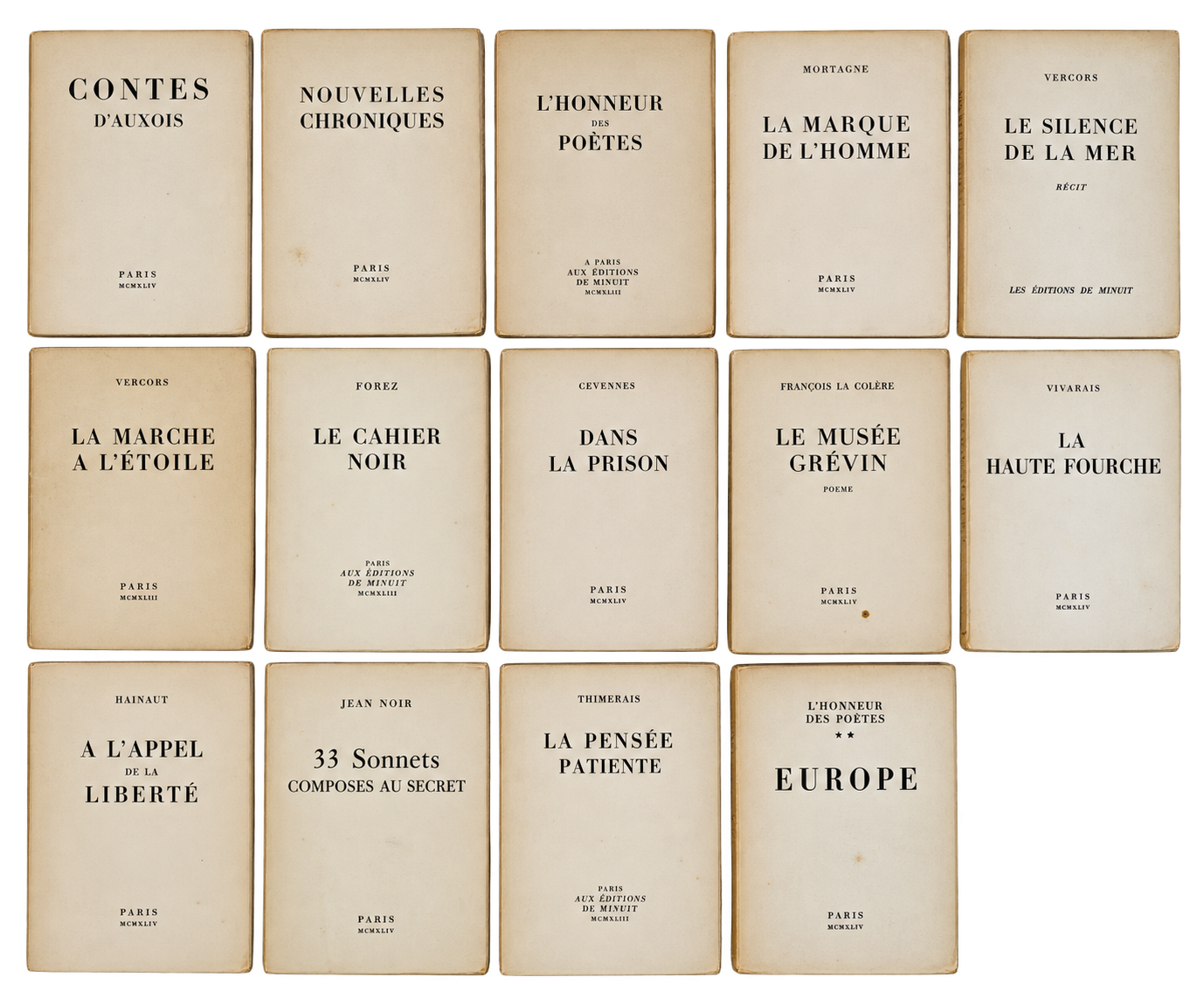
A fourteen-volume curated archive drawn from the 1945 first public edition of Les Éditions de Minuit’s Collection “Sous l’oppression,” republishing works first circulated clandestinely during the German occupation of France. Many originally appeared under pseudonyms, concealing writers participating in an illegal publishing network whose discovery could mean arrest, imprisonment, deportation, or death. Printed openly after Liberation by Aulard, one of Minuit’s clandestine printers, these editions deliberately preserved the wartime identities, dates, and publication statements of the underground books. This archive is from the numbered vélin issue; the physically examined limitation statement identifies No. 3293.
Included Titles:
Listed approximately in descending order of historical impact, literary significance, and enduring association with the French Resistance.
Le Silence de la Mer — Vercors (Jean Bruller)
L’Honneur des Poètes — Collective anthology, assembled by Pierre Seghers, Paul Éluard & Jean Lescure
Le Cahier Noir — Forez (François Mauriac)
Le Musée Grévin — François la Colère (Louis Aragon)
33 Sonnets Composés au Secret — Jean Noir (Jean Cassou)
La Marche à l’étoile — Vercors (Jean Bruller)
Nouvelles Chroniques — Charles Morgan, André Gide, Raymond Mortimer, Gabriel Audisio, Claude Bellanger & André Chamson
Contes d’Auxois — Auxois (Édith Thomas)
Europe — Collective anthology of French and foreign poets
Dans la Prison — Cévennes (Jean Guéhenno)
La Pensée Patiente — Thimerais (Léon Motchane)
La Haute Fourche — Vivarais (Pierre Bost)
La Marque de l’homme — Mortagne (Claude Morgan)
À l’appel de la Liberté — Hainaut (Georges Adam)
Condition:
Very Good. The fourteen volumes remain well preserved in their original printed wrappers, with moderate age toning, scattered light soiling, occasional handling marks, minor edge wear, and localized wear to several spine folds. Interiors remain consistently clean and structurally sound. No replacement wrappers, modern reproductions, or restoration are observed.
Story Of The Archive
Under Nazi occupation, Les Éditions de Minuit published books it was forbidden to publish—and writers concealed their identities to help survive the act of publishing them.
Founded clandestinely in occupied Paris, Minuit became one of the defining literary publishers of the French Resistance. Its writers, editors, printers, and distributors worked outside the authorized publishing system to circulate literature beyond German censorship.
The books were clandestine in every sense. Printers worked secretly. Distribution depended on trusted networks. And many writers disappeared behind names such as Vercors, Forez, François la Colère, Jean Noir, Auxois, Cévennes, Thimerais, Vivarais, Mortagne, and Hainaut.
These were not simply literary pen names. They were part of the machinery of survival. Behind them stood writers whose real identities could not safely appear on books published in defiance of the occupation.
The writers concealed behind those names included some of the major figures of French literature: François Mauriac, Louis Aragon, Jean Cassou, Jean Guéhenno, Édith Thomas, Pierre Bost, and Jean Bruller, while collective volumes brought still more voices into Minuit’s clandestine catalogue.
Then came Liberation.
In 1945, Minuit brought its underground literature into public view through Collection “Sous l’oppression.” The new editions preserved the pseudonyms, wartime dates, and clandestine publication statements of the books they reproduced.
One surviving colophon reproduced within these volumes records that the original work had been printed under Nazi occupation on July 14, 1943—Bastille Day—“the day of oppressed liberty.”
The 1945 limitation statement tells the other half of the story: the books were now being printed openly in Paris by Aulard, clandestine printer of Les Éditions de Minuit.
The names that once helped conceal the people behind these books had become evidence of what those people risked to publish them.
Why It’s In The Collection
The Minuit Resistance Archive belongs in Consigned to Darkness because it preserves the moment underground literature crossed from resistance into historical record.
These are not the clandestine wartime first editions themselves. They are Minuit’s first public return to literature created and circulated under occupation, produced by the publishing network that had previously been forced underground.
That distinction is what makes the 1945 manifestation important.
The editions deliberately preserve their clandestine identities. A reader after Liberation still encountered Vercors rather than Jean Bruller, Forez rather than François Mauriac, François la Colère rather than Louis Aragon, and Jean Noir rather than Jean Cassou—names that had once helped protect the people behind the words.
The fourteen books also reveal the extraordinary range of literary resistance. Le Silence de la mer became an international symbol of resistance; L’Honneur des poètes carried clandestine poetry across occupied France and into the wider Allied world; Mauriac and Aragon attacked collaboration and occupation behind false names; and Jean Cassou composed the poems of 33 Sonnets while imprisoned for Resistance activity.
Other volumes preserve quieter but no less revealing forms of dissent: prison writing, fiction, collective testimony, political argument, and stories of ordinary people confronting occupation.
As a curated archive, the fourteen volumes therefore preserve more than individual texts. They preserve different ways writers discovered that literature itself could resist.
During the occupation, anonymity helped these books survive. After Liberation, Minuit preserved those hidden names so readers would remember why they had been necessary.
Collection Categories: French Resistance · Underground Publishing · Resistance Literature · Witness Literature · Free Expression · Censorship · Anti-Authoritarianism · Anti-Totalitarianism · Political Dissent · War & Conflict · Literature · Poetry · Publication-Event Object
———
Authentication Evidence
The archive comprises fourteen volumes from the 1945 first public edition of Collection “Sous l’oppression,” assembled as a curated archive rather than represented as the complete twenty-volume publisher’s collection.
All fourteen volumes retain original printed wrappers consistent with the 1945 public edition.
The editions reproduce wartime title pages, pseudonymous author credits, dates, and clandestine publication information from the underground editions they reprinted.
Les Éditions de Minuit’s own historical bibliography confirms the clandestine identities represented throughout the archive, including Vercors (Jean Bruller), Forez (François Mauriac), François la Colère (Louis Aragon), Auxois (Édith Thomas), Jean Noir (Jean Cassou), Thimerais (Léon Motchane), Vivarais (Pierre Bost), Mortagne (Claude Morgan), Cévennes (Jean Guéhenno), and Hainaut (Georges Adam).
The photographed justification statement identifies Aulard as clandestine printer of Les Éditions de Minuit and establishes the post-Liberation public issue.
The limitation comprised multiple paper states. For France: 35 copies on Madagascar paper, 200 on pur fil, and 3,500 on vélin, with additional numbered copies produced for foreign distribution.
The physically examined volume states “Exemplaire sur Vélin — N° 3293,” placing it within the French vélin issue numbered 236–3,735.
A reproduced clandestine colophon records original wartime printing under Nazi occupation on July 14, 1943, preserving the underground publication history within the later public edition.
Institutional records independently identify volumes in this collection as the première édition publique of works originally published clandestinely by Minuit.
No evidence of replacement wrappers, modern facsimiles, or restoration is observed.
These volumes are authenticated as examples of the 1945 First Public Edition · Vélin Issue of Collection “Sous l’oppression,” not as clandestine wartime first editions.
Limitation number 3293 has been physically confirmed on the examined volume; matching limitation numbers across all fourteen volumes have not yet been individually verified, so no claim of a uniformly numbered archive is made.