
 Image 1 of 1
The Magnolia Jungle — P. D. East
Full Title: The Magnolia Jungle: The Life, Times and Education of a Southern Editor
P. D. East
Simon and Schuster, Inc. · New York · 1960
First Edition · First Printing · Signed Presentation Copy
The Book:
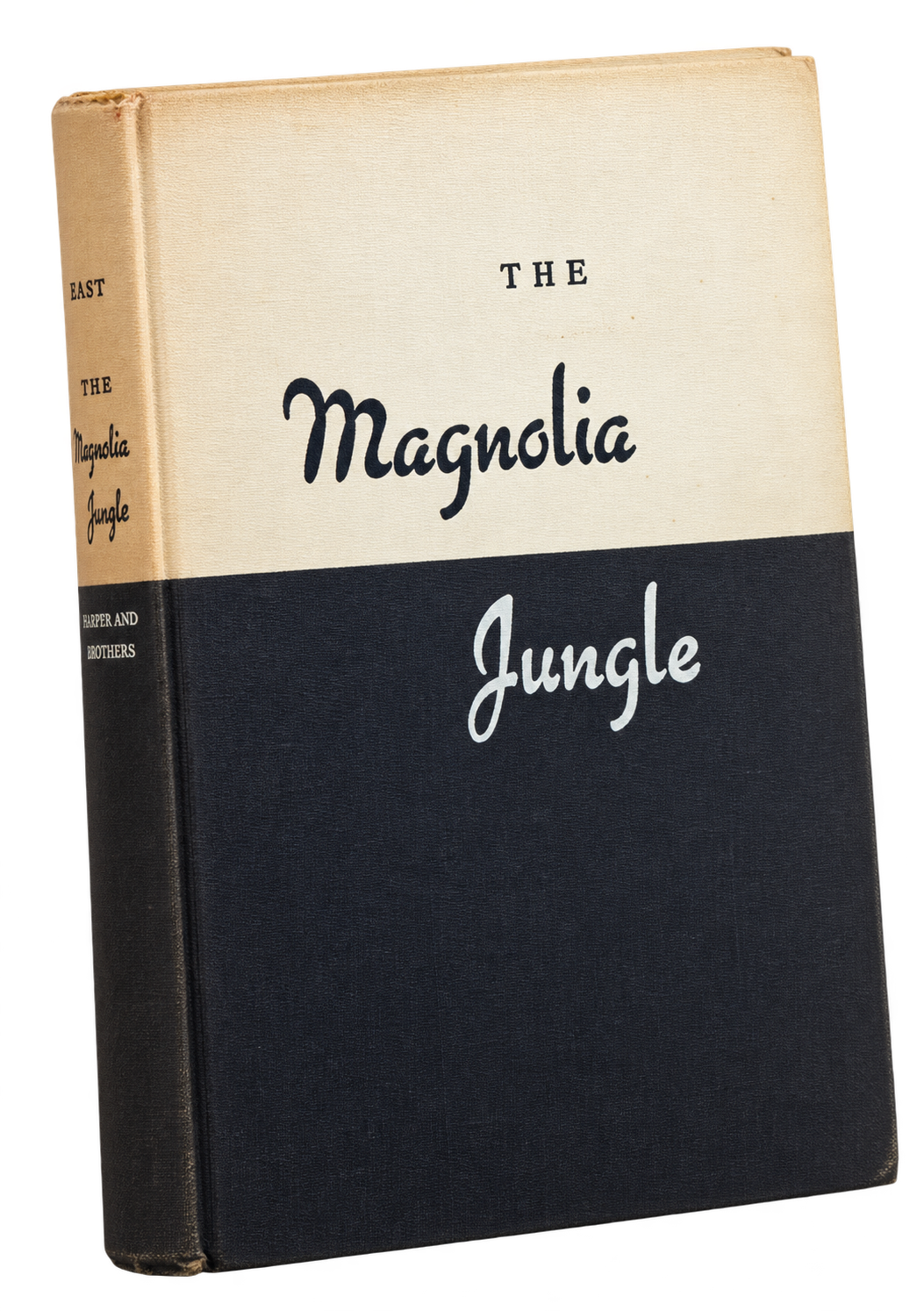
The First Edition · First Printing of P. D. East’s autobiographical account of becoming one of the most outspoken white critics of segregation in Mississippi. As editor of the Petal Paper, East used satire to attack white supremacy, the White Citizens’ Councils, the Ku Klux Klan, and the hypocrisies of Jim Crow—at enormous personal and financial cost. xi, 243 pp.; illustrated. Original two-tone black-and-cream cloth retained. This copy is personally inscribed and signed by East to Robert Grossman: “To Robert Grossman / with warmest and kindest regards — / P. D. East.”
Condition:
Very Good+. Original two-tone black-and-cream cloth remains sound and attractive, with light toning and scattered soiling to the cream cloth, minor rubbing and handling evidence, and a few small spots to the endpapers. Binding is square and firm; interior otherwise clean. The presentation inscription remains clear and intact. No rebinding or restoration observed. No dust jacket present.
Story Of The Book
P. D. East was a white Mississippi newspaper editor who discovered that mocking white supremacy could destroy almost everything around him.
After founding the tiny Petal Paper in 1953, East began using its pages to attack segregation, the White Citizens’ Councils, the Ku Klux Klan, and the racial hypocrisy of the Jim Crow South.
The response was devastating.
Local subscribers disappeared. Advertisers abandoned the paper. East and his family were ostracized. The newspaper increasingly survived on national advertising and out-of-state support. And the pressure was not only social or economic: records of the Mississippi State Sovereignty Commission document official interest in East, including efforts to investigate possible NAACP and Communist connections.
Yet East kept publishing.
Supporters including Eleanor Roosevelt, Steve Allen, and Maxwell Geismar helped sustain his work, while John Howard Griffin—author of Black Like Me—witnessed firsthand the isolation East and his wife endured.
The Magnolia Jungle is what dissent looks like when the printing press is small, the town is hostile, and the cost of speaking is paid at home.
Why It’s In The Collection
The Magnolia Jungle belongs in Consigned to Darkness because free expression means little if the price of using it is economic ruin, social exile, and government scrutiny.
East did not oppose segregation from a safe distance. He challenged it through a local newspaper inside the community whose racial order he was attacking. His punishment came not through formal censorship, but through advertisers, subscribers, neighbors, political organizations, and the state itself.
That makes this book an especially strong object in the collection: a firsthand account of a publisher using control of his own press to resist entrenched power—and documenting the retaliation that followed.
The presentation inscription adds one more layer. The dissident editor who lived the story personally signed this copy of the record he left behind.
Collection Categories: Free Expression · Publication-Event Object · Witness Literature · Memoir & Testimony · Investigative Journalism · Anti-Authoritarianism · Political Dissent · Political History · Civil Rights · Human Rights · Signed
———
Authentication Evidence
Title page identifies the work as The Magnolia Jungle: The Life, Times and Education of a Southern Editor by P. D. East.
Title page identifies Simon and Schuster · New York as publisher.
Copyright page states “Copyright © 1960 by P. D. East.”
Copyright page explicitly states “FIRST PRINTING.”
Copyright page identifies Simon and Schuster, Inc., Rockefeller Center, 630 Fifth Avenue, New York 20, N.Y. as publisher.
Copyright page gives Library of Congress Catalog Card Number 60-10973.
Copyright page states that the volume was manufactured in the United States by George McKibbin & Son · New York.
Mississippi Department of Archives and History cataloging records the 1960 Simon & Schuster edition as xi, 243 pages, illustrated, consistent with this copy.
Independent first-edition records confirm the same 1960 Simon & Schuster issue and the explicit “FIRST PRINTING” statement.
Original two-tone black-and-cream cloth binding remains present.
Binding retains titles to the front board and spine consistent with documented first-printing copies.
Front free endpaper bears a handwritten presentation inscription apparently reading “To Robert Grossman / with warmest and kindest regards — / P. D. East.”
The inscription and signature are executed directly in blue ink on the original front free endpaper.
No evidence of mechanical reproduction, facsimile application, insertion, transplantation, or later alteration is observed.
Mississippi Department of Archives and History also records an author-autographed copy of the 1960 edition, independently establishing signed copies of the original issue.
The recipient Robert Grossman has not been securely identified; no association attribution is made beyond the inscription itself.
No evidence of book-club manufacture, later publisher issue, modern rebinding, facsimile material, or restoration is observed.
Observable physical and bibliographic evidence supports identification as the 1960 First Edition · First Printing · Signed Presentation Copy.